This report evaluates Neutrl across five risk domains (hedging, liquidity, counterparty exposure, valuation integrity, and operational control) to assess whether its synthetic-dollar design can remain solvent under stress.
The system mitigates core risks through trade-level and portfolio-level hedging, conservative leverage, high liquidity coverage, regulated custody, and liquidation-based valuation with real-time ZK-verified reserves.
Residual risks are structural rather than mechanical, including extreme-volatility behavior, multi-billion-scale deployment, and proving stability across full market cycles.
Neutrl’s architecture is robust and continuously verified today, but long-term confidence will depend on empirical performance as the protocol expands and integrates more deeply across crypto-native markets.
The term “market-neutral” is widely used across DeFi but rarely subjected to rigorous definition. Many structures that adopt the label rely on leveraged basis trades or partial hedges that introduce latent directional exposure.
Neutrl’s design seeks to implement a delta-neutral, fully collateralized synthetic dollar whose yield is generated from a mix of short-duration, hedged on-chain strategies and discounted OTC allocations. This report examines the protocol’s risk architecture, identifying potential failure modes, measurement frameworks, and mitigation controls intended to preserve solvency and neutrality under varying market conditions.
Neutrl’s risk framework spans five interdependent domains:
Hedging & Market Risk: The integrity of neutrality and its limits under volatility.
Liquidity & Redemption Risk: The system’s ability to satisfy withdrawals under pressure.
Counterparty & Custody Risk: The soundness of entities holding collateral.
Valuation & Reserve Integrity: The conservatism of asset pricing and reserve accounting.
Operational & Governance Risk: The quality of oversight and control during disruption.
Each dimension represents a distinct failure vector and the control layer built to contain it.
A delta-neutral system fails when its hedges cannot keep pace with underlying price movement. Rapid rallies, exchange liquidations, or unexpected funding shifts can create temporary directional exposure. The risk is most acute when hedges are linked to long-vesting or illiquid assets that cannot be shorted directly. Sustained negative funding rates can also compress returns, gradually distorting neutrality.
Neutrl maintains neutrality through a layered hedge structure designed for both immediacy and verification.
Each OTC allocation is paired at entry with a corresponding short position in the same token on a liquid perpetual venue, fixing the discount spread. These per-trade hedges are automatically rebalanced as prices shift, ensuring each deal remains self-contained and neutral. At the portfolio level, aggregate deltas are recalculated continuously so that system-wide exposure stays near zero.
All OTC allocations are short-vesting (typically 3–6 months), on-chain, and fully deliverable, allowing direct hedging rather than reliance on off-chain agreements. This limits duration and liquidity mismatch, which are common points of failure in comparable structures. While the long exposure consists of time-locked rather than immediately fungible tokens, conservative leverage and excess margin coverage ensure that the hedge functions equivalently to a bona fide offset at the portfolio level.
Leverage parameters remain intentionally conservative. Average effective leverage is about 0.6× and capped at 2×, with 80% of total assets held in liquid stablecoins or liquid basis strategies reserved for margin coverage. Under these constraints, forced liquidations or ADL (auto-deleverage) events are statistically rare.
If a short is closed under stress, the position is algorithmically immediately re-opened at prevailing prices, minimizing realized loss and often improving overall hedge efficiency. Negative-funding environments are addressed through venue rotation or token-borrow hedges, monitored across exchanges in real time.
Liquidity stress occurs when redemption demand coincides with constrained collateral mobility or elevated margin requirements. If liquid reserves are insufficient while a significant portion of assets remains in vesting or hedged positions, the protocol could face delayed withdrawals or forced unwinds at disadvantageous prices. This mismatch between redemption flow and hedge maintenance represents the primary liquidity failure mode.
Neutrl’s asset allocation framework maintains structural liquidity across three tiers:
Liquid Reserves: stablecoin and short-duration instruments held in Fireblocks custody for immediate settlement.
Hedge Collateral: margin capital distributed across Binance and Bybit, readily transferable back to reserves.
Vesting Assets: short-dated OTC tranches (3~6 months) that continuously roll into liquidity.
As of 17 November 2025, verified reserves totaled $129.9 million against $124.3 million NUSD outstanding, implying a collateral ratio of 104.47%. Approximately $78 million is held in Fireblocks, $36 million on exchanges (Binance + Bybit) for margin, and $12.8 million in OTC aggregate, and $2.8m in reserves.
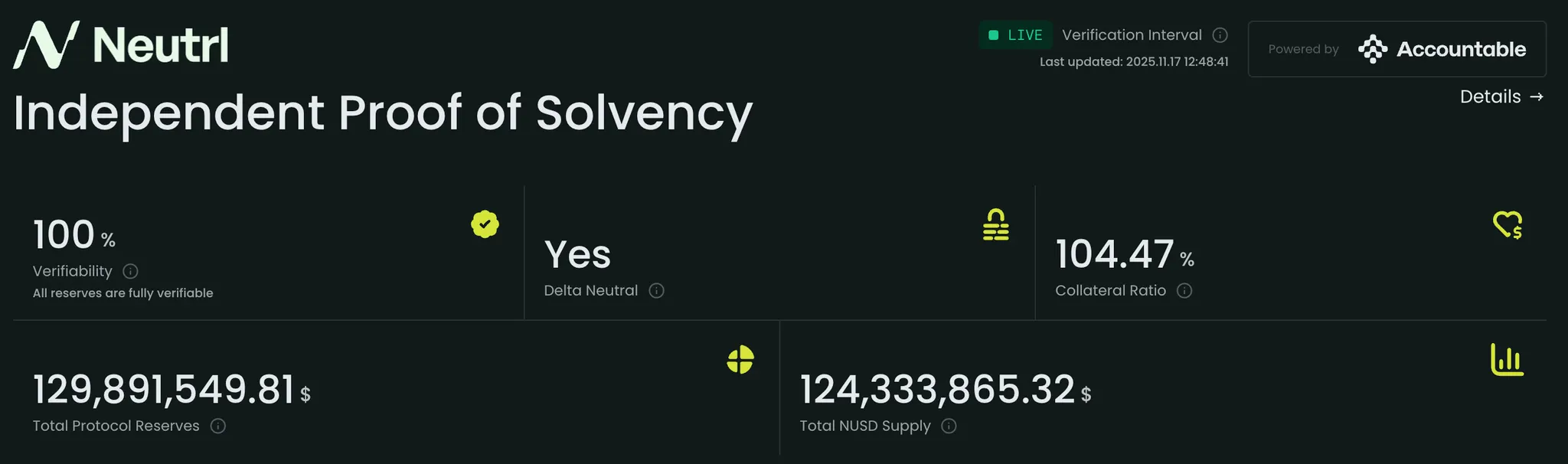
Source: Neutrl Transparency Dashboard
Internal liquidity simulations indicate redemption capacity of 25–50% of TVL within a single day under stressed but orderly conditions. Withdrawals are processed on a FCFS basis. KYC-verified counterparties redeem directly; non-verified holders access liquidity through secondary pools such as Curve.
The system’s liquidity behavior is counter-cyclical. In declining or range-bound markets, margin requirements and funding costs fall, increasing available liquidity when redemptions tend to rise. During risk-on phases, higher margin usage coincides with reduced withdrawal activity, given the larger expected inflow of stablecoins searching for higher yield.. This negative correlation lowers the probability of simultaneous stress across both liquidity and margin domains.
Counterparty or custody failure can compromise solvency even in a correctly hedged structure. Default by OTC counterparties, inaccessibility of custodied assets, or exchange insolvency could prevent delivery or withdrawal of collateral. Dependence on unenforceable legal agreements rather than verifiable on-chain control introduces the same structural vulnerability.
Neutrl confines exposure to deliverable, on-chain assets only. It does not engage in SAFTs, pre-TGE contracts, or other paper-based obligations. All OTC allocations reference tokens that already exist on-chain and are subject either to immutable vesting contracts or to time-locked custody with regulated institutions.
Custodial arrangements are diversified across BitGo and Coinbase Custody, both regulated entities operating segregated wallets and deterministic release schedules. On-chain enforcement prevents unilateral modification or early withdrawal.
Hedging collateral is held off-exchange through Fireblocks, CeFFU, and Copper, minimizing dependency on centralized exchange wallets. Venue exposure is monitored continuously; margin is distributed primarily across Binance and Bybit within predefined concentration limits. Accountable’s zero-knowledge attestations verify balances and venue distribution in real time.
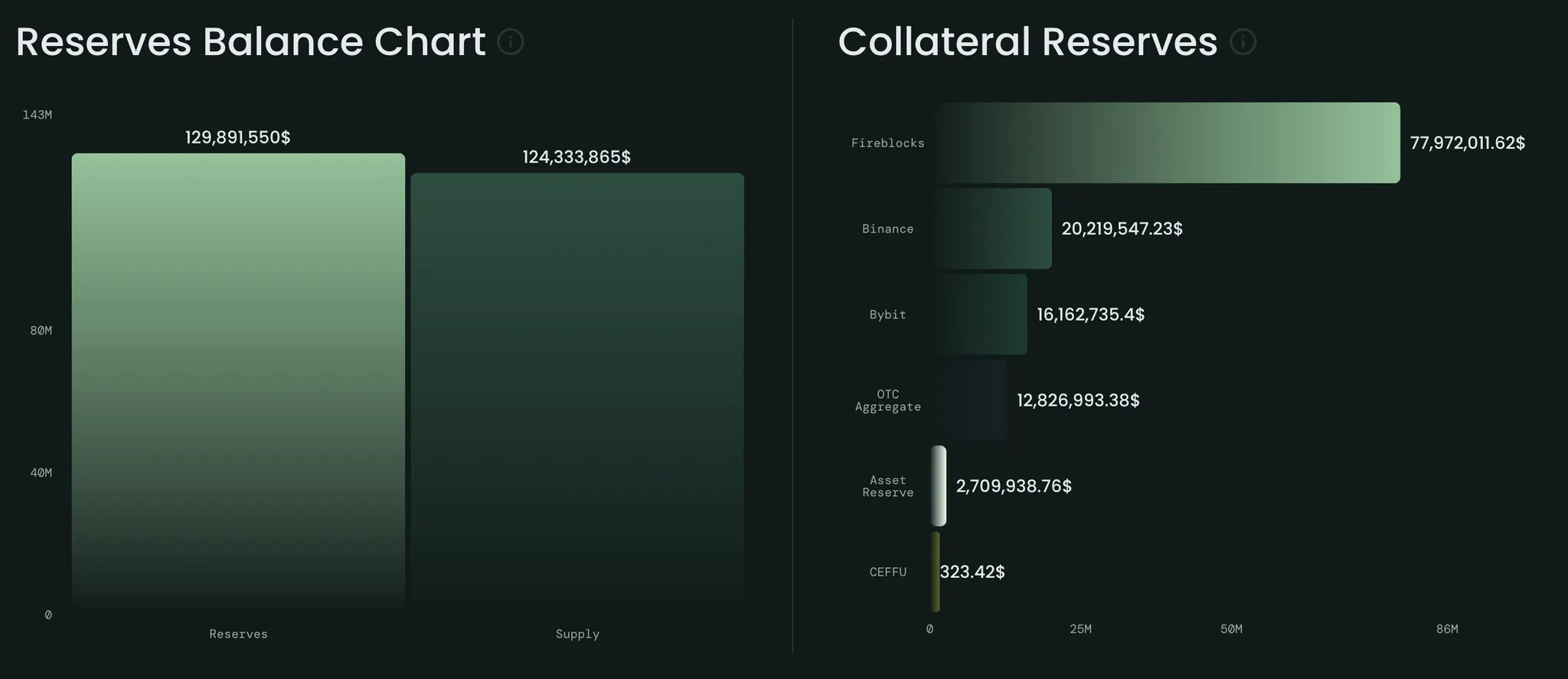
Source: Neutrl Transparency Dashboard
This configuration localizes risk to auditable, regulated entities and cryptographically enforced contracts rather than contractual promises, reducing counterparty dependency to observable operational parameters.
Inaccurate or optimistic asset valuation can conceal effective undercollateralization. If vesting assets are marked near spot without sufficient liquidity discounts or haircut adjustments, reported reserves may overstate realizable value. Under market stress (particularly if secondary liquidity for OTC tranches diminishes) the true collateral ratio could fall below parity, triggering redemptions or forcing asset sales at unfavorable prices.
Neutrl employs a conservative valuation methodology consistent with institutional standards for restricted assets. All OTC positions are marked to immediate liquidation value, not spot. Time-weighted illiquidity discounts are applied according to tranche duration and secondary market depth, incorporating data from STIX and executable bids from verified OTC counterparties.
Each valuation is independently verified through Accountable’s zero-knowledge proofs, which confirm correct application of discount factors, vesting schedules, and position caps without exposing position-level data. As of 16 November 2025, Accountable attested to a collateral ratio of 104.47%, with $129.9 million in reserves against $124.3 million NUSD outstanding.
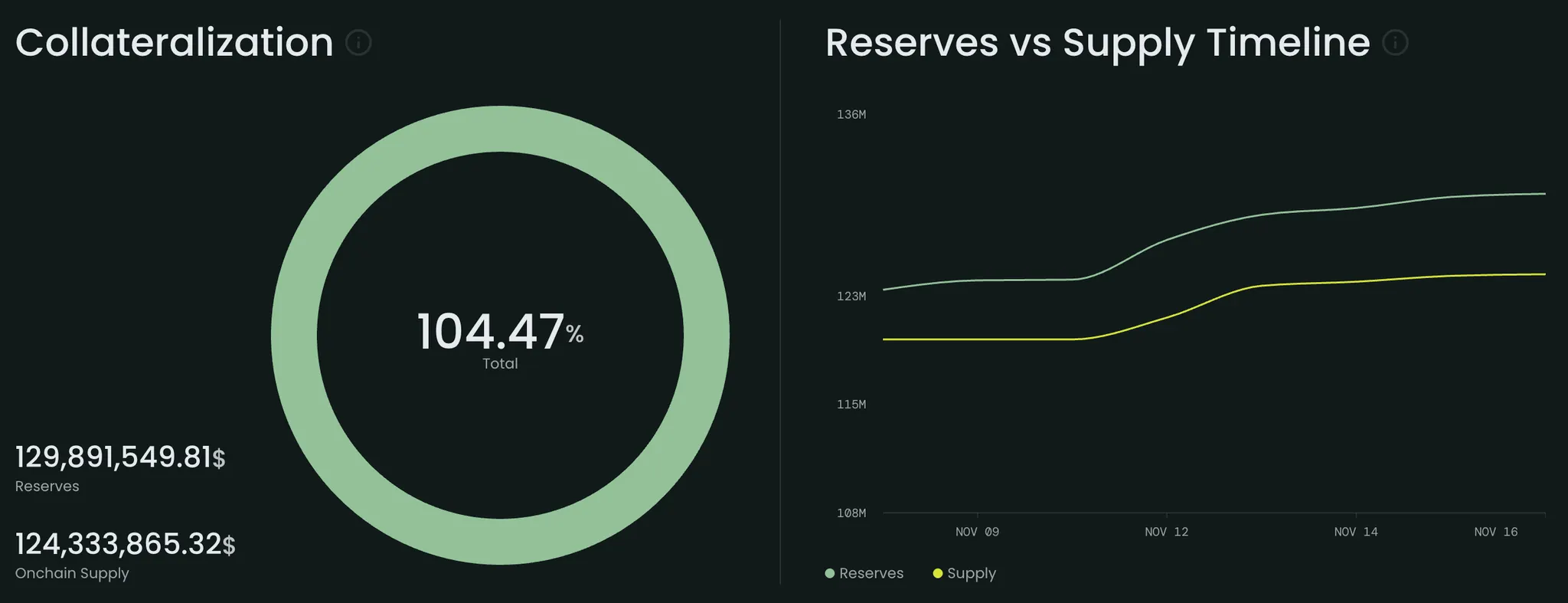
Source: Neutrl Transparency Dashboard
Operational failure can compromise system integrity even when financial parameters remain sound. Vulnerabilities include smart contract exploits, off-chain integration failure, delayed hedge execution, or governance inaction during abnormal events. Centralized intervention without formal oversight introduces separate governance and credibility risks.
Neutrl maintains continuous monitoring and automated circuit-breaker functionality across all protocol layers. Smart contracts and exchange integrations are observed by Hypernative, an independent real-time risk detection system that identifies anomalies such as margin imbalance, delayed re-hedging, or unrecognized withdrawals. Upon detection, Hypernative can automatically suspend minting or redemption within seconds.
Emergency procedures are executed by contributors at Neutrl Labs, who steward the Neutrl Protocol and hold limited authority to singlehandedly implement system pauses or rebalancing actions. All such interventions require multisign approval and are recorded and disclosed publicly through Neutrl’s official channels. Any modification to core functionality is documented and communicated in advance.
Looking forward, Neutrl Labs has indicated that an external Risk Committee may be introduced to provide independent oversight of reserve policy, margin management, and incident review. This addition would further institutionalize governance and strengthen the protocol’s risk-management framework.
While Neutrl’s architecture is well defined and continuously verified, certain dimensions remain inherently forward-looking. These do not undermine the protocol’s current solvency posture, but they define the areas where empirical evidence will accumulate over time as the system scales.
Neutrl’s structure is rigorously modeled and continuously attested, but it still represents a new class of market-neutral yield. No prior on-chain system has systematically captured OTC-discount accretion under continuous, portfolio-level delta hedging, and its behavior under extreme volatility or prolonged bear markets will ultimately be determined by live performance across a full cycle.
The underlying mechanics, however, are not without precedent. The closest analogue in tradfi is convertible arbitrage, where investors purchase discounted restricted assets and short the underlying to neutralize price exposure, earning the discount as it accretes toward par. Neutrl applies a similar principle to short-vesting OTC token blocks while maintaining real-time delta neutrality across the portfolio.
What is novel is the integration of these components into a transparent, programmatic, synthetic-dollar framework. The mechanisms have institutional precedents; the complete system does not.
OTC supply is unlikely to be the bottleneck. Neutrl’s relationship with STIX provides access to steady secondary flow, and the projected unlock schedule for the top 100 tokens exceeds $55 billion over the next two years, far more than required to support the protocol’s scaling roadmap. Neutrl targets $2 billion in TVL over this same period, a level that sits comfortably within the depth of expected unlock-driven OTC supply.
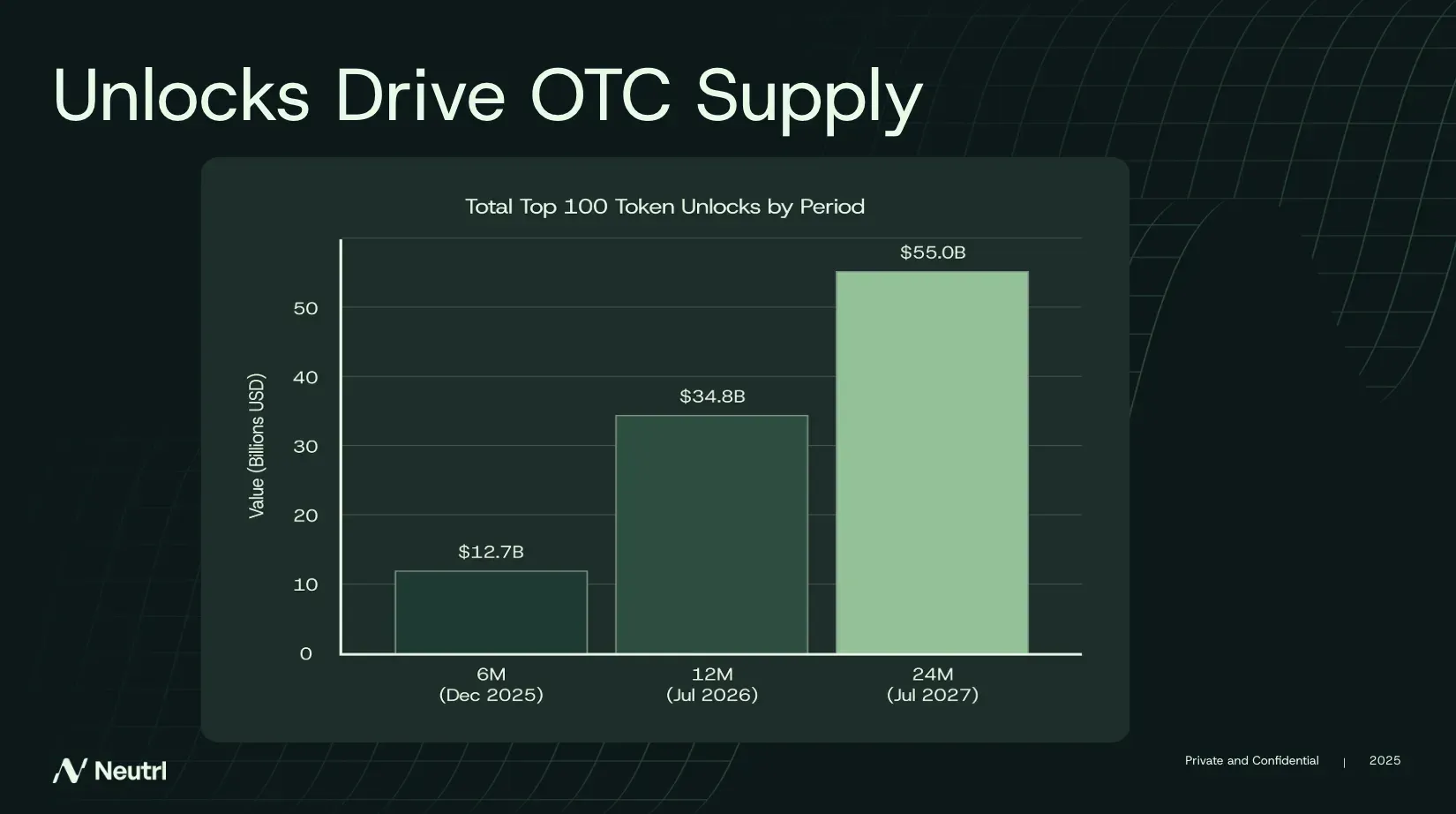
Source: Neutrl
Where uncertainty lies is not in sourcing, but in scaling the full engine. Larger position sizes introduce more variables: concentration management across OTC issuers, cross-venue margin coordination, discount compression as allocations grow, and the operational load of maintaining neutrality across a broader book. These are practical challenges rather than structural gaps, but they remain questions that only live deployment at multi-billion scale can ultimately answer.
In the near term, NUSD’s adoption will be shaped by crypto-native platforms (e.g. lending markets, DEX liquidity layers, structured-product protocols, custodial fintechs, cross-margin systems, CeFi desks, etc.). These players are less constrained than traditional institutions, but they still evaluate new yield-bearing assets through a disciplined risk lens: How does this instrument behave under stress?
A synthetic dollar backed by hedged OTC positions will remain unconventional until it demonstrates repeatable, observable stability across regimes. These actors will look for neutrality during sharp rallies, orderly redemptions during drawdowns, consistent behavior when funding regimes invert, and clear evidence that collateral buffers and margin usage respond predictably to volatility. NUSD’s deeper integration will depend on demonstrated behavior over time—transparent stress tests, real-time solvency verification, and a track record where the system behaves exactly as expected during market dislocations.
Neutrl’s risk architecture emphasizes verifiability, liquidity discipline, and operational control. Neutrality is enforced at both trade and portfolio levels through direct hedging, conservative leverage limits, and continuous delta monitoring.
The liquidity framework maintains a high proportion of immediately accessible assets, enabling the protocol to meet significant redemption volumes under stress. Valuation methodology reflects liquidation-based pricing with externally verifiable discounts, ensuring reserve integrity is grounded in realizable.
Custody and exchange exposures are diversified across regulated entities and secured through off-exchange settlement infrastructure. Automated anomaly detection, combined with transparent governance procedures executed by Neutrl Labs, provides a defined response path under operational stress.
While no synthetic dollar is free from risk, Neutrl’s system design and verification architecture represent a materially higher standard of transparency and control than is typical in many DeFi structures. Solvency and neutrality are observable states, continuously validated through public attestations. Ultimately, the most persuasive proof will come from how the system behaves through multiple market cycles.


Dive into 'Narratives' that will be important in the next year


 Neutrl
 Frax
Frax

