Source: https://x.com/brevis_zk/status/1998001986529321128?s=20
Brevis recently launched ProverNet mainnet beta, a decentralized marketplace for ZK proof generation. At its core is TODA (Truthful Online Double Auction), an auction mechanism designed to solve a uniquely difficult coordination problem.
ZK proof workloads aren't uniform. Some need sub-second latency, others process for hours. Some require GPU acceleration, others run better on CPUs. Matching this diversity efficiently requires an auction mechanism built for heterogeneous markets, where honesty, not strategy, drives optimal outcomes.
This piece breaks down how traditional auctions work, why they fail in ZK proving markets, and how TODA solves these problems.
Auctions are one of the oldest price-determination mechanisms in history. On the surface, these seem to follow a simple rule: "whoever bids the highest price wins." However, this interaction hides intense psychological battles and sophisticated calculations the parties engage in.
Auction formats generally fall into two categories: open-outcry auctions, where participants openly observe and compete with each other's bids, and sealed-bid auctions, where each party submits a price without disclosing it to others. English and Dutch auctions are examples of open-outcry, while government procurement bidding is an example of sealed-bid.
Despite their different forms, they share a key characteristic: participants must strategize around what others might do. From a game-theoretic standpoint, auctions make it rational to deceive.
Say I value an item at $100, but I believe a competitor will bid around $80. I can win by bidding just slightly higher and pocket the difference. As a result, traditional auctions don't reveal true valuations. They become sophisticated guessing games where participants predict others' behavior while hiding their own. In some markets, this is fine, and even part of the fun.
In markets like fine art, where scarcity is everything, these psychological battles can be part of the charm. But in a computing-resource market dealing with ZK proofs, where efficiency and speed are paramount, "strategy" simply means "inefficiency.”
Winner’s Curse: Even when you win, you don’t really win
In the ZK market, excessive competition pushes both buyers and sellers into what economists call the winner's curse. Buyers overpay to secure bids. Sellers undercut themselves to win work, sometimes pricing below cost. Strategies meant to outsmart others end up harming both sides and reducing market efficiency. Hence why “you win, but you don't really win.”
Collusion: Market failure
In markets with few participants, or where parties can easily infer others' information, collusion becomes likely. The moment a small group of provers keeps prices artificially high or steers wins toward specific buyers, trust in the decentralized market collapses.
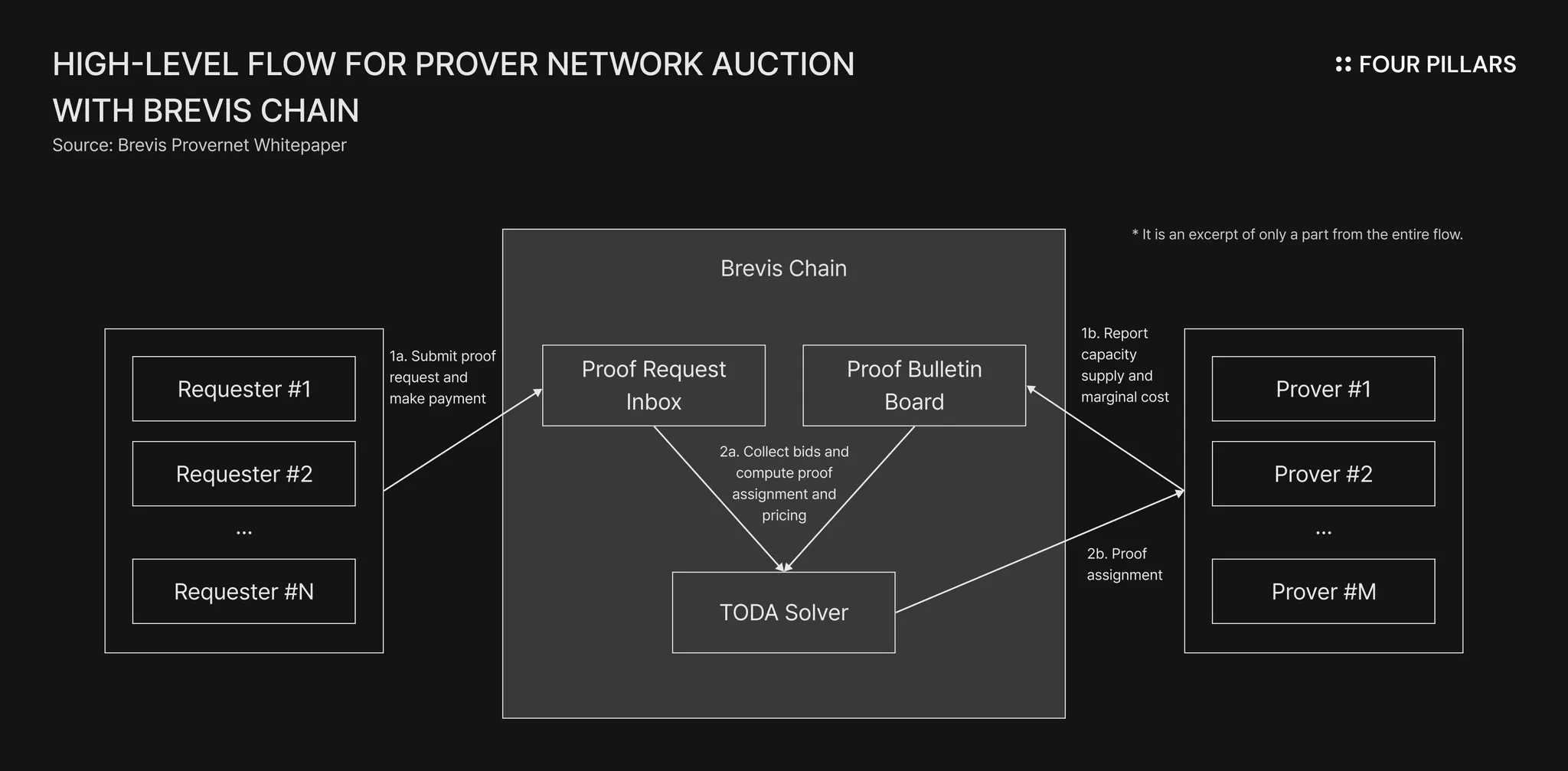
Brevis adopts TODA (Truthful Online Double Auction) to solve these problems. As the name suggests, being truthful is the most advantageous strategy.
Double Auction: Matching Many to Many
Traditional auctions typically involve many buyers competing for a single seller's item. But the ZK proving market is more complex — multiple buyers and many provers operate simultaneously. Brevis uses a double auction to handle this complexity.
Buyer submits: “I can pay up to $100 for this job, and it must finish within 10 seconds.”
Seller submits: “I can process this job for $80.”
The marketplace continuously matches both sides in real time. Rather than many buyers chasing one seller, it's an ongoing optimization across the entire market.
Solving the Winner’s Curse With “Critical Price”
The winner's curse occurs when participants bid beyond their true valuation. TODA eliminates this by making honesty the optimal strategy.
Here's how: buyers enter the maximum they're willing to pay, and sellers enter their real cost. But winners don't pay their submitted price. Instead, they pay a market-determined "critical price." For example, if I submit $100 but the job clears at $80, I only pay $80.
This removes anxiety for all participants:
“Am I paying too much?”
“Am I selling too cheaply?”
Just state your real preferences and the mechanism handles the rest.
Preventing Collusion Through Task Decomposition
Brevis doesn't auction off monolithic "ZK proofs." Tasks decompose into multiple sub-steps: zkVM execution, compression, aggregation, and more. A prover with strong GPU performance might bid for computation-heavy tasks, while another with a strong CPU setup might bid for aggregation work.
This heterogeneity is the key. Different tasks require different hardware capabilities, so no single group can easily dominate the market or manipulate prices. The structure itself prevents collusion.
Brevis’s introduction of TODA transforms proof-generation into a public good accessible to everyone.
For proof requesters, this means no more building expensive in-house infrastructure or accepting vendor lock-in from centralized services. A competitive marketplace of specialized provers is available immediately. Integrating cryptographic verification becomes a matter of weeks, not quarters.
For proof providers, this means freedom to specialize. GPU-optimized for real-time processing? Bid on those jobs. Built for complex aggregation? The marketplace finds you the right work. No need to cover every use case.
As a result, computing resources once controlled by a few are now distributed by market principles. Applications get cryptographically verified computation while decentralization stays intact. And the market rewards capability and efficiency, not strategic maneuvering.
ProverNet mainnet beta is live now with TODA at its core. As ZK adoption accelerates and more computation moves off-chain, efficient coordination of proving resources becomes foundational infrastructure. Brevis is building that layer, and TODA is how it works.


 Brevis
