Circle has unveiled a new feature called Nanopayments.
It allows transfers as small as $0.000001 while claiming zero gas fees. How is that possible?
The secret lies in batched settlement.
If every payment created its own onchain transaction, gas costs would quickly add up. Instead, Nanopayments collects users’ offchain payment signatures through the Circle Gateway. The system calculates net balances and periodically settles accumulated payments in a single batch.
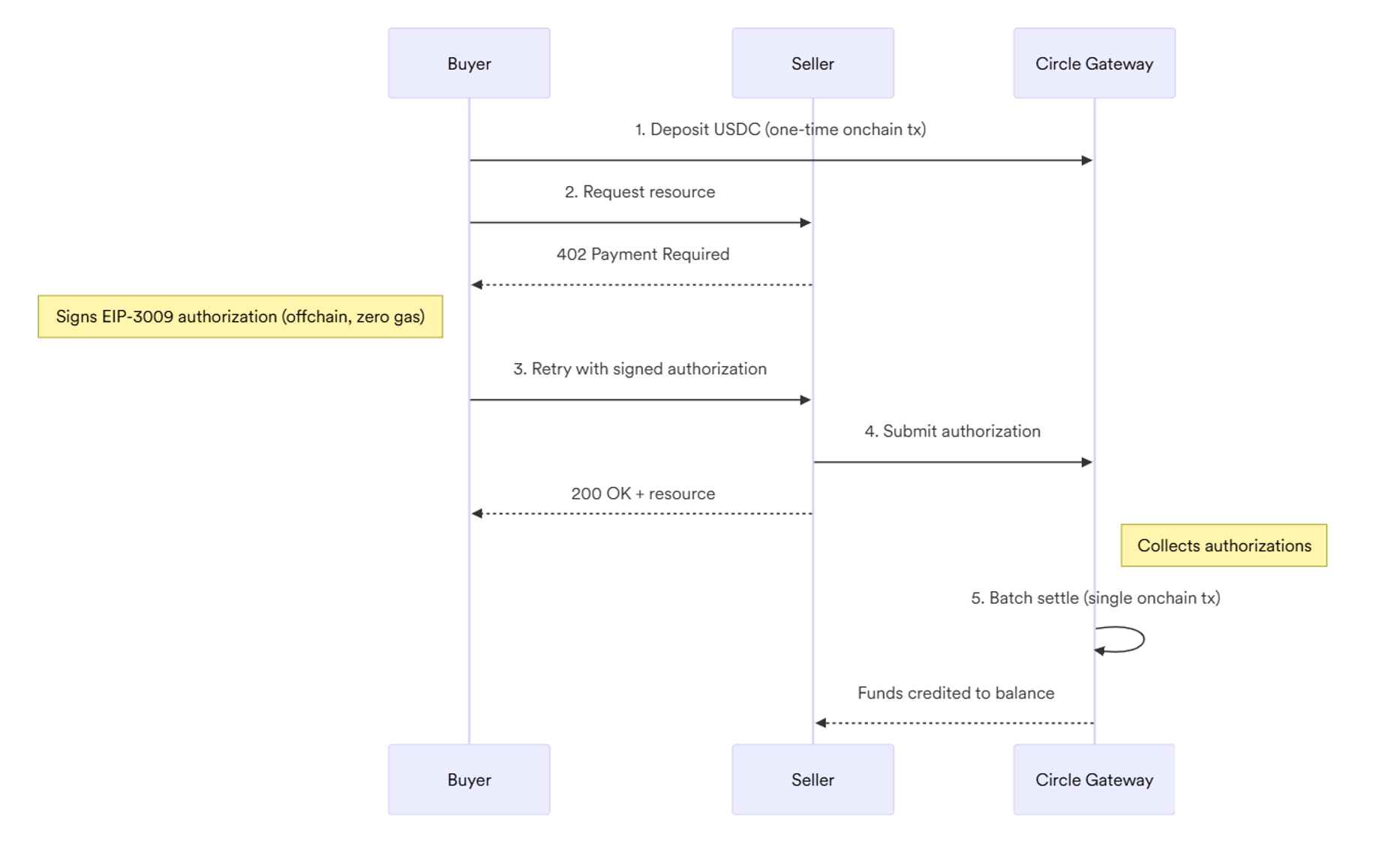
Here is a simplified look at the process:
Deposit:
The buyer sends USDC from their wallet to the Circle Gateway Wallet. This is an onchain transaction and gas is paid only once at the initial deposit.
Request and negotiate:
The buyer requests a paid resource from the seller. The seller can respond through the x402 protocol.
Sign authorization:
The buyer signs an EIP-3009 message. This is an offchain signature that authorizes payment to the seller and requires no gas.
Settle and serve:
Circle Gateway verifies the signature and checks the buyer’s balance. The corresponding amount is locked. The seller immediately delivers the paid resource to the buyer.
Batch settlement:
The Gateway periodically aggregates pending offchain signatures, calculates net balances, and settles them onchain in a single transaction.
In other words, thousands of offchain payment transactions are consolidated into one onchain transaction. That is why the effective gas cost approaches zero.
One point worth highlighting is that the offchain payment authorization process might appear custodial at first glance. However, Circle Gateway is designed to be non custodial.
Circle Gateway runs inside an AWS Nitro Enclave TEE. Within this environment, the system verifies EIP-3009 signatures, computes batch settlement results, and signs the final batch transactions. The TEE signing keys are securely protected using AWS KMS. Even Circle employees cannot access the enclave or the keys.
There have been many attempts to implement micropayments. Most approaches simply relied on sending transactions on networks with extremely low gas fees.
Nanopayments takes a different path. By aggregating offchain transactions and processing them in batches, it dramatically reduces gas costs. (For reference, the USDT chain Stable has implemented a similar concept at the network level called the USDT Transfer Aggregator.)
This approach could become especially meaningful in the future. As the agentic economy evolves, AI agents may increasingly stream payments in real time. Nanopayments creates the infrastructure that makes that model viable.



 Circle
