Imagine a built-in payment system inside the messaging app you use every day. Now imagine that the service holds a 97% share of the messenger market. Then imagine that payment system sitting at the same table as Google, Visa, and Coinbase to discuss an AI payment standard for the internet. As a Korean, KakaoPay joining the x402 Foundation feels something like that to me.
Of course, joining the foundation does not mean a product launch is imminent. Still, the standards a company chooses to review, and the companies it reviews them with, signal the kind of future it is looking toward.
KakaoTalk is more than a messenger. It is closer to everyday infrastructure that supports social life in Korea.
Messenger market share: 97% (Jan 2025)
Monthly active users: 48.9 million (South Korea's population : 51.7 million)
Usage rate among people in their 20s: 97.5%
Koreans use KakaoTalk to chat, call taxis, send money, send gifts, sign up for insurance, and trade stocks. Kakao's strategy is simple. It brings as many services as possible into KakaoTalk, so users have fewer reasons to leave the app. In effect, Kakao has built a national-scale super app, and KakaoPay is the payment layer inside it. KakaoPay ranks first in the simple-pay market with a 42.4% share, and it has 24 million monthly active users.
There is still active debate over whether agentic commerce will be built on top of existing commerce infrastructure or create a completely new market. But the first wave of adoption is likely to happen on top of existing infrastructure. Even a scenario in which agentic commerce takes share from current commerce must begin from the infrastructure that already exists.
McKinsey argues that agents will not wait for new infrastructure to be built, but will operate on existing commerce rails. Agents do not rebuild payment networks from the ground up. They move across rails that tens of millions of users and merchants already trust. Even if a completely new market opens up, securing share on existing rails remains the main starting point. In Korea, one of the clearest candidates for that rail is KakaoPay. Kakao has already started building the infrastructure that would allow agents to operate on top of it.
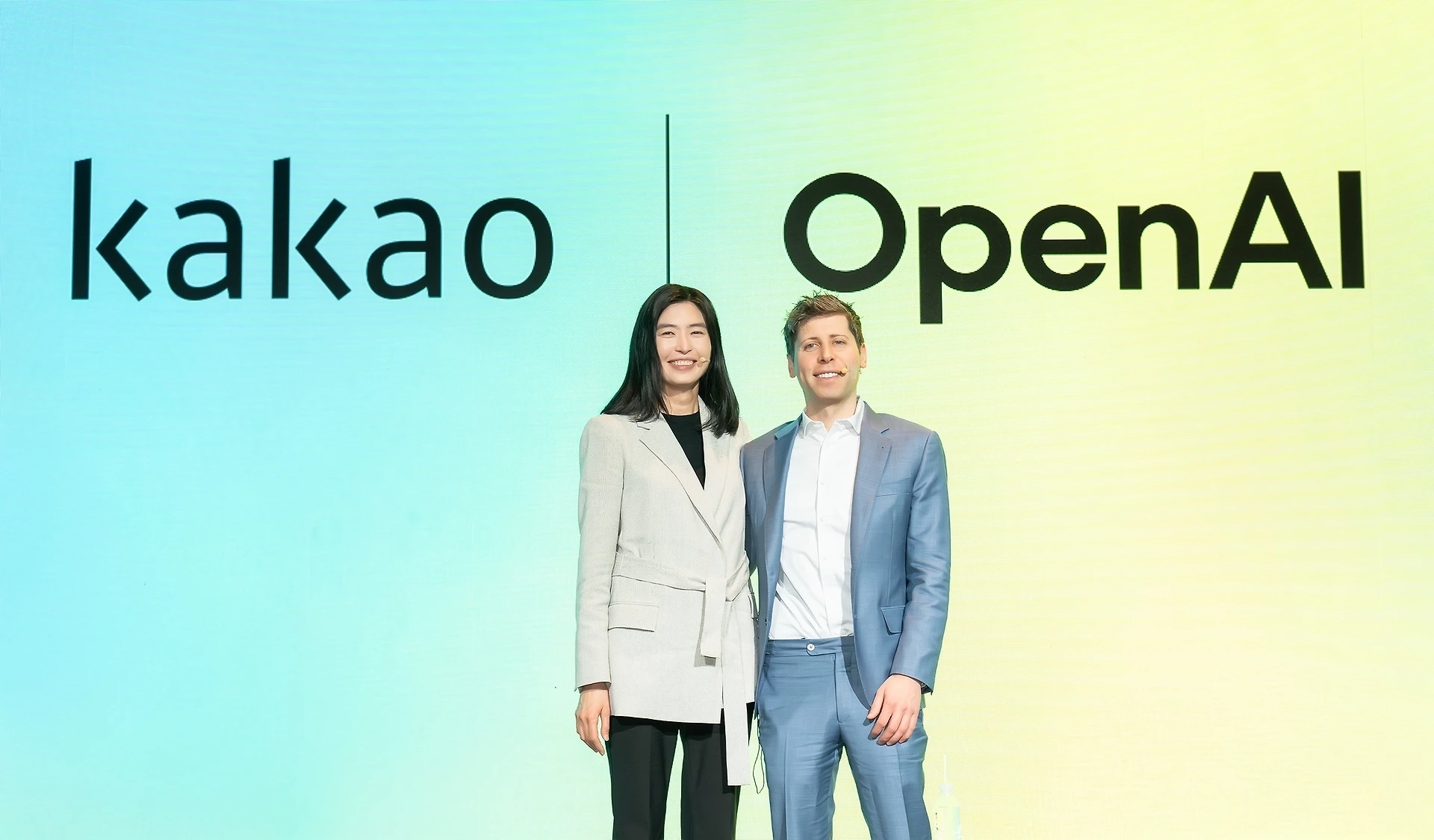
In South Korea, often described as the "Galapagos" of IT, Kakao signed the country's first strategic partnership with OpenAI in February 2025. It was a highly symbolic partnership. CEO Shina Chung and Sam Altman even held a joint press briefing. In October that year, ChatGPT for Kakao officially launched inside KakaoTalk, and it passed 2 million users within 10 days.
Source: Kakao
More important here are Kakao Tools, the layer Kakao built on top of ChatGPT. This structure lets ChatGPT connect directly to Kakao services such as Kakao Map, Gifting, Reservations, and Melon and carry out real actions. For example, if a user types, "Book an Italian restaurant near Gangnam," ChatGPT can search Kakao Map, find a venue with available slots, and complete the reservation. Separately, Kakao introduced its own AI agent, Kanana, and also unveiled PlayMCP and Agentic AI Builder, which combine Kakao's own language models with OpenAI models.

Source: Kakao
This is not yet a complete form of agentic commerce. But the pieces are coming together quickly.
Users: about 48 million KakaoTalk users, 24 million KakaoPay payment users
Agents: ChatGPT integration, Kakao Tools, and Kanana, with gradual expansion under way
Services: taxis, shopping, gifts, reservations, music, maps, insurance, and securities
Kakao has users. It is building agents. It also has services that agents can access. That last point should not be treated as obvious. In the shopping layer of the agentic commerce stack, global markets are already seeing heavy infrastructure competition, even in the process by which an agent discovers a product and gets to the point just before checkout. The stack is fragmented, from protocol standards such as ACP and UCP, to checkout services such as Rye and Henry Labs, to product discovery services such as Refibuy and Catalog. To complete a single action, finding and choosing a product, agents often need separate infrastructure for each step. Inside the Kakao ecosystem, that shopping layer is already connected. Gifting has a large product catalog. Reservations has service catalogs across restaurants, lodging, beauty, and more. Kakao Map connects to place search. All of this leads into KakaoPay in a single flow. Global big tech companies are assembling this structure through combinations of startups and protocols. Kakao already has it within one ecosystem.
When "super app" was treated as a marketing term, its value may have been overstated. In the age of agents, the opposite may be true. The more fragmented services are, the weaker an agent's ability to act becomes. The more concentrated services are within one ecosystem, the smarter the agent becomes. The real value of the super app may only now be coming into view. That leaves one question. What do agents need to act more freely and, more importantly, more autonomously? In the end, they need payment rails.
One objection naturally follows. Do agent-to-agent payments really need a new rail? Could the existing card payment structure not handle it? Stripe and Tempo's MPP (Machine Payments Protocol), for example, implements agent payments on top of existing card networks using SPT (Shared Payment Token). Given that legacy commerce still runs largely on card payments, this is a practical approach.
At the same time, skeptics argue that even if x402 has strengths in fees and programmable payments, it may still fail to move beyond legacy payment methods. That view may be even stronger in a market like Korea, where payment infrastructure shifts slowly. The introduction of Apple Pay alone took about nine years, which makes that skepticism easy to understand.
Yet KakaoPay's announcement, made on x402 Day, that it would join the x402 Foundation adds a different angle to the discussion. If Kakao links the domestic consumer base it already has to agentic commerce, adds x402-based stablecoin payments on top, and this move develops alongside the introduction of a stablecoin framework in Korea, this could become a flywheel.

More agents appear. More x402 payments occur. Merchant adoption of x402 expands. More services open up to agents. User experience improves. That, in turn, brings more users to agents.
Within the x402 ecosystem, the biggest question has always been the same. The protocol exists, but who will actually use it at scale? If KakaoPay integrates x402 into the agent ecosystem it is building, the picture changes. It would connect 24 million payment users, agent infrastructure already in operation, ChatGPT for Kakao, Kakao Tools, and Kanana, and one of the country's largest everyday commerce ecosystems inside Kakao, including Gifting, Taxis, and Reservations, all at once. That is why I think the killer app x402 has long been waiting for could emerge in Korea.
One question always follows any discussion of a Korean KRW stablecoin: why issue one at all? In Korea, where the existing payment infrastructure is already fast and convenient, it is not easy to find a clear reason to tokenize KRW. Use cases such as cross-border remittances and asset tokenization are often mentioned, but in practice they have not yet become persuasive enough to replace the current system.
But the story changes if x402-based agentic commerce takes hold on top of KakaoPay. The transaction size would remain small because the activity centers on micropayments. But the very high transaction frequency created by agents, combined with low fees, could become a meaningful use case that shows why a KRW stablecoin should exist. It would create a payment layer for machine-to-machine transactions that existing card networks struggle to process.
The current KRW stablecoin market is already a contest involving the five major commercial banks, along with platforms, crypto exchanges, securities firms, and card companies. And all sides are ultimately focused on the same thing: securing places to use the token and channels to distribute it.
From this angle, KakaoPay and Kakao deserve close attention. If Kakao first creates a reasonable use case through x402-based agentic commerce, and a consumer base built on 49 million KakaoTalk users then flows into a KRW stablecoin payment ecosystem, that alone could give the Kakao camp a structural advantage over rivals such as Naver, Upbit, and Toss. Seen from this perspective, KakaoPay's participation in the x402 Foundation may be a move that also looks ahead to competition over a KRW stablecoin.
There are still clear hurdles.
First, stablecoin regulation is not yet in place. Korea has put the Virtual Asset User Protection Act into force, but a separate framework for stablecoins has not yet been finalized.
The Electronic Financial Transactions Act, which governs the safety of electronic payments and financial transactions, also assumes a structure in which a user directly uses an access medium to instruct a transaction, in other words, a structure centered on a human actor. In a model where an agent acts autonomously on the basis of prior delegation, key questions remain. These include the scope of the user, whether broad delegation qualifies as a transaction instruction, and whether an agent-specific key can be recognized as an access medium. This is not only a Korean issue. In February 2026, the United Kingdom also identified a review of regulatory changes for agentic AI payments as an official task. In the end, the issue is institutional design, not technology.
Even so, if x402 is adopted after these institutional issues are addressed, and if the x402 ecosystem reaches the broad adoption it has been seeking, the form of agentic commerce we have imagined may first take shape in Korea. From that perspective, KakaoPay joining the x402 Foundation should be read as a sign that a Korean model of agentic commerce is moving closer to reality.