Lido V3 Phase 3 went live on March 3, making stETH minting permissionless for any stVault operator. What catches my eye is the reserve ratio tier system sitting underneath it, which prices staking risk at the operator level for the first time in Lido's history.
In V2, if an operator gets slashed, every stETH holder eats the loss through a negative rebase. Risk is fully socialized. Your exposure to a reckless operator in the Core Pool is identical to your exposure to the best one, which means the protocol has no mechanism to reward quality or punish negligence.
In V3's stVaults, Each vault is isolated, so slashing stays contained within that vault's collateral buffer, never bleeding into stETH broadly. The reserve ratio schedule determines how much capital efficiency each operator earns.
Non-identified operators get a flat 50% reserve ratio, meaning half their deposited ETH sits idle as a buffer. That's deliberately punitive. Identified operators get tiered ratios ranging from 2.5% at Tier 1 for the most credentialed category up to 20% at Tier 5 for basic identification — up to 20x better economics than the default tier. DVT operators running Obol or SSV clusters get 2-4% across all tiers, the best terms in the system, because distributed key generation provides genuine fault tolerance.
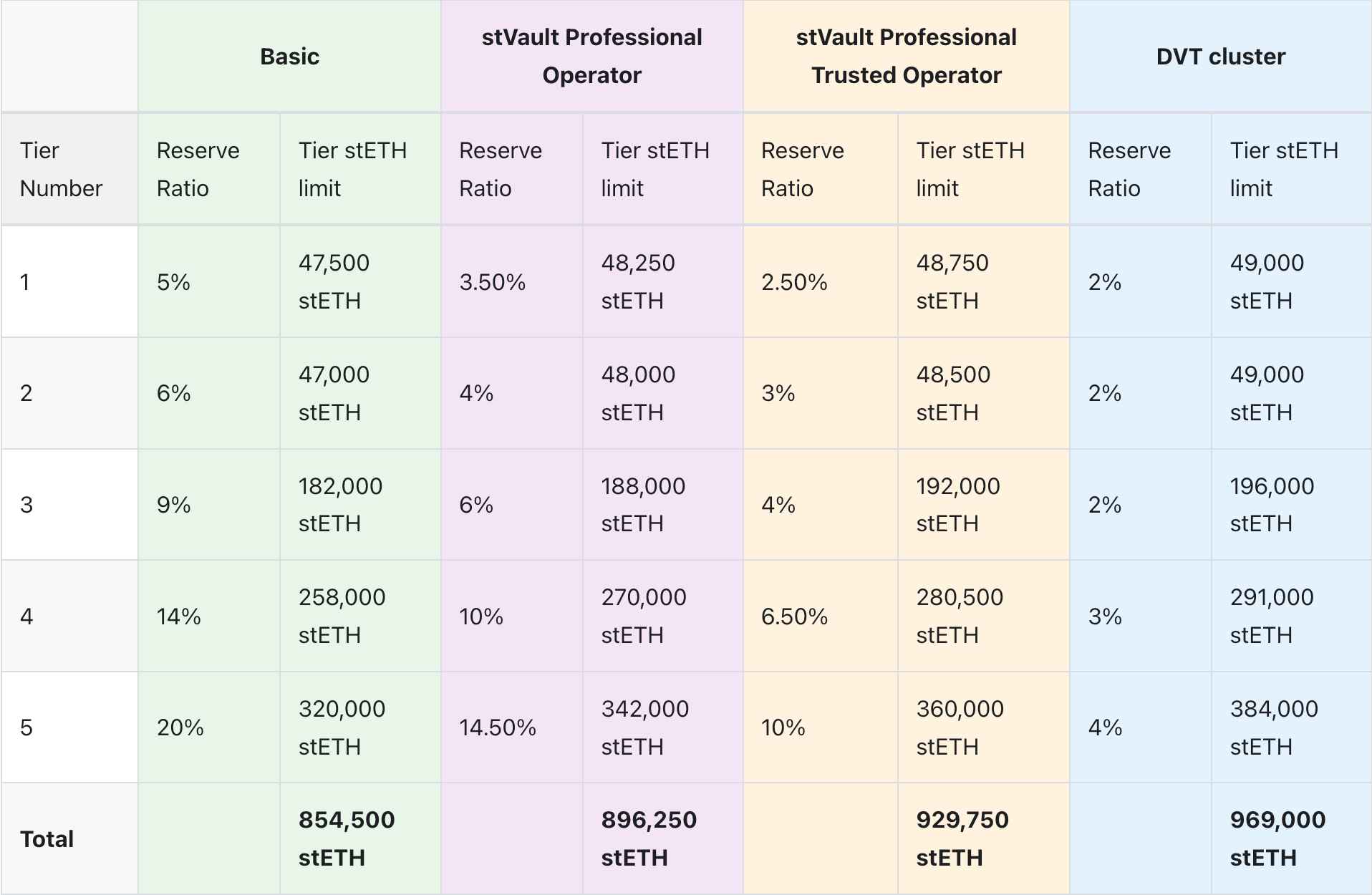
Source: Lido docs
Think of it like credit ratings applied to validators. A top-tier operator with years of clean history, proper identification, and a demonstrated business case gets dramatically better terms than an anonymous operator spinning up a vault for the first time. The protocol is encoding a judgment about reliability directly into capital requirements, and that judgment creates an incentive gradient: identify yourself, build a track record, adopt DVT, and your economics improve at each step. I don't think the market has internalized what this means for operator behavior if the incentive gradient works as designed — the entire supply side of liquid staking starts competing on verifiable quality rather than price.
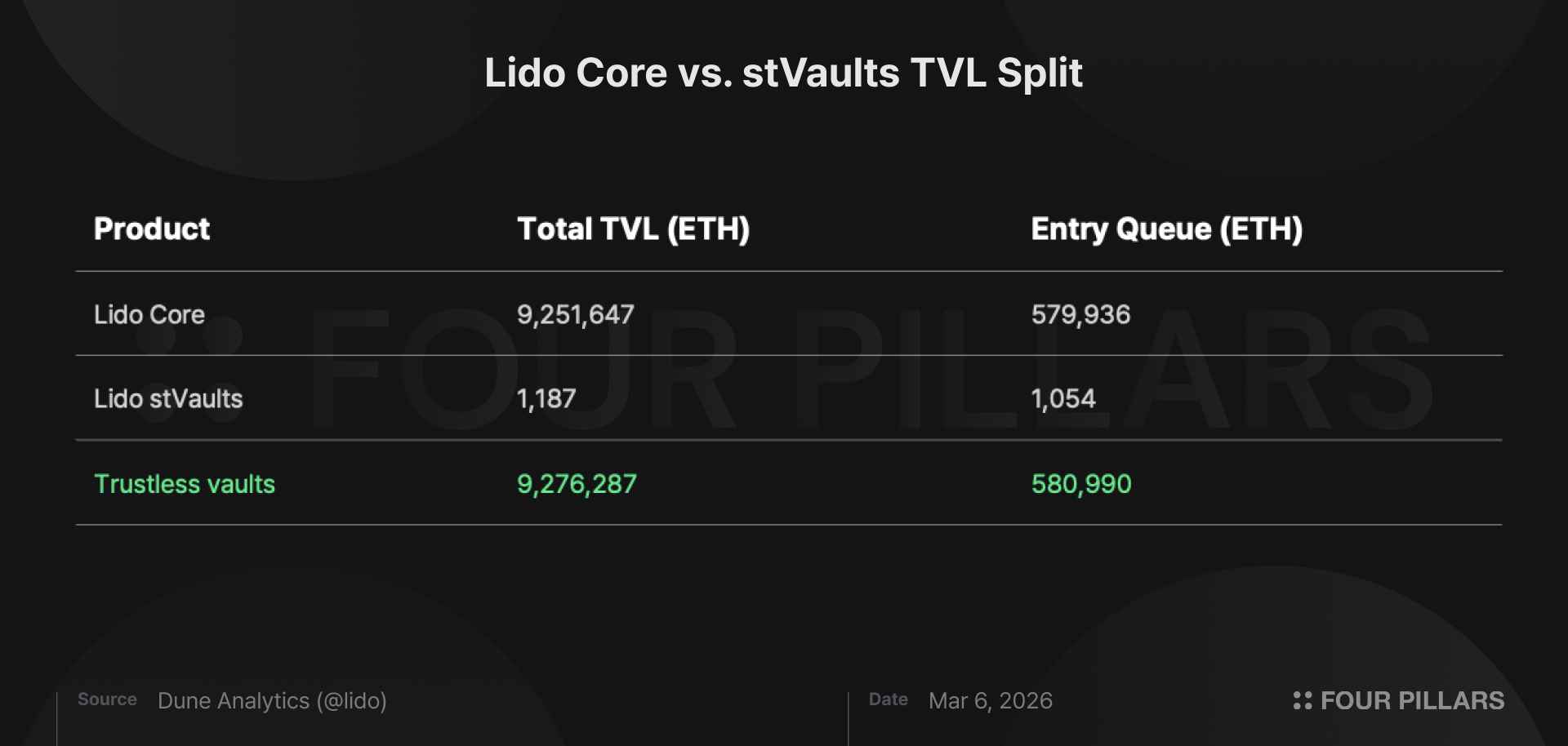
The Core Pool (9.2M ETH, or $19.2B in TVL as of Mar 5, 2026) stays completely untouched. Same stETH, same oracle, battle-tested. stVaults bolt on as an opt-in modular layer sharing the same token but operating independently, with a global minting cap at roughly 30% of Core TVL (around 3M stETH) so the Core Pool always remains the liquidity anchor. EIP-7251 from Pectra helps too, since max effective balance per validator jumps from 32 to 2,048 ETH, letting operators consolidate validators and cut infrastructure overhead significantly (fewer validators to manage, lower operational complexity, better unit economics at scale). One detail that flew under the radar is that vault owners can permanently disconnect from future DAO upgrades, preserving sovereignty for operators who need governance-risk isolation.
The fee structure tells you where Lido's head is at. Identified operators with 250+ ETH pay 0% infrastructure fees until March 31, meaning Lido is subsidizing supply-side adoption to populate stVaults with credentialed operators before depositor demand shows up. Classic two-sided marketplace sequencing: lock in quality supply first, let capital follow. Their GOOSE-3 target is 1M ETH in stVaults by end of 2026, and the fee waiver is Lido buying optionality on that capacity at near-zero cost while the window is open.
The counter-argument worth taking seriously is governance surface area. Who decides which operator lands in which tier? If tier assignments become political or the identification process turns into a gatekeeping mechanism, you've reintroduced centralization risk wearing decentralization clothes. But the escape hatch (permanent DAO disconnection) and the DVT pathway (which is permissionless by design) suggest Lido is at least aware of the tension, even if it's not fully resolved.
That said, stVault deployment velocity tells you whether the 50% default reserve ratio makes the non-identified tier cosmetic or functional. As of launch, stVaults hold 1,187 ETH total, and 1,054 ETH is sitting in the entry queue — an 88% queue-to-TVL ratio. Minting utilization against the 30% cap is a genuine catalyst if utilization pressure forces governance to expand it. Tier distribution between DVT operators (2-4% RR) and identified non-DVT (2.5-20%) reveals where capital efficiency demand is concentrated. And the first Force Rebalance Threshold trigger (any vault hitting its reserve ratio minus 0.25%) would be the first live stress test of vault isolation and proof-of-concept for the model.
Lido has been the staking incumbent for years, and incumbents usually don't innovate at the infrastructure layer because they have the most to lose. How this plays out is going to be the most interesting thing happening in staking going forward.


 Lido
Lido
