Across Protocol has posted a proposal to dissolve its DAO and token structure, transitioning to a U.S. C-Corporation called AcrossCo. ACX token holders are offered two options: a 1:1 token-to-equity conversion, or a USDC buyout at $0.04375, a 25% premium over the 30-day average price. Following the announcement, ACX surged approximately 85%, with the market reacting strongly to the "token-to-equity conversion" narrative itself.
Recent developments, including Backpack's token-to-equity staking program and the sidelining of TNSR holders during Coinbase's acquisition of Vector, illustrate how rapidly the boundary between tokens and equity is being redrawn.
At the same time, Uniswap's fee switch, Sky's buyback program, and Aave's revenue-sharing proposal demonstrate that it is possible to imbue tokens with economic value within a DAO structure, suggesting that token-equity convergence is not the only path forward.
Across's experiment is not an isolated event. It represents a broader industry-wide reckoning with the legal structures of crypto projects and the fundamental value proposition of tokens. The solutions, however, are not one-size-fits-all; the optimal path depends on each protocol's revenue structure and business model.
Source: @AcrossProtocol
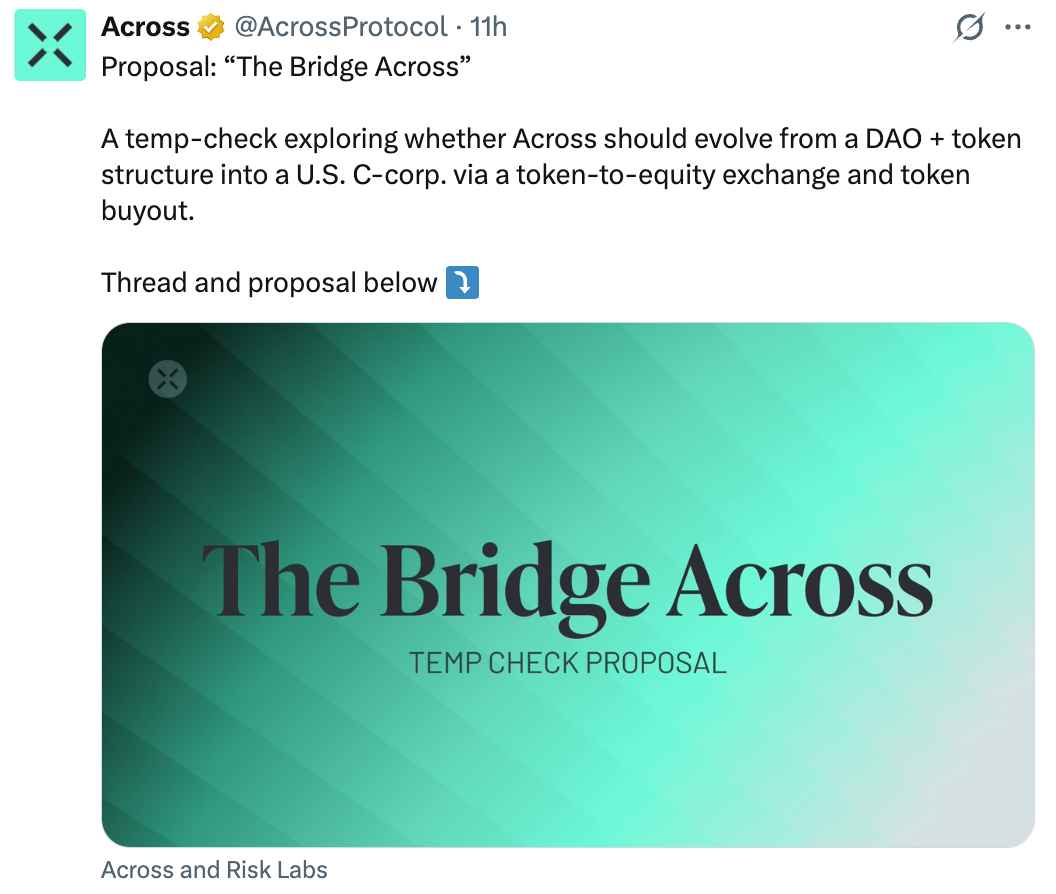
On March 11, 2026, Risk Labs, the core development team behind Across, a cross-chain intent-based bridge protocol, posted a proposal titled "The Bridge Across" on its governance forum. The central idea was to dissolve the existing DAO and token structure and transition to AcrossCo, a U.S. C-Corporation, as the new operating entity.
ACX holders are presented with two options. The first is a 1:1 conversion of tokens into AcrossCo equity. Holders with 5 million ACX or more can exchange directly for shares, while smaller holders can participate through a fee-free special purpose vehicle (SPV) structure. The minimum exchange threshold is approximately 250,000 ACX (roughly $10,000), a practical constraint dictated by U.S. securities law. The second option is a USDC buyout at $0.04375 per token, a 25% premium over the trailing 30-day average trading price. The buyout window is expected to open within approximately three months of the proposal's passage and remain available for six months, funded by the protocol's liquid assets (currently roughly equivalent to its market capitalization).
Co-founder Hart Lambur, in a lengthy post on X, emphasized that he had originally been a "token maximalist," but concluded that in the current macro environment, holding a token does more harm than good. He explained that while Across has signed contracts with numerous tier-1 projects despite lacking a legal entity, the requirement to route all agreements through a foundation has been a practical barrier when doing business with traditional financial institutions and crypto-adjacent companies.
Lambur's argument for the transition is also tied to Across's strategic direction. He summarized Across's future in one word: "stablecoins." In an environment where countless stablecoins, from USDC and USDT to USDH, USDe, and PYUSD, are proliferating, he argues that the current model where users pay fees to move dollars is unsustainable. The cost should be borne by asset issuers earning interest, not by users. Across has already implemented this model through an agreement with Hyperliquid's native stablecoin USDH. Two additional undisclosed partnerships will adopt the same "free bridging" structure, and Lambur explains that these kinds of deals require legal contracts outside the protocol.
The market reaction was immediate. ACX surged roughly 85% following the announcement, reaching approximately $0.06. What makes this notable is that the rally was not driven by a change in protocol fundamentals, but by the narrative of "tokens being convertible to equity" itself. Despite remaining over 96% below its all-time high of $1.69, the market assigned a premium to the possibility of this structural transition.
The reason Across's proposal is attracting so much attention is that it is not an isolated event. Over the past several months, the crypto industry has seen a series of attempts to redefine the boundary between tokens and equity. Viewed together, these cases point to a structural shift underway.
Source: Backpack
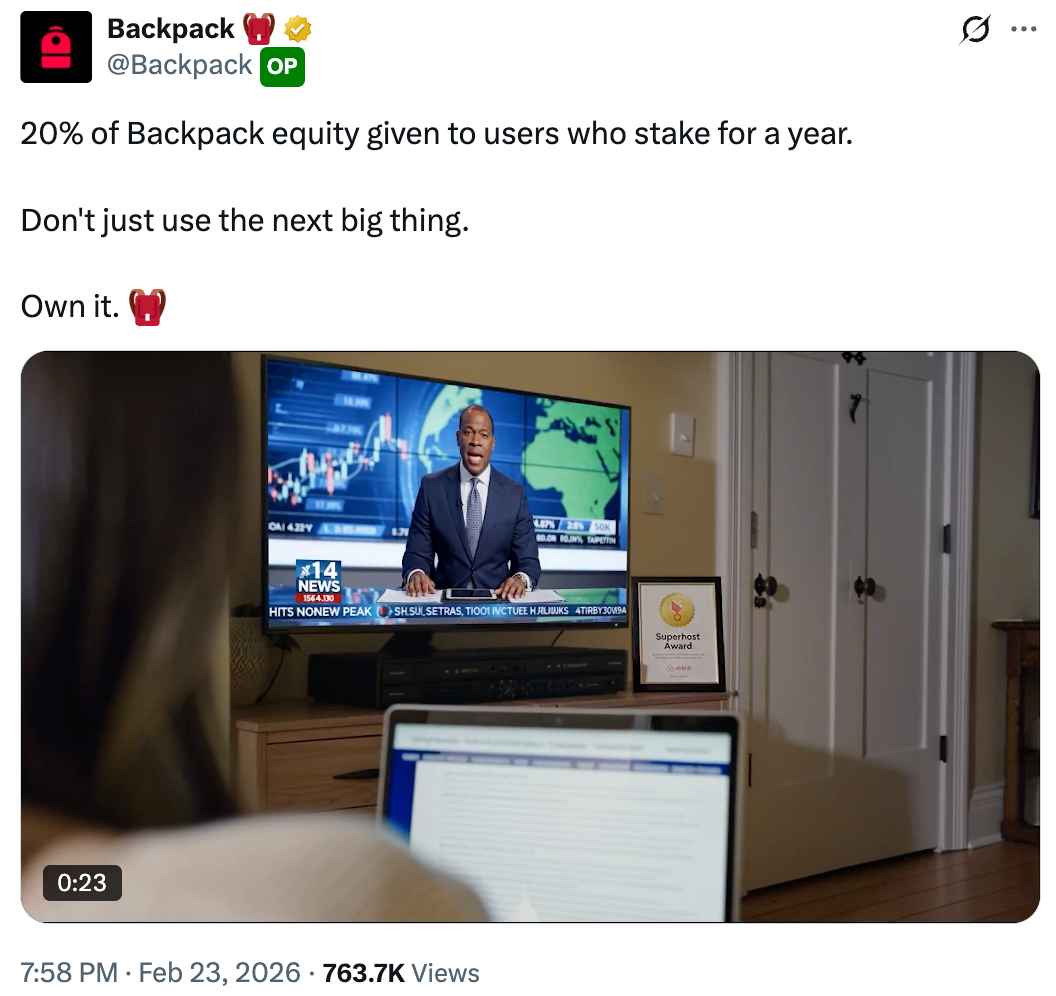
On February 23, 2026, Backpack, a Solana-based exchange, announced a staking program offering token holders access to 20% of the company's equity. The structure allows holders who stake their tokens for one year to exchange them for shares at a fixed ratio.
What makes Backpack's tokenomics interesting is their deliberate break from industry convention. At the token generation event (TGE), only 25% of the total 1 billion supply (250 million tokens) was put into circulation, with 24% allocated to points program participants and 1% to Mad Lads NFT holders. Team tokens are locked until one year after the IPO. Founder Armani Ferrante has stated that this structure was designed as an explicit rejection of the recurring pattern in crypto where insiders receive priority allocations and then dump on retail investors.
Where Backpack differs from Across is in the direction of travel. Across is converting from tokens to equity; Backpack is grafting equity-like properties onto its token. But both cases share a common recognition: tokens alone are insufficient to deliver meaningful value to holders.
Source: @coinbase
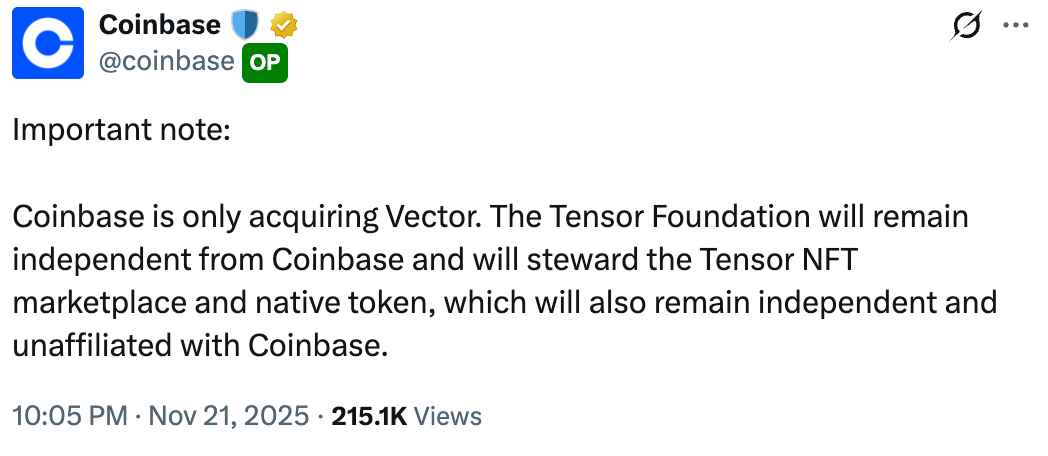
There are also counterexamples. In November 2025, when Coinbase acquired Vector, a Solana-based trading platform, Vector's team and infrastructure were absorbed into Coinbase, but the Tensor Foundation and the TNSR token were left as independent entities. On the surface, this appeared to preserve decentralization. In practice, what happened was different. Vector was Tensor's consumer-facing product and the core asset driving TNSR's utility. TNSR briefly spiked on the acquisition news, but it was Coinbase, the acquirer, that captured the equity value. Token holders were left with governance rights over an entity stripped of its core asset.
The community raised questions about this outcome: equity holders captured the value from the acquisition, while token holders were effectively dispossessed of the core asset without compensation. This case illustrates, by contrast, why Across's proposal could be received positively by token holders. At a minimum, Across is explicitly offering token holders the opportunity to convert to equity.
Based on the cases above alone, it would be easy to conclude that tokens have structurally failed to deliver value to holders. But during the same period, there have also been efforts to build direct links between tokens and protocol revenue while maintaining the DAO structure.
Uniswap's fee switch is the most prominent example. On December 25, 2025, the Uniswap DAO passed the "UNIfication" proposal with an overwhelming majority of approximately 125 million UNI in favor. The proposal allocates a portion of protocol fee revenue to a UNI token buyback and burn mechanism via smart contract, burns an additional 100 million UNI from the treasury, and has Uniswap Labs cease collecting frontend fees. This is the largest-scale example of directly linking token value to protocol success through on-chain mechanisms, without any corporate conversion. As of February 2026, a follow-up proposal is underway to extend the fee switch to eight L2 networks including Arbitrum, Base, and Optimism, with estimated annual protocol revenue reaching approximately $61 million if approved.
Note: Uniswap's fee switch operates through the TokenJar/Firepit system. Protocol fees accumulate in the TokenJar, and when UNI holders voluntarily burn UNI in the Firepit, they can withdraw a corresponding amount from the TokenJar.
Sky (formerly MakerDAO) and its buyback program also deserve attention. Since February 2025, the Sky protocol has deployed over $102 million to continuously purchase SKY tokens on the open market, making it one of the largest and most transparent buyback programs in DeFi. The Sky Frontier Foundation estimates total protocol revenue for 2026 at approximately $611.5 million, an 81% increase year over year. Protocol profit is projected at $157.8 million, a 198% increase from the prior year. Sky stands as a leading example of achieving revenue-to-token value alignment while maintaining the DAO structure.
Aave is moving in the same direction. In January 2026, Aave Labs founder Stani Kulechov previewed a formal proposal to share revenue generated outside the protocol (from frontend apps, swap integrations, institutional lending products, etc.) with AAVE token holders. The process has not been entirely smooth. In December 2025, DAO members discovered that frontend fees were flowing to Aave Labs rather than to the DAO treasury, triggering a governance dispute. The revenue-sharing proposal is partly an effort to resolve this conflict. This serves as a dual-sided case: it shows that token holder rights can be protected when DAO governance actually functions, while also exposing the friction costs inherent in the governance process.
There is a structural backdrop to why these cases are emerging in concentrated fashion in early 2026.
On the regulatory front, the SEC launched an innovation exemption program for crypto companies beginning in January 2026. DTCC received a three-year pilot authorization for tokenization services, and Nasdaq filed an application for trading tokenized securities. As regulatory uncertainty has diminished, the risks associated with protocols adopting traditional corporate structures have dropped significantly. It is worth noting, however, that this regulatory easing has facilitated movement in both directions: not only the Across path of dissolving tokens, but also the Uniswap path of activating fee switches. The UNIfication proposal explicitly cited the shift away from the hostile regulatory environment under the Gensler-era SEC as a premise.
Separately, industry fatigue with the limitations of DAO structures has been building. Around the same time, Aave founder Kulechov publicly criticized the internal workings of DAOs, sparking a debate across the DeFi community. The inability to execute enforceable contracts, the absence of a legal counterparty, and the structural friction in partnering with corporate entities are problems not unique to Across. However, it is important to distinguish whether this represents a majority view across the industry or a problem concentrated among a specific type of protocol. For protocols like Sky or Uniswap, where on-chain fee-based revenue models function well, the limitations of DAO structures are less pronounced. The issue is more acute for protocols like Across, which depend more heavily on off-chain B2B contracts.
One question runs through all of these cases: what is a token?
If governance tokens are what their name implies, they should be voting rights. But most governance token holders do not vote, and token prices move with little correlation to the quality of a protocol's governance. The same applies to so-called utility tokens. In most cases, a token's "utility" is not essential to using the protocol, and the service works much the same with or without it.
In this context, tokens are a kind of quasi-security with no clear claim to dividends, voting power, or residual assets. The rights that equity naturally carries simply do not exist for tokens. This creates a structural discount and drives a wedge between a protocol's actual value and its token's market value.
But this diagnosis contains a hidden assumption: that delivering value to token holders requires legal rights (i.e., equity). This assumption may feel intuitive, but it is in fact a claim that needs to be proven. On-chain mechanisms can deliver economic value without legal rights, and these mechanisms have begun to activate in earnest during 2025 and 2026.
The fee switch model is one example. As Uniswap's case demonstrates, when a portion of protocol fees is automatically routed to token burns via smart contract, token holders receive economic benefits through supply reduction without receiving a legal dividend. This has been recognized as one of the most significant tokenomics changes among DeFi blue chips, creating a more direct link between the UNI token and protocol revenue and trading activity. Because this mechanism is executed in code, it does not depend on a board's dividend decision or legal enforcement. One could argue it is actually a more deterministic mechanism than legal rights, since smart contracts execute automatically when conditions are met, without discretionary judgment by a board.
The buyback-and-burn model works similarly. Purchasing tokens on the open market with protocol revenue and burning them produces an effect economically equivalent to share buybacks in equity markets. The difference is that share buybacks depend on board resolutions, while on-chain buybacks execute automatically once governance votes set the parameters.
Viewed this way, the "structural discount" on tokens can originate from two distinct causes.
The first is a lack of design: protocols that have not implemented value-delivery mechanisms like fee switches or buybacks at all. In this case, the solution is to introduce such mechanisms, and a conversion to equity is not necessarily required. The second is a limitation of form: even where mechanisms exist, insufficient investor protection due to the absence of legal enforceability, access to corporate information, or residual asset claims. In this case, corporate conversion may be the rational choice.
For Across specifically, its business model as a bridge protocol is moving toward fee revenue converging to zero, which makes on-chain value-delivery mechanisms like fee switches difficult to operate. When revenue comes from B2B contracts rather than protocol fees, a legal entity is essential, and in this context, Across's choice is rational. However, it is more accurate to interpret this as a limitation of tokens within Across's specific business model, rather than generalizing it as a structural limitation of tokens as such.
Those who chose equity, like Across and Backpack, have concluded that the token form alone cannot fully convey a protocol's value to its holders. But Uniswap and Aave are attempting to show that with properly designed mechanisms, tokens can perform value-delivery functions comparable to equity. The difference lies not in the form ("token or equity") but in the design ("does a value-delivery mechanism exist or not").
This invites a question from the opposite direction as well: can grafting equity-like properties onto tokens, or converting tokens to equity outright, coexist with crypto's foundational value of decentralization? In Across's case, AcrossCo, a centralized corporation, will own the IP and lead development and business operations. The protocol infrastructure itself will reportedly remain open and permissionlessly accessible, but the structure for capturing economic value becomes identical to that of a traditional company.
Ultimately, token-equity convergence is not moving in a single direction but in two directions simultaneously. The path from tokens to equity and the path from equity to token-form issuance coexist. On top of this, a third path is emerging: tokens remaining as tokens while acquiring equity-like value-capture functions through fee switches and similar mechanisms. At the point where these three currents meet, the distinction between tokens and equity is giving way to a more fundamental dividing line: whether a value-delivery mechanism exists or not.
Source: @RyanSAdams
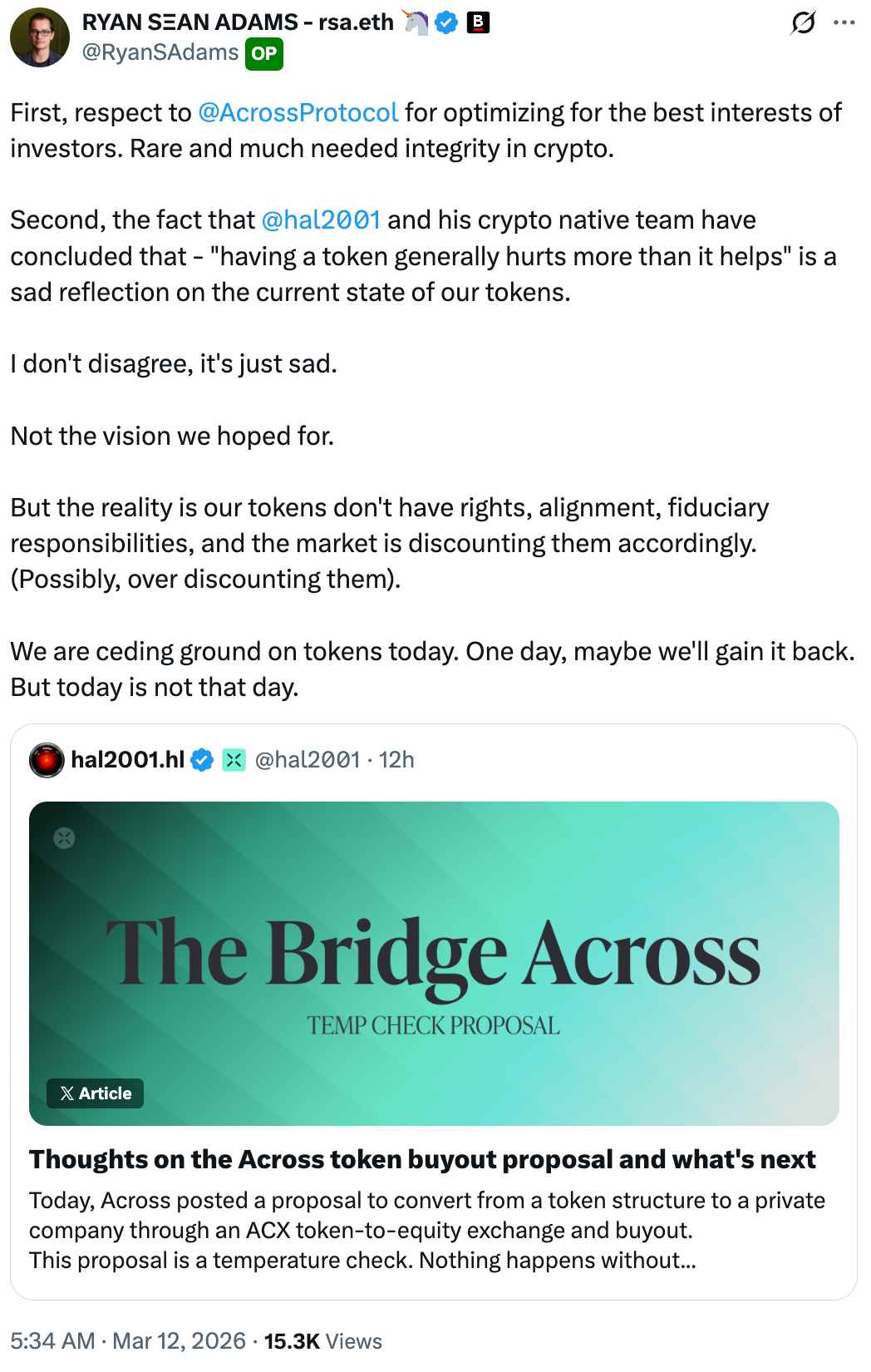
Ryan Sean Adams of Bankless expressed respect for Across's decision to prioritize investor interests, while also noting that the fact that a crypto-native team concluded "holding a token does more harm than good" reflects the current state of the industry. He observed that tokens today carry no rights, no alignment, and no fiduciary responsibilities, and the market is pricing them accordingly. "Today we are retreating from tokens. Maybe we'll get it back someday. But not today," he added. His perspective functions both as an endorsement of the Across proposal and as self-criticism directed at the industry as a whole.
In a similar vein, Felipe Montealegre of Theia Research evaluated Across's move in the context of a broader trend among protocols such as Morpho, Uniswap, Aave, and Kamino that are treating their token holders appropriately. He noted that it is encouraging to see an increasing number of projects choosing to "do the right thing."
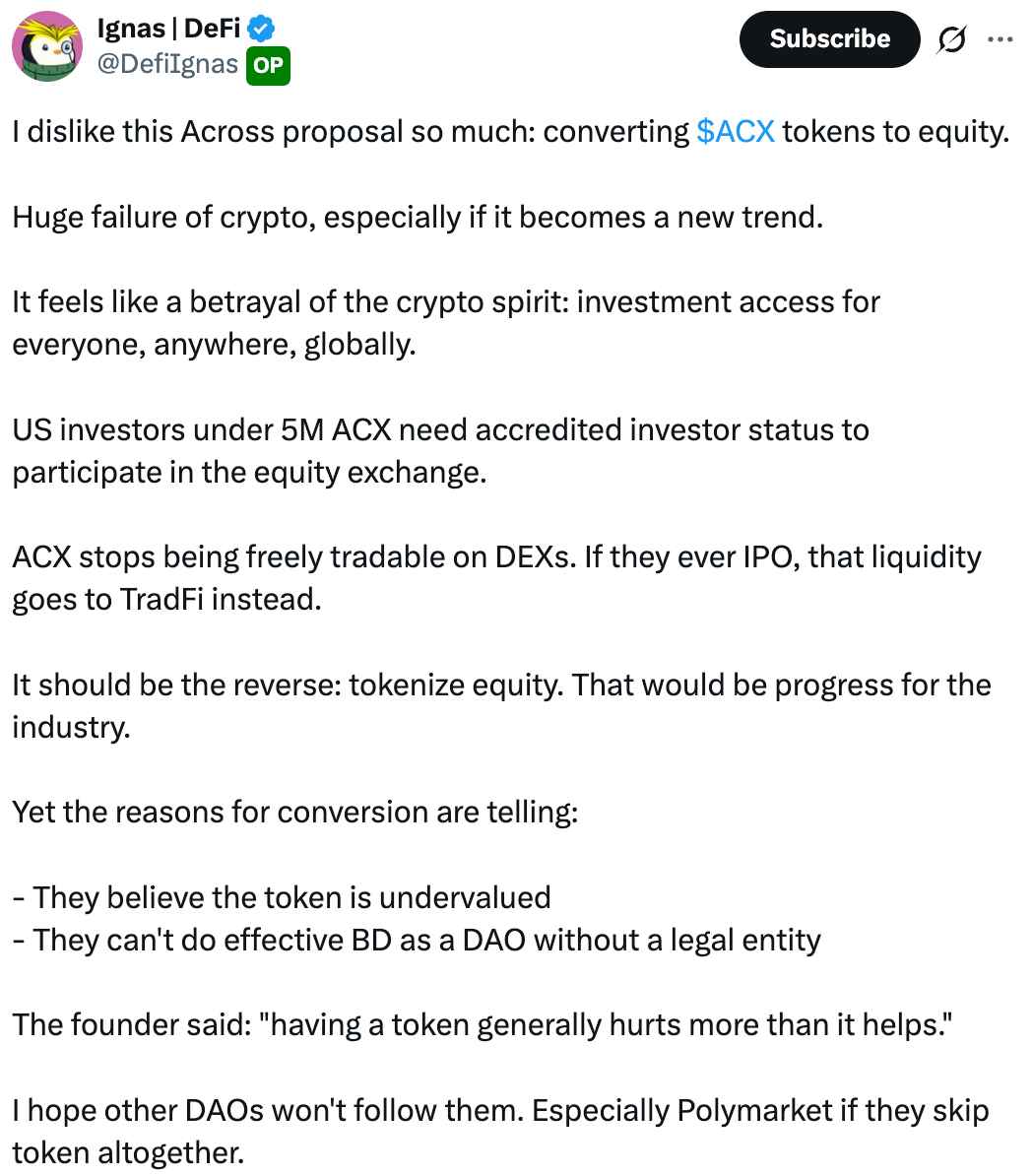
Source: @Defiignas
Researcher DefiIgnas took a sharply critical stance. He argued that converting tokens to equity undermines a core crypto value: the principle that anyone, anywhere, should have access to investment opportunities. In practice, U.S. investors holding fewer than 5 million ACX would need to qualify as accredited investors to participate in the equity exchange. DefiIgnas also raised concerns that ACX would no longer trade freely on decentralized exchanges, and that even if an IPO were to occur in the future, the resulting liquidity would flow to traditional finance. He believes the direction should be reversed: tokenizing equity represents progress for the industry, while reverting tokens to equity is a step backward.
That said, DefiIgnas acknowledged that the rationale for the conversion is compelling. He agreed with the problem statement that tokens are undervalued and that effective business development is impossible without a legal entity, but warned that this should not become a trend for other DAOs. He also expressed concern about the scenario where projects like Polymarket skip token issuance altogether.
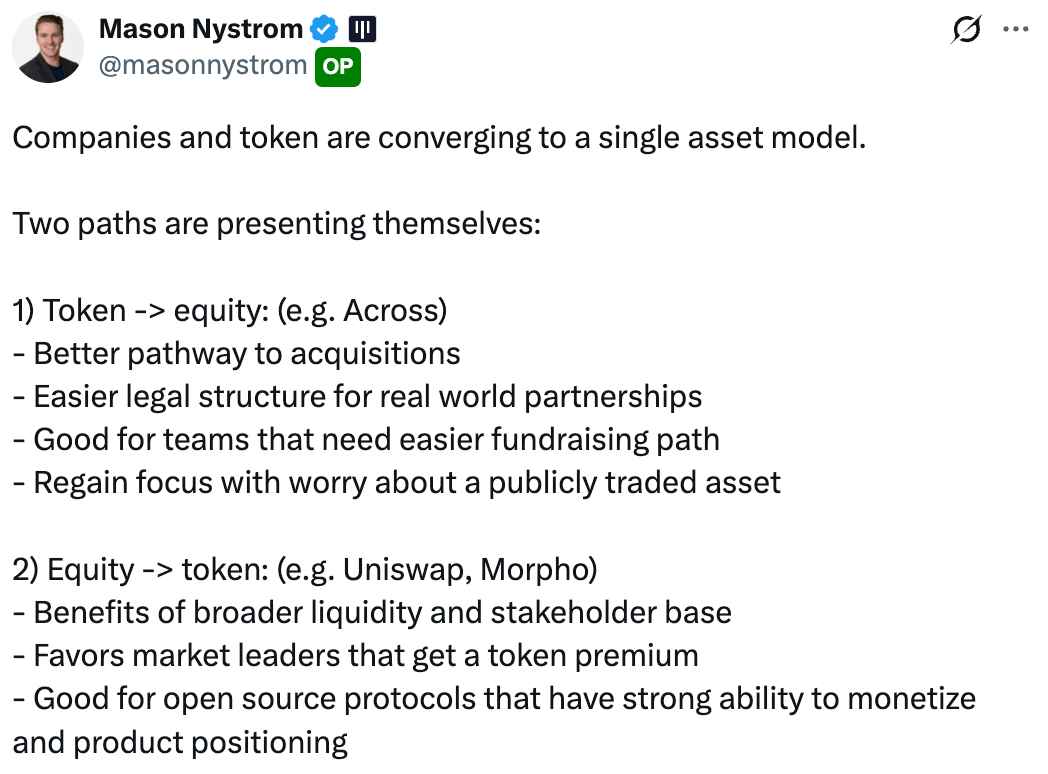
Source: @masonnystrom
Mason Nystrom of Pantera Capital framed the debate at a higher level. He argued that companies and tokens are converging toward a single-asset model, with two paths currently on offer. One is the Across path, from tokens to equity, which facilitates mergers and acquisitions and traditional partnership structures but sacrifices public market liquidity. The other is the Uniswap/Morpho path, from equity to tokens, which offers broad liquidity and a wider stakeholder base but favors protocols with dominant market positions. Nystrom's framework aligns precisely with the "bidirectional convergence" thesis discussed in Section 4, confirming that Across's case is not a single-project issue but a structural inflection point for the entire industry.
Across Protocol's proposal touches a problem that has existed implicitly across the crypto industry for years, one that nobody has addressed head-on: most governance tokens have, frankly, failed to deliver a protocol's economic value to their holders.
A more precise diagnosis of the causes of this failure is needed. Whether the token as a vessel is structurally incapable of holding value, or whether the mechanisms for filling that vessel simply have not been designed, are two separate questions. Uniswap's fee switch, Sky's buyback program, and Aave's revenue-sharing proposal point toward the latter possibility. With properly designed mechanisms, automatic revenue distribution via smart contracts can partially substitute for the legal protections, dividend potential, and residual asset claims that naturally accompany equity.
On the other hand, for structures like Across where revenue comes from off-chain B2B contracts rather than protocol fees, on-chain mechanisms alone have clear limits. In such cases, transitioning to a legal entity and converting tokens to equity becomes a rational choice. The gap between these realities has been papered over for years with rhetoric about "the spirit of decentralization" and "the power of community," and the market has responded with a structural discount.
In the end, "token or equity" is not a binary question. The optimal path varies depending on each protocol's revenue structure and business model.
For protocols where on-chain fee-based revenue is central, fee switches and buybacks can function as token value-delivery mechanisms. Where global accessibility and permissionless participation are core values, it may be more appropriate to retain the token structure while strengthening its mechanisms.
For protocols where off-chain B2B contract revenue is central, a legal entity is essential, and a token-to-equity conversion is rational. This path is suited to cases where contracts with traditional financial institutions, corporate partnerships, and IP ownership are key competitive advantages.
Across's formal governance vote is not expected until early April, but the proposal is widely expected to pass. The direction of the discussion it has sparked is also clear: a token's value must be tied to the protocol's success, and the mechanism for that linkage must be concrete and executable, not an abstract promise. Whether that mechanism takes the form of legal rights (equity), smart contracts (fee switches), or network utility (gas/staking) depends on each protocol's specific circumstances.
One thing is clear. The era in which tokens exist under the banner of decentralization while delivering no concrete value to their holders is steadily losing ground.


Dive into 'Narratives' that will be important in the next year


 SBI
SBI