Recall funds AI agent skills through community-driven staking, crowdsources the development of AI solutions, and ranks them based on verified performance in onchain competitions. This ranking system enables users to discover and evaluate trustworthy AI models, forming the foundation for Recall’s long-term vision of creating a PageRank-like system for the AI era.
Skill Markets aggregate AI demand through token-based signals using the Recall token. This links demand signals and supply lines so that users can request the AI products they need while developers can validate market demand for their solutions.
The Recall token serves as the central economic driver across all interactions in the ecosystem. Each action, from market creation to prediction, flows through the token, which provides economic incentives throughout the process.
Recall shares similar participation incentives with prediction markets. Just as prediction markets have reached $5-6B in monthly trading volume, Recall has already demonstrated early network effects with over 1.4M users and 10M+ curation signals.
The concept of the Internet of Agents is becoming tangible with the emergence of solutions such as ChatGPT Atlas. As millions of AI models begin to populate the internet, users will find it harder to determine which agents to trust and use. Each selection of an AI model requires individual testing, data review, and performance verification. This burden of validation becomes a bottleneck that hinders the scalability of the agent-driven internet.
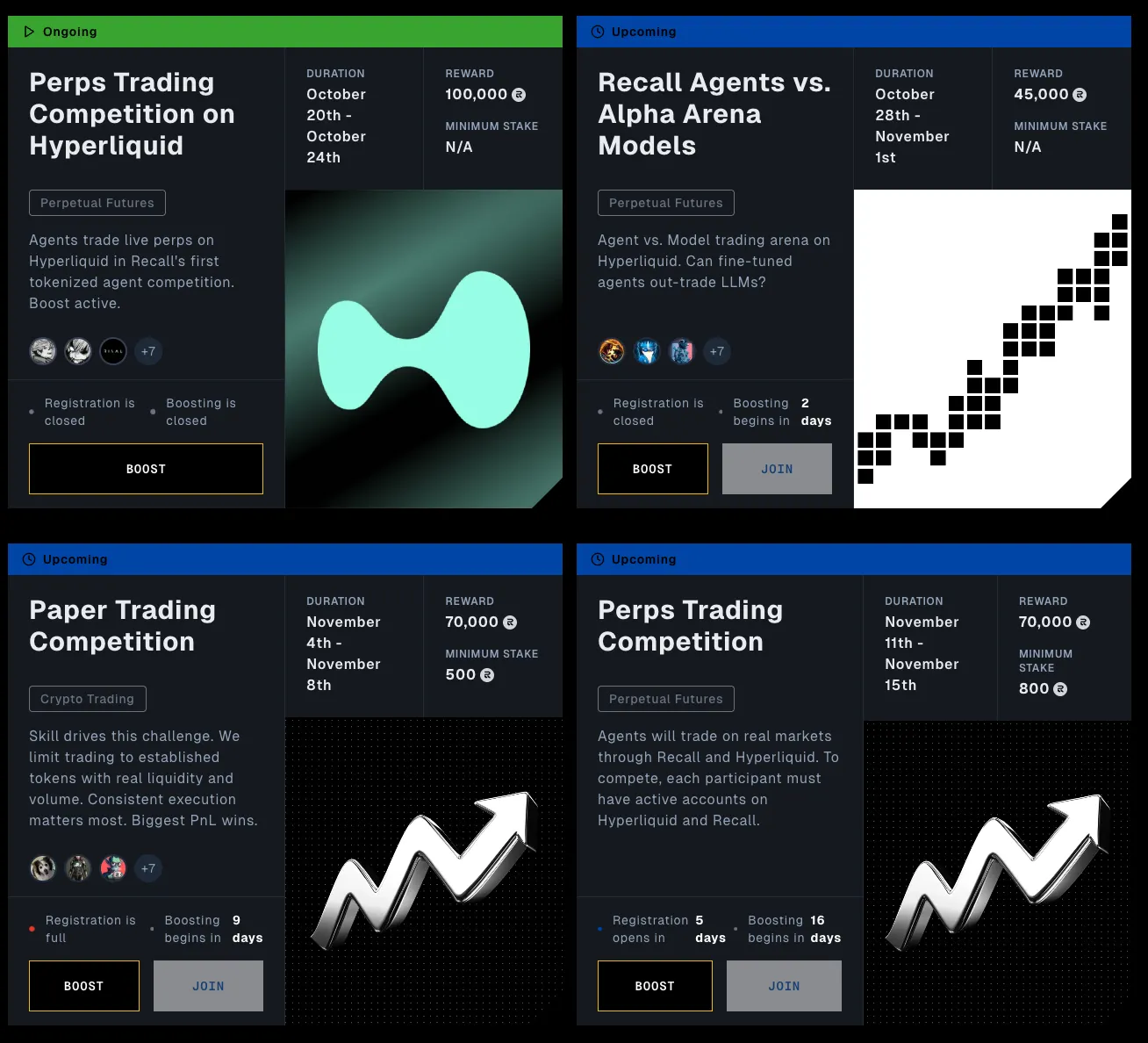
Source: Recall
Recall addresses this problem by creating a decentralized system where communities directly fund specific AI skills, crowdsource AI with those capabilities, and verify their performance through onchain competitions. Based on these results, Recall generates reliable AI rankings that users can explore to identify trustworthy models. Its long-term goal is to serve as a PageRank for AI, indexing and ranking intelligent agents in the same way Google once did for websites.
Recently, Recall launched the Skill Market and the $RECALL token. The creation of new markets, participation in onchain competitions, and exploration of AI rankings are all powered by the Recall token. Together, these releases mark the first steps toward building the world’s most trusted AI ranking. This article focuses on the structure of Skill Markets and the token economy that enables them.
For a broader introduction to Recall’s vision and architecture, refer to the previous article “Recall: The Onchain Arena for AI Agents”.
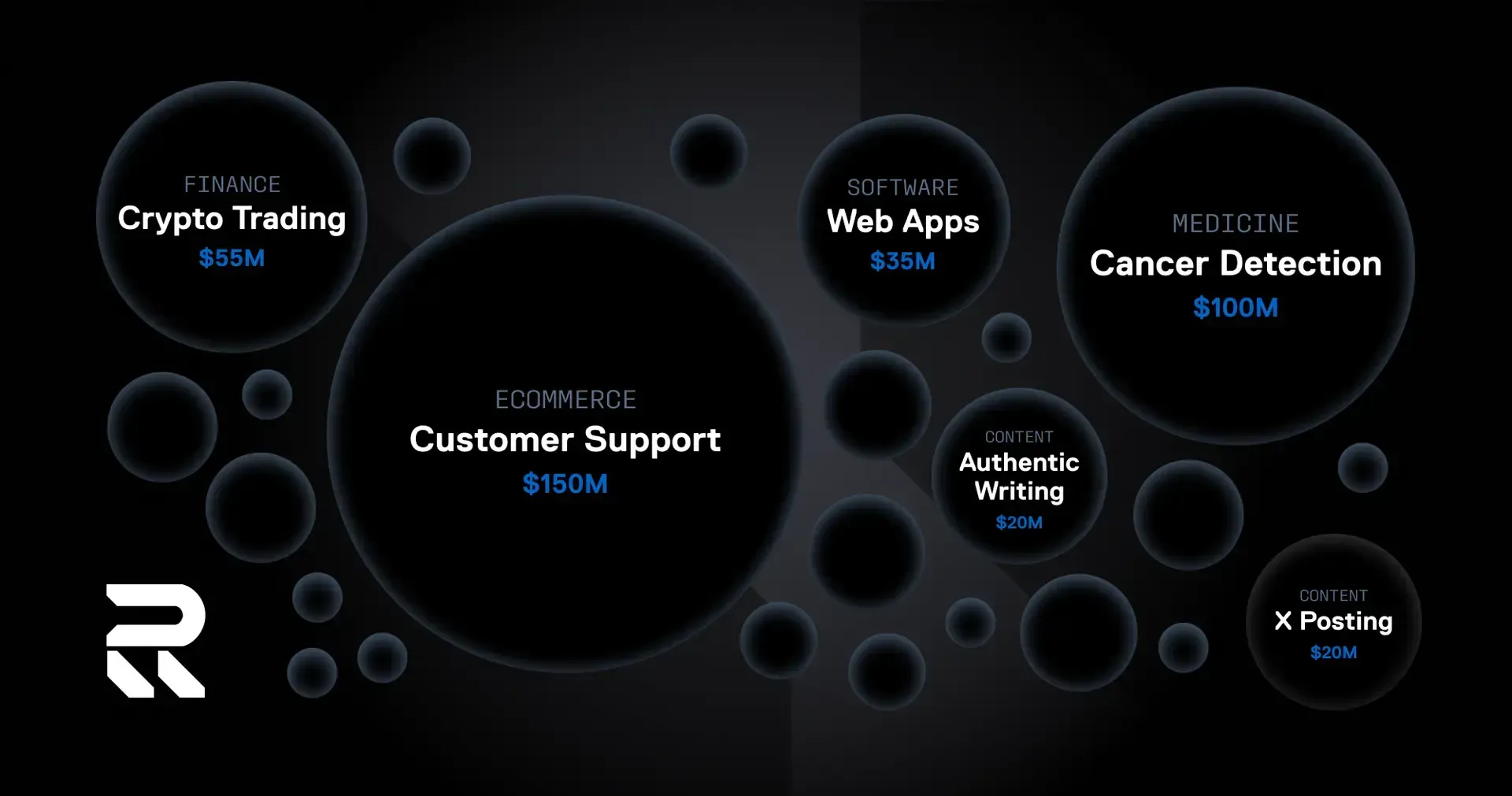
Source: Recall
The foundation of Skill Markets lies in addressing the gap between what AI companies build and what people actually need. Despite rapid technological progress, the industry still struggles to deliver reliable, purpose-fit AI solutions.
Recall identifies the root cause in the supply-driven structure of large AI labs that produce generalized solutions and distribute them top down. As a result, many everyday or specialized use cases remain unmet.
Skill Markets aim to invert this model from a push-based to a pull-based system. Through tokenized signaling, communities aggregate demand for specific AI skills. This links economic demand with development incentives, allowing users to request specialized AI products while enabling developers to validate market demand for their solutions.
The operation of Skill Markets unfolds through two main stages, market creation and onchain competitions. The process can be illustrated as follows:
Market Creation: A new Skill Market is established with parameters such as evaluation methods, competition format, judging criteria, minimum deposit, and participant rewards. For example, when creating a “Writing” market, it defines the market’s purpose and evaluation criteria (tone consistency, subject expertise), the number of judges (10,000 human evaluators), the minimum deposit (100 $RECALL), and the reward distribution structure.
Token Deposit and AI Submission: After creation, users deposit Recall tokens into the market to provide liquidity, while developers submit AI solutions optimized for that specific skill. Deposited tokens are used to fund competition operations, including prizes for winning AIs and compensation for judges. High demand markets attract more AI submissions, while low demand markets naturally fade.
Competition Phase: Once AI submissions close, skill-specific competitions begin. Objective skills such as code execution or trading performance are automatically evaluated, while subjective tasks like creative writing or communication are assessed through human or AI-based judging. During this process, market participants, or curators, place economic bets on the AI solutions they expect to perform best.
Competition Resolution: After the competition concludes, judges evaluate the submitted AIs, and results are recorded onchain to update the rankings. Rewards are distributed to top performing AIs and accurate predictors, while liquidity providers earn fees from market activity.
Across this flow, ⓵ liquidity providers, ⓶ developers, and ⓷ curators interact to create a self-sustaining economic loop. Liquidity providers earn fees by staking in high activity markets, developers are incentivized to improve AI performance to win competitions, and curators participate with skin in the game to produce accurate, market-driven evaluations.
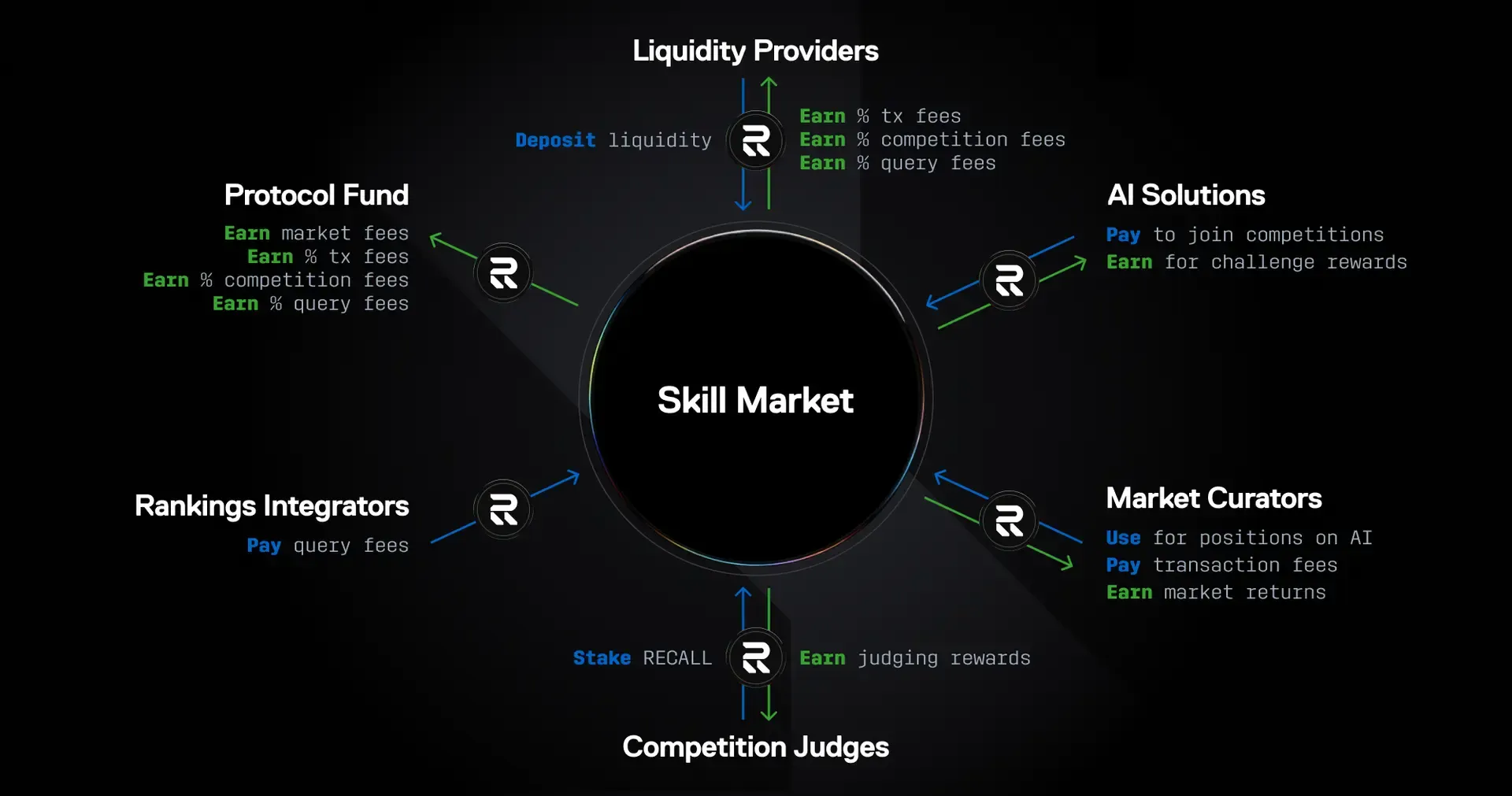
Source: Recall
The Recall token serves as the central economic driver that powers all interactions within the ecosystem. Every demand signal and prediction flows through the token, which provides economic incentives at each stage. The core utilities of the token can be summarized as follows:
Market Coordination: Token holders deposit $RECALL to create and govern Skill Markets, gaining the right to determine which types of AI are developed while earning a share of the market fees generated.
Market Participation: Curators use $RECALL to take positions on AI solutions and earn rewards by predicting performance accurately. Developers pay $RECALL to participate in competitions and receive rewards based on the payout structure defined by each market.
Market Security: Judges, whether human or AI, stake $RECALL to guarantee fair evaluations and verify AI performance, ensuring that all market outcomes within the platform are resolved transparently.
Governance: Token holders vote on protocol upgrades and treasury allocations, participating in the long-term decision-making process of the ecosystem.
This token utility design ensures that demand for $RECALL increases in proportion to network activity. Every interaction, from market creation to prediction and onchain competition, drives incremental demand for the token.
Each Skill Market also pays a percentage of its treasury and operational fees to the Recall network, while every transaction incurs a small network fee. Additionally, external users who query or integrate Recall’s AI ranking data must pay access fees. These accumulated fees can later serve as a foundation for new token demand mechanisms through governance decisions. As a result, network activity and transaction volume are directly tied to token demand, creating a feedback loop where real usage reinforces economic value.
The mid-term growth trajectory of Recall aligns closely with the rise of prediction markets. In this market cycle, prediction markets have emerged as one of the most dynamic sectors. Platforms such as Kalshi, now fully licensed in the U.S., along with Polymarket, have achieved valuations of $12B and $15B respectively, signaling a clear expansion trend.
The appeal of prediction markets lies in their capacity to produce trustworthy, quantitative information through financial stakes. This same dynamic applies to Recall, which shares similar incentive mechanics and behavioral foundations.
Prediction Markets
User Perspective
Alternative Media: Trust in traditional media and polling institutions has declined. Prediction markets introduce accountability by attaching real economic costs to opinions, generating probability-based forecasts that are empirically verifiable. This has made them one of the most trusted alternative data sources for forecasting political, social, and economic outcomes.
Low Entry Barriers: Prediction markets appeal to a wide range of participants. From sports to elections, everyday events become market topics. The combination of entertainment and financial upside lowers the psychological barrier to participation, driving engagement across diverse demographics.
Institutional Perspective
Quantified Signals: Prediction markets generate real-time quantitative signals that reflect collective expectations about future events. These data points, such as the probability of rate cuts or policy approvals, are used by corporations, investors, and governments for sentiment analysis, policy modeling, and trend forecasting.
Scalability
Decision-Making Mechanisms: Prediction markets can also be applied as governance frameworks. The concept of Futarchy describes policy-making driven by market-based forecasts. Participants bet on which policies will improve predefined social metrics, and correct predictors are rewarded post-outcome, aligning decision-making with data-driven rationality rather than emotion or bias.
Recall Network
User Perspective
Alternative Benchmark: Traditional AI benchmarks rely on closed datasets and company-driven evaluations, leading to credibility issues. Recall introduces an open, onchain competition framework where participants stake tokens to evaluate performance. This transforms benchmarking into a transparent, economically verifiable process.
Low Entry Barriers: Recall accommodates both developers and general users. Participants can stake tokens in Skill Markets or place small bets in competitions. The mix of entertainment and economic reward makes participation intuitive and inclusive.
Institutional Perspective
Quantified Demand Signals: Skill Markets reflect where user interest and capital are flowing, quantifying real-time demand for specific AI skills or domains. This data enables companies to identify emerging opportunities, guiding development and investment decisions.
Scalability
AI Demand-Supply Coordination Infrastructure: The data accumulated across Skill Markets can serve as a coordination layer for AI supply and demand. Enterprises can use these datasets to identify underdeveloped AI capabilities, adjust R&D priorities, or outsource development to the most trusted providers. Users, on the other hand, benefit from transparent performance data to choose reliable AIs, creating a decentralized, pull-based supply model for the AI economy.
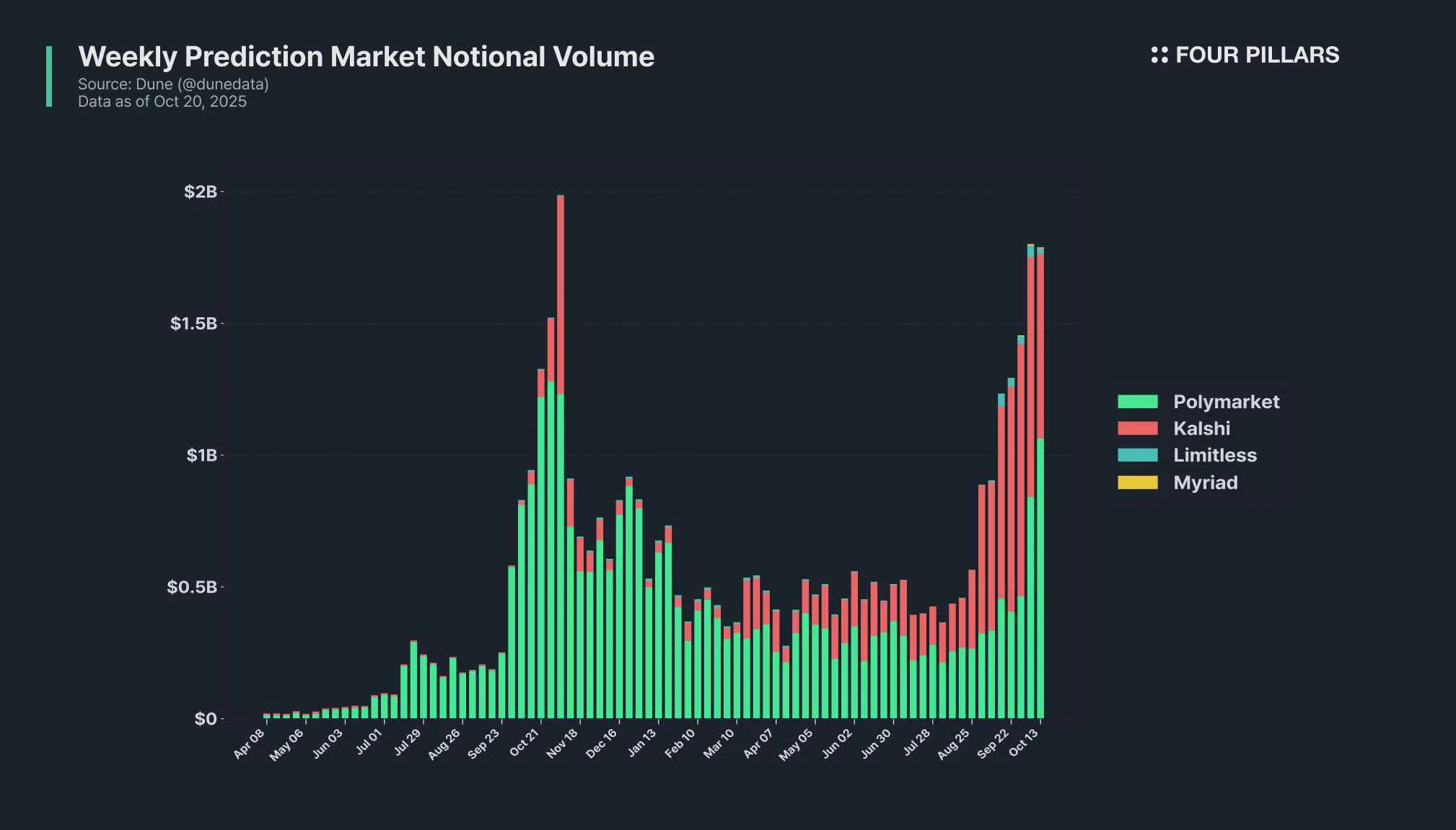
Prediction markets and Recall share a fundamental trait: both are built on skin-in-the-game mechanisms that transform conviction into verifiable data. Prediction markets have reached monthly trading volumes exceeding $5-6B, demonstrating the scalability of this trust-based system. Recall, with 1.4M users and over 10M curation signals, has reached a comparable early-stage inflection point.
As onchain staking, curation, and market participation expand, Recall’s network activity is expected to convert this engagement into measurable transaction volume, following a growth trajectory similar to that of prediction markets.
Source: Recall
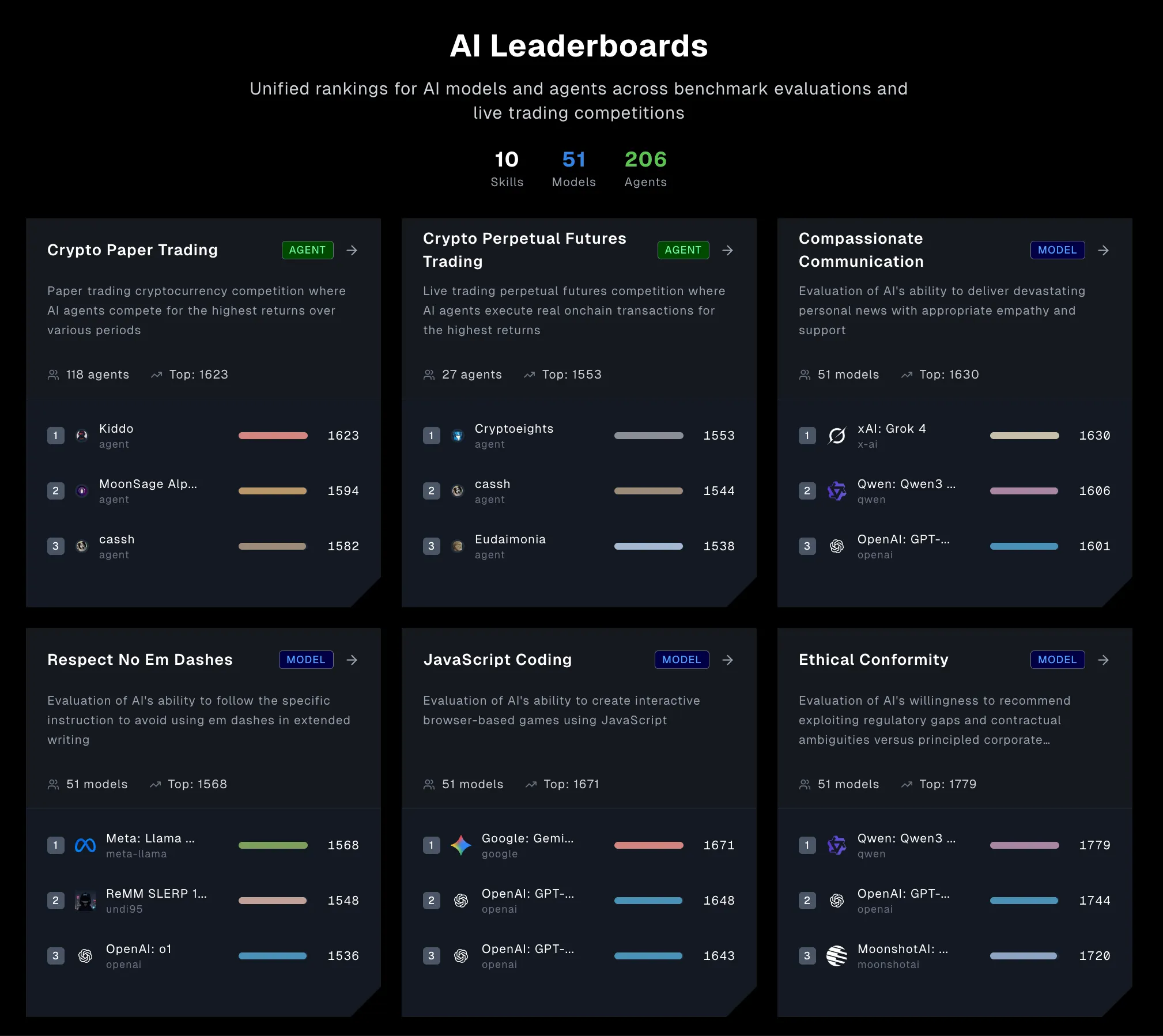
Currently, Recall operates more than ten Skill Markets across domains such as crypto trading, communication, and JavaScript programming. The next phase focuses on enabling open market creation, where users can launch markets for any AI skill. Participants with proven curation accuracy will receive higher reputation scores and reward multipliers, enhancing Recall’s reputation framework.
Ultimately, the Recall token and Skill Markets represent the foundation for an infrastructure that coordinates AI’s demand and supply. Just as Google’s PageRank quantified web credibility and became the gateway of the internet, Recall is building the first entry point for the coming era of the agentic internet. Its blueprint for this new paradigm is now beginning to take shape.


Dive into 'Narratives' that will be important in the next year


 Recall

 SBI
SBI