*[ASA News] is a bi-weekly newsletter where we share the most important news related to stablecoin in Asia. (2025..01.19~02.01)

Source: Etherfuse and Shinhan Securities Form Strategic Partnership to Expand Tokenized Sovereign Debt Access Across Asia
Etherfuse, a tokenized sovereign debt infrastructure company, has entered into a strategic partnership with Shinhan Securities, one of Asia's leading securities firms. The collaboration aims to support the expansion and institutional distribution of tokenized sovereign debt across Asia, coming amid growing institutional interest in applying high-performance blockchain infrastructure, including Monad, Solana, and Stellar, to established government bond markets. Sovereign bonds remain a core component of Asian capital markets, serving as key instruments for long-term allocation, liquidity management, and capital preservation. Financial institutions are increasingly focused on digital systems that improve access, settlement, and transparency without altering the economic foundations of these instruments.
The partnership focuses on facilitating institutional access to sovereign debt represented onchain. Through Etherfuse's Stablebond framework, government bonds can be accessed in tokenized form while maintaining predictable interest mechanics, verifiable backing, and alignment with regulatory and market standards across Asian jurisdictions. Shinhan Securities will serve not as an issuer or distributor of Stablebonds, but rather in a brokerage and real asset acquisition and management support role, enabling Etherfuse to smoothly acquire and stably operate Korean government bonds.
David Taylor, CEO of Etherfuse, stated: "Asia represents one of the most important regions for the future of digital finance. Partnering with Shinhan Securities allows us to extend tokenized sovereign debt in a way that aligns with institutional expectations and existing market structures." Jeseok Hong of Shinhan Securities added: "This collaboration demonstrates how trusted traditional financial infrastructure can work with blockchain to broaden efficient cross-border access to Korean government bonds. We are committed to supporting global partners like Etherfuse as they scale institutional-grade digital finance across Asia, while helping establish a transparent and compliant framework for on-chain issuance and distribution.”
1.2.1 Suhyeon Jeong (ASA Contributor, Shinhan Securities) – Access first, utility second, and operations as the real differentiator
The key takeaway from the Etherfuse–Shinhan Securities collaboration is that it sketches a practical route for USD onchain liquidity to gain exposure to KRW-denominated Korean Treasury Bonds (KTBs). Compared to the traditional path, FX conversion, account opening, and broker-driven onboarding, an onchain distribution model is ultimately trying to compress the access layer.
There is also a recurring skepticism around whether tokenizing KTBs has “real utility.” But that question applies to most jurisdictions outside the U.S, the more relevant question is which use cases can be built to create utility over time, rather than whether it exists on day one.
What remains to be seen is execution. Verifiable reserves, predictable redemption and settlement flows, and clearly defined accountability across the offchain infrastructure and the onchain layer will be the main determinants of trust and scalability.
This comment is for information purposes only; not an investment advice.
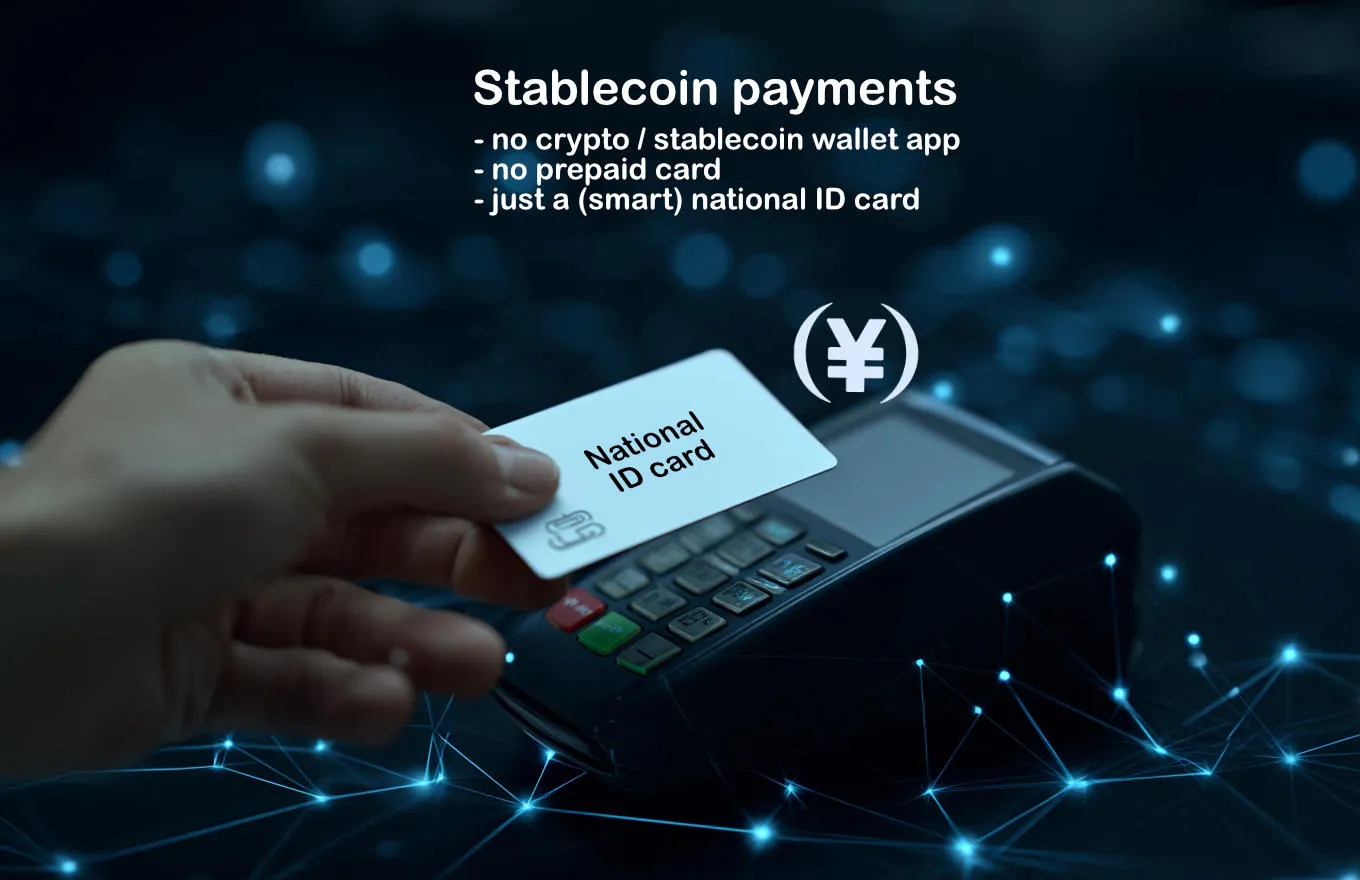
Source: Japan Launches My Number Card-Based Stablecoin Payment Pilot
Sumitomo Mitsui Card (SMBC Card) and MynaWallet are launching a proof-of-concept program for stablecoin payments using Japan's My Number national ID card. The program aims to use the My Number Card as a "wallet" to enable yen-linked stablecoin tap payments on SMBC Card's stera terminals. The first pilot will be conducted on January 23-24 at Rising Zephyr Fukuoka's home basketball arena, with cooperation from Fukuoka City.
In the experiment, users register with their My Number Card and receive JPYC (a yen-linked stablecoin), then make payments by tapping their card on stera terminals at venue shops. Behind the scenes, stablecoin balance transfers occur on the blockchain. MynaWallet aims to achieve both high security and convenience in identity verification by leveraging the Public Key Infrastructure for Personal Identification (JPKI), while SMBC Card provides extensive cashless payment infrastructure to merchants nationwide, including small and medium-sized businesses, through its stera platform.
The two companies have designed this pilot not as a one-off experiment but as a continuous program expanding across regions and use cases. Future plans include deployment at sports and entertainment events, commercial facilities, tourist attractions, and public facilities, as well as expansion into digital local currencies in collaboration with local governments, subsidy distribution, and administrative fee and utility bill payments. In the medium to long term, they also plan to build an inbound payment system allowing foreign tourists to use their stablecoins (e.g., USDC) at physical stores in Japan via stera terminals.
2.2.1 Moyed (ASA Contributor, Delta Network) – 'National ID × Stablecoin': Japan's Vision for Financially Inclusive Payment Infrastructure
The core of this pilot lies in designing a stablecoin payment experience that "anyone can easily use." Currently, the biggest barriers to stablecoin adoption are technical hurdles like wallet installation, seed phrase management, and understanding gas fees. MynaWallet bypasses these by leveraging an already-deployed infrastructure: the national ID card (My Number Card). A payment experience completed with just a card tap, no separate app installation or complex onboarding, can include elderly users and those with low technical familiarity.
For JPYC, this partnership is an extension of its strategy to "expand real-world utility." Since its FSA registration in November 2024, JPYC has rapidly secured diverse use cases including healthcare app rewards, direct agricultural product sales, and DeFi lending products. The integration with SMBC Card's stera terminals represents entry into the massive offline merchant market beyond online applications. Notably, stera is an open platform supporting various payment methods including credit cards, electronic money, and QR codes, opening a pathway for JPYC to be incorporated into existing payment infrastructure.
What's particularly noteworthy is that this experiment has inbound payments in mind. If foreign tourists can use their USDC at offline stores in Japan, stablecoins will function as an integrated currency exchange and payment solution. This reads as a move to position Japan as a "global testbed" for stablecoin payments, beyond a mere domestic payment experiment. While Korea remains mired in debates over KRW stablecoin issuance rights, Japan is already moving to the next stage: securing use cases and global connectivity.

Source: Japan's finance minister backs exchanges as gateway for digital assets
Hashed Open Finance, a subsidiary of crypto venture capital firm Hashed, has released a litepaper for Maroo, a Layer 1 blockchain tailored to the Korean won (KRW) economy. Maroo positions itself as a "sovereign blockchain" combining the openness of public blockchains with compliance features essential for financial applications, auditability and privacy protection. Transaction fees are designed to be paid in KRW stablecoins (OKRW) to facilitate user onboarding and mitigate volatility risk.
Maroo's key feature is its "dual track" system. It separates at the network level an "open path" allowing unrestricted wallet creation and transactions, and a "regulated path" that imposes identity verification or limits based on transaction size. The Programmable Compliance Layer (PCL) automatically verifies transfer limits, sanctions lists, and other requirements at the transaction level, with the ability to update as regulations change.
According to the litepaper, all Maroo validators must be located within Korea, and only users who complete KYC/KYB/KYA (Know Your Agent) can access the regulated path. Features for verifying AI agent identity, ownership, and permission scope, as well as managing spending limits and policy-based approvals, are also included. Simon Kim, CEO of Hashed, stated: "Stablecoins are emerging as a key pillar of financial infrastructure in the global market. We hope Maroo will serve as a foundation for banks, financial institutions, and fintech companies to explore next-generation financial services together."
3.2.1 Heechang (Strategy Lead, Four Pillars) – Korea's Stablecoin Chain Is Coming, and Asia Needs This.
I am fundamentally optimistic about public blockchains. Most meaningful innovation and collaboration will, and should, happen in open manner.
That said, regulators, governments, and financial institutions do not simply “arrive” on public chains. They operate under strict internal rules, minimum operational requirements, and risk frameworks that sometimes demand capabilities such as transaction reversibility in the event of a critical failure or exploit.
This gap is particularly big in Korea and across East Asia. Since many foundational crypto projects were developed outside the region, public-sector and regulated financial institutions have struggled to engage deeply with them. The challenge is not technological sophistication, but institutional alignment: answering how public blockchains function, how risks are managed, and how compliance can be enforced in a way regulators can trust.
In that context, chains like Maroo can play a crucial intermediary role. They offer a middle ground where institutions and legislators can experiment, learn, and observe the tangible benefits of crypto infrastructure in an environment that speaks their language. If successful, these systems can later interoperate with public blockchains, rather than compete with them.
This section is provided by rwa.xyz. To receive the latest stablecoin and RWA news, join RWA.xyz Newswire.
UAE's first licensed dirham stablecoin (AE Coin) integrated into national payment system for merchant acceptance
Issuers required to maintain AED 15 million minimum capital, monthly audits, and full reserve backing
Banks can participate as issuers, custodians, or conversion service providers; interest payments prohibited
4.1.2 Bermuda Partners with Coinbase and Circle to Build National Onchain Economy
Government agency stablecoin payment pilot planned, promoting USDC adoption among local businesses
Digital wallet distribution aimed at reducing transaction costs and improving financial access for residents and businesses
Based on 2018 Digital Asset Business Act; non-exclusive partnerships allow integration of other firms and technologies
4.1.3 Six Major Korean Financial Groups Push to Establish KRW Stablecoin Issuing SPV
Six financial groups including Hana Financial and Standard Chartered Korea in discussions to establish stablecoin issuing SPC
Government targets lifting token issuance ban next month; central bank opposes big tech participation
Separate Kakao-led consortium also forming, creating competition between banking and tech sectors for stablecoin dominance
4.2.1 NYSE Announces 24/7 Tokenized Share Trading Platform with Stablecoin Funding Support
Platform to feature onchain trading, instant settlement, and stablecoin-based funding capabilities
Supports both natively issued digital securities and tokenized traditional shares with full dividend and governance rights
Combines NYSE Pillar matching engine with blockchain-based post-trade systems supporting multi-chain settlement and custody
4.2.2 Gusto and Zerohash Launch Stablecoin-Based Payroll Pilot for International Contractors
Aims to reduce cross-border settlement times from days to minutes using regulated stablecoin infrastructure
Addresses growing demand as 33% of US small businesses outsource roles and 11% employed international contractors in 2025
Offers contractors custodial and self-custodied digital wallet options for USD payments
Integrates M-Pesa's existing mobile money infrastructure with ADI Chain blockchain for low-cost cross-border payments
Includes First Abu Dhabi Bank's planned dirham-backed stablecoin issuance under UAE Central Bank supervision
Maintains familiar mobile money interface; no blockchain technical knowledge required from users
4.3.1 Gulf Energy Exchange Launches Oil-Backed Stablecoin OIL1
Dual-pegged to both USD and Gulf crude oil, combining $2.4T oil market with $260B stablecoin market
Built on Circle's Arc blockchain with Microsoft cloud infrastructure; pending Bahrain Central Bank approval
Enables 24/7 trading, fractional ownership, and programmable instant settlement of oil-backed assets
Offers Argentine peso (wARS), Brazilian real (wBRL), and Mexican peso (wMXN) stablecoins on Ethereum, Base, and World Chain
Targeting $100M in assets under management by year-end; initial volume reached $200K in December 2025
Plans DeFi lending products to reduce forex risks for Latin American borrowers earning in local currencies
4.3.3 Flutterwave Partners with Turnkey to Launch Stablecoin Wallets Across Africa
Integration will enable USDC and USDT balance support alongside existing fiat currencies for KYC-completed customers
Secure embedded wallet infrastructure aims for low-cost, fast, 24/7 cross-border payments
Currently testing with select merchants before wider rollout; marks significant step toward making stablecoins core to Africa's financial ecosystem
4.3.4 LINE NEXT Partners with JPYC to Integrate Yen Stablecoin into Its Services
JPYC stablecoin to be integrated into LINE NEXT's stablecoin wallet, accessible through LINE Messenger
Partnership focuses on developing payment capabilities and reward distribution mechanisms for Japanese users
Joint JPYC-based reward programs and campaigns planned to drive mainstream adoption


Dive into 'Narratives' that will be important in the next year


 QFEX
QFEX