In decentralized networks, the true role of a token is to function as a design tool that creates real usage flows, aligns incentives among participants, and encodes a shared long-term vision. Viewed through this lens, the recent discussions around the introduction of staking within the SSV Network represent less a feature upgrade and more an attempt to redefine the economic role of the $SSV token within the broader Ethereum ecosystem.
Source: SSV Network Docs
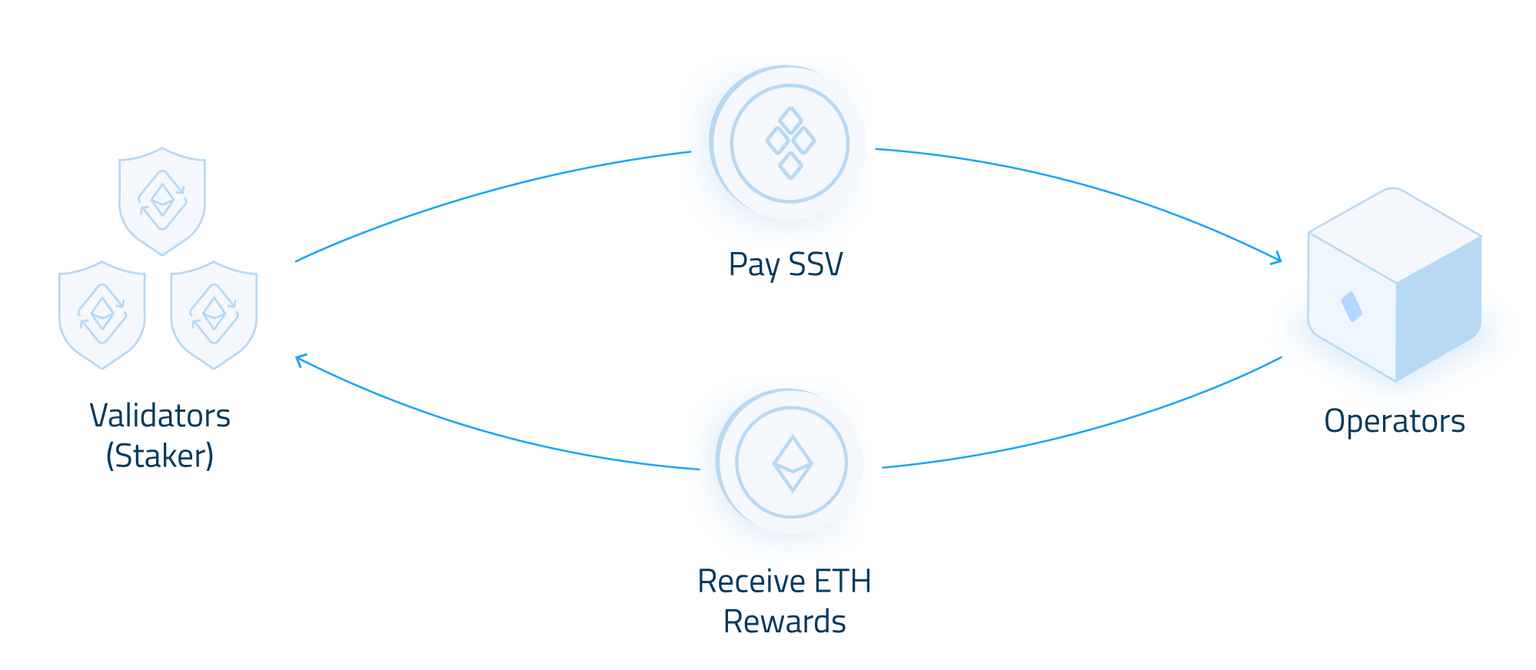
Historically, SSV’s economic structure was relatively straightforward. Validators using SSV paid operators an Operating Fee, denominated in $SSV, while approximately 1% of validator rewards were collected as a Network Fee and routed to the protocol itself. A portion of these fees flowed into the DAO treasury, where they could be used to adjust and maintain the network’s tokenomics over time.
However, this structure also introduced a degree of friction. From the perspective of Ethereum validators—who think, account, and manage risk almost exclusively in ETH—denominating core costs and revenues in a separate token created both accounting and psychological dissonance. More importantly, it meant that SSV’s economic layer was not fully aligned with its identity as infrastructure designed to strengthen Ethereum’s security.
The core objective of the proposed SSV Staking mechanism is to resolve this misalignment. By switching validator Network Fees from $SSV to $ETH, the protocol improves fee predictability while clearly anchoring incentives to Ethereum’s native unit of account. At the same time, the introduction of a dedicated SSV staking contract establishes a more robust operational deposit structure for operators, while giving token holders a direct and transparent claim on network-level revenues.
This shift is particularly timely in light of Ethereum’s post-Pectra changes. With the maximum amount of ETH that can be bonded to a single node increasing to 2,048 ETH, fees are no longer meaningfully measured by validator count alone. Instead, they increasingly reflect the actual amount of ETH secured and operated, underscoring that SSV’s proposed changes are not arbitrary, but closely aligned with Ethereum’s evolving validator architecture.
For SSV holders, the value proposition becomes materially clearer. By staking SSV, users receive a 1:1 wrapped representation—cSSV (Composable SSV)—while ETH fees generated by the network accrue continuously based on the proportion of SSV staked. Rewards can be claimed without unstaking, and because cSSV is an ERC-20 compliant liquid token, it can be freely deployed across a wide range of DeFi strategies.
As a result, a concrete usage loop emerges: “Stake SSV → Earn ETH → Use cSSV across DeFi.” Through this flow, SSV transitions from a static governance or fee token into an asset that captures ETH-denominated cash flows, directly tied to network usage and growth.
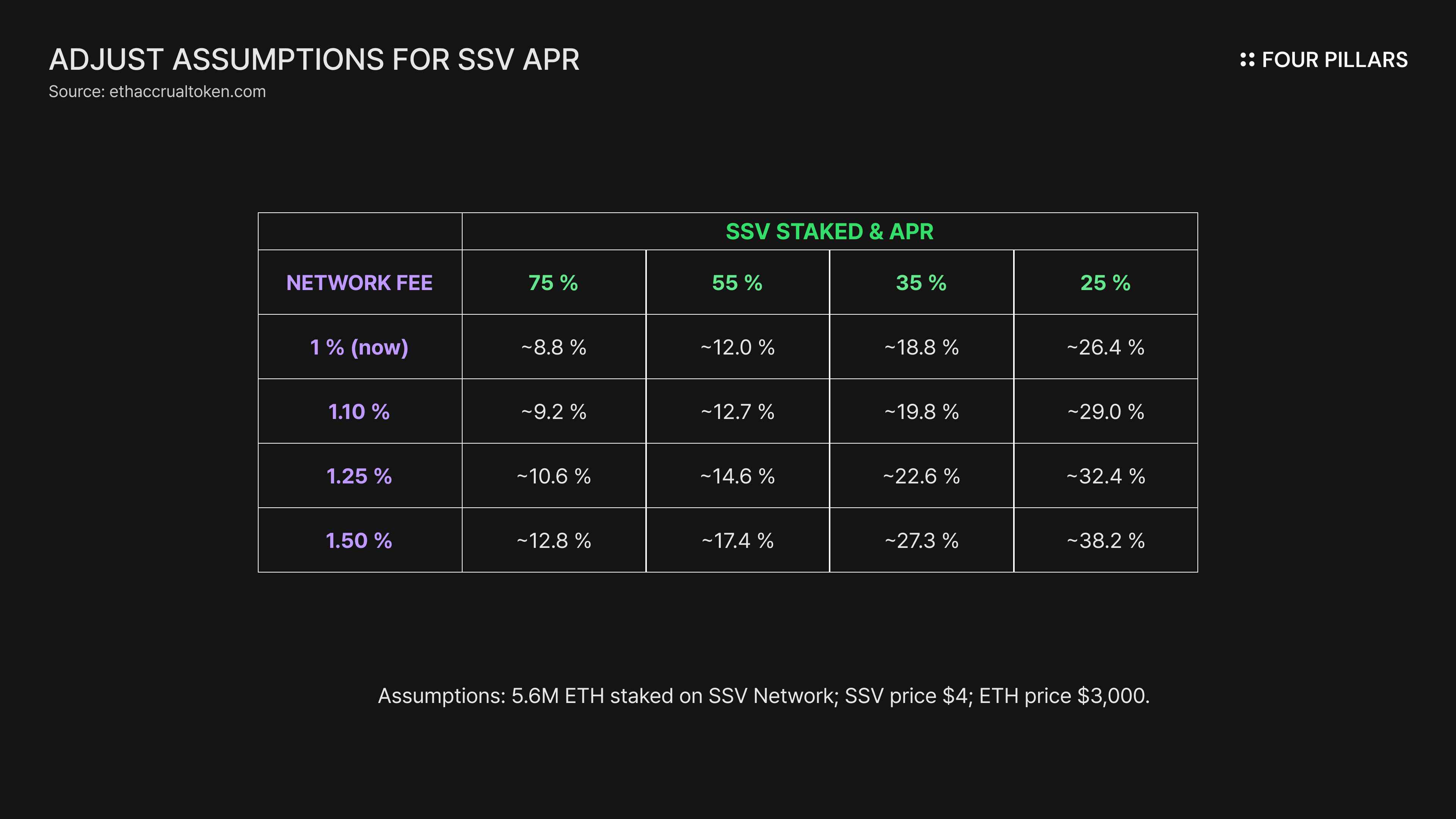
Ultimately, SSV is positioning itself not merely as an external, decentralized component that supplements Ethereum’s security, but as a network-level economic layer—one that aligns validators, operators, and token holders around ETH-based incentives.
As the March mainnet rollout of staking approaches, SSV token governance will become increasingly important in coordinating stakeholder incentives through parameters like Network Fees, marking a step toward SSV’s evolution from security middleware to a sustainable extension of Ethereum’s infrastructure.


