
One of the blockchains representing the Cosmos ecosystem, Noble, announced today (January 21, 2026) that it will migrate its infrastructure from the existing Cosmos-based stack to the Commonware stack.
In fact, this is not the first time a payment-focused chain has adopted the Commonware stack. More precisely, the moment Commonware began gaining widespread attention in the industry was when it became known that Tempo, a Layer 1 blockchain closely watched by many, was building its chain on top of Commonware.
Today, the names making headlines are Tempo and Noble. But as time goes on, it would not be surprising to see more chains either launch directly on Commonware or, like Noble, migrate their existing infrastructure to it. This naturally raises the question: why Commonware? What is it about Commonware that makes it fundamentally different from existing infrastructure stacks?
That question is becoming increasingly difficult to ignore.
First and foremost, Commonware’s biggest point of differentiation starts from its design philosophy.
Up until now, most blockchain infrastructures have been built as frameworks—providing developers with tools that are only customizable within a predefined set of rules. These frameworks undeniably made it easier for developers to build blockchains in the first place. However, when it comes to designing a blockchain for a specific purpose, this approach has revealed clear limitations.
The core issue is that, when developers try to build the infrastructure they actually want, unnecessary components inevitably come bundled along with it. If you attempt to customize your own chain using an existing blockchain framework, you often end up tearing apart far more of the system than intended, or encountering unexpected bugs along the way. This is what many call the curse of frameworks.
Once a framework is heavily modified to fit bespoke needs, updating the SDK later becomes extremely difficult. This was not a theoretical concern—it was a recurring, real-world problem observed across certain ecosystems. In the end, you get a system that is easy to build quickly, but increasingly hard to maintain over time.
But what if, instead of having networking, consensus, execution, storage, runtime, and the mempool bundled into a single, opinionated package, each of these components could be independently selected and tuned based on the chain’s purpose?
If that were possible, we would be able to experience infrastructure where everything—from core functionality to performance characteristics—is aligned with the chain’s intended use case. In that sense, one could argue that many of the so-called “purpose-built blockchains” we have seen so far may have only been half measures.
This is precisely where Commonware takes a fundamentally different approach.
Instead of treating the blockchain as a single monolithic framework, Commonware breaks it down into “primitives,” much like LEGO blocks. Today, these primitives are broadly categorized into seven types: P2P, Networking, Consensus, Execution, Storage, Runtime, and Mempool. Developers are free to select and combine whichever primitives they want, and Commonware does not force any particular configuration.
What makes this even more interesting is that this flexibility does not end at deployment. Even while a chain is live and operating, individual primitives can be modified or replaced. This reframes blockchains not as rigid, irreversible structures, but as systems that can continuously evolve and adapt over time.
Of course, Commonware’s strengths are not limited to modularity alone.
Its potential for performance is also worth paying close attention to. Recently, Commonware’s founder, Patrick O’Grady, introduced a protocol called Minimmit. Minimmit is likely to become a core consensus algorithm within the Commonware stack. According to the published paper, it targets block times of roughly 300 milliseconds, while simultaneously strengthening guarantees around block finality. Rather than pursuing speed at the expense of safety, the protocol presents a notably advanced methodology that attempts to optimize both.
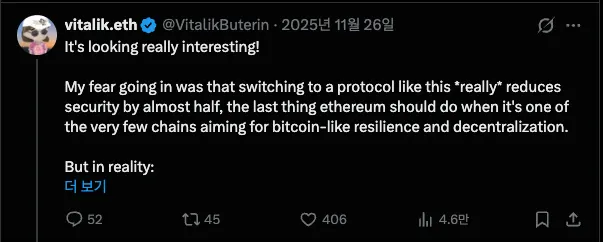
source: Vitalik’s Tweet
Even Vitalik Buterin, the founder of Ethereum, reportedly gave a positive assessment after reviewing the Minimmit paper—an encouraging signal that this is more than just an abstract academic exercise.
That said, there are currently no blockchains built on Commonware that are live in production. As a result, how this technology will perform under real-world conditions remains an open question. Still, from the perspective of infrastructure design philosophy and protocol architecture, this represents one of the most interesting new approaches introduced since consensus innovations like Mysticeti.
At the very least, for anyone genuinely interested in the future of blockchain infrastructure—and in what “true” purpose-built chains might actually look like—Commonware appears to be a project well worth following closely going forward.