Lido's Curated Module (CM) is the core module responsible for roughly 92% of all stETH staking volume. However, the limitations of its original design are becoming increasingly apparent: a rigid fee structure, inflexible stake allocation, and an accountability framework that relies solely on reputation.
The 0x02 validator type (EIP-7251) introduced in Ethereum's Pectra upgrade raised the maximum effective balance per validator from 32 ETH to 2,048 ETH. This shift demands an architecture-level redesign for large-scale staking protocols like Lido.
CMv2 aims to transform the Curated Module from a "managed registry" into a "Validator Marketplace" through the introduction of bond-based economic accountability, a seven-category node operator classification system, streamlined governance, and native 0x02 support.
The full migration is expected to take approximately 4.5 to 6 months and will incur an estimated protocol-level reward loss of around 738.5 ETH. This will be the largest infrastructure transition in Lido's history.
Lido is a liquid staking protocol that distributes user-deposited ETH across node operators (entities that run validation infrastructure) to participate in Ethereum's consensus, earning staking rewards in return. Users deposit ETH and receive stETH, which can be freely used across the DeFi ecosystem. 90% of staking rewards go to stETH holders, while the remaining 10% is split as protocol fees between node operators and the Lido DAO treasury.
At the center of this entire structure sits the Curated Module. It was the first staking module Lido ever built, previously known as the Node Operators Registry. True to its name ("curated" meaning "carefully selected"), participation requires passing Lido DAO's governance review process. Only professional staking organizations and Ethereum client teams that meet criteria across business continuity, security practices, infrastructure configuration, software stack diversity, and geographic distribution are granted eligibility.
Within the module, stake is allocated using a "bottom-up" approach. New deposits are prioritized toward the node operator with the fewest active signing keys. Over time, this naturally results in an even distribution of stake across operators. Withdrawals work in the opposite direction with a "top-down" approach, processed sequentially starting from the operator with the most keys.
Source: Lido
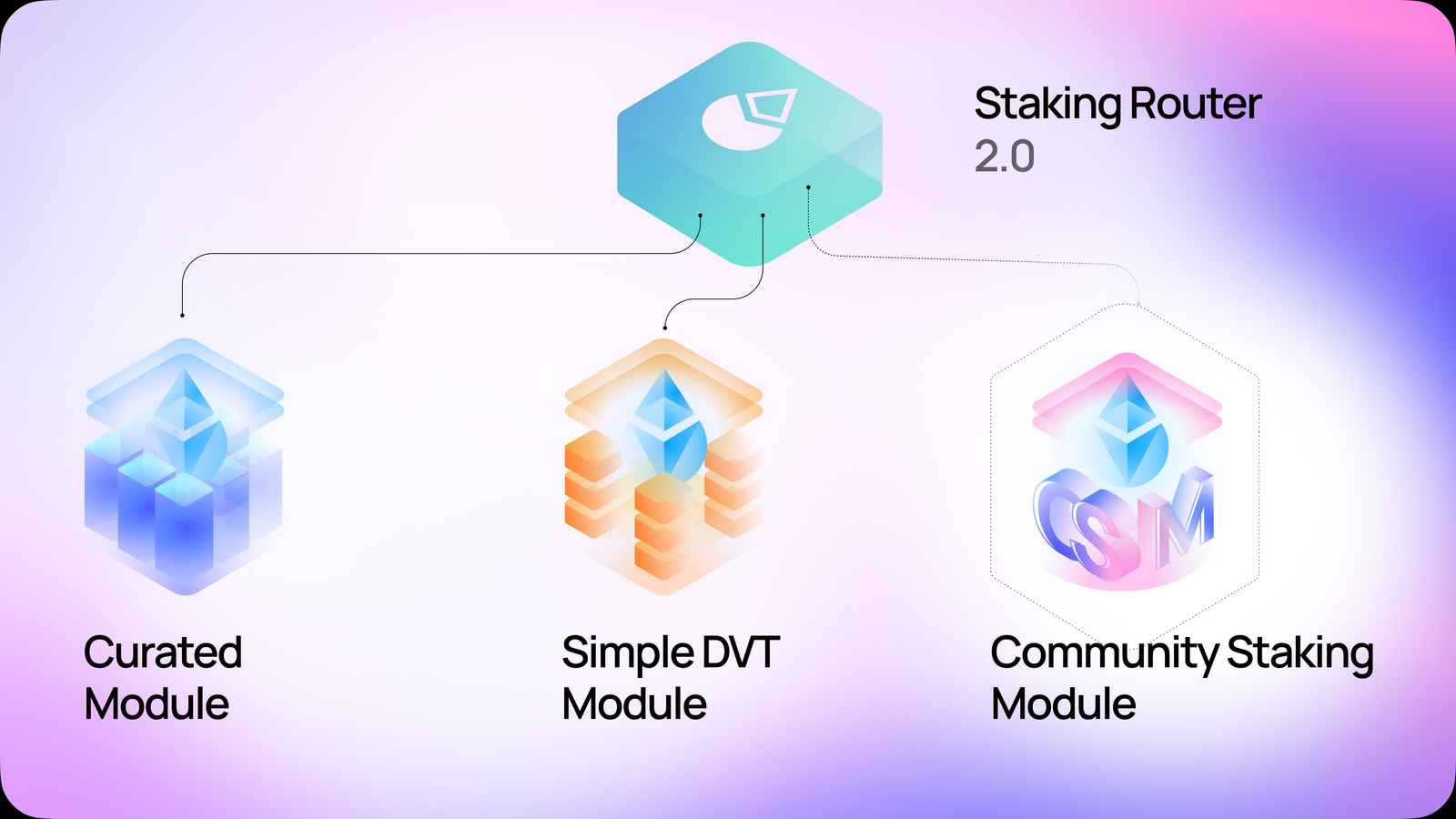
Beyond the Curated Module, Lido currently operates two additional modules. The Community Staking Module (CSM) is a permissionless module where community participants such as solo stakers can join by posting a bond. The Simple DVT Module (SDVTM) is a cluster-based module leveraging Distributed Validator Technology (DVT). These modules are connected through a higher-level structure called the Staking Router, which automatically distributes new deposits according to each module's remaining capacity and share limits.
A critical point here is that the Curated Module is the only module with no share cap. When the other modules have no remaining room for allocation, the Curated Module serves as the final fallback. It is also the only bondless module. While CSM participants must post bonds in ETH, stETH, or wstETH, Curated Module operators participate purely on the basis of reputation validated through the DAO review process. This structure has worked well so far, but the growing maturity of the staking market has introduced new challenges, and that is precisely the starting point for the CMv2 discussion.
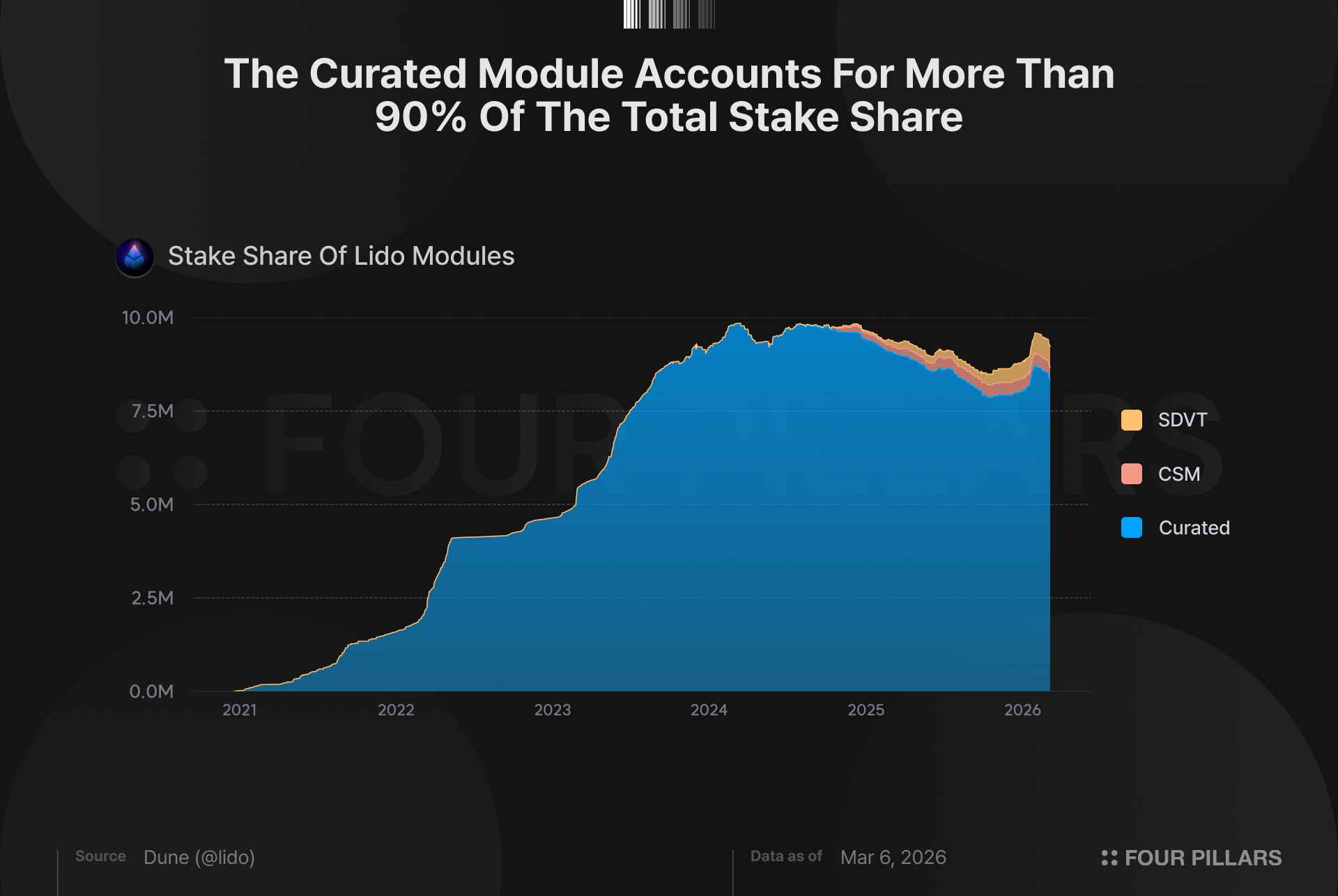
The Curated Module currently holds about 91% of total stETH supply, approximately 8.5M ETH. In dollar terms, that amounts to roughly $18 billion in TVL (as of March 5, 2026, at ETH $2,121). The remaining approximately 8% is distributed across the CSM and SDVTM, but for all practical purposes, Lido's staking infrastructure runs on the Curated Module.
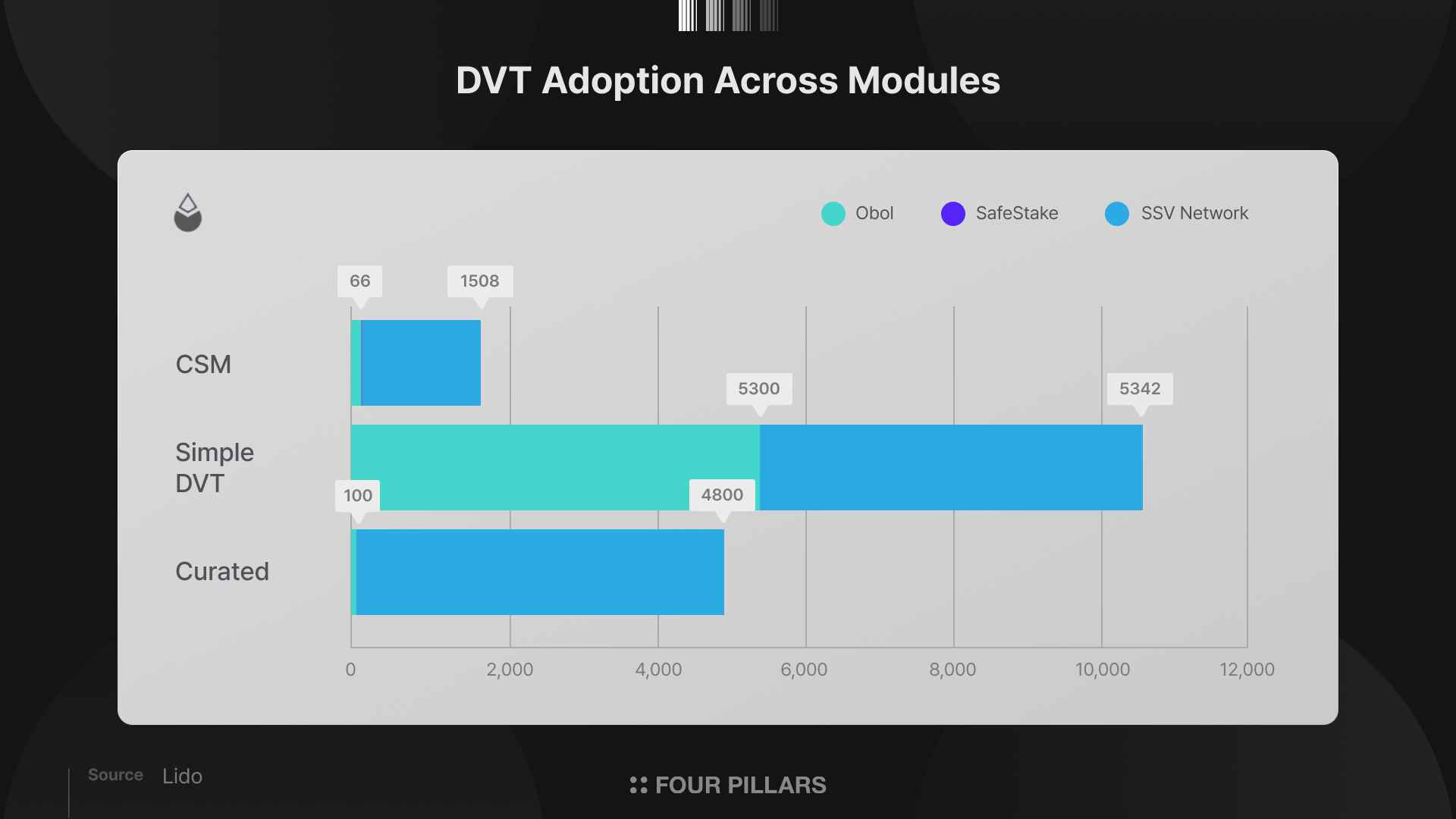
Figures published by Lido for Q3 2025 also confirm that DVT adoption has been expanding rapidly.
Five major node operators in the Curated Module transitioned approximately 4,900 validators representing around 156,800 ETH to DVT setups based on Obol and SSV Network. As a result, the total number of DVT validators across Lido rose to 17,124, an increase of roughly 57.65% from the previous quarter. The CSM share cap was also expanded to 5% with the CSM v2 upgrade in October 2025, then raised again to 7.5% in January 2026, allowing permissionless operators to handle approximately 1.5% of all staked ETH.
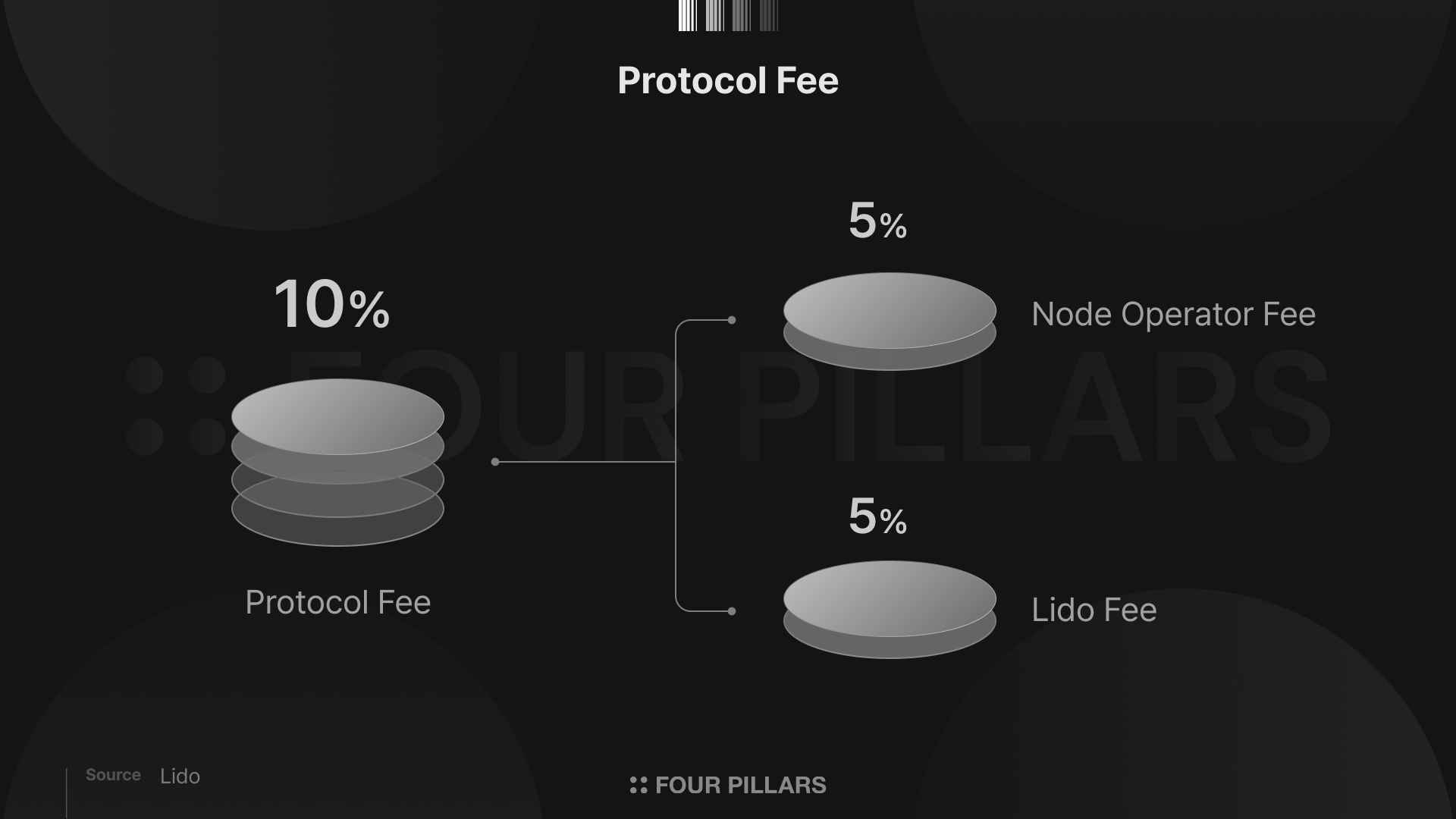
The fee structure has also changed recently. In December 2025, Lido DAO passed an on-chain vote (Omnibus Proposal #195) to restructure the Curated Module's fees. Previously, the 10% protocol fee was split evenly between node operators (5%) and the DAO (5%). Under the new structure, fees are differentiated by operator type: 3.50% for Standard operators, 4.00% for Extra Effort operators, and 4.50% for Client-Team operators. The higher the contribution to the Ethereum ecosystem, the greater the reward. Lido estimates that this restructuring alone will generate an additional approximately 2,600 ETH in annual protocol revenue in 2026. However, these incremental improvements do not fundamentally resolve the structural limitations inherent in the Curated Module. As external conditions evolve and internal design constraints compound, the need for a more fundamental redesign has become evident.
The most direct trigger for the redesign is Ethereum's Pectra upgrade. Applied to mainnet on May 7, 2025, Pectra was the most expansive upgrade in Ethereum's history, incorporating 11 EIPs, and the one with the greatest impact on staking is EIP-7251.
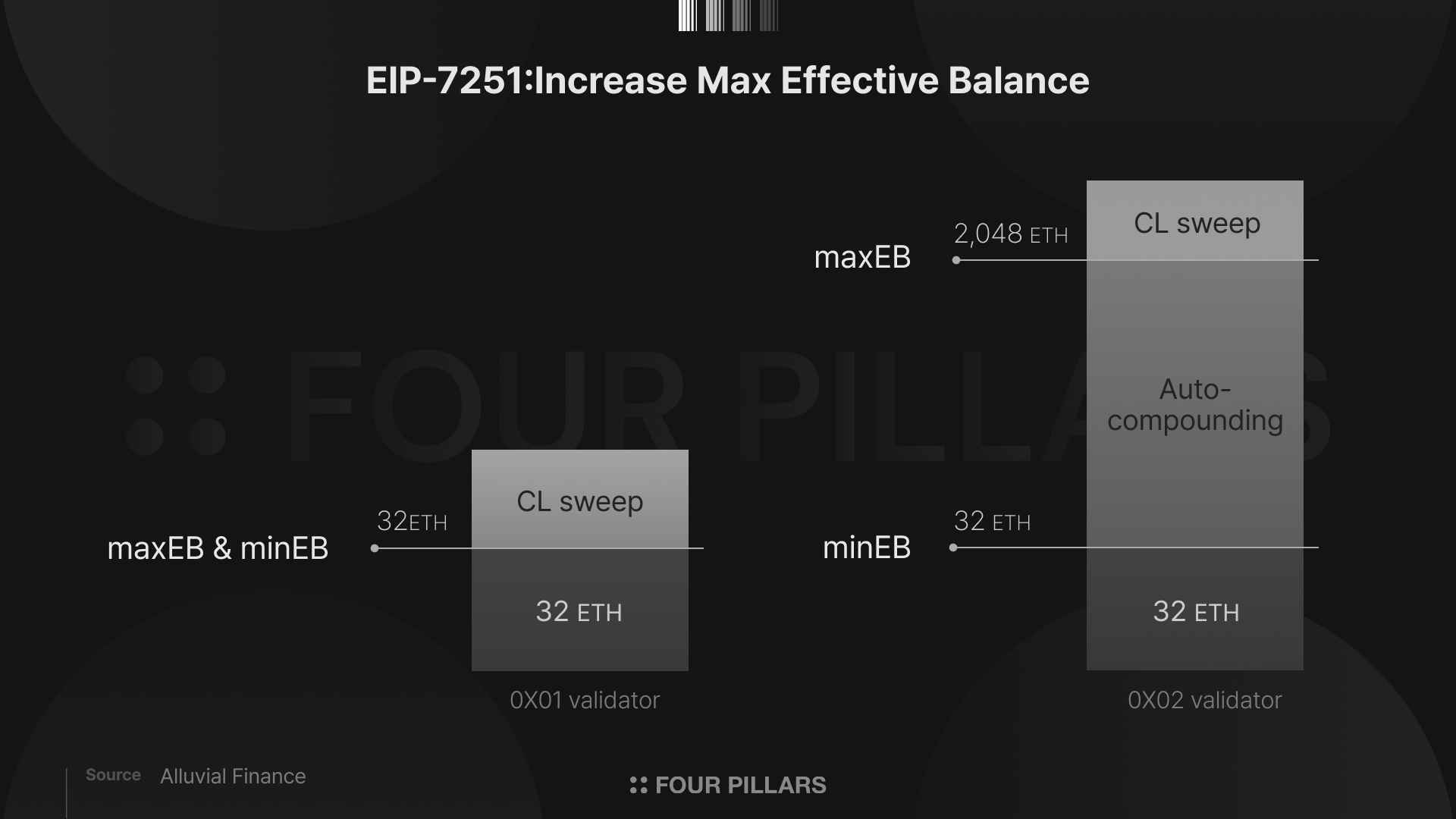
EIP-7251 dramatically raised the maximum effective balance per validator from 32 ETH to 2,048 ETH. To take advantage of this, validators must convert their existing 0x01 withdrawal credentials to the new 0x02 type. 0x02 validators can stake anywhere from 32 to 2,048 ETH, with rewards auto-compounding until the balance reaches 2,048 ETH. Previously, any amount exceeding 32 ETH was automatically withdrawn, meaning that achieving compounding required manually withdrawing funds and creating new validators.
The implications for Lido are significant. The Curated Module currently manages approximately 7.95M ETH. Under the 32 ETH regime, this requires more than 248,000 validators. With 2,048 ETH validators, the same scale can be operated with just around 3,882 validators. Fewer validators mean reduced P2P message overhead, lighter BLS signature aggregation load, and a smaller beacon state, all of which improve Ethereum's overall consensus efficiency.
The problem is that CMv1 was designed around the assumption of 32 ETH validators. Routing, accounting, and risk models all rest on the premise that each validator holds a fixed balance of 32 ETH. Dynamic balances ranging between 32 and 2,048 ETH, the concept of topping up existing validators with additional deposits, and partial withdrawals without a full exit are all difficult to accommodate within the existing architecture. Supporting 0x02 is not a matter of adding a single feature; it requires rebuilding the module architecture from the ground up.
Beyond external factors, structural issues within the Curated Module itself have also motivated the redesign.
For a long time, CMv1 maintained a fixed fee model that evenly split the 10% protocol fee between node operators (5%) and the DAO (5%). While this was simple and predictable, two problems have emerged as market conditions have shifted.
The first is intensifying external competition. In the global market, professional node operators are competing with lower fees, additional risk coverage, and flexible pricing structures. In this environment, the Curated Module's fixed fees have ended up at the upper end of market pricing. Since competition among staking protocols ultimately comes down to who can offer better yields, rigidity in cost structure directly translates to weakened competitiveness.
The second is the inability to reflect differences among operators. In CMv1, the same fee rate applies to all operators. In reality, though, there are substantial differences in performance, infrastructure configuration, geographic distribution, client diversity, and contributions to the Ethereum ecosystem. This raises the question of whether it is optimal to treat a team that directly develops an Ethereum client under the same economic terms as a purely for-profit infrastructure operator. The recently introduced three-tier fee structure (Standard, Extra Effort, Client-Team) is a transitional solution, but due to the current architecture's technical constraints, fees can only be set at the module level and cannot be adjusted per individual operator.
Currently, the primary mechanism governing node operator behavior in the Curated Module is reputation. It is a system built on the expectation that professional operators will perform well and make good on any damages if problems arise. This model has worked well for over five years, but the fact that it "has worked" does not mean it "will continue to be sufficient."
The core issue is the absence of measurable accountability. Even when slashing incidents, misrouting of execution layer rewards, or extended downtime occurs, node operators bear no actual economic cost. Reputational loss is certainly a cost, but it is difficult to quantify and does not provide direct compensation to affected stakers.
In the absence of economic accountability mechanisms, the DAO often has to intervene directly when problems arise. This naturally leads to governance efficiency issues.
The final issue is operational efficiency in governance. Under the current structure, even simple administrative tasks like changing a node operator's address require an on-chain DAO vote. While this ensures transparency, it has the drawback of delaying emergency responses and imposing unnecessary fatigue on governance participants. Lido DAO operates Easy Track, a lightweight governance tool, but many operational processes still depend on traditional on-chain voting.
CMv2's design is built on four principles: sustainability, competitiveness, alignment, and autonomy. The rollout is divided into two phases, with Phase 1 scheduled for the first half of 2026 and Phase 2 for Q4 2026.
3.1.1 Introduction of Node Operator Bonds
The most notable change in CMv2 is the introduction of a bond mechanism. Economic collateral is now layered on top of what was previously a purely reputation-based accountability framework.
Each node operator must provide a bond in ETH, stETH, or wstETH. This bond covers operational risks such as slashing, execution layer (EL) reward violations, and severe downtime. Bonds are held as stETH, providing capital efficiency for operators while also being subject to actual burning in the event of an incident to cover losses.
A key design decision worth noting is that bonds are tied to the operator (specifically the sub-operator) rather than to individual validators. If bonds were set per validator, slashing losses could exceed the bond allocated to that specific validator. Operator-level bonds pool this risk while reducing management overhead. It strikes a balance appropriate for a permissioned module: requiring lower bonds than the permissionless CSM model while still establishing measurable accountability.
3.1.2 Penalty Framework
Paired with bonds is a transparent penalty process. Bond deductions occur in three main scenarios. First, when validator slashing occurs, the Curated Module Committee (CMC) files a penalty report through an Easy Track motion, and an amount covering the loss plus missed rewards is burned from the bond. Second, when execution layer rewards are found to have been diverted somewhere other than Lido's reward vault, the diverted amount plus a fixed fine is locked from the bond. Third, prolonged or severe downtime, delayed exits, and protocol rule violations also qualify as penalty events. All penalty processes include a challenge period, maintaining a balance between decentralized oversight and rapid response.
3.1.3 Native Support for 0x02 Validators
CMv2 is designed from the outset to support only 0x02 validators. This goes beyond mere "compatibility"; bond parameters and penalty amounts are calibrated from the start for maximum balances of 2,048 ETH. In Phase 1, existing validators from CMv1 will be consolidated and migrated to CMv2's 2,048 ETH validators.
3.1.4 Node Operator Type Classification
In CMv1, all node operators effectively belonged to the same category. CMv2 subdivides them into seven types.
Professional Operator: A "trial" tier for operators newly joining after CMv2 launches. Since they do not yet have a sufficient track record within Lido, a relatively higher bond is required.
Professional Trusted Operator: The default type assigned to operators migrated from CMv1 or those who have passed the trial phase.
Public Good Operator: Organizations that develop Ethereum execution or consensus layer clients or contribute to public infrastructure. They receive higher compensation.
Decentralization Operator: Operators who run infrastructure in underrepresented regions in the validator distribution or use rare client combinations. Their contribution to geographic and client diversity may be recognized through somewhat more flexible performance standards.
Extra Effort Operator: A type for operators who make additional contributions to the protocol, such as attracting stake through stETH vaults, early testing of new technologies, or running Lido oracle infrastructure.
Multi-Operator DVT Cluster / Intra-Operator DVT Cluster: These represent DVT clusters among independent entities and DVT clusters within a single entity, respectively, providing incentives for DVT adoption.
A notable point is that a single node operator can simultaneously run sub-operators of multiple types. For example, an operator might run part of its infrastructure in an underrepresented region while operating the rest as a standard professional operator. This design more accurately reflects the reality that operators mix and match various strategies and infrastructure configurations.
3.1.5 Governance Streamlining
CMv2 proposes the establishment of a Curated Module Committee (CMC). The CMC handles day-to-day module operations on behalf of the DAO, including node operator review, type assignment, penalty reporting, and operational oversight. The key point is that the CMC operates through Easy Track motions, following an optimistic governance structure that handles routine matters efficiently while allowing the DAO to exercise a veto when needed. Operators will also be able to change their manager and reward addresses directly, significantly reducing friction for simple administrative tasks that previously required on-chain DAO votes.
If Phase 1 lays the foundation, Phase 2 is where the Curated Module transforms into a full-fledged Validator Marketplace, nicknamed "ValMart."
The centerpiece of Phase 2 is Custom Fee Curves. Node operators will be able to set nonlinear fee curves, pricing flexibly across different tiers of delegated ETH volume. This allows them to reflect real-world cost structures. For instance, an operator could apply lower fees for initial small stakes and different fees for larger volumes. The system dynamically allocates stake by considering both the DAO's decentralization criteria and the fees offered by operators.
The Strike System is a long-term accountability mechanism that tracks violations cumulatively. Strikes accumulate across categories such as performance degradation, delayed exits, and policy violations. Rather than triggering immediate penalties, they result in a gradual reduction of stake allocation weight. If enough strikes accumulate within a given period, an operator can be ejected from the Curated Module.
The Additional Bond Reserve is a mechanism through which operators can voluntarily deposit extra stETH bonds to increase their weight in stake allocation. LDO Lock and Delegation allows operators to lock LDO tokens and participate in governance, demonstrating alignment with the protocol's interests and improving their allocation weight accordingly.
All of these parameters combine to form the ValMart algorithm. Fee curves, operator types, strike counts, additional bonds, and LDO lock amounts are all factored in comprehensively for dynamic stake allocation, while per-operator maximum stake caps preserve decentralization.
What I read in this design is Lido's intention to transform the Curated Module from a "DAO-managed registry" into a "self-regulating market." Until now, stake allocation has been heavily dependent on DAO decision-making. Once Phase 2 is complete, operators will be able to attract more stake through their own actions: setting competitive fees, posting additional bonds, actively participating in governance, and maintaining strong performance. This structure is expected to reduce the DAO's administrative burden while raising the protocol's overall service quality through healthy competition among operators.
Phase 2 also introduces Direct Deposits. This feature allows specific registered DeFi protocols or institutional products to deposit directly into a desired node operator's pool and receive stETH on a 1:1 basis. For example, a protocol that wants to deposit specifically into validators using DVT technology or pre-confirmation sidecars could use this mechanism. This mechanism is subject to per-operator capacity limits and stands in a complementary relationship with Lido V3's stVaults.
CMv2 is not an upgrade to the existing module but a deployment of entirely new smart contracts. Migrating the Curated Module's entire stake (approximately 7.95M ETH) to CMv2 is therefore essential, and the process is planned in two stages.
The first stage is initial seeding. To bring CMv2 up to its intended scale, approximately 3,882 0x02 keys must be prepared, requiring roughly 124,224 ETH in new deposits. The cost of this stage varies depending on several protocol timing constraints, including withdrawal delays for 0x01 validators, skimming schedule variability, oracle reporting delays, and activation queue congestion.
The second stage is consolidation. After seeding, the remaining approximately 7.82M ETH is consolidated into the new validator structure. Consolidation is more reward-efficient than a full exit-and-redeposit cycle, but it is constrained by Ethereum's consolidation queue limits. The theoretical minimum migration period under these constraints is approximately 117 days.
According to the cost analysis shared by Lido, the total protocol-level reward loss from the migration is estimated at roughly 738.5 ETH. Broken down: approximately 55.6 ETH related to initial seeding, approximately 41.9 ETH related to new deposits, and approximately 682.9 ETH related to consolidation. Gas costs are estimated at an upper bound of approximately 40 ETH at 2 gwei, or roughly 1.5 ETH at current low gas prices (0.07 gwei).
The full migration is expected to begin in spring 2026 and take approximately 4.5 to 6 months under ideal network conditions. The 738.5 ETH reward loss amounts to roughly $1.57 million (as of March 5, 2026, at ETH $2,121), representing approximately 0.28% of Lido's annual rewards. This cost will be borne by stETH holders, while operational costs (such as gas) will be covered by the DAO.
This migration cost can be viewed as a kind of decentralization premium. As long as Ethereum continues to evolve, large-scale staking protocols like Lido will inevitably face costs associated with architectural redesigns. Lido recognizes this and is actively exploring optimization strategies, particularly to accelerate the initial seeding stage. It is also worth noting that the existing Curated Module will continue to accept deposits during the migration period, but new ETH entering CMv1 during this time will eventually need to be migrated to CMv2 as well, incurring proportional additional costs (approximately 8.72 ETH in additional reward loss per 100,000 ETH).
I view CMv2 from two perspectives.
The first is the "adaptation cost" that the evolution of Ethereum's base layer imposes on the protocols built on top of it. Pectra's 0x02 validators hold significant potential to improve the network's overall consensus efficiency, but to accommodate them, protocols like Lido must undertake a complete redesign of their core modules, endure months-long migrations, and absorb costs in the millions of dollars. Lido estimates upgrade costs of roughly $1.8 to $2.8 million per hard fork, and these costs recur whenever there is a substantive change to the consensus layer. One could call this a "decentralization premium," but ultimately the bill falls on stakers and the DAO. As long as Ethereum keeps evolving, these costs will arise structurally, and the ability to manage them efficiently will determine the long-term competitiveness of staking protocols.
That raises the question: what is Lido ultimately trying to gain by absorbing these unavoidable costs? The second perspective addresses that answer: the implications of CMv2's "ValMart" vision. Once Phase 2 is complete, the Curated Module will transform from a static, DAO-managed registry into a dynamic market where operators compete through fees, bonds, governance participation, and performance. This represents a fundamental shift in Lido's node operator management paradigm.
What makes this particularly interesting is how this market mechanism attempts to resolve the tension between decentralization and efficiency in a new way. Pure market logic would concentrate stake among the most efficient handful of operators, but parameters such as operator type weighting, performance flexibility for Decentralization Operators, and per-operator maximum stake caps check that concentration. The design reveals an intent to find a balance between market efficiency and the public good of Ethereum network decentralization.


Dive into 'Narratives' that will be important in the next year


 Lido
Lido Ethereum
 Pharos
 Solana