In this article, I introduce a new content monetisation model for the AI era called CAPS (Content Attribution Payment Scheme), where content referenced by AI is automatically rewarded, and ads are shown not on web pages but inside AI answer interfaces.
To make this model work, you need four things: an ad infrastructure, AI and LLM technology, a rich content ecosystem, and a micropayments system. Interestingly, Naver is one of the very few players that already has all four within a single ecosystem.
With its closed loop from search and ads, to HyperCLOVA-class LLMs, to platforms like Naver Blog, and finally to Naver Pay points (and potentially a KRW stablecoin based payment layer), Naver could use CAPS to build a flywheel where creators, users, advertisers and the platform all benefit.
When the way we consume content changes, new revenue models inevitably follow.
In the past, people running blogs or websites mostly relied on page-view based ads as their primary source of income. Now, however, users are no longer reading search results directly as much as before. Instead, they increasingly consume summaries and answers generated by AI. Because information referenced by GPT or Perplexity can be accessed without viewing any ads at all, the sustainability of the traditional ad model is becoming questionable.
One of the companies that responded most quickly to this shift is Cloudflare. Cloudflare introduced a model called Pay Per Crawl, which proposes a structure where each crawl request by an AI crawler that reads web content is compensated financially. This frees content creators from the binary “allow or block” choice and gives them a new way to monetise the crawling itself.
I believe the core value of stablecoins is precisely this: turning previously non-monetisable activities into monetisable ones.
In the chart analysed by Nic Carter of Castle Island Ventures, there is a conspicuous gap where no payment method satisfies extremely low per-transaction value and extremely high transaction frequency at the same time.
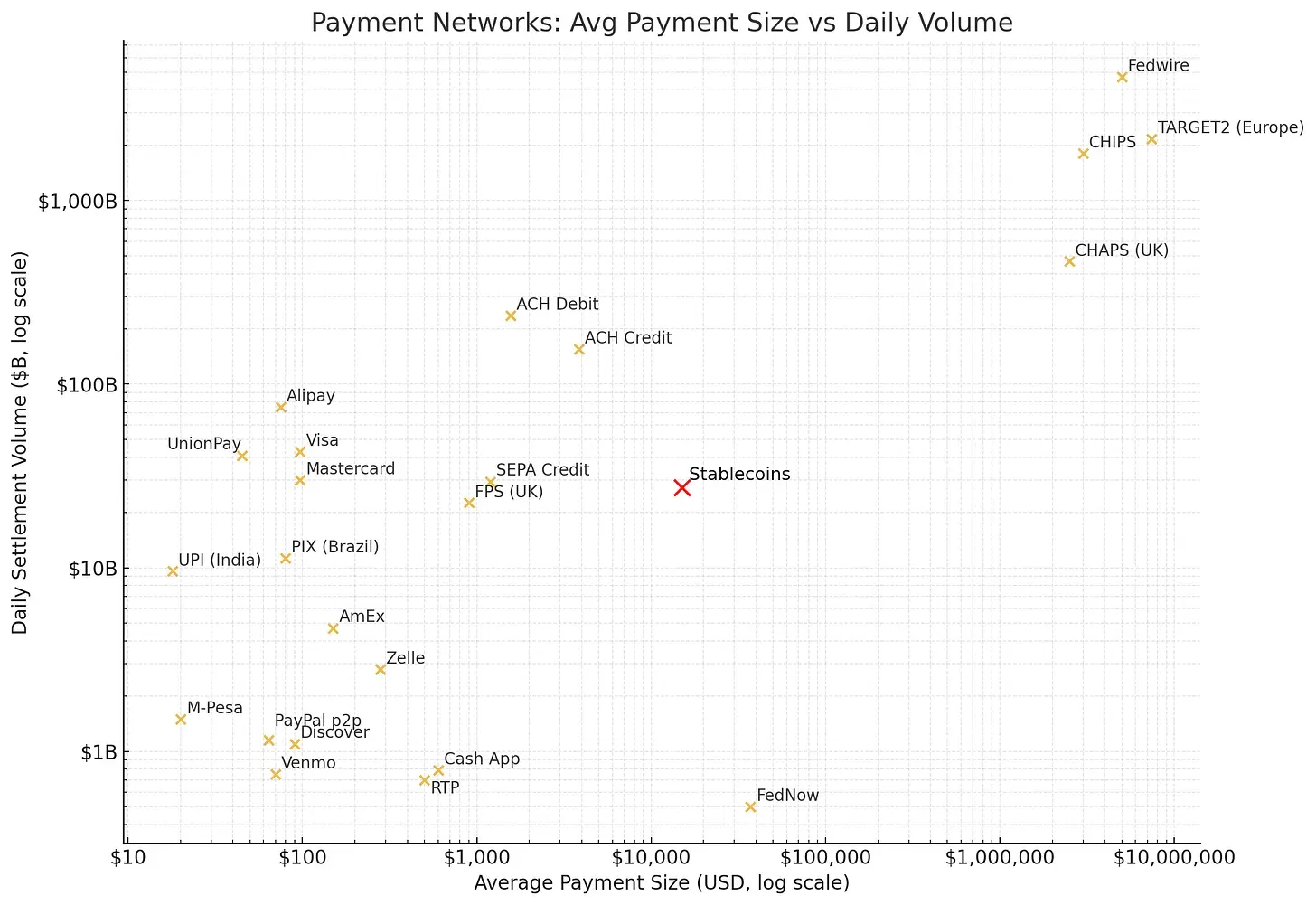
If a payment rail suited to that region already existed, we would likely have seen many more business models built on micropayments by now. The most promising candidate to fill that gap is the stablecoin, which I see as the key infrastructure that can unlock micro-transaction based business models.
Notably, shortly after announcing Pay Per Crawl, Cloudflare launched its own stablecoin, NET, positioning it as the payment rail for these new monetisation schemes. In other words, Cloudflare explicitly chose stablecoins as the settlement layer for this new revenue model.
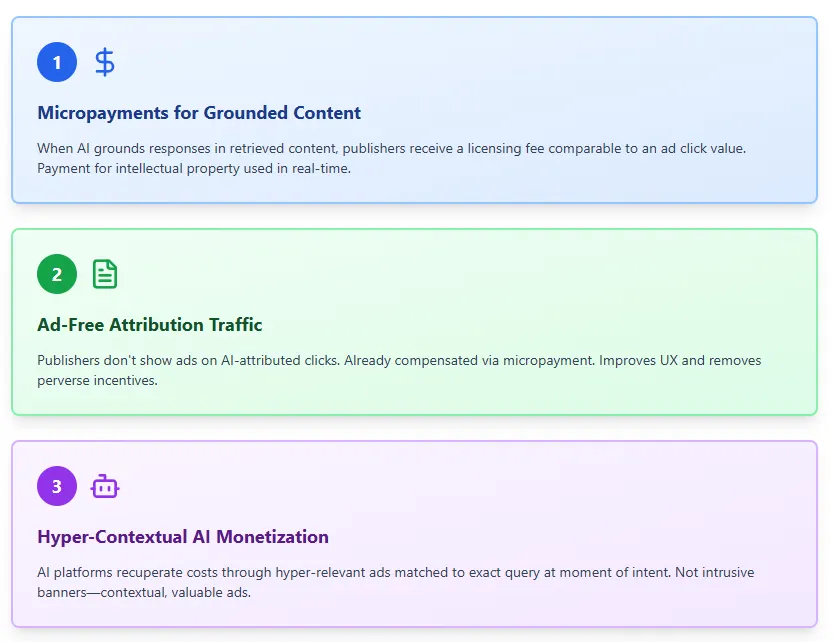
Among the ideas I have seen so far, CAPS, the Content Attribution Payment Scheme proposed by Dejan, is the most convincing model for content monetisation in the AI era. CAPS rewires the revenue loop in line with a world where AI-mediated information consumption becomes the default:
When an AI references a specific blog post in order to generate an answer, the author of that post receives a small reward, benchmarked to the value of an ad click.
The ad slot moves away from the blog page itself and into the AI answer interface.
The AI platform shares part of that ad revenue with content creators and keeps the rest as platform revenue.
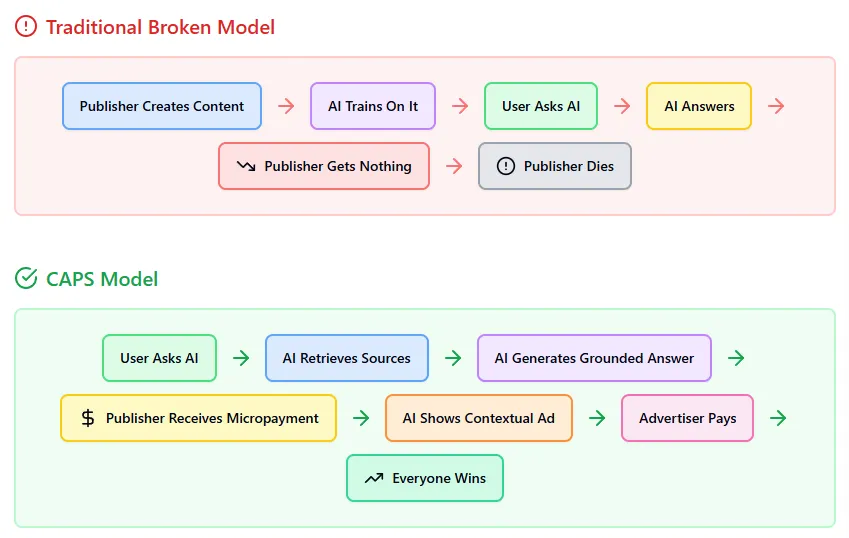
The user flow looks like this:
A user asks a question to an AI assistant (for example, “How can I reduce my income tax in Australia?”).
To build the answer, the AI references relevant articles and blog posts, then composes a response while displaying the necessary sources.
On the answer screen, the user sees ads related to tax advisory services or automated tax filing SaaS products.
The authors of the content referenced by the AI then receive a share of the ad revenue that the AI platform earns from that answer.
In short, CAPS suggests a shift from “search → click → page-view → ad impression” to “AI → source lookup → answer generation → compensation to referenced content creators → ads shown in the AI interface”.
To make CAPS real, you need four conditions to be satisfied:
Advertising
Ad slots inside the AI interface
Intent-based targeting derived from the question context
AI
Answer generation that is explicitly source-aware
Ability to estimate the relative contribution of each source
Content
A healthy ecosystem that reliably supplies differentiated, human-authored content
Payment rail
Infrastructure capable of processing real-time micropayments at high frequency
If you have all four, you can at least theoretically implement something like CAPS. The problem is that very few companies in the world possess all four elements at once.
At this point, it was natural for me to think of Naver Corporation from South Korea.
For readers outside Korea who may not be familiar with it:
Naver Corporation is South Korea’s leading internet platform company. It operates the country’s dominant search engine and portal, along with services that span online advertising, commerce, content, cloud and fintech.
In the Korean market, Naver’s position roughly combines parts of what Google (search and ads), Amazon (marketplace and commerce infrastructure) and PayPal or Cash App (consumer fintech and payments) each represent in other countries, stitched into a single ecosystem. Analysts often highlight its tightly integrated platform that connects search, commerce, content and fintech.
Naver has also built its own large language model, HyperCLOVA X, and is rolling it out across services such as search, commerce and payments as part of what it calls an “on-service AI” strategy.
To give a sense of scale, in a recent quarter Naver reported:
Revenue: ~$2.4B (+15.6% YoY, +7.6% QoQ)
Operating profit: ~$440M (+8.6% YoY), 18.2% margin
Net income: ~$570M (+38.6% YoY), 23.4% margin
Revenue breakdown:
Search: ~$820M
Commerce: ~$760M
Fintech: ~$330M
Content: ~$390M
Enterprise (cloud/AI): ~$120M
The important point here is less the exact numbers and more the picture they paint: Naver is not a niche startup but a large-scale platform that already earns significant revenue from search ads, commerce, fintech and content.
Now, if we overlay the CAPS requirements on top of Naver’s actual capabilities:
Naver runs search and ad infrastructure as a core business.
It has a proprietary LLM, HyperCLOVA X, that is actively being deployed into search and commerce under an “AI-first” service strategy.
It owns a massive content pool through Naver Blog, where humans publish differentiated content at internet scale.
It operates Naver Pay as a widely used digital wallet and payment service, with large transaction volume and a strong presence both on and off platform.
Naver is also in the process of a major stock-swap deal to acquire Dunamu, operator of the Upbit crypto exchange, through Naver Financial. Analysts expect this to significantly accelerate Naver’s move into digital asset payments, and several reports mention that a Korean won stablecoin project is under discussion as part of the broader strategy.
When you combine:
Naver Pay points as the existing consumer-facing wallet
A potential KRW stablecoin as an onchain, programmable payment rail
The scale of search, commerce, content and AI Naver already operates
…Naver becomes one of the very few companies in the world that could implement CAPS entirely within its own closed loop.
On top of that, recent announcements from Naver already hint at experiments in a similar direction:
AI Briefing reportedly converts around 15 percent of search queries into AI summaries, improving click-through rates and ad efficiency.
The ADVoost feature uses AI to automatically optimise ads based on Naver Shopping products, and has contributed to strong growth in commerce-related ad revenue, alongside a structural change in fee policies.
Even looking at just these two examples, the synergies you could unlock by combining them with CAPS are quite clear:
When AI Briefing references Naver Blog posts, blog operators could be compensated based on their relative contribution.
ADVoost could take the context of the AI Briefing query and automatically recommend Naver Shopping products, creating incremental commerce revenue on top of the AI answers.
Here is a scenario of what it might look like if Naver were to implement CAPS, seen from the perspective of users, advertisers, and Naver Blog creators.
User: A searches “best autumn foliage spots in Seoul” in the Naver app
At the top of the results, an AI Briefing summary card appears, listing the main spots in one glance. Beneath that, a line like “3 sources cited: ○○ Travel, B’s Naver Blog, Naver News” appears, so the user can grasp the key information without opening each blog.
Under the summary card, an ad appears such as “20 percent discount on autumn foliage season accommodation”.
When A clicks the ad, the revenue-sharing engine automatically calculates how to split the ad revenue across the three cited sources according to their contribution.
The payment module then sends amounts like ₩1.3, ₩0.9, ₩0.8 to each content creator’s Naver Pay wallet in the form of Naver Pay points or, in the future, KRW stablecoin units.
If A clicks through to read the original blog post for more details, the system could trigger an additional bonus payment.
Through this flow, Naver can leverage its unique asset, Naver Blog, to deliver a more trustworthy AI search experience, while the reward mechanism encourages the production of more high-quality blog posts. The result is a positive feedback loop.
Advertiser: B, a marketer at an accommodation app, runs an “autumn foliage season” campaign via ADVoost
B goes into Naver AD Manager and chooses an ad product such as “AI Briefing context ads”. For Naver Shopping products, ADVoost can automatically optimise performance.
AI Briefing automatically matches the accommodation app’s ads only to queries with clear intent such as “autumn foliage”, “domestic travel”, “weekend trip”.
In this setup, ads appear only on queries with strong commercial intent, which improves efficiency. At the same time, the fact that a portion of ad revenue flows back to content creators provides additional ethical satisfaction for brands and marketers.
Travel blogger B: opts-in to “Allow AI search citation” in blog settings
B goes to their blog settings, turns on the option “Allow AI search citation”, and sets a base unit price (for example, a minimum reward per citation).
B’s post “Guide to autumn foliage spots in Seoul” starts to be repeatedly referenced in AI Briefing summaries.
The revenue-sharing engine and payment module aggregate those events and send Naver Pay points to B’s wallet in real time or at regular intervals.
Creators can choose whether to allow their posts to be used by AI search. For those who want to monetise, this means that even if direct traffic declines due to changing consumption patterns, they can still earn rewards in proportion to how often their content is referenced by AI.
In theory, if Naver adopts a model like CAPS, it can provide blog creators with real-time rewards, which will encourage the production of more high-quality content. That content, in turn, improves AI Briefing and search quality, provides users with more trustworthy information, and enables advertisers to run highly contextual ads. Ultimately, Naver can build a virtuous cycle in which creators, users, advertisers and the platform all grow together.
On top of that:
Naver is already pursuing a strategy that connects commerce, search and content into a single AI-centric experience.
Very few companies in the world possess all four of the elements required for CAPS in one stack: advertising, LLM, content ecosystem and payment rail.
With the planned Dunamu stock-swap and the resulting ability to seriously experiment with a KRW stablecoin based payment system, on top of Naver Pay points, Naver has a realistic path to building the kind of micropayment infrastructure that CAPS requires.
Considering all of this, the future where Naver adopts a model like CAPS feels much more realistic than it might first appear. In fact, my hunch is that Naver may already be considering something similar.


Dive into 'Narratives' that will be important in the next year


 Mastercard
