The era of AI has truly arrived. No longer confined to tools like large language models that merely respond to user queries, AI is increasingly permeating everyday life as an active agent capable of performing a wide range of tasks autonomously. Finance is no exception to this shift. As blockchain technology has made financial systems more digitally native, the industry has become one in which AI can increasingly take over roles that were once performed by humans.
In this context, INFINIT goes beyond simply automating a limited set of DeFi strategies. By building infrastructure that allows anyone to easily design and execute their own DeFi strategies, INFINIT seeks to lower barriers to entry and drive the democratization of DeFi. At the same time, it offers a concrete example of how AI agents can be applied to automate financial activity in practice.
However, significant challenges remain. While AI systems are powerful, they are far from infallible, and finance is directly tied to users’ assets, making legal considerations and questions of responsibility unavoidable. These issues require careful examination and the development of appropriate safeguards. That said, such challenges are ultimately a matter of time. A future in which agents move beyond DeFi to replace a broad range of financial activities is increasingly plausible—and it naturally raises the question of what role INFINIT will play at the center of that transition.
Source: INFINIT
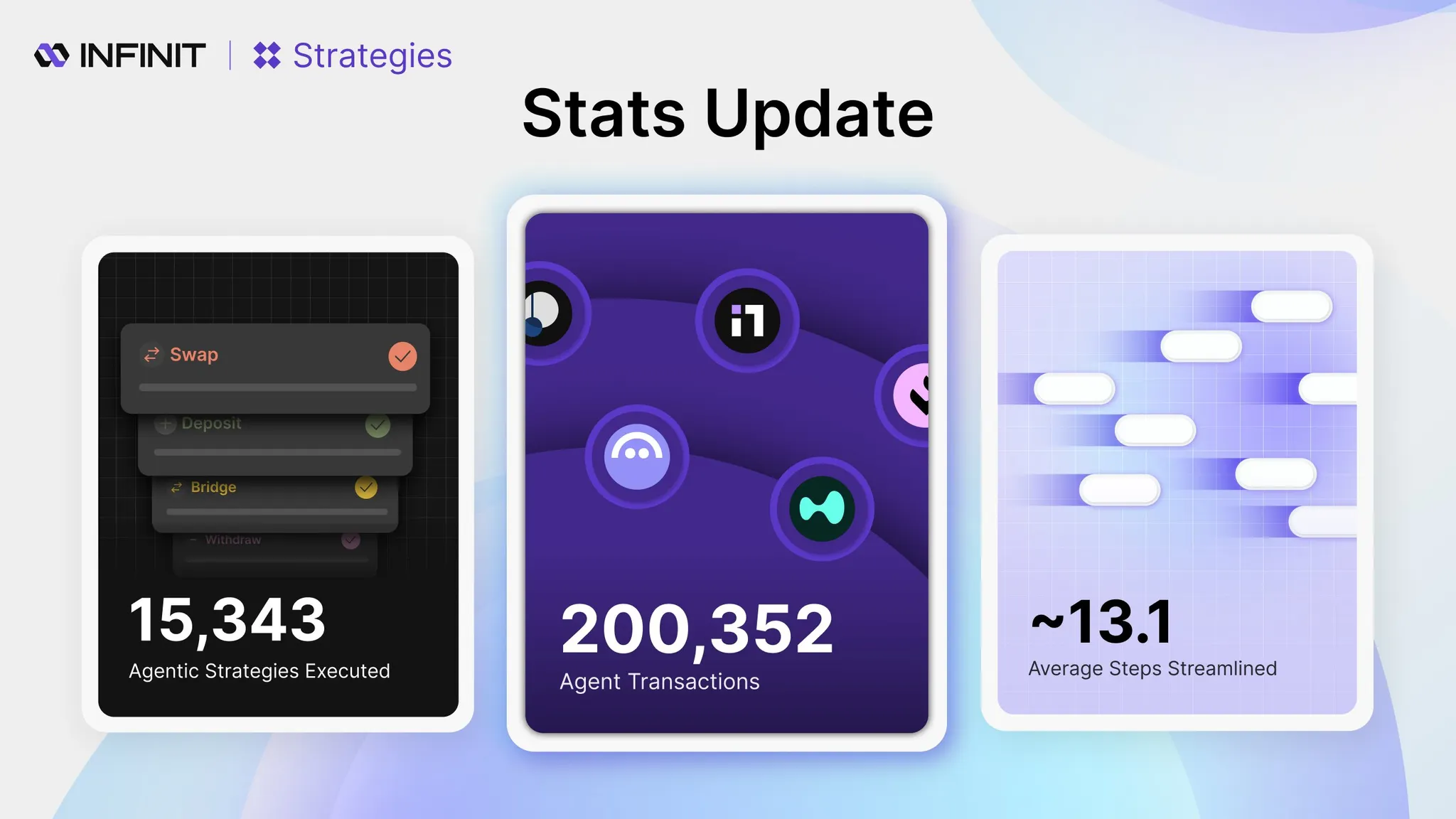
INFINIT, previously introduced by the author through Four Pillars, is a protocol designed to make DeFi more accessible by leveraging AI agents. Over the past year, INFINIT has processed approximately 678,000 agent-driven transactions and executed around 20,000 DeFi strategies, demonstrating meaningful traction and growth. Notably, the strategies executed through INFINIT compress an average of 13.1 individual DeFi steps into a single workflow, significantly improving the practical usability of DeFi.
What deserves particular attention is that all of these results were achieved solely through INFINIT Strategies developed internally by INFINIT itself. Even without reaching the stage where “retail users can directly follow the strategies of well-known DeFi KOLs,” INFINIT has already produced meaningful outcomes.
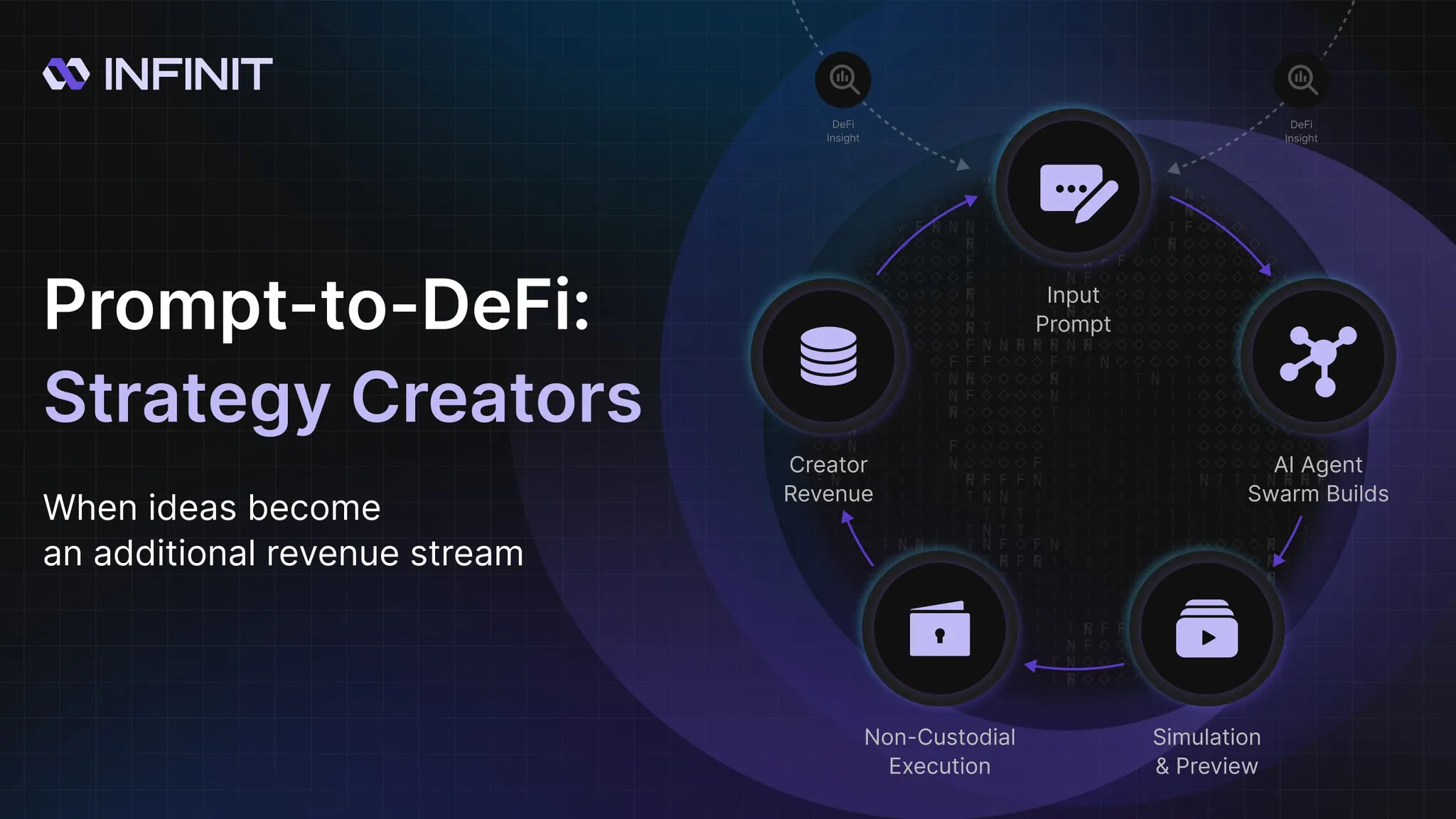
Now, INFINIT is placing its product vision on a more direct proving ground with the launch of Prompt-to-DeFi (launched in December 18, 2025), a product that enables anyone to become a strategy creator by building their own multi-step DeFi strategies across chains and protocols using plain language.
Source: INFINIT
If INFINIT’s earlier products focused primarily on demand-side automation, enabling users to easily execute DeFi strategies, Prompt-to-DeFi shifts its focus toward the supply side of expert-level DeFi strategies.
For DeFi to achieve true mass adoption, two prerequisites must be met:
DeFi experts can easily create strategies without needing technical expertise(complex coding for example) and are accessible to general users.
General users must be able to execute those strategies with minimal friction.
Up to this point, INFINIT has effectively satisfied the second condition. Going forward, however, INFINIT can be seen as addressing the first condition through its Prompt-to-DeFi functionality.
(As of the time of writing, general users are not yet able to utilize strategies created by DeFi experts; however, this capability is expected to be enabled in future updates.)
INFINIT’s Prompt-to-DeFi feature is differentiated by the following characteristics:
No-code strategy creation: DeFi strategies can be defined entirely through natural language. If a strategy can be described clearly in words, it can now be transformed from static text into an executable DeFi product.
New monetization path for DeFi experts: Experts can generate additional income by creating and sharing strategies, and earn as users adopt them.
Whether Prompt-to-DeFi can meaningfully democratize both the usage and supply of DeFi strategies remains an open question. Comparing on-chain and usage metrics before and after its launch will be an especially interesting point of observation.
In theory, everything looks elegant. The space INFINIT is attempting to pioneer is no exception.
In an ideal scenario, retail users would be able to deploy diverse DeFi strategies with a single click—without understanding complex blockchain mechanics—while DeFi experts could scale profits that were previously constrained to individual capital bases by monetizing their strategies. If realized, this would be a win-win outcome for all participants.
In practice, however, there are still many obstacles to overcome. Whether the era of “strategy copying” can truly materialize—and what prerequisites must be satisfied for INFINIT to grow sustainably—requires closer examination.
First and foremost, users must establish fundamental trust in both DeFi experts and AI agents. This is categorically different from typical AI-powered services.
For example, when using ChatGPT to retrieve information, even if the AI is not fully trusted, the worst-case loss is generally limited to accepting incorrect information as fact. By contrast, products like INFINIT are involved in how users manage their capital, even though they do not take custody of user assets.
This structural difference alone creates a substantial psychological and practical barrier to adoption.
In information-only use cases, incorrect judgments can often be corrected later. In DeFi, however, a single mistake can result in irreversible capital loss. While users may tolerate this risk for small amounts, it remains unclear whether they will be willing to commit meaningful levels of capital under such conditions.
To mitigate this, INFINIT conducts internal testing and validation on strategies—even those designed by well-known DeFi experts—to ensure their validity and safety. Nevertheless, this process still ultimately relies on trust in INFINIT itself as a platform.
Overcoming this challenge inevitably requires time. If the product operates stably over a prolonged period without major incidents, users will gradually develop confidence in its accuracy and reliability. Even then, fostering user confidence in the AI agents and the DeFi experts developing these strategies remains an ongoing focus—one that INFINIT must continue to strengthen at the product level.
When individuals design and execute their own DeFi strategies, responsibility for losses generally lies with the individual, except in specific cases such as protocol-level hacks. INFINIT, however, introduces a far more complex accountability structure: strategies are designed by users, while execution is handled by AI agents.
Because INFINIT is a self-custodial platform, users clearly bear some responsibility. That said, when incidents occur, there must be clearly defined standards determining who is responsible, and to what extent, depending on the cause.
To address this, INFINIT applies safeguards on both the strategy creation and execution. On the strategy side, only whitelisted users are allowed to create public strategies, helping ensure that strategies are designed by experts and reducing the risk of bad actors. On the execution side, AI agents only use audited tools and logic, with execution paths reviewed for correctness and reliability.
If a strategy itself is structurally flawed, responsibility should fall on the expert who designed it. If the strategy is sound but fails due to execution errors or agent logic, responsibility may rest with INFINIT. Without such predefined and transparent accountability frameworks, users may hesitate to engage with the platform confidently. Ultimately, defining and communicating these boundaries of responsibility is as critical as technical execution itself.
Most DeFi strategies derive returns from information asymmetry—identifying underexposed opportunities and deploying capital before those opportunities are arbitraged away. In this sense, INFINIT faces a structural irony.
Why would DeFi experts voluntarily disclose their farming opportunities and make them executable with a single click?
In reality, most experts prefer to monopolize these opportunities rather than share them. To persuade them to publish high-quality strategies, clear and compelling incentive structures are essential.
Only when the rewards for sharing outweigh the costs of disclosure will DeFi experts treat strategy sharing as a legitimate revenue stream. However, if these incentives are funded entirely by users, demand could decline as a result.
Designing the right balance of incentives between experts and users is therefore one of INFINIT’s core challenges.
A growing number of agent infrastructures—such as x402—are emerging, and their convergence with blockchain technology is promising. Still, reaching true commercial viability will require substantial time and effort.
AI development is progressing at an exponential pace, and related infrastructure may evolve faster than anything we have previously experienced. What appears distant today could arrive sooner than expected. Nevertheless, automating meaningful financial actions through agents demands rigorous legal, regulatory, and security validation.
Despite these challenges, the overall direction is correct. DeFi strategies that INFINIT aims to simplify—strategies that are effectively inaccessible to ordinary users—represent exactly the type of domain where agents can gain early traction.
While many hurdles remain, INFINIT’s product direction is sound. The Prompt-to-DeFi feature may not achieve instant mass adoption, but it has strong potential to become a core pillar of the platform over time.
The types of strategies created by users on INFINIT, and how many users ultimately adopt DeFi strategies through INFINIT, will be critical indicators to watch going forward.


Dive into 'Narratives' that will be important in the next year


 Infinit
 Affluent