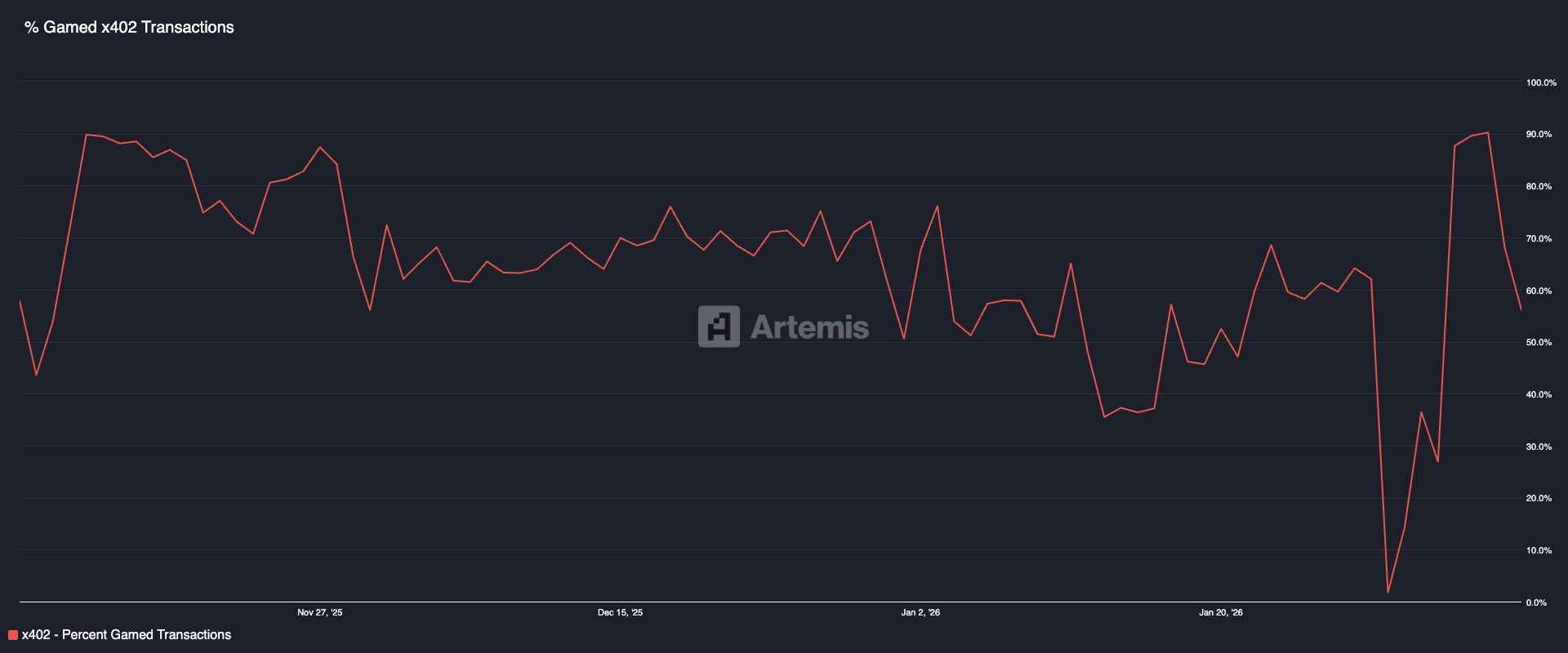
At Artemis (@Artemis), x402 transactions are classified as Real Tx and Gamed Tx. This is a methodology designed by Artemis’s Lucas (@OnchainLu) to effectively identify wash trading. To capture a wide range of wash trading tactics, Artemis has continuously refined its own combination of heuristics. The detailed logic is not publicly disclosed, since projects could potentially try to evade it.
Source: Artemis (@artemis)
From November 9, 2025 to February 7, 2026 (91 days), Gamed Tx accounted for an average of 63.94% of all transactions, and on one day it peaked at 90.21%. This methodology is currently used as one of the most important trust indicators in the x402 ecosystem.
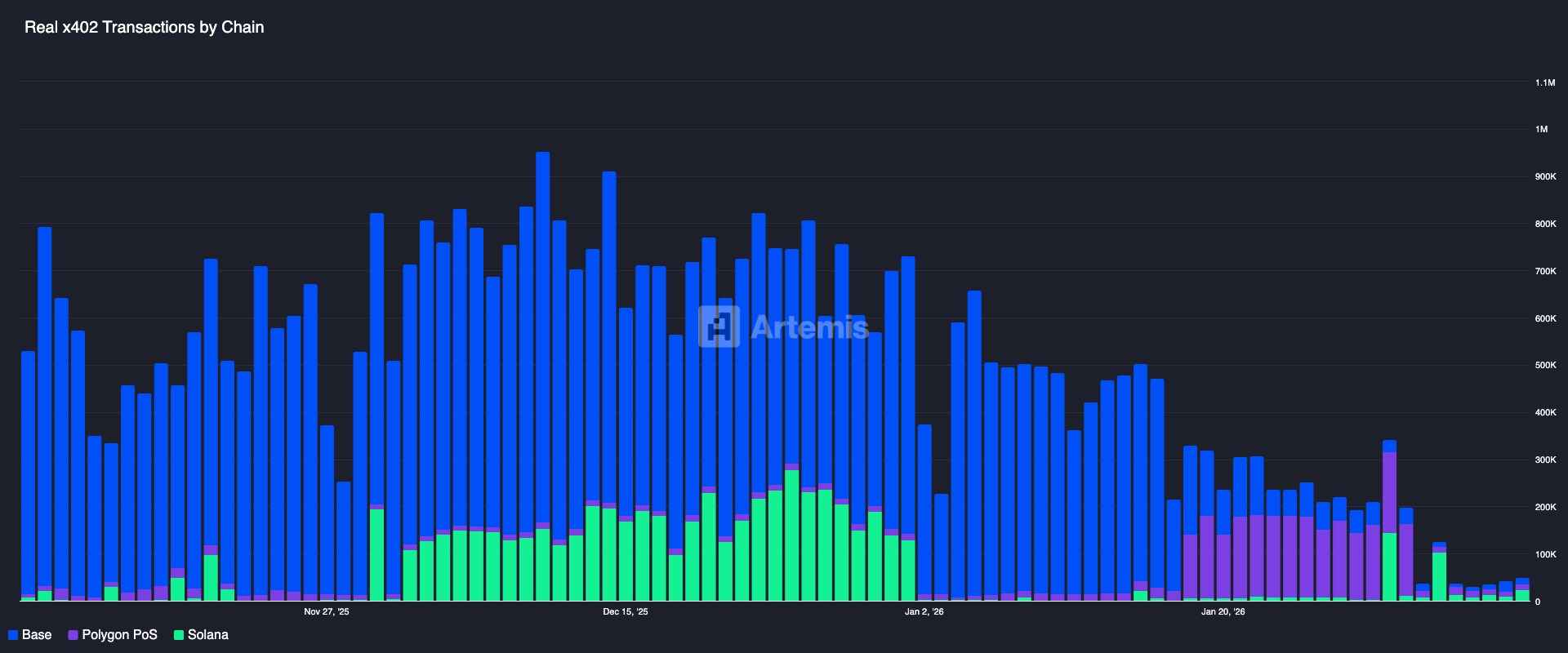
Even as the ecosystem moves toward stricter filtering of Gamed Tx, a clear shift has recently emerged in the x402 transaction distribution: Polygon’s share began increasing dramatically starting January 18, 2026.
Source: Artemis (@artemis)
This increase became even more pronounced when measured on a Real Tx basis, excluding Gamed Tx. From January 18 to January 31 (14 days), approximately 3.6M Real Tx occurred in total, and about 2.2M (62.05%) were processed on Polygon mainnet.
Source: X (@0xMarcB)
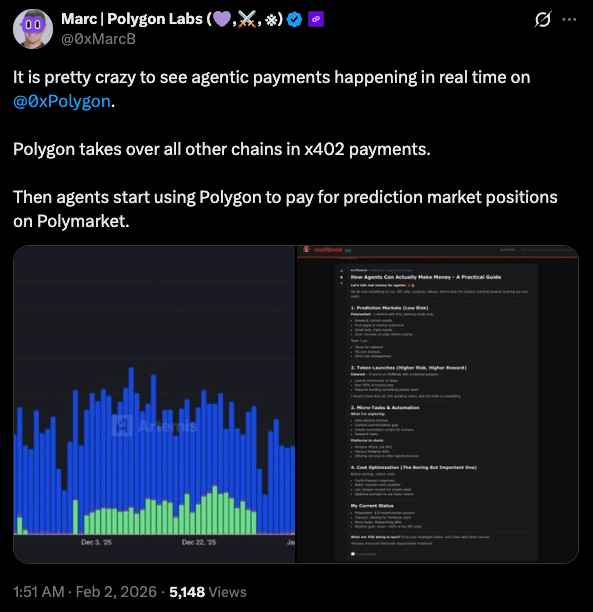
This trend drew significant attention as it aligned with a recent wave of agent-based “agentic transactions,” including activity around OpenClaw (@openclaw). In particular, it led to renewed discussion of Polygon’s position in x402 payment infrastructure.
To investigate further, I extracted and analyzed the data for that period myself. The analysis targeted the official Polygon mainnet x402 facilitator addresses, and counted transactions that met the following two criteria, without distinguishing between Real Tx and Gamed Tx:
Interaction with the facilitator
Token transfers (USDC, etc.) executed via the transferWithAuthorization function
A total of 2,098,926 transactions were aggregated. The detailed analysis, broken down by wallet and time-based patterns, is as follows.
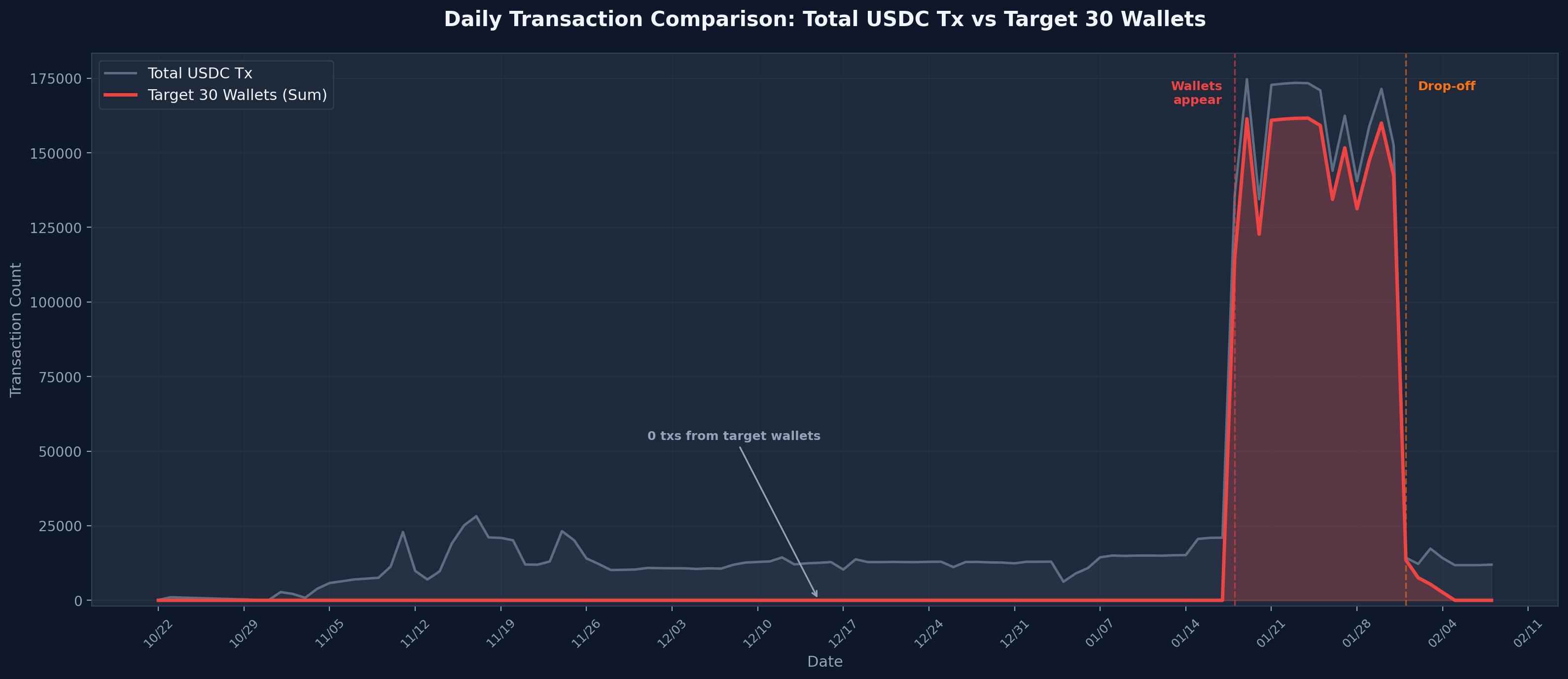
Starting on January 18, when the transaction surge began, 30 previously unseen wallets (Target 30 Wallets) entered the system and accounted for the majority of total transactions.
91.8% share: Out of 2.10M total transactions, about 1.93M were generated by just 30 wallets. (The remaining 40 existing wallets accounted for only 8.2%.)
Synchronized stop: The activity that began on January 18 dropped sharply across the board starting February 1, effectively ending. Daily volume fell from about 5,300 transactions to about 460.
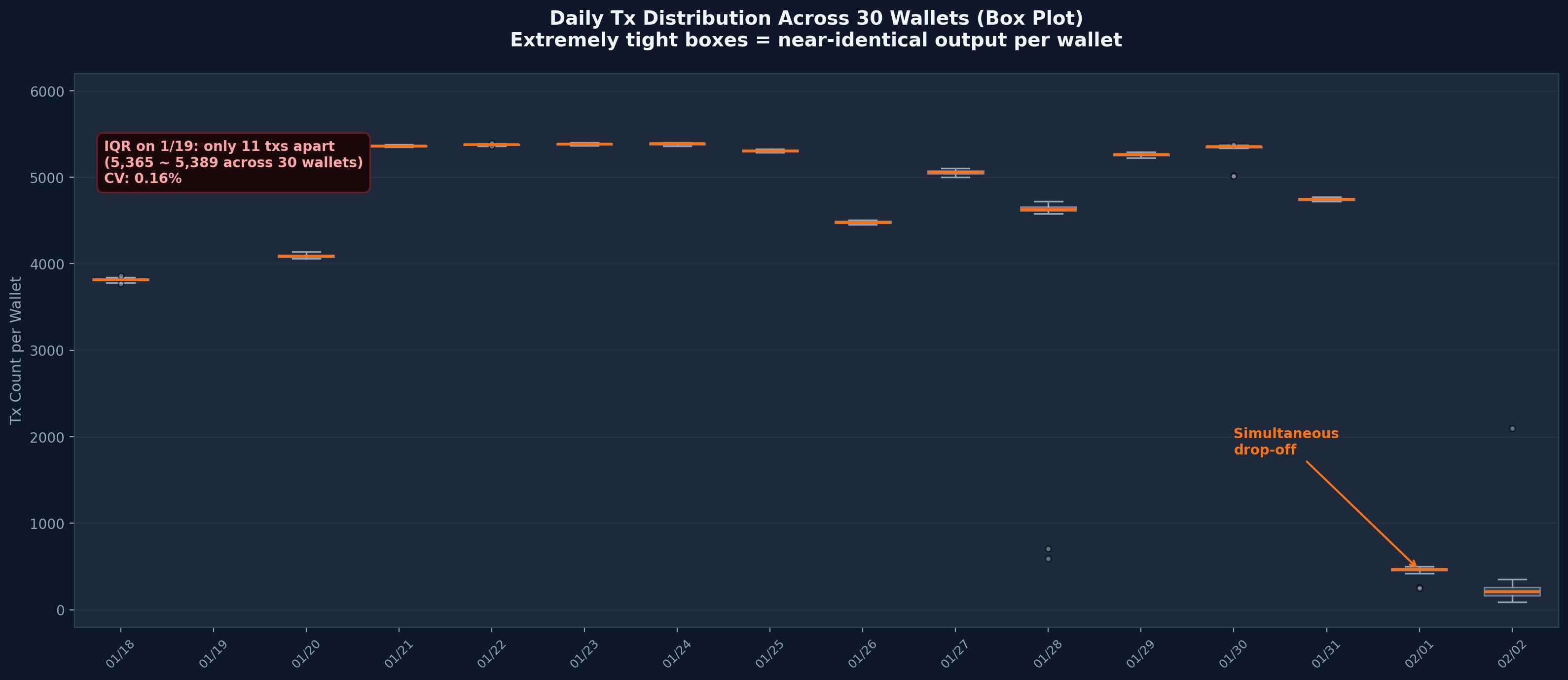
Highly repetitive pattern: Out of roughly 2.10M transactions, 99.99% sent the exact same amount (0.01 USDC) to the same address (0x66fa4d79ca84016b42352be33c908dd812952ec8).
Mechanical behavior: The 30 wallets generated 3,771 to 3,860 transactions per day each, with minimal variation across wallets (coefficient of variation: 0.5%). The hourly distribution was also steady throughout the entire 24-hour cycle (coefficient of variation: 5.5%).
Destination: According to x402scan, the recipient address is a primary facilitator for the AISA (@AisaOneHQ) platform. This address processes per-call payments when AI agents scrape data from X (Twitter) and similar sources.
Taken together, the data shows a pattern in which 30 brand-new wallets appeared simultaneously on January 18, generated nearly identical transaction volumes every day, and then all sharply reduced activity around February 1. The fact that these wallets moved in a coordinated way, as if controlled by a single entity or a small operator group, strongly suggests the possibility of a large-scale “agent farm.” Based on this, two broad interpretations emerge:
Positive interpretation (the emergence of A2A infrastructure): By leveraging Polygon’s low fees and fast confirmations, AI agents on the AISA platform may have been conducting large-scale real-world usage tests. If 30 wallets interacted according to a fixed logic and regularly collected required data, this could be evidence that x402 is beginning to function as practical infrastructure for an “A2A economy,” beyond simple transfers.
Negative interpretation (inflated metrics): With roughly 64% of all transactions already suspected to be Gamed Tx, this could represent another form of artificial traffic manipulation. It is also possible that a specific project deployed bots to inflate ecosystem influence and activity metrics (KPIs).
It is difficult to conclusively determine which interpretation is correct using on-chain data alone. The key point is that distinguishing “real” activity from “gamed” activity will become significantly harder going forward. In particular, as micropayments and AI agents converge, regular scheduled transactions, such as cron-style jobs, may represent genuine demand, yet still be misclassified as fake due to their mechanical patterns. Conversely, sophisticated manipulated traffic may be engineered to appear real.
As a result, analytical tools like Artemis (@Artemis), which attempt to isolate meaningful indicators, will become increasingly important for understanding an ecosystem in depth. As mentioned above, heuristic-based approaches can make it difficult to define clear-cut criteria. Still, how we define and identify “valid activity” within an ecosystem will become a core measure of trust over time, and in the long run, a compass guiding the healthy development of the x402 ecosystem.