Source: GTE Blog
Today, LayerZero ,the de facto leader in interoperability within the crypto market, announced its own blockchain, Zero. At the same time, GTE revealed that it would be building on the Zero blockchain, drawing significant attention from the market.
But wait, until recently, GTE appeared to be developing its own chain by implementing Minimmit, the consensus protocol from Commonware, effectively building a proprietary blockchain infrastructure. So how does this align with the decision to use Zero?
The answer becomes clear once we examine GTE’s architecture.
Source: GTE Blog
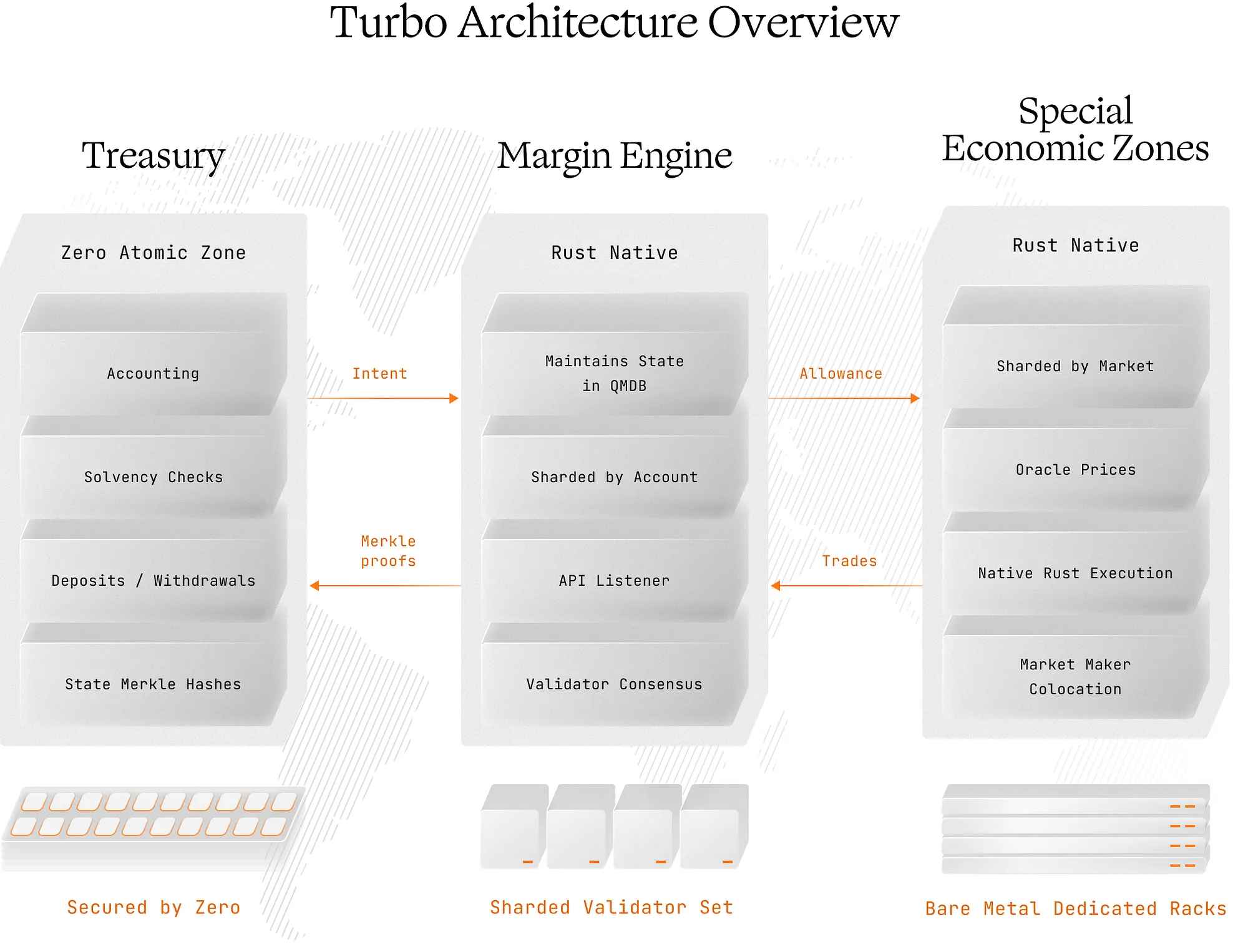
If we examine GTE’s architecture, it consists of roughly three distinct layers, each designed to perform a specialized function in order to achieve maximum performance. They can be outlined as follows:
Special Economic Zones (SEZs):
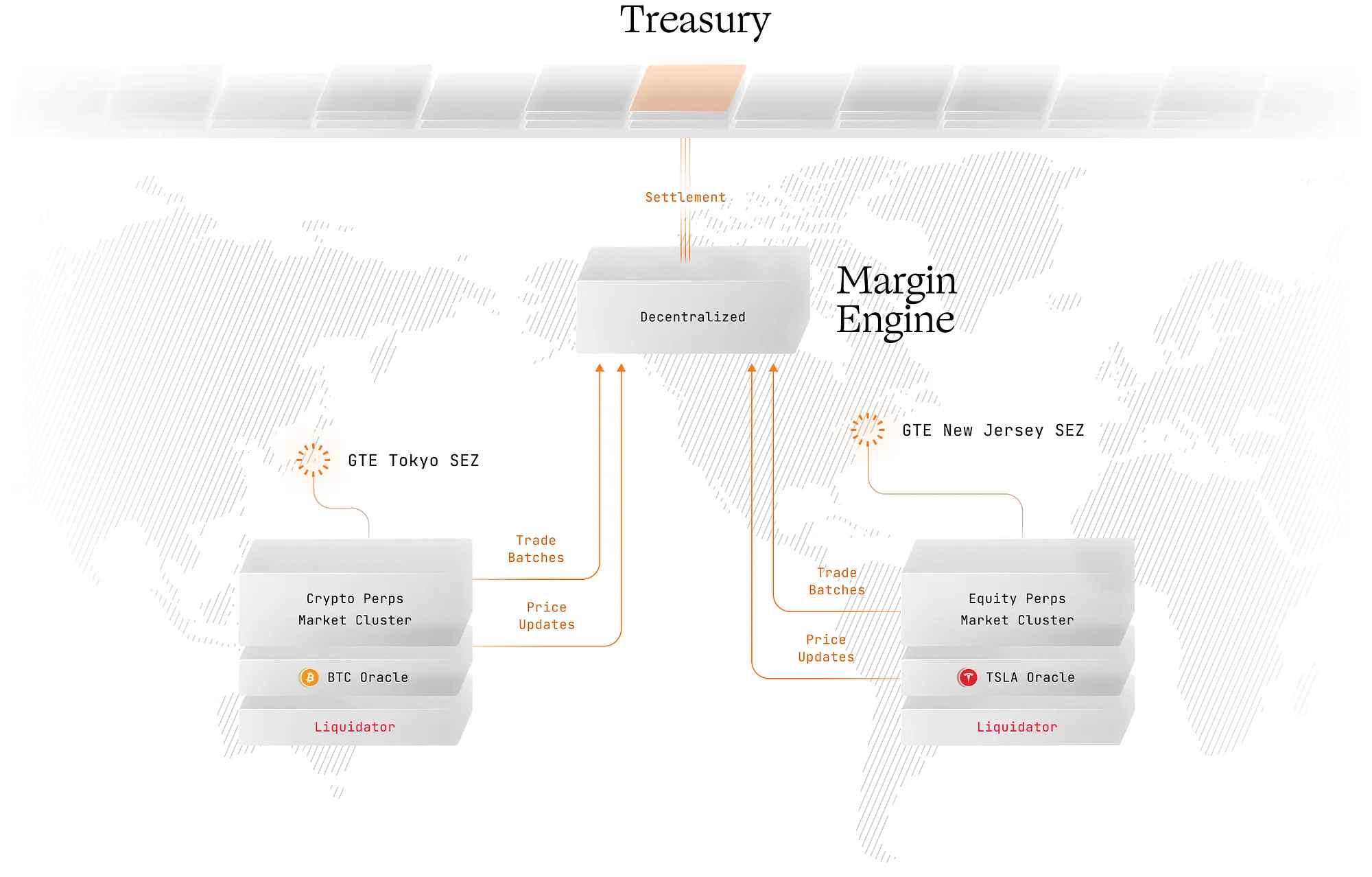
SEZs can be understood as ultra-high-speed matching engines — the execution layer capable of processing millions of orders per second with nanosecond-level latency. In traditional financial markets, this corresponds to the exchange’s matching engine. For professional traders, the ability to receive and react to price changes even fractions of a second faster directly impacts profitability, making latency minimization structurally critical. For this reason, SEZs are deployed on bare-metal servers rather than public cloud infrastructure and are physically located near major financial hubs where price discovery occurs. The goal is to ensure that newly formed price information reaches the matching engine with minimal delay. Because SEZs operate on separate physical infrastructure, they function as an off-chain execution layer, while final settlement occurs on-chain — effectively separating speed from security.
Margin Engine:
The Margin Engine serves as GTE’s equivalent of a clearing house. When an order is submitted, it verifies whether the trade can be executed within the user’s available margin and risk limits, and calculates the required collateral. It also analyzes account states across the system to manage aggregate risk, reflects real-time profit and loss (PnL) as prices fluctuate, and continuously monitors maintenance margin levels to determine whether liquidation is necessary. In short, the Margin Engine is not merely a calculator but the core risk control infrastructure that preserves the stability of the exchange.
Treasury Layer:
The Treasury Layer is responsible for final settlement. Users deposit and withdraw funds through this layer, and all post-trade settlement is ultimately finalized here. In some respects, it performs functions similar to those of DTCC in traditional finance — particularly in terms of custody and settlement.
Within GTE’s three-layer architecture, the component that incorporates independent consensus is the Margin Engine layer. To summarize: SEZs handle ultra-low-latency execution via physical bare-metal infrastructure; the Margin Engine establishes account states, collateral requirements, PnL, and liquidation criteria at the network level through its own consensus mechanism (e.g., the Minimmit Consensus Protocol); and the Treasury Layer leverages Zero — LayerZero’s next-generation Layer 1 blockchain — for deposits, withdrawals, and final settlement.
This structure suggests two broader implications.
First, future blockchain designs may increasingly move away from monolithic architectures that attempt to encapsulate all functions within a single chain. Instead, we may see more systems that separate domains requiring consensus, domains requiring extreme speed, and domains requiring final settlement. In other words, even a network with its own independent consensus does not necessarily need to function as a single all-encompassing Layer 1.
Second, the decision to use Zero as the Treasury Layer implies that Zero may aspire to be more than just another new Layer 1. It could potentially position itself as infrastructure for the final ownership and settlement of global assets — in effect, something akin to a digital-era DTCC. Of course, a more definitive assessment will require concrete implementations and regulatory alignment from both GTE and Zero. Nonetheless, this architecture signals that the era of categorizing blockchains simply as Layer 1 or Layer 2 may be coming to an end. It demonstrates that systems can possess independent consensus while still coexisting symbiotically with other Layer 1 networks — a design approach that may point toward the next generation of financial infrastructure.