LayerZero's newly unveiled L1 blockchain, "Zero," has attracted strategic interest from Wall Street's core infrastructure players, including Citadel Securities, DTCC, and ICE. For a blockchain that has not yet launched its mainnet, this level of engagement is remarkable. It reflects the expectation that Zero can address institutional-grade financial infrastructure requirements that existing blockchains have structurally failed to deliver.
Zero targets 2 million TPS alongside Raspberry Pi-level decentralized verification through a full-stack suite of technological innovations: real-time proof generation powered by the Jolt zkVM, automatic parallel execution via FAFO, QMDB's 3 million state updates per second, and SVID-based data availability. This can be considered one of the most contemporary solutions to the blockchain trilemma.
Rather than incrementally improving existing blockchains, Zero opted for a ground-up redesign. What sets it apart is that demand was secured before the technology was built. Partnerships with Citadel, DTCC, and ICE mean that the pathway for massive traffic at mainnet launch is already in place. This positions Zero as one of the strongest candidates to trigger crypto's mass adoption.
Source: LayerZero
This week's most significant topic in the crypto industry was the reveal of "Zero," LayerZero's own Layer 1 blockchain. The announcement itself drew attention, given that LayerZero is the undisputed leader in cross-chain interoperability. But what made it even more compelling were the names that accompanied the reveal.
Citadel Securities, the world's largest market maker, handling roughly 35% of U.S. listed retail equity volume, made a strategic investment in the ZRO token. DTCC, the entity responsible for settlement infrastructure in U.S. equity markets, stated it would explore using Zero for tokenized securities and collateral management. ICE (Intercontinental Exchange), the parent company of the New York Stock Exchange, announced plans to explore Zero as infrastructure for 24/7 tokenized markets. And Cathie Wood of ARK Invest joined the advisory board.
It is exceptionally rare for Wall Street's core infrastructure firms to show this level of interest in a blockchain that has not even launched its mainnet. So why did they choose Zero over the countless blockchains already in existence?
My view is that Zero has clearly broken through something that existing blockchains were structurally unable to provide.
Yet, aside from LayerZero's own technical blog posts, there is almost no in-depth writing on Zero's architecture, and retail participants can only work with a limited understanding. This article therefore aims to take a closer look, based on publicly available information, at how Zero is structured, what design rationale underlies its key choices, and which aspects remain undisclosed or in need of further clarification.
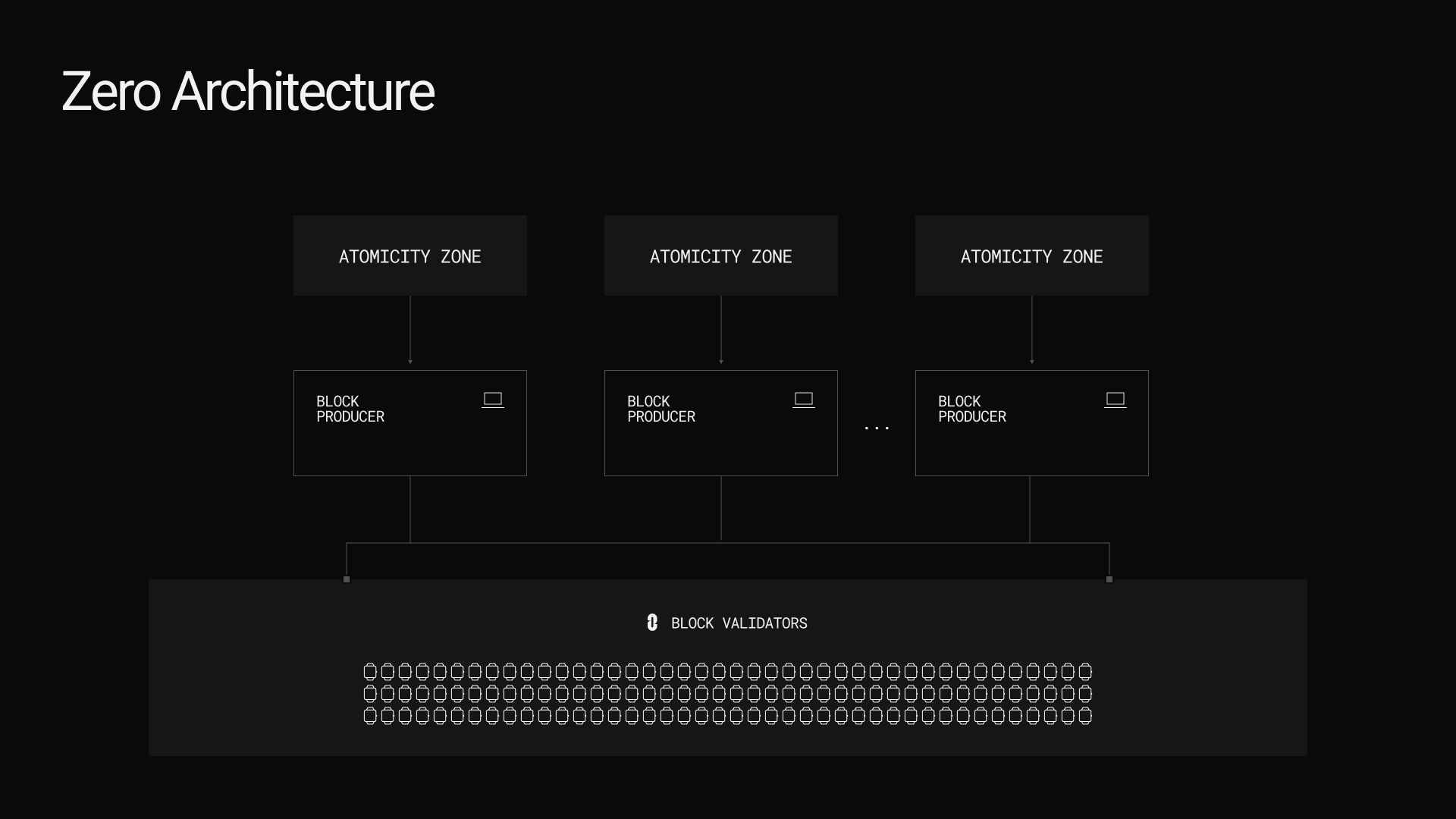
Zero is, at its core, a blockchain. It therefore contains all the fundamental elements you would expect: transaction execution and state transitions, block production, state validation, and state storage. The most distinctive feature of Zero's architecture is what it calls the "Atomicity Zone", a separated execution environment.
Source: LayerZero
For readers familiar with the Ethereum ecosystem, each Atomicity Zone can be loosely compared to an enshrined zero-knowledge rollup (note that this is my own interpretive framing).
Each Atomicity Zone processes state transitions independently. In simpler terms, each Zone manages its own state through an arbitrary execution environment, whether that be the EVM, SVM, or something else entirely. Within each Zone sits a component called the Block Producer, whose role is similar to what a sequencer does in the conventional Ethereum rollup architecture. The Block Producer executes user transactions to produce state transitions, constructs blocks, and generates a zero-knowledge proof attesting to the validity of that execution. These proofs are then verified by Block Validators, which make up Zero's settlement layer. Each Zone is operated in parallel by Zero.
At this point, some readers may be inclined to dismiss Zero as simply a collection of appchains bundled together, or to compare it to prior architectures that paired parallel execution chains with a single settlement chain: Polkadot's parachains, Avalanche's subnets, or TON's workchains.
However, Zero's technical features distinguish it fundamentally from any existing blockchain. The following sections examine these in detail.
2.2.1 Execution Environment Abstraction
Zero's most significant differentiator is that its Atomicity Zones are not bound to any specific virtual machine. Whether it is the EVM, SVM, or an entirely new execution environment, all can operate on the same verification pipeline.
This is possible because Zero adopts Jolt, a zkVM, as its core proving engine. Jolt compiles high-level languages like Rust and C++, as well as existing blockchain clients like Geth and Reth, into RISC-V, a general-purpose instruction set architecture (ISA), for execution. In other words, regardless of the language or logic the Block Producer uses to execute transactions, at the proof generation stage, everything is translated into a RISC-V execution trace.
This design allows each Atomicity Zone to run completely different logic while still enabling real-time verification. For example, one Zone could run an execution environment optimized for high-frequency trading, while another provides an EVM-compatible environment, yet both submit proofs to the settlement layer in the same RISC-V-based format.
2.2.2 Real-Time Proof Generation
Zero's Atomicity Zones generate zero-knowledge proofs at near real-time speeds. Understanding how this is possible requires looking at Jolt's design philosophy.
Conventional zkVMs convert CPU computations into complex polynomial-based arithmetic circuits. While mathematically precise, this approach is inherently slow and carries substantial computational overhead. Jolt (Just One Lookup Table) fundamentally inverts this paradigm. It realizes a concept known as "lookup singularity": instead of directly performing and proving complex computations, it references a massive table containing the input-output results of all possible instructions and simply looks up the answer.
An analogy may help. Instead of "compute 2 + 2 and prove the computation is valid," Jolt reframes the problem as "prove that you are pointing to the row in a pre-computed table where the result of 2 + 2 is 4." This dramatically simpler formulation delivers a step-change improvement in proof generation efficiency.
On top of this foundation, LayerZero pushes Jolt's performance to the extreme with Jolt Pro, a previously undisclosed technology. LayerZero assembled its own team of cryptographers to develop Jolt Pro, building on a16z crypto's open-source Jolt codebase. (Collaboration with a16z crypto took place during the GPU-friendly algorithm design process.)
Jolt Pro optimizes the memory access patterns central to the lookup table approach for large-scale parallel processing, designed to extract maximum throughput from high-performance GPU and FPGA clusters. In short, it amplifies Jolt's software innovation with an additional layer of hardware acceleration.
According to published specifications, Jolt Pro can prove RISC-V instructions at speeds exceeding 1.61 GHz per cell (unit cluster), which LayerZero claims is approximately 100 times faster(Ref.) than competing zkVMs.
Existing blockchains hit scalability walls not simply because of CPU speed. In reality, two hidden bottlenecks were the more fundamental constraints: scheduling and database I/O. Zero tackles both head-on with two technologies: FAFO and QMDB.
2.3.1 FAFO (Fast Ahead of Formation Optimization)
Existing blockchains, Ethereum in particular, had to process transactions sequentially. Since one transaction had to complete before the next could begin, the entire network's throughput was effectively capped by the performance of a single CPU core. Zero eliminates this fundamental constraint with the FAFO engine.
Most blockchains process transactions one after another. Even unrelated operations are lined up in sequence as a precaution against errors, and this sequential processing requirement is what prevents scaling, regardless of how much additional hardware is thrown at the problem. FAFO was designed specifically to solve this.
At its core, FAFO automatically analyzes whether transactions conflict with one another at the engine level. It identifies non-conflicting transactions and rearranges them for parallel execution. Crucially, this process imposes no additional burden on developers or users. Developers can continue writing code that assumes sequential execution; the complexity of parallelization is absorbed entirely by the engine.
Another important feature FAFO provides is "hotspot isolation." Even when traffic concentrates on a specific Atomicity Zone or a specific piece of state, causing congestion, the fees and processing speeds of unrelated transactions remain completely unaffected.
2.3.2 QMDB (Quick Merkle Database)
For 2 million TPS to be a genuine technical target rather than a marketing slogan, storage speed matters more than CPU performance. The Merkle Patricia Trie structure used by Ethereum requires traversing a tree to access data, resulting in O(log n) complexity, with the resulting excessive disk I/O creating severe bottlenecks. The severity of this problem is widely recognized across the industry: Monad has built its own MonadDB, and Ethereum itself is discussing a transition to Verkle Trees.
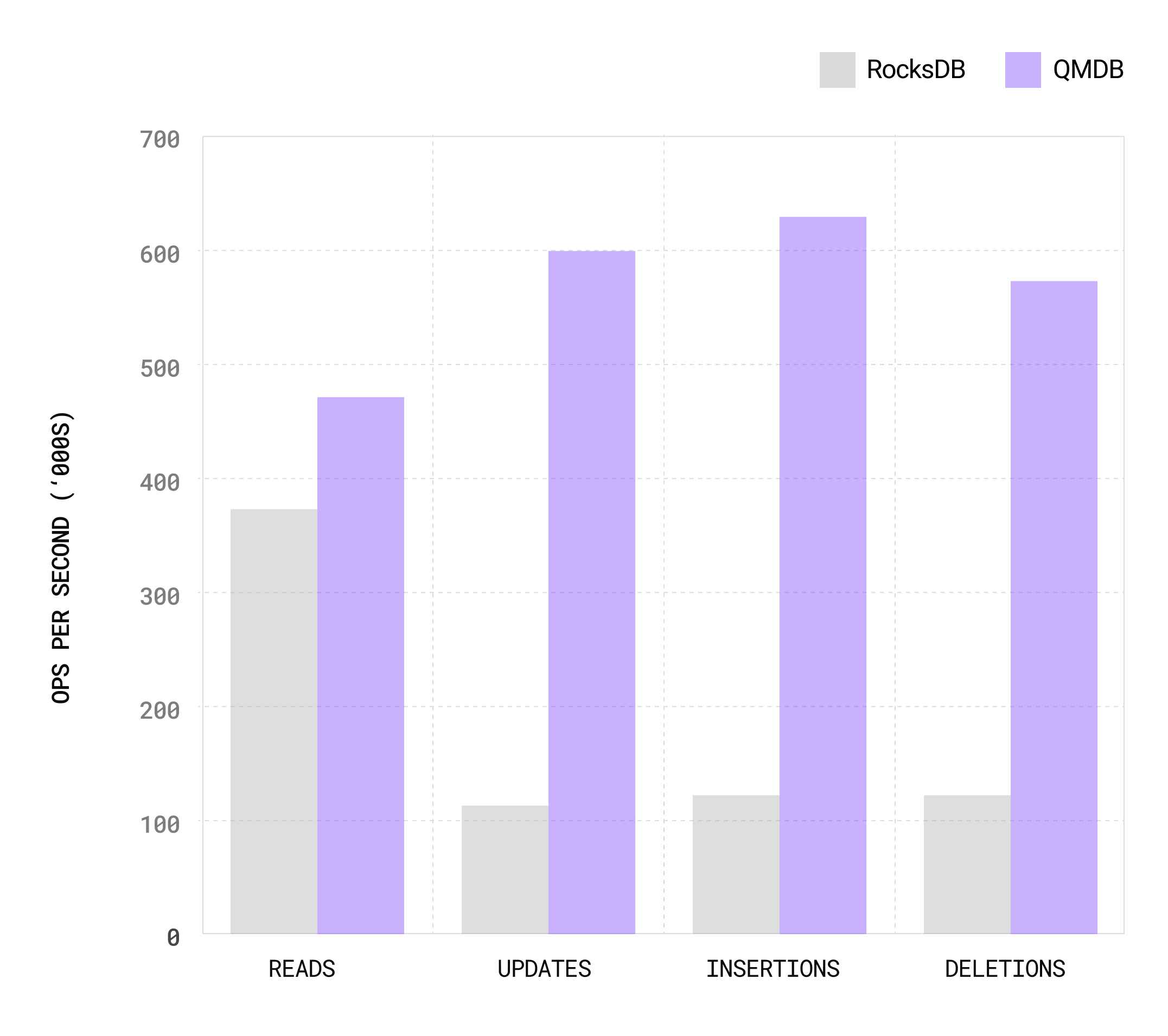
Zero addresses this with QMDB (Quick Merkle Database), a fundamentally new database. QMDB employs a log-based flat storage structure designed to fully utilize the hardware capabilities of modern SSDs. Rather than traversing a tree to locate data, QMDB processes data access in near-constant O(1) time. Write operations are not committed individually either; they are batched asynchronously and written together.
Source: LayerZero
As a result, QMDB can handle 3 million state updates per second. This is roughly 100 times faster than existing blockchain databases and about 6 times faster than RocksDB, the industry-standard database developed by Meta. The 2 million TPS figure can even be discussed as a feasible target only because QMDB exists.
A throughput of 2 million TPS inevitably raises data availability (DA) concerns. How are ordinary nodes supposed to handle data pouring in at gigabytes per second? High-performance throughput and decentralized verification appear to be physically irreconcilable goals. Zero resolves this dilemma through two mechanisms: verification asymmetry and SVID.
2.4.1 Verification Asymmetry
The core of Zero's design philosophy lies in a clear separation of roles. Execution is handled by Block Producers equipped with high-performance hardware, while verification is handled by decentralized validators running on minimal hardware. This asymmetric structure is possible because of the inherent properties of zero-knowledge proofs. Block Validators do not need to re-execute transactions. They only need to verify the zero-knowledge proofs generated by Jolt, and this verification process requires near-constant cost regardless of the proof's size or the complexity of the original computation. As a result, validators can run on very modest hardware.
2.4.2 SVID (Scalable Verifiable Information Dispersal)
The real challenge, however, lies not in the proofs but in the data. For validators to check a zero-knowledge proof, they must know that the block's data actually exists somewhere on the network. Propagating the data generated at 2 million TPS through conventional P2P gossip protocols is physically impossible.
SVID (Scalable Verifiable Information Dispersal) was introduced to solve this. SVID splits block data into small fragments using erasure coding and distributes them across the network. Validators can statistically confirm that data has been properly dispersed through random sampling alone, without downloading the entire block.
A particularly noteworthy aspect is that SVID uses authenticated high-speed channels for inter-node communication. By securing data transmission bandwidth of 10 GB/s, more than 1,000 times faster than Ethereum's PeerDAS, Zero chose to transmit data at high speed and verify through sampling, rather than storing data on every node. This is an approach that redefines the data availability problem from the lens of "transmission" rather than "storage."
Source: LayerZero
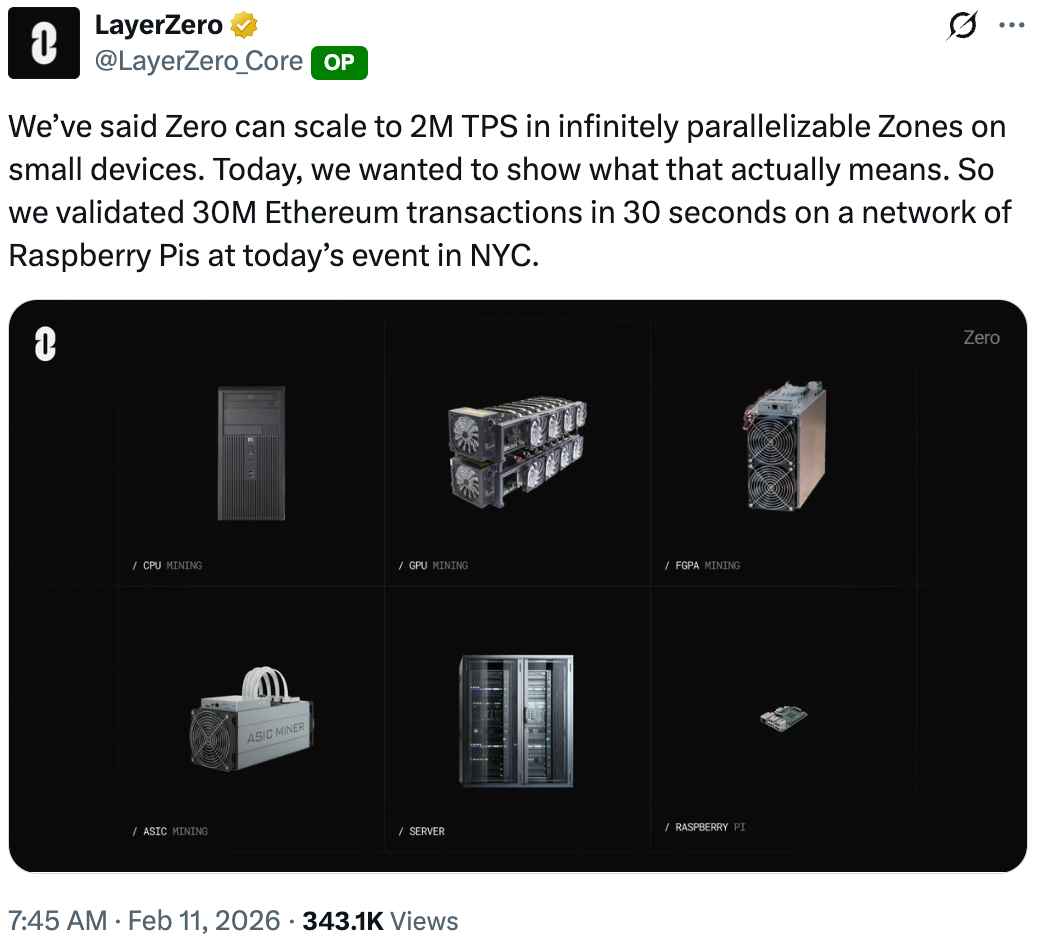
The results produced by this combination of technologies are impressive. During a live demonstration in New York, a validator node built from a Raspberry Pi verified one month's worth of Ethereum mainnet transactions (approximately 30 million) in just 30 seconds. It was a moment that suggested two seemingly contradictory goals, ultra-high throughput and ultra-low-spec decentralized verification, can in fact be achieved simultaneously.
For the high-performance Zones described above to function as a single cohesive organism rather than fragmenting into silos, robust and efficient governance is essential. Zero seeks to solve this challenge not through technical constraints, but through a political system.
2.5.1 Unified Governance
The most pressing problem facing the Ethereum L2 ecosystem today is fragmented governance and divergent roadmaps. Each L2 has its own set of interests and develops in its own direction, resulting in scattered liquidity, a convoluted user experience, and declining efficiency across the ecosystem as a whole.
Zero's Atomicity Zones are built on a fundamentally different philosophy. Individual Zones do not possess independent sovereignty. Under the principle that "all Zones are owned by Zero," the addition, upgrade, or deprecation of any Zone can only be decided through Zero's on-chain governance. By analogy, Zero operationally resembles a federal state governed by a single constitution. Each Zone autonomously performs its specialized function, but ultimate governing authority rests with Zero. This design eliminates liquidity fragmentation at its root and enables a consistent user experience.
2.5.2 The Senator Model
A chronic problem in blockchain governance is the lack of expertise and voter apathy. It is unrealistic to expect average token holders to independently verify and rationally vote on complex changes to zero-knowledge technology or economic models. As a result, most governance systems end up dominated by a handful of large holders, or suffer from extremely low voter turnout.
Zero addresses this with the "Senator Model," which consists of three core components.
The first is expert-led decision-making. Verified experts in fields such as cryptography and economics serve as Senators and lead technical decisions. Rather than requiring every voter to understand the technical details of each proposal, the system allows them to delegate judgment to domain experts.
The second is liquid democracy. ZRO holders can delegate their voting rights to Senators they trust. This is similar to traditional representative democracy, but augmented by the transparency and immediacy inherent to blockchain.
The third is non-permanent delegation. Holders can revoke their delegation at any time or directly vote to override a Senator's decision as a final exercise of authority. This design seeks to capture both the convenience of delegation and the checks and balances of direct participation.
2.5.3 Removal of Automatic Slashing
Zero consistently applies the philosophy that "decentralization comes not from making validators work harder, but from making them work less" to its economic model as well. The greatest psychological and economic barrier preventing ordinary users from becoming validators is the fear of slashing. The risk that staked assets could be partially confiscated if a node temporarily goes offline or sends an incorrect response due to a software bug effectively pushes less technically proficient participants out of the network.
Zero has boldly removed automatic slashing from its consensus layer. Clearly malicious attacks such as double-signing are punished through governance-based judicial procedures, but automatic penalties for simple node downtime or software bugs have been eliminated. This decision serves as a key incentive for Raspberry Pi-level validators to participate in the network as watchdogs, free from economic risk.
2.5.4 The Elevation of $ZRO
Under the original LayerZero protocol, ZRO's utility was limited as a governance token. With the launch of the Zero chain, however, ZRO's role undergoes a fundamental upgrade: it becomes the native gas token and a core element of network security. Users pay ZRO as gas to access the network's 2 million TPS throughput, and the collected ZRO is redistributed as incentives to validators and Senators. This creates an economic flywheel where growing network usage translates into greater rewards for verification and governance.
Zero's blueprint is undeniably a refreshing approach. If Zero succeeds to be implemented just as described in current design, it deserves to be recognized as one of the most contemporary answers to the blockchain trilemma. However, several important points remain unverifiable from publicly available information alone.
2.6.1 Censorship Resistance
Zero's design clearly gives validators the authority to reject invalid blocks, providing solid guarantees around safety. But questions remain about liveness: the guarantee that the network will continue to operate without halting. If Block Producers intentionally ignore a specific user's transactions, or if Block Producers collude to stop producing blocks, the mechanism to forcibly resume operation has not been clearly disclosed.
Ethereum's L2s maintain an "escape hatch" that allows users to submit transactions directly to L1 if a sequencer attempts censorship. But Zero is not an L2; it is the L1 itself. If high-performance Block Producers form a cartel, what options do Raspberry Pi validators have beyond "rejecting invalid blocks, effectively halting the network"? Whether an active mechanism exists to counter censorship is a question that must be answered before mainnet launch.
2.6.2 Senator Authority
The Senator Model is an excellent governance tool for securing expertise. However, a question remains: can governance-based "judicial procedures" keep pace with blockchain speed? Blockchains operate on the scale of milliseconds, while governance votes and consensus-building can take days to weeks. For ordinary token holders' "override votes" to serve as a meaningful check when Senators collude or are compromised, the voting process must be sufficiently fast and accessible. Whether this is realistically achievable cannot be judged until concrete governance parameters are disclosed.
2.6.3 Specifics of Proof Verification
Sections 2.2 and 2.4.1 describe the structure in which Jolt Pro generates zero-knowledge proofs and Block Validators verify them. However, critical technical details about how verification concretely works have not been made public.
The first concern is the unit of proof. It is unclear whether the zero-knowledge proofs generated by Block Producers are at the transaction level, batch proofs at the block level, or whether different units apply to different Atomicity Zones. The QMDB paper states that "state roots can be generated at the transaction level if desired," suggesting transaction-level proofs are technically feasible, but the actual strategy Zero employs could not be confirmed.
Second, the computational structure on the validator side is unclear. It has not been disclosed whether verification is performed through on-chain precompiles or is embedded in the protocol-native consensus logic. Given that each Atomicity Zone can run a different execution environment, it also needs to be confirmed whether proofs generated from different Zones follow a uniform format. Since Jolt unifies all execution into RISC-V instructions as described in this article, a unified verifier seems likely, but this has not been formally stated.
Third, it is unclear whether proofs generated simultaneously from multiple Atomicity Zones are recursively aggregated. If dozens of Zones each produce block-level proofs, there could be significant differences in verification cost and finality time between validating each one individually versus compressing them into a single aggregated proof. Admittedly, only three Atomicity Zones have been officially announced so far (a general-purpose Zone, a global market Zone, and a payments Zone), so this question may be premature.
2.6.4 Consensus Protocol and Finality
There is almost no detailed description of the consensus mechanism in the available materials. LayerZero's official blog mentions only "Delegated Proof-of-Stake (DPoS)" and "supermajority agreement," with no specifics on the consensus framework or finality time.
This is especially important given that Zero aims to serve as institutional financial infrastructure. In trading and settlement workflows, finality time is a critical system design parameter, and DTCC or ICE would need this figure to be clearly defined before considering real-world adoption. Even if 2 million TPS is achieved, if finality latency exceeds several seconds, applicability in time-sensitive use cases such as high-frequency trading could be limited.
2.6.5 Interoperability Between Atomicity Zones
Given Zero's architecture of running multiple Atomicity Zones in parallel, how interoperability between Zones will work remains an open question.
Based on currently available information, two possibilities can be inferred. The first is that LayerZero leverages its interchain messaging protocol, already battle-tested across more than 165 connected blockchains, for inter-Zone communication. The second is that the structural characteristic of all Zones being owned by a single protocol and sharing the same settlement layer enables protocol-native atomic transactions without external messaging. The latter would be more ideal, as it would eliminate latency and trust assumptions at their source, but no mention of such a mechanism has been found.
A close analysis of Zero's architecture leads to an intriguing conclusion. Zero's design bears a striking resemblance to the final form Ethereum is trying to reach over the course of years. The difference is that Zero started from a clean slate, unencumbered by Ethereum's legacy, and implemented that vision in a compressed timeframe.
3.1.1 Scaling Without Fragmentation
Ethereum adopted a rollup-centric roadmap for scalability, but this choice produced severe side effects: liquidity fragmentation and a complicated user experience. Discussions around based rollups and enshrined rollups are underway to address these issues, but realization remains distant due to resistance from existing L2s, which have already built independent ecosystems and vested interests, as well as the sheer technical complexity involved.
Zero's Atomicity Zones may be the closest implementation to the enshrined rollup concept Ethereum aspires to. All Zones share L1 security and governance as integral parts of the Zero protocol, with thousands of execution environments functioning as if they were a single chain. Zero captures the scalability of L2s without sacrificing the unified liquidity and user experience of an L1, embedding that ideal structure into its design from the outset.
3.1.2 RISC-V zkVM
Vitalik recently posted a long-term proposal on the Ethereum Magicians forum aimed at simplifying Ethereum's execution layer. In it, he suggested the possibility of replacing the EVM with a general-purpose instruction set like RISC-V to dramatically improve SNARK proof efficiency.
However, the enshrined zkEVM approach of implementing each EVM opcode as a zero-knowledge circuit carries a structural problem: circuit complexity explodes with every EVM upgrade. The alternative proposed was to compile EVM execution code into a simple, standardized ISA like RISC-V, and then prove the execution of that ISA.
Zero's Jolt demonstrates the potential to turn Vitalik's hypothesis into reality. Rather than struggling to optimize the ZK-unfriendly EVM, Zero skips that process entirely and runs EVM clients themselves (Geth, Reth, and others) on top of RISC-V. This achieves the goal of execution environment abstraction. Even if the EVM changes in the future or an entirely new VM is introduced, the verification layer only needs to handle a single instruction set: RISC-V.
3.1.3 Stateless Clients
Ethereum's state bloat problem has made it increasingly difficult for ordinary users to run full nodes. To address this, efforts are underway to introduce Verkle Trees and stateless clients, but this transition is also proving difficult due to compatibility issues with existing infrastructure. Zero never encounters this problem in the first place. Since validators do not re-execute transactions, they have no need to store state at all. Statelessness is the default.
3.1.4 DAS and SVID
Ethereum is pursuing Danksharding to support rollup scalability by verifying data availability through sampling. SVID already possesses 10 GB/s bandwidth and sampling technology, with mainnet specifications that far exceed the throughput Danksharding ultimately aims to achieve.
Taken together, these parallels support the interpretation that Zero is a version of each component in Ethereum's roadmap, designed from scratch in its optimal form, free of legacy constraints.
3.2.1 Incremental Improvement vs. Ground-Up Redesign
Over the years, numerous high-performance EVM projects have taken the approach of repairing and upgrading a massive ship while it is still at sea. The achievements of these projects, delivering incremental improvements in parallelization, database optimization, and consensus algorithm refinement, are worthy of respect.
But Zero took a completely different path. It inherits Ethereum's core values (decentralized verification and a programmable blockchain) while redesigning the entire underlying skeleton from scratch. The RISC-V-based Jolt, the removal of automatic slashing, and the Senator Model are all products of boldly dismantling and reassembling design assumptions that existing blockchains had long taken for granted.
3.2.2 Synchronizing Technology and Liquidity
Crypto history has repeatedly shown that even the most technically superior chain becomes a ghost town if users and capital do not arrive. From this perspective, the most noteworthy aspect of Zero is that demand was locked in before supply was initiated.
The participation of Wall Street's core infrastructure firms like Citadel, DTCC, and ICE as partners means that the highway for massive traffic from global equities, bonds, and derivatives is already paved by the time mainnet launches. Technology is not waiting for business; rather, the enormous demands of business called forth the limits of technology. Zero is, without question, one of the most promising candidates to become the trigger for the mass adoption that crypto has long been searching for.


Dive into 'Narratives' that will be important in the next year


 LayerZero
 Ethereum
 Pharos
 Solana