Lido faces two competing challenges: decentralization and operator reliability. IDVTC is a strategic attempt to address both simultaneously by combining identity verification (ICS) with DVT.
Lido has spent two years validating DVT adoption through SimpleDVT, and the voluntary DVT adoption observed within CSM serves as the foundation for proposing IDVTC.
IDVTC converts DVT's risk reduction into economic incentives. Distributed validator operation lowers the risk of penalties and slashing, and that reduced risk translates into lower bond requirements and greater capital efficiency. For Lido, which pursues both structural safety and decentralization, IDVTC is a significant milestone.
Lido is the largest Ethereum staking pool, at its peak holding over 30% of all staked ETH. As a result, Lido has long faced criticism for being a centralizing force in Ethereum's infrastructure. In response to this criticism, and to contribute to Ethereum's vision, Lido has consistently worked to decentralize its operator set. It has been gradually reducing the dominance of its Curated module, which consists of 39 professional node operators, while expanding its operator pool through SimpleDVT and the Community Staking Module (CSM) by lowering participation requirements and growing a community-based operator ecosystem.
At the same time, Lido faces a challenge pulling in the opposite direction. Its market share has dropped sharply from over 30% two years ago to around 21% as of March 2026. A significant factor is Lido's failure to capture the rapidly growing institutional staking demand.
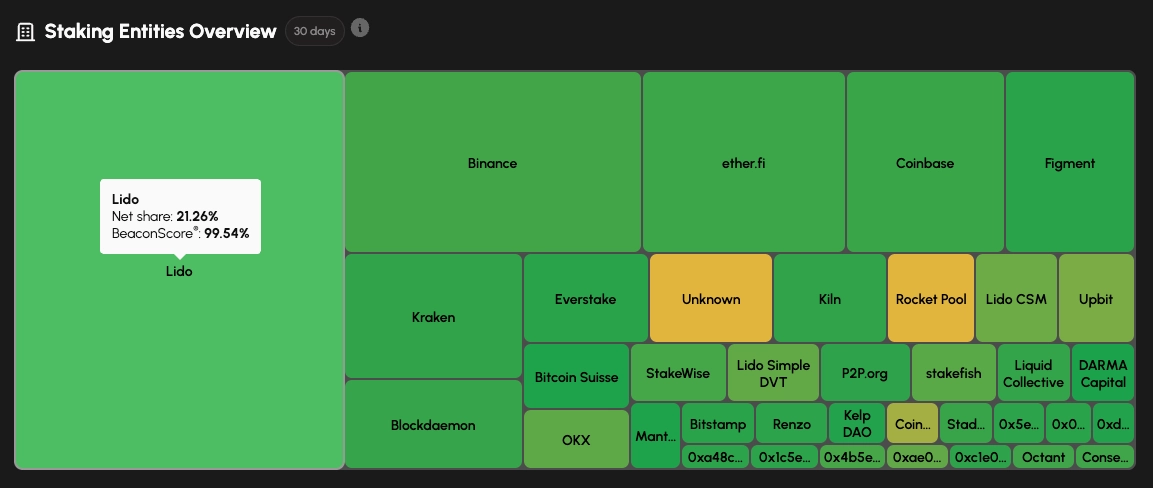
Source: beaconcha.in
The root of the problem lies in the fact that PoS staking does not guarantee the return of principal. Penalties can occur depending on the competency of the operators running the validators, and in the worst case, slashing can happen. Slashing incidents have occurred within Lido on several occasions as well.
For this reason, institutions prefer to contract directly with exchanges or licensed professional validator firms such as Figment, Blockdaemon, and Kiln, where identity and reliability are guaranteed. This preference is fundamentally at odds with Lido's direction toward permissionless and decentralized operator participation.
This dilemma is illustrated clearly by two recent incidents. On February 14th, a data center bug at Launchnodes, a Curated operator, caused approximately 3 hours and 15 minutes of downtime. 5,572 Lido validators were affected, resulting in a loss of 3.836 ETH. Because Launchnodes was a verified Curated operator, the loss was fully reimbursed by Launchnodes.
On March 12th, a validator operated by a permissionless operator in CSM was slashed. CSM is designed to require operators to bond ETH to cover such incidents, so the loss was covered, but the inherent instability of a permissionless structure remains undeniable.
Lido's vision is a decentralized staking pool open to permissionless participation. However, in Ethereum's PoS environment where staking penalties and slashing exist, decentralizing the operator set inevitably comes with risk.
On March 16th, Lido proposed the introduction of Identified DVT Clusters (IDVTC) to the Community Staking Module (CSM). This is a strategy aimed at striking a balance between Lido's vision of a community-based, decentralized pool and the demand for operator reliability.
Before looking at IDVTC, let's first discuss how Lido has approached the adoption of DVT (Distributed Validator Technology).
In June 2024, Lido deployed a DVT-based SimpleDVT module to mainnet, separate from the Curated module. The SimpleDVT module is a permissioned DVT pool consisting of 82 clusters. DVT is a technology that allows a single validator to be operated collaboratively by multiple operators. By distributing the operational burden, risk is also distributed, and the threshold for becoming a Lido operator can be lowered.
The SimpleDVT module was also designed to run for three years before being wound down. In conclusion, SimpleDVT succeeded in proving DVT's stability and performance within the Lido pool. Validators in the SimpleDVT module achieved a RAVER performance of 97.9%, surpassing the Ethereum network average of 97.3%, and naturally encouraged diverse client combinations, contributing to improvements in client diversity.
The CSM module does not mandate DVT usage. Anyone can participate as a solo validator, and whether to use DVT is entirely up to the operator.
Even so, without any incentives or requirements, 20% of CSM validators voluntarily adopted DVT. This figure became the central basis for the IDVTC proposal. As of late 2025, across the entire Lido protocol, 100% of SimpleDVT, 20% of CSM, and 3.5% of the Curated module are using DVT, meaning approximately 8% of all Lido validators are operating with DVT.
If 20% chose DVT without any incentives, then with a properly designed incentive structure, DVT adoption can be driven up systematically. DVT lowers the risk of slashing and allows bond requirements to be reduced while achieving the same or higher level of security. This enables the virtuous cycle of: lower bonds, higher capital efficiency, more participants, and greater decentralization.
IDVTC is the proposal that attempts to systematically design this virtuous cycle.
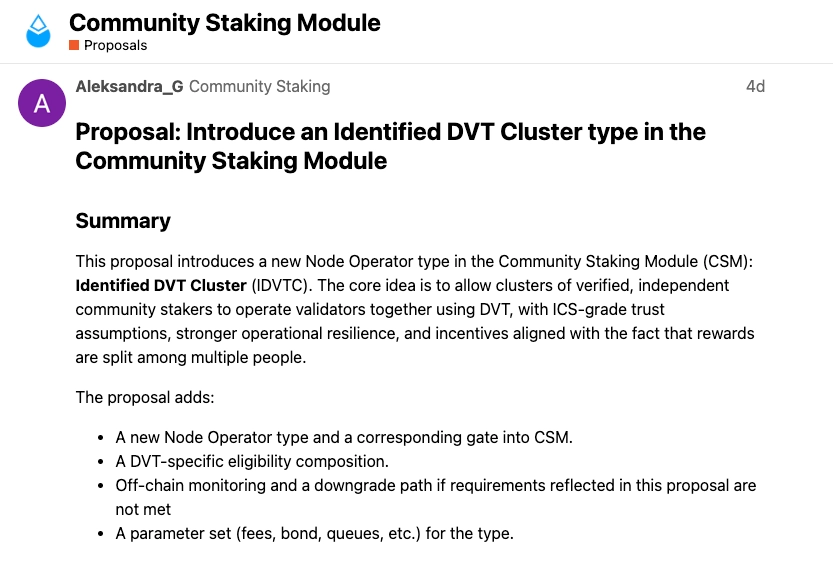
A new proposal was posted to the Lido Research Forum on March 16, 2026. It proposes adding a new node operator type, IDVTC, to CSM v3. In short, IDVTC can be summarized as "a pool where four verified community stakers co-operate validators using DVT."
An IDVTC is a cluster consisting of exactly four independent participants. Each member must hold ICS (Identified Community Staker) status as a verified community operator, and keys must be generated through a DKG (Distributed Key Generation) ceremony using Obol or SSV.
The cluster size for IDVTC is fixed at four operators, which is smaller than the seven-member clusters in SimpleDVT. Having participated as an operator in a seven-member SimpleDVT cluster myself, I can say that coordinating and communicating among seven operators is far more cumbersome than one might expect. The per-validator reward is also diluted among more participants, which makes it less economically attractive. Reducing the cluster size to four is, in my view, an excellent design decision.
The core incentive of IDVTC is capital efficiency. According to the proposed parameters, IDVTC achieves a higher capital multiplier than ICS (solo participation) once the bond exceeds 2.5 ETH. At its peak, up to 3.1x capital efficiency compared to solo staking is possible.
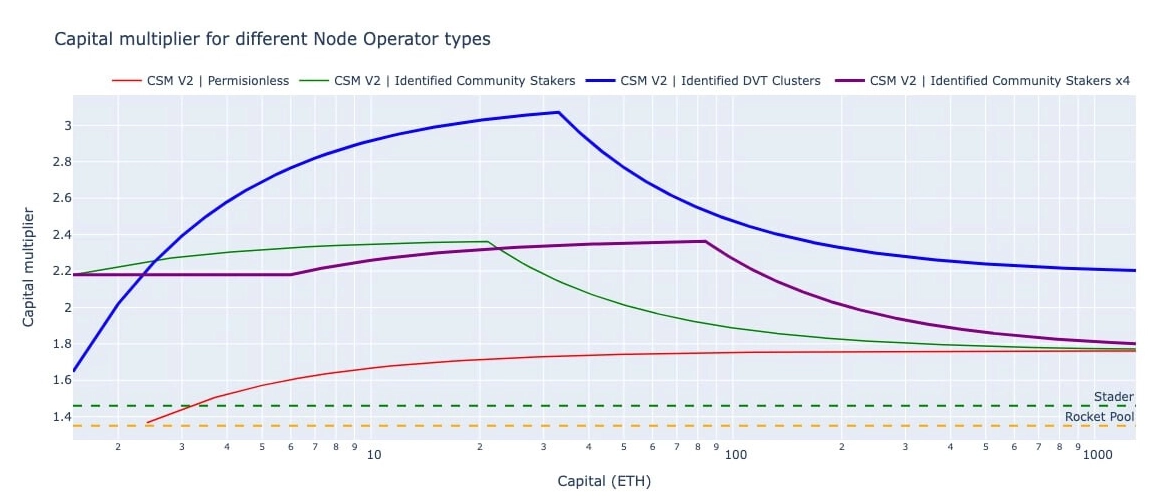
Source: Lido IDVTC Proposal
This economic advantage is directly derived from the security benefits of DVT. The distributed signing structure structurally reduces the risks of slashing, downtime, and EL reward theft. Lower risk allows bond requirements to be reduced proportionally, enabling more validators to be operated with the same capital. Bond reduction translates directly into improved returns.
Governance over IDVTC is delegated to the CSM Committee. The committee holds authority to adjust eligibility criteria, execute Easy Track motions, and pause application intake. If non-compliance is detected, the operator type is automatically downgraded to the default CSM type, and bond requirements are adjusted upward accordingly, which can lead to key ejection.
This governance process matters. It means IDVTC is not just a system of incentives; it also incorporates a structure for imposing penalties on non-compliant operators.
The Curated module, consisting of 39 operators, still accounts for approximately 90% of all validators in Lido. On average, a single operator runs around 7,350 validators. The bar for being selected as a Lido Curated operator is therefore extremely high, which runs directly counter to Lido's vision of decentralization. The community-based, permissionless CSM module, on the other hand, falls short on reliability.
Lido has spent years examining and validating the adoption of DVT. DVT can enhance stability while simultaneously distributing operational risk. It is central to Lido's goal of lowering the barrier for operator participation and ultimately achieving a fully permissionless structure.
Through the SimpleDVT module, Lido has validated that DVT is sufficiently viable in a mainnet environment. Now, Lido has proposed introducing IDVTC to CSM. For Lido, which pursues both structural safety and pool decentralization, the adoption of IDVTC is a significant milestone.
Lido still holds the largest staking share in the Ethereum ecosystem. Lido's direction determines the direction of 20% of Ethereum's infrastructure. In this light, Lido's efforts to adopt DVT, lower the barrier for operator participation, and build a decentralized, permissionless structure are highly encouraging.
Vitalik Buterin has proposed Native DVT as a long-term goal at the Ethereum protocol level, signaling that distributed validator operation is the direction Ethereum's infrastructure is heading. Lido's IDVTC moves in the same direction. The direction of Ethereum and the direction of Lido are aligned.


Dive into 'Narratives' that will be important in the next year


 Lido
Lido Ethereum
 Pharos
 Solana