LayerZero announced "Zero," a new L1 blockchain with app-specific execution environments called "Zones," backed by strategic investments from Citadel Securities, ARK Invest, and Tether, along with collaborations from DTCC, ICE, and Google Cloud.
Zero poses a competitive threat across multiple crypto infrastructure categories at once, challenging modular infra plays, standalone zkVMs, institutional chains, and Ethereum's rollup roadmap by combining high throughput, a 100x faster zkVM called Jolt Pro, and interop across 165+ chains.
The core strategic play is bridging TradFi and crypto, a tokenization platform, while DTCC, Citadel Securities, and ICE are actively evaluating Zero for clearing, settlement, and 24/7 trading infrastructure that goes well beyond crypto-native use cases.
Whether Zero delivers on these promises in production remains the essential question. However, it pushed crypto from the comfort zone.
LayerZero just redrew the boundaries of the crypto industry. With the announcement of Zero, a new Layer 1 blockchain with app-specific isolated execution environments called "Zones," and a revamped interoperability stack, the team behind crypto's dominant cross-chain protocol is making its most ambitious move yet.
Citadel Securities made a strategic investment in ZRO. ARK Invest also invested, with Cathie Wood joining the advisory board. Tether deepened its existing relationship with a direct investment in LayerZero Labs, making it the only token project that Tether and Circle both invested in. DTCC, ICE, and Google Cloud signed on as collaborators. When the world's largest market maker, the parent company of the NYSE, the clearinghouse that processes $2.5 quadrillion annually, and the world's largest stablecoin issuer all show up on the same announcement, the signal is hard to dismiss.
Usually, this kind of announcement, heavy on tech jargon and light on production readiness, amounts to overpromise. Viable on testnets, invisible on mainnet.
But LayerZero is one of the very few projects that actually delivered the tech and dominated its sector in the past. It launched in 2022 with the ambition of becoming the Layer “Zero" of crypto, connecting all L1, and L2 blockchains. It now supports over 165+ mainnets with cross-chain messaging infrastructure. Its OFT standard has become the de facto way to launch tokens across chains, with over $34 billion in assets relying on it, including USDT0, PayPal's PYUSD, Ethena's USDe, and Ondo's USDY. USDT0 alone has facilitated over $70 billion in cross-chain value transfer in under twelve months.
Meanwhile, the previous interop leader IBC remained confined to the Cosmos ecosystem. Wormhole, once dominant in cross-chain asset transfer through wrapped tokens, was forced to respond with NTT after OFT's emergence rendered its approach outdated.
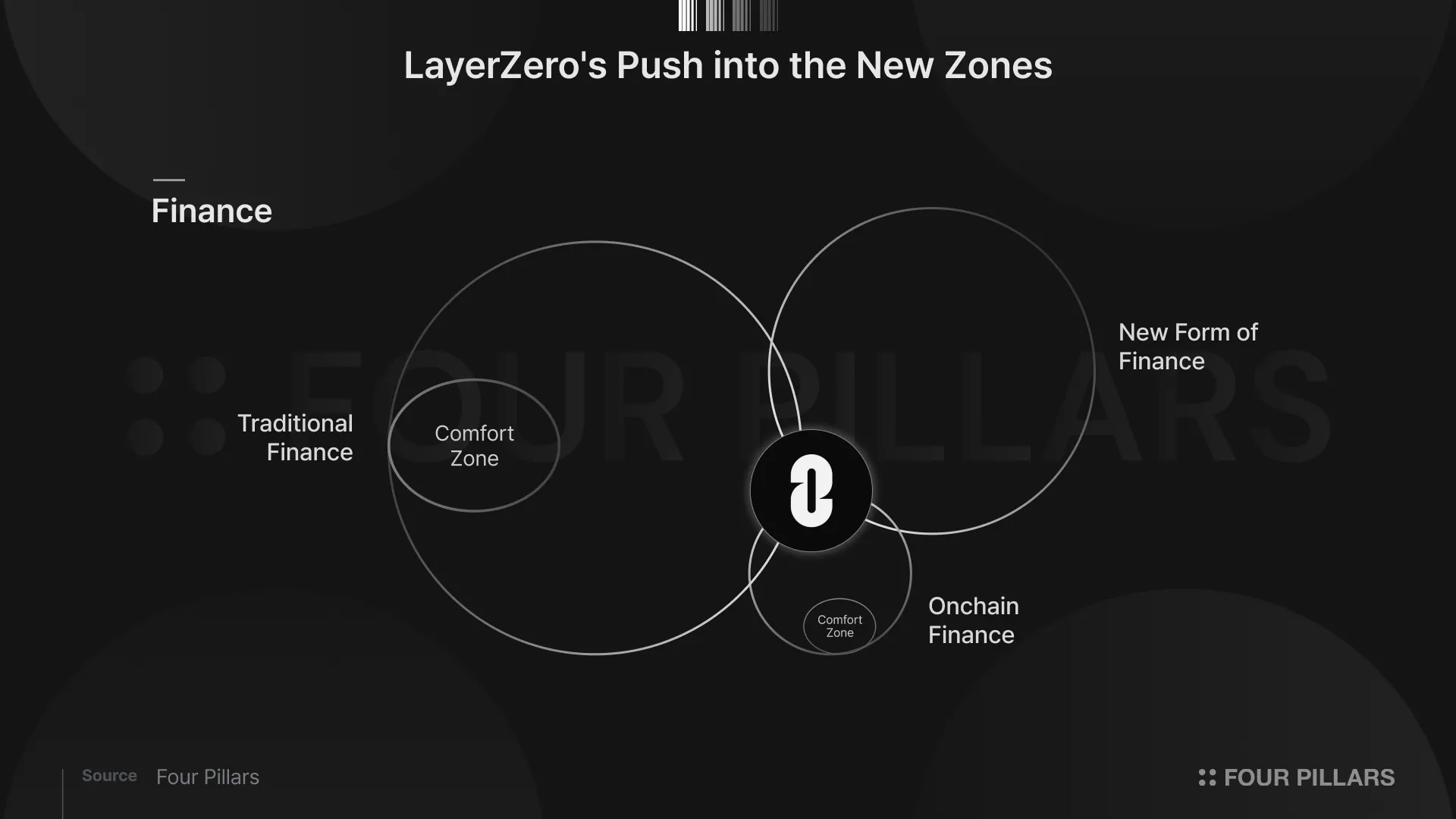
Now, LayerZero is pushing everyone else out of their comfort zone, and opening up the new zones.
As Zero chain provides new infrastructure, these projects need to push better infra.
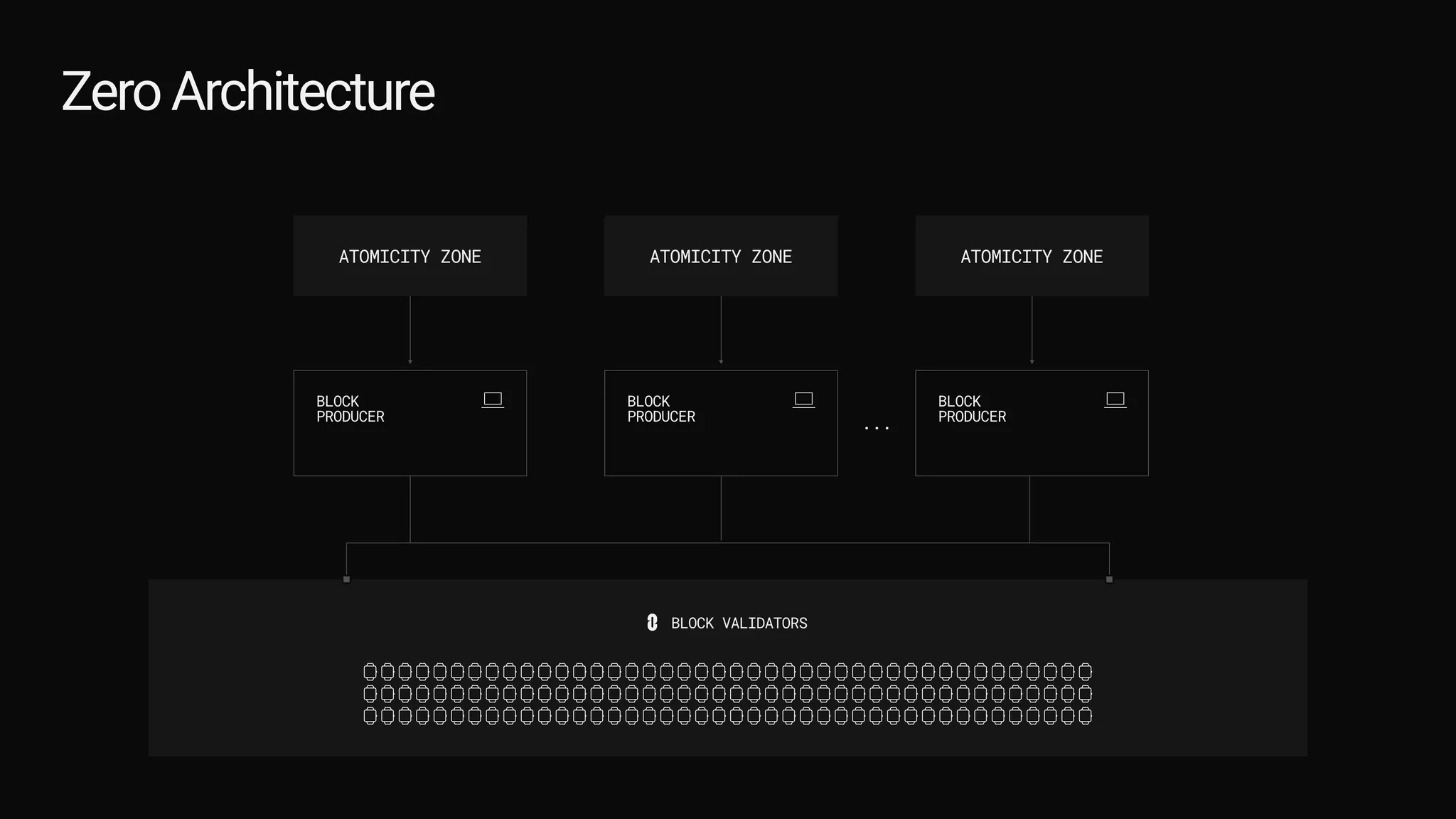
In Zero, application execution happens in Atomicity Zones, asynchronously-executed shards of the Zero blockchain. Atomicity Zones are tightly integrated with and inherit the security of the settlement layer. Zones can be any type of computer application.
Zero: Technical Positioning Paper, LayerZero
The modular thesis was simple: monolithic chains can't scale, so break the blockchain into specialized layers (execution, settlement, data availability, consensus) and let developers mix and match. Projects like Dymension (RollApps), Saga (Chainlets), Initia (Interwoven Rollups), and AltLayer (Restaked Rollups) all bet their existence on this premise, building infrastructure for applications to spin up custom execution environments connected by shared settlement and DA layers.
Zero's heterogeneous Zone system challenges this entire architecture. Each Zone can be purpose-built and optimized for a specific use case, whether that's an EVM general-purpose Zone, a privacy-focused payments Zone, or a high-frequency trading Zone, while sharing a unified security model through ZK proofs.
Why would anyone deploy a Dymension RollApp when they can launch a Zone on Zero with faster execution, native interoperability to 165+ chains, and institutional partners like DTCC and Citadel Securities already evaluating to lauch on the platform? The modular stack was a patchwork solution to a scaling problem that Zero claims to solve at the architectural level.
The value proposition of "spin up your own chain" weakens considerably when a single chain can offer dedicated execution, and millions of TPS per Zone, and best in the industry interop.
Jolt Pro proves RISC-V around 100x faster than existing zkVMs. This leap is what finally makes real-time verifiable computation practical.
Zero-knowledge virtual machines have been one of crypto's most hyped infrastructure categories. RISC Zero, Succinct's SP1, and Nexus have all been racing to build the fastest general-purpose zkVM, each claiming incremental improvements in proving speed and verification cost.
Jolt Pro leveled up the game. Built on a16z's Jolt framework, Jolt Pro proves RISC-V execution approximately 100x faster than existing zkVMs. This isn't incremental. It's a generational leap that makes real-time verifiable computation practical for the first time. Jolt Pro proves RISC-V at over 1.61 GHz per cell, with a clear roadmap to 4 GHz by 2027.
However, the tech needs to be tested in production, but the important thing is that having the right partners to build on their zkVMs. Currently, most zkVM projects struggle to find the right use cases, now mostly focusing on generating proof for zkRollups.
Source: X (@LayerZero_Core)
Blockchain platforms that provide purpose-built for traditional financial institutions also have new competitions. Canton and Avalanche Subnets have carved out a niche by meeting banks and asset managers where they are, offering familiar compliance frameworks, privacy guarantees, and integration paths with legacy infrastructure.
Canton Network is the rising credible player in this space. Developed by Digital Asset, Canton is already in production with a remarkable roster of participants. Goldman Sachs, BNY Mellon, Broadridge, CBOE, and S&P Global have all deployed on Canton, running real workloads in a permissioned environment designed from the ground up for regulated finance. Canton's sub-transaction privacy ensures that participants only see the data they're entitled to, a requirement that is non-negotiable for institutional adoption. Its integration with DTCC's infrastructure, SWIFT messaging, and custodial systems means institutions don't need to rip and replace their technology stack.
Avalanche pursued a parallel strategy through its Subnets (now rebranded as L1s under ACP-77). Evergreen Subnets allow banks to launch permissioned blockchain environments with custom validator sets and compliance controls. Citi, JPMorgan, and WisdomTree have all piloted tokenization projects on Avalanche infrastructure. Yet most remain in pilot stage, and the gap between a successful proof of concept and production deployment remains significant.
Zero's challenge to these platforms is nuanced. It doesn't invalidate Canton's production success or its privacy architecture. Zero proposes a similar but different model through Nexus and LayerZero's interop stack: institutional-grade compliance and privacy (via purpose-built Zones) combined with native connectivity to 165+ public chains. If a tokenized treasury issued through DTCC's infrastructure could simultaneously serve institutional participants in a privacy-preserving Zone and DeFi protocols across every major chain, the addressable market expands dramatically.
Canton's production track record is a genuine competitive moat, and Zero has not yet proven anything in production. But the question is whether a permissioned-first model can capture the full value of tokenization when the end state increasingly looks like a hybrid world, one where institutional assets need to flow between regulated environments and open markets.
Institutional blockchain platforms succeeded by lowering the barrier to entry for traditional finance. Canton did this well and remains in production. But Zero is arguing that the next phase requires infrastructure that collapses the boundary between institutional rails and public networks entirely.
Source: X (@LayerZero_Core)
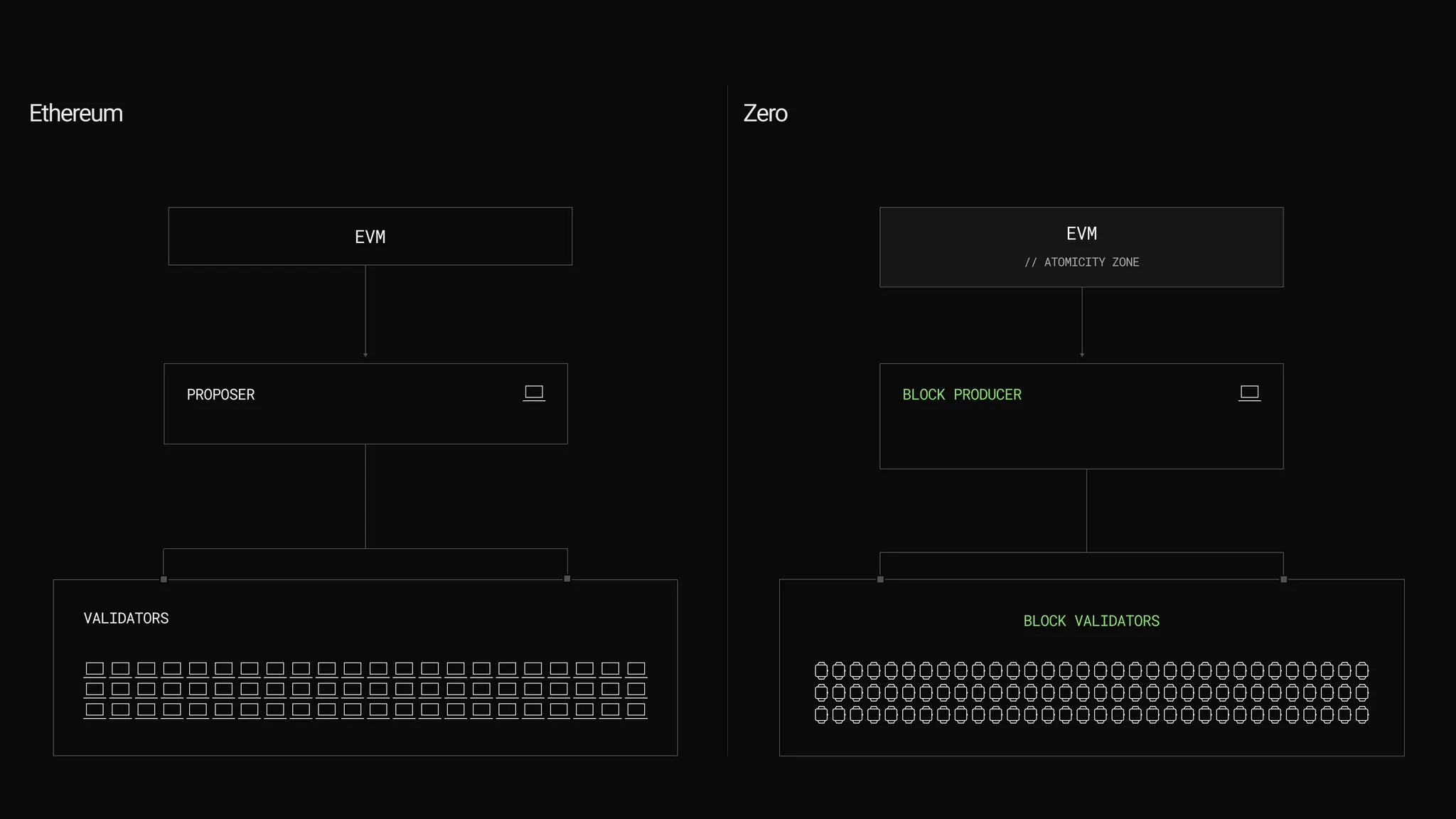
Ethereum's roadmap is fundamentally a series of incremental patches to make Ethereum a global settlement layer for finance, rollups, etc. PeerDAS, danksharding, Verkle trees, proposer-builder separation: all of these are attempts to gradually upgrade a system to handle more throughput without sacrificing decentralization.
Zero takes a different approach entirely: start from scratch with 2026 hardware assumptions and build four simultaneous 100x improvements into the foundation.
Zero claims 2M TPS per Zone, low transaction costs, and near-instant finality. And it's launching with the institutions that actually move global markets: DTCC (clearing $2.5 quadrillion annually), ICE (NYSE's parent company), and Citadel Securities (which handles around 35% of U.S. retail stock trades).
What makes Zero's announcement compelling isn't any single breakthrough in isolation. It's the compounding effect of four improvements arriving simultaneously:
Compute (FAFO): 1M+ TPS on a single EVM node through parallel transaction scheduling. FAFO's ParaLyze system pre-analyzes transactions to identify conflicts, while ParaFramer groups non-conflicting transactions into parallel-executable frames.
Storage (QMDB): 3M+ updates per second with zero disk reads for Merkleization. Unlike competing approaches that sacrifice cryptographic verifiability for speed, QMDB maintains full Merkle trees.
Networking (SVID): 10 GiB/s DA throughput by decoupling data availability from validation.
Cryptography (Jolt Pro): The first gigahertz-class proving system for zkVMs, enabling real-time verifiable computation at scale.
To be clear: Ethereum isn't dead. It remains the most vibrant core ecosystem in crypto. But for the specific use case that arguably matters most, becoming the settlement layer for global financial markets, Zero just proposed a credibly better architecture. Whether it delivers in production remains the critical open question.
Zero's architecture consists of a core layer and application-specific "Zones," what LayerZero describes as the first "decentralized multi-core world computer." Unlike sovereign chains, Layer 2s, or rollups, every Zone is owned by Zero and governed by the same unified protocol.
Each Zone is functionally equivalent to the single EVM that Ethereum runs, but Zero executes them simultaneously across multiple cores.
It launches in fall 2026 with three initial Zones alongside an expanded interoperability and tokenization stack. Here's where the real strategic depth of the announcement lies.
Source: Interoperability | LayerZero
LayerZero already dominates cross-chain value transfer. Over hundreds of billions in assets rely on the OFT Standard across 165+ chains, and most of the top stablecoins are supported by LayerZero. USDT0 alone has facilitated over $70 billion in cross-chain transfers in under twelve months. This isn't an adoption thesis. This is proven infrastructure at scale.
But Zero represents a fundamental expansion of what "value transfer" means. Until now, LayerZero sat beneath other chains, connecting them. With Zero, LayerZero becomes a destination chain itself, not just one, but with multiple applications while still serving as the connective tissue for every other chain.
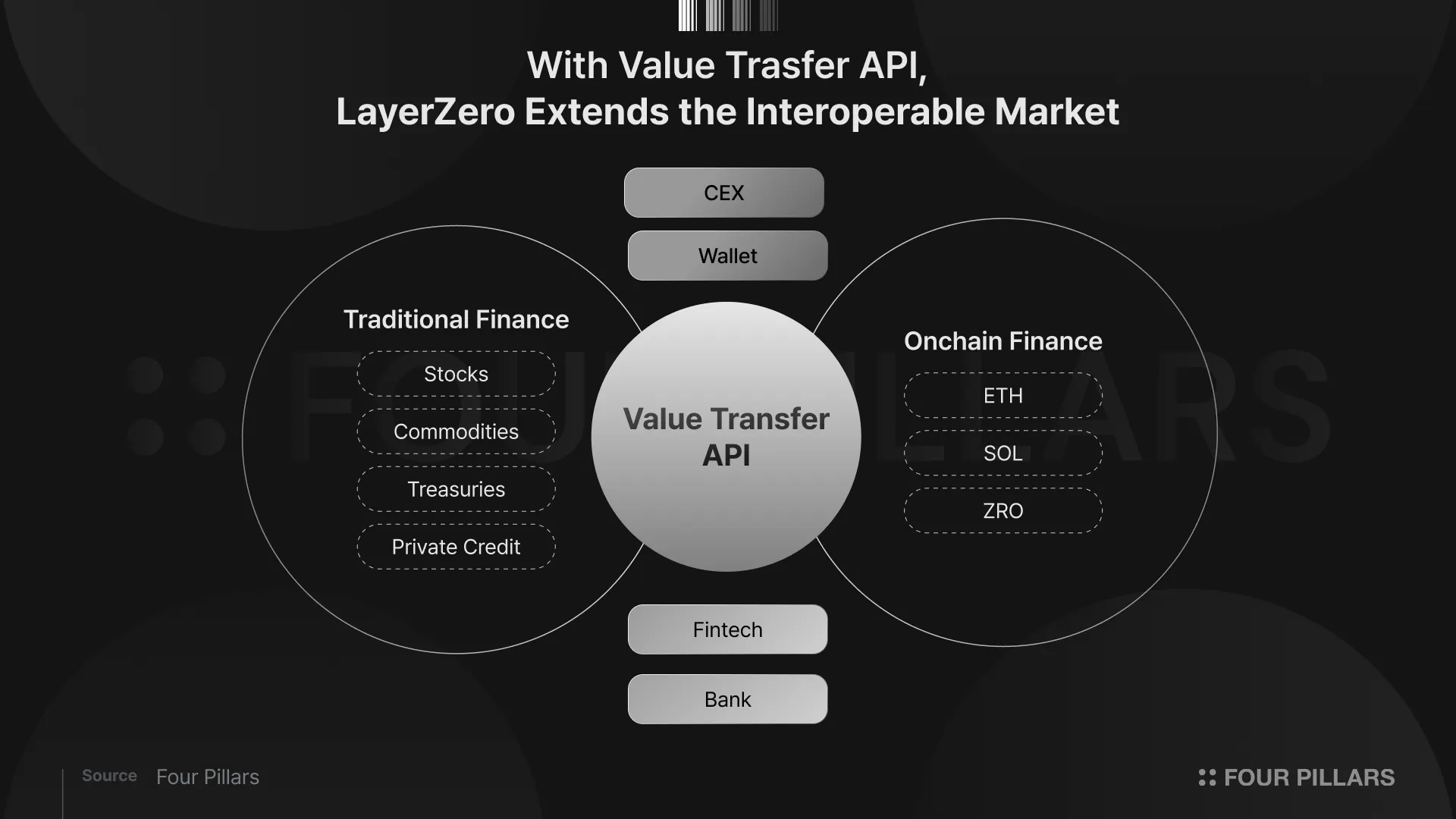
The product stack now covers the full spectrum: a unified Value Transfer API for wallets and exchanges, sub-second intent-based Swaps with MEV protection, OFT for native cross-chain token movement, Direct Deposit for one-click exchange funding from any chain, and Stargate (acquired August 2025) as the unified liquidity network. With Zero, OFT becomes even more powerful. Tokens move not just across external chains but natively between Zero's own Zones, unifying the interop protocol and execution environment.
These Zones can also be operated by traditional financial institutions, extending the value transfers not within crypto but to the broader financial market.
The result is a full-stack value transfer layer, from raw cross-chain messaging to user-facing deposit flows, offering vertical integration no competitor currently matches.
Source: Tokenization of Financial and Real-World Assets | Ripple
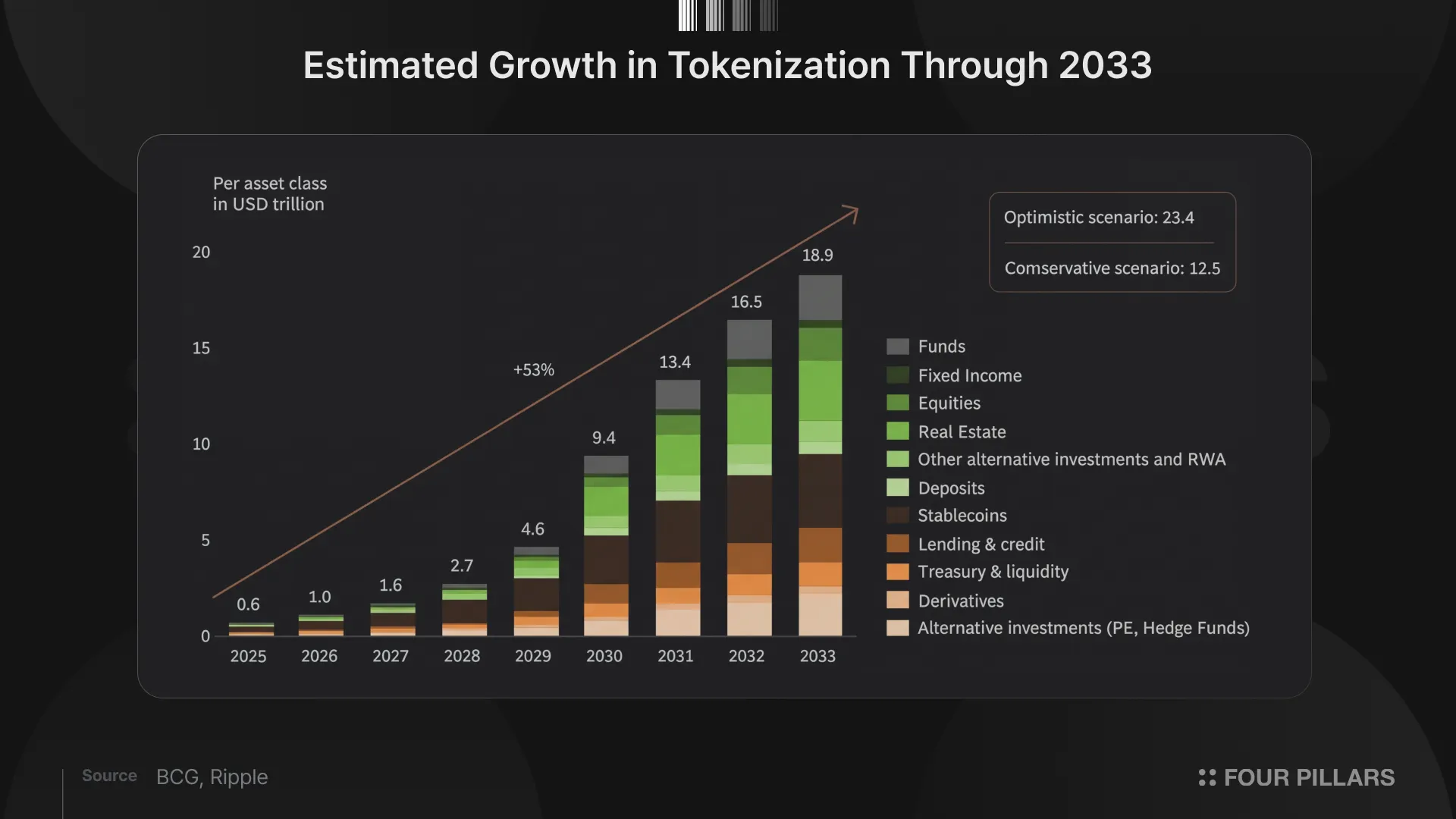
Tokenization has been crypto's most-discussed institutional use case for years. BlackRock launched BUIDL ($1.7B+ AUM), Ondo and Franklin Templeton brought tokenized treasuries to market. But most pilots hit the same wall: cross-chain distribution and lifecycle management. An issuer can tokenize a bond on Ethereum, but how does it reach investors on Solana, Arbitrum, or Avalanche? How do you enforce compliance rules consistently across fifteen chains?
Nexus solves this. The detail is yet to be revealed, but according to the website, it's LayerZero's generalized offering for issuing, moving, and redeeming tokenized assets across chains at scale, standardizing token issuance, cross-chain movement, policy enforcement, and rate limiting. The Managed Assets suite provides institutional-grade controls across the full token lifecycle: minting, distribution, burning, and compliance reporting.
The DTCC signal matters most. DTCC clears virtually all U.S. equities and fixed-income trades, nearly $2.5 quadrillion annually. It is planning to enhance the scalability of the DTC Tokenization Service and Collateral App Chain.
Consider what DTCC tokenization at scale actually means: equities, bonds, treasuries, and structured products issued as tokens, moving through Zero's Zones while being compliant, and LayerZero's interop connecting them to every chain with investor demand. That's not a crypto use case.
Zero isn't just pitching faster DeFi. It's allowing an infrastructure for the migration of traditional markets to 24/7 on-chain operation.
Citadel Securities handles approximately 35% of all U.S. retail stock trades. Its collaboration with LayerZero goes beyond advisory: Citadel is evaluating how Zero's technology applies to "trading, clearing and settlement workflows that require high performance and reliability," and made a direct strategic investment in ZRO. What does Citadel care about? Latency, throughput, and deterministic execution. FAFO's 1.1 million TPS and QMDB's 3 million state updates per second start to approach the performance envelope where on-chain trading becomes viable for institutional market makers.
Also ICE, NYSE's parent company, is examining Zero as it prepares for 24/7 markets and tokenized collateral integration. Michael Blaugrund joined Zero's advisory board. The 24/7 thesis is critical: as demand from global investors grows and regulators approve around-the-clock trading, markets need settlement infrastructure that never sleeps, exactly what a blockchain with near-instant finality provides.
The three initial Zones map directly to these use cases: a general-purpose EVM Zone, a privacy-focused payments Zone (for institutional settlement requiring data confidentiality), and a trading Zone (for Citadel/ICE-grade market infrastructure). This isn't a chain launching and hoping applications show up. It's a chain launching with the applications, and their institutional backers, already defined.
"I grew up in rural New Hampshire in about as peaceful a time and environment as possible. Despite that, I have seen my former profession banned for profit from Las Vegas lobbyists, payment processors unilaterally cancelled, I've been debanked, and I've been forced out of multiple homes due to uncertain or outright hostile regulation. I've seen the economy blow up, and I've had my financial institutions blow up. I've watched conmen take billions from those who trusted them. And compared globally, I am one of the lucky ones."
Immutable. Permissionless. Censorship-resistant.
These aren't just buzzwords for LayerZero. They're the founding principles Bryan Pellegrino has said from day one. Zero launches as permissionless to validate, build, and transact on. Pellegrino's quote above isn't abstract ideology. It's lived experience shaping a design philosophy: build infrastructure that no single entity can shut down, cancel, or control, then invite the world's largest institutions to use it on those terms.
Whether Zero delivers on these promises in production remains the essential question. The chain doesn't launch until fall 2026.
But for every project that assumed its market position was secure (modular infra plays, standalone zkVMs, parallel EVM chains) the comfort zone just got a lot less comfortable. And for the broader industry, the question isn't whether Zero will succeed exactly as described. It's whether the convergence of institutional capital, proven interop infrastructure, and genuine technical breakthroughs signals that the era of blockchain as real financial infrastructure has finally begun.
“Zero will propel our values into the world, not because we hope the existing financial system shares them, but because these principles are so powerful they cannot be ignored. We set out not to replace a single piece of the stack or to capture the tiny fraction captured to date. We set out to change the entire system. A new backend. Globally distributed, globally owned. Permissionless and censorship-resistant. A system open to all. A better system, where mathematical proofs reign supreme.”


Dive into 'Narratives' that will be important in the next year


 LayerZero
 Ethereum
 Pharos
 Solana