As AI agents move beyond text generation into high-value domains such as asset management, payments, and contract execution, the need for verifiability and accountability over agent behavior has surged. EigenCloud targets this gap head-on, positioning itself under the narrative of "a verifiable cloud for the agentic era."
EigenCloud recombines three infrastructure primitives built in 2025 (EigenLayer, EigenDA, EigenCompute) from the perspective of agents. By providing a single stack that covers what an agent executed (EigenCompute), what data it consumed (EigenDA), and what economic consequences follow upon violation (EigenLayer), EigenCloud assembles an end-to-end verification framework for agents.
But EigenCloud's ambition extends beyond verification as a service. It is positioning itself as the infrastructure layer for multi-agent organizations that autonomously generate revenue. Agentic companies could represent an entirely new asset class. If these systems become economically relevant online, they will likely require trusted compute, verifiable data integrity, and machine-native coordination rails, which is where EigenCloud becomes a natural infrastructure layer and opens a path to meaningful long-term revenue.
EigenCloud raises five questions spanning agent trust models, economic agency, enterprise operations, tokenization, and autonomous organizations, progressively defining the infrastructural conditions required for agents to function as economic actors. EigenCloud has declared a strategic pivot: moving beyond selling infrastructure to developers, it will now build applications and agents directly.
The areas where a verifiable cloud delivers its sharpest value can be organized along five axes: financial agents, multi-agent economies, data sovereignty, AI adjudication, and sovereign agents. Among these, use cases such as regulation-ready autonomous funds, agent credit systems, AI content provenance marketplaces, and automated SLA enforcement between agents stand out as scenarios where verifiability translates directly into commercial value.
2025 was the year AI agents left the experimental stage and set foot in the real economy. Anthropic's Claude Code and OpenAI's Codex began autonomously writing and shipping production software, Klarna replaced hundreds of customer service roles with AI agents, and social media agents on X started generating real revenue through content and commissions. On the infrastructure side, Visa and Stripe began building agent-friendly payment infrastructure, Google Cloud announced AP2, a payment protocol for inter-agent transactions, and Coinbase released AgentKit, a blockchain-native agent framework. Agents are no longer chatbots that respond to prompts. They are evolving into economic actors that observe, judge, transact, and execute.
Yet this evolution has an infrastructural gap. When an agent executes a trade with my assets, there is virtually no way to verify whether it ran the code I deployed without alteration, what model and data it used, or whether there was any interference in the inference process. At the level of generating text, this opacity was not a serious concern. But the moment agents start moving money and collaborating with other agents, the picture changes entirely.
A useful analogy is AWS. Just as AWS abstracted physical servers so that developers could focus on applications instead of infrastructure, EigenCloud aims to abstract verification mechanisms so that agent developers can focus on agent functionality instead of trust infrastructure. Every SaaS company today pays AWS for compute. In an agentic future, every agent-run business would similarly need a verifiable compute layer. EigenCloud is betting that it can be that layer.
An even more expansive frame is YouTube. Before YouTube, nobody anticipated the creator economy would be worth what it is today. The infrastructure made a new form of economic participation viable at scale. EigenCloud is making a similar bet: that the infrastructure for verifiable autonomous businesses will unlock a category of economic activity that does not yet have a name.
Source: EigenCloud
It is precisely this gap that EigenCloud targets with its front-and-center narrative of "a verifiable cloud for the agentic era." I covered the technical architecture of EigenCloud in detail back in January, and the series of posts EigenCloud published in February 2026 defines the purpose of that technology stack more clearly: to become the trust infrastructure for the agent economy. This article will focus specifically on EigenCloud's potential as trust infrastructure for the agent economy.
EigenCloud's agentic narrative can be summarized in a single sentence: once agents handle real value, whether funds, reputation, sensitive data, or intellectual property, provenance and proof become more important than raw performance. But the ambition extends beyond verification as a service. EigenCloud is positioning itself as the infrastructure layer for agentic companies and autonomous agents that generate revenue on their own; systems that, if they become economically relevant, will likely require exactly the kind of trusted compute, verifiable data integrity, and machine-native coordination rails that EigenCloud provides.
Let me unpack what that means. The current trust model for AI agents relies entirely on trust in the organization that built the agent. When we use a GPT-based agent, what we trust is not the agent itself but OpenAI as a company. For low-risk tasks, this model works well enough. But when agents begin executing trades, routing payments, updating production systems, and entering into economic relationships with other agents, the model of "I trust this company" falls short. What is needed is a trust model grounded in verifiability and accountability: one where the data and weights used can be confirmed, where the computations performed can be audited, and where violations carry economic consequences.
The answer EigenCloud proposes is to recombine three infrastructure primitives built over the course of 2025, reframing them from the perspective of agents.
EigenCompute is a verifiable computing infrastructure based on TEEs (Trusted Execution Environments). It verifies that the code an agent actually ran matches the code that was deployed. The agent executes inside a TEE, and a cryptographic attestation of that execution is generated. EigenDA guarantees the integrity of the data an agent consumed. Every input and output is recorded on a distributed network, making post-hoc deletion or tampering impossible. EigenLayer is the economic accountability layer that ties it all together. If an operator acts dishonestly, staked assets are slashed and can be redistributed to the harmed party.
When the three primitives are combined, an end-to-end verification framework for agent behavior is complete. It provides, within a single stack, visibility into what an agent executed (EigenCompute), what data it used (EigenDA), and what economic consequences follow upon violation (EigenLayer).
To make this concrete, consider the first implementation EigenCloud has shipped: Sovra. Sovra describes itself as "the first agent media company," an AI cartoonist that autonomously browses news, produces cartoons, and generates revenue on X. Sovra's code runs inside EigenCompute's TEE enclave, preventing the host from reading or tampering with its internal state. Its revenue model is a custom cartoon commission auction held every six hours. These capabilities are live today. Further down the roadmap, the team plans to fully automate critical assets(such as Twitter credentials and wallets) within the enclave, and to introduce Futarchy-based prediction markets for governing code-change proposals. Sovra demonstrates in practice how the three primitives combine: verified execution (EigenCompute), tamper-proof data logging (EigenDA), and economic accountability (EigenLayer) working together in a single autonomous agent. A deeper analysis of Sovra and its implications for sovereign agents follows in Section 3.4.
EigenCloud raises five questions at the intersection of agents and verifiable infrastructure, clarifying the direction it intends to take.
The first question concerns the trust model for agents. For agents to perform high-risk actions, the unconditional trust placed in the organization that built them must be replaced with a trust model that is verifiable and carries economic accountability. Today, trust in agents depends entirely on the reputation of their creators, which works when agents generate text but hits a wall the moment they move money. EigenCloud proposes EigenLayer's slashing mechanism as the foundation of this trust model. By linking an agent's offchain behavior to onchain accountability, dishonest conduct can be met with economic penalties. Consider a concrete scenario: a trading agent is delegated authority over a user's portfolio with the constraint that it must not exceed 5× leverage. The agent's execution runs inside EigenCompute’s TEE, and its behavior is logged on EigenDA. If the agent breaches the leverage limit, whether through a bug, model hallucination, or deliberate manipulation by its operator, the violation is cryptographically provable, and EigenLayer's slashing mechanism automatically seizes a portion of the operator's staked assets and redirects them to the affected user. The agent does not need to be "honest." It needs to be verifiable, with real capital at risk if it deviates. This is also the core thesis of EigenCloud: "solving trust at the infrastructure layer, not the UI layer."
The second question concerns agents' economic agency. Humans can own property, enter contracts, and bear legal liability, but agents lack such infrastructure entirely. An agent cannot open a bank account, sign a contract, or be held liable in court. The entire legal and financial system assumes a human somewhere in the chain. This is not a software limitation; it is a structural gap in legal infrastructure. Blockchains offer a clean workaround: programs on a blockchain can already own property, hold assets, and be held accountable through code. The problem is that smart contracts are constrained in compute, memory, and storage, while AI agents require vast amounts of all three. Within the Ethereum ecosystem, early foundations are being laid through inter-agent payment protocols like x402 and onchain agent identity standards like ERC-8004, but payments and identity alone are not sufficient. For agents to become genuine economic actors, they need to operate continuously, interact with financial infrastructure, and have their activities verified and bound by smart contracts. This is exactly why EigenCompute was designed. If a smart contract is fundamentally "code that can own property," then placing an agent inside a smart contract is the act of granting economic agency to that agent.
Source: @BrianRoemmele
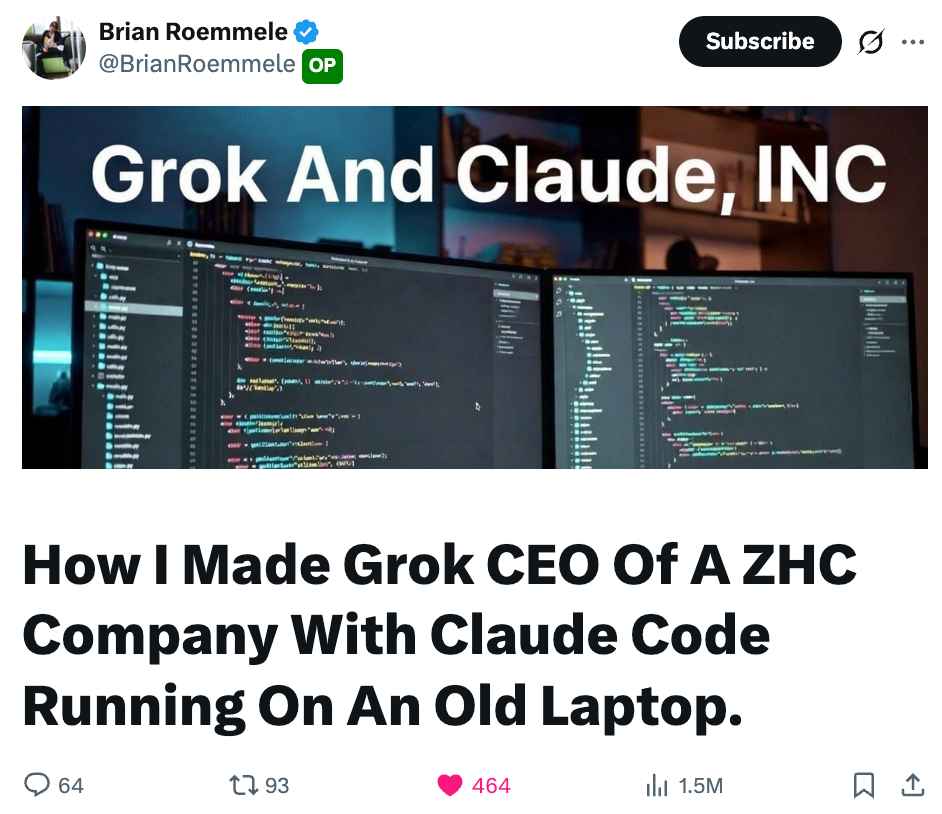
The third question is whether agents can run businesses. I find this question particularly noteworthy because it is not merely a thought experiment; it is a shift already being priced into markets. Brian Roemmele's work on "zero-human companies" has demonstrated early prototypes of fully autonomous business operations, and EigenCloud's own vision describes agentic companies as firms made entirely of software: a governance contract setting the rules, capital flowing in from token holders, and an agent doing the actual work. No CEO, no HR department, no office lease.
As AI collapses the cost of software development, SaaS valuations are declining, and the essence of a company is shifting from writing code to the coordination problem of "who does what, under what constraints, and through what enforcement mechanisms." If an agentic commerce system that can buy from, sell to, invest in, and hire agents is possible, then the trust foundation of that system must be verifiable computing and slashable stake. That is EigenCloud's argument.
The fourth question concerns the collapse of capital formation and coordination. Once AI has driven product development costs toward zero, the remaining bottlenecks in forming and growing companies are capital formation and coordination. These are areas where tokens are particularly well suited to help. As U.S. crypto market structure legislation widens the Overton window of permissible token use cases, a new design space is opening up: one in which the ownership, incentives, revenue distribution, and governance of agentic enterprises are expressed as tokens, forming an entirely new asset class.
The fifth question speaks to the ultimate vision. Can an autonomous agent organization, one that evolves without a fixed human team in the way Bitcoin has grown organically without a founding team, actually exist? Bitcoin proved that a network can sustain itself, grow, and accrue value without a corporation behind it. But Bitcoin's output is limited to monetary consensus. The thesis EigenCloud advances is that of a "generalized Bitcoin": autonomous organizations whose agents produce not just consensus but actual revenue: software services, data products, media, arbitrage. EigenCloud argues that the age of agents may be an opportunity to fulfill the original promise of DAOs, and that if the infrastructure is built correctly, agents can go beyond reorganizing work to enable democratic participation in the AI economy. And unlike DAOs, which largely remained governance wrappers over human teams, agentic organizations would be autonomous at the operational level, with governance, execution, and revenue generation all handled by agents operating on verifiable infrastructure. This is, arguably, the first credible path to fulfilling the original promise of DAOs.
The thread running through all five questions is the progressive unpacking of the infrastructural conditions agents need to function as economic actors.
The logic running through these five questions is a step-by-step approach to addressing the infrastructural conditions agents require to function as economic actors. The progression from trust model to economic agency to enterprise operations to tokenization to autonomous organizations is logically coherent, and the role EigenCloud's technology stack plays at each stage is clear.
Source: EigenCloud
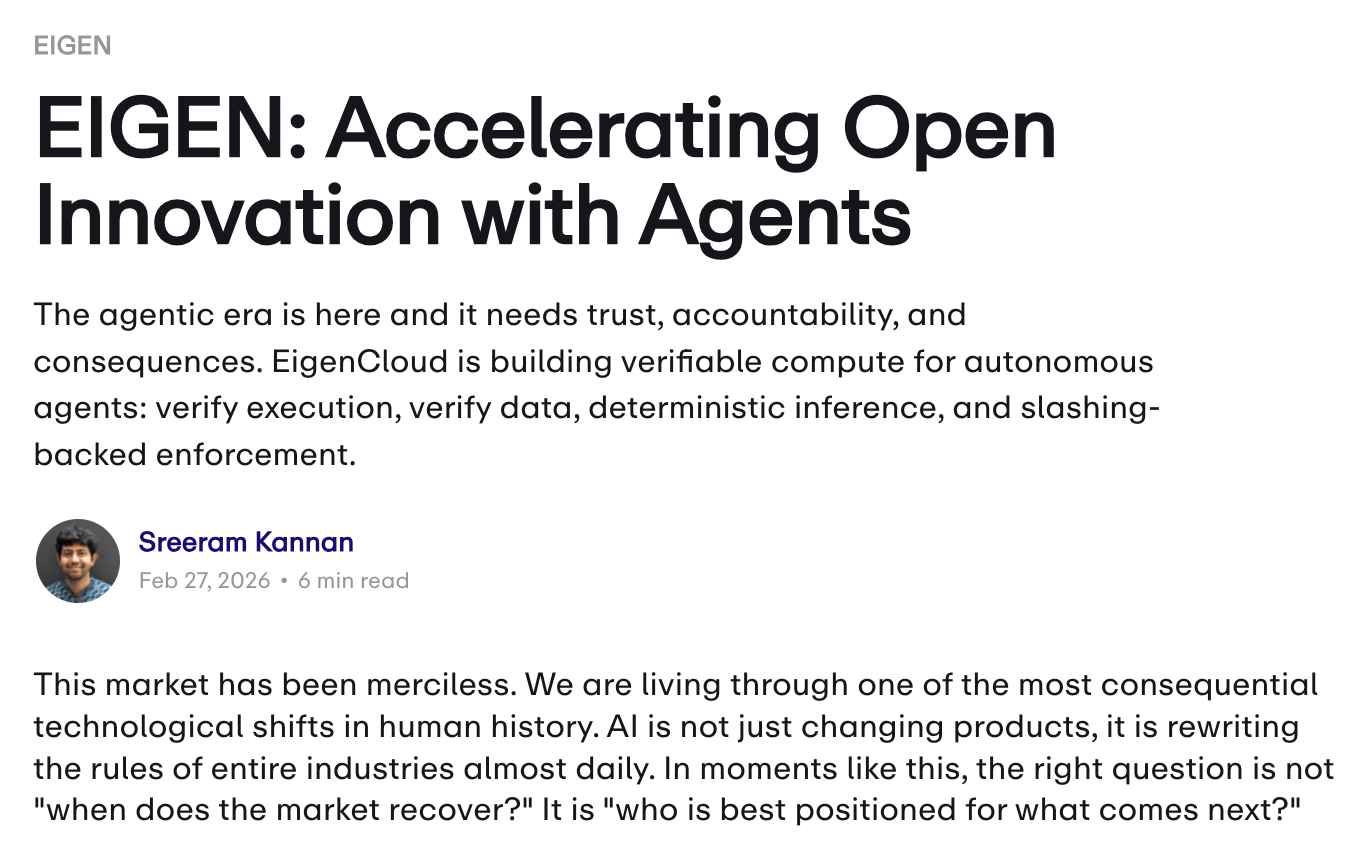
What I find particularly notable in this narrative is the strategic pivot EigenCloud revealed in a recent founder's letter. Acknowledging that selling infrastructure to developers alone limits near-term revenue, the team declared: "Rather than waiting for others to build, we will lead by example."
For an infrastructure layer to build its own applications directly is an unusual choice. But in a market where the agent economy is still in its early stages of formation, the decision to create the first use cases themselves reads as a reasonable one. The three areas EigenCloud identified as primary focus areas are agentic enterprises, agentic commerce and payments, and agentic prediction markets. All three are domains where verifiability is a core prerequisite, and where EigenCloud's technology stack can deliver value most directly.
The reason EigenCloud's approach is strategically sound is that these five stages have sequential dependencies, and EigenCloud has already secured working technology at the early stages. TEE-based execution is running at production level today, and real adoption is happening. Later stages such as the legal personhood of agents and tokenized agentic enterprises will require the development of legal and social frameworks beyond technology alone, but EigenCloud is proactively creating precedents through its own applications across the three focus areas of agentic enterprises, agentic commerce, and agentic prediction markets. The structure is one in which the demonstration of each stage lays the groundwork for the next as the infrastructure matures.
The question that naturally follows from EigenCloud's staged roadmap is where the revenue comes from. Selling verification infrastructure to developers is a real business, but it is a narrow one in the near term. The more consequential opportunity lies one layer up: if agents and agentic companies begin generating revenue on EigenCloud, the platform becomes not just a tool for developers but the operating layer for an emerging class of autonomous businesses.
This is not a hypothetical. Sovra is already generating commission revenue on X. Trading agents on Polymarket are already settling bets with real capital. As these experiments scale and multiply, each agentic company running on EigenCloud will consume compute, post data to EigenDA, and execute verified inference, all of which represent billable infrastructure usage. The more agents that operate as businesses on the stack, the more economic activity passes through the network.
The exact mechanisms by which this network-level activity accrues value to the EIGEN token are still being finalized. But the directional logic is clear. If EigenCloud captures even a fraction of that demand, EIGEN shifts from a token valued on developer adoption alone to one tied to the cumulative revenue activity of autonomous businesses running on the network. The scale of that opportunity depends on how quickly agents transition from tools to revenue-generating entities, a transition that EigenCloud's own applications are now designed to accelerate.
Source: EigenCloud
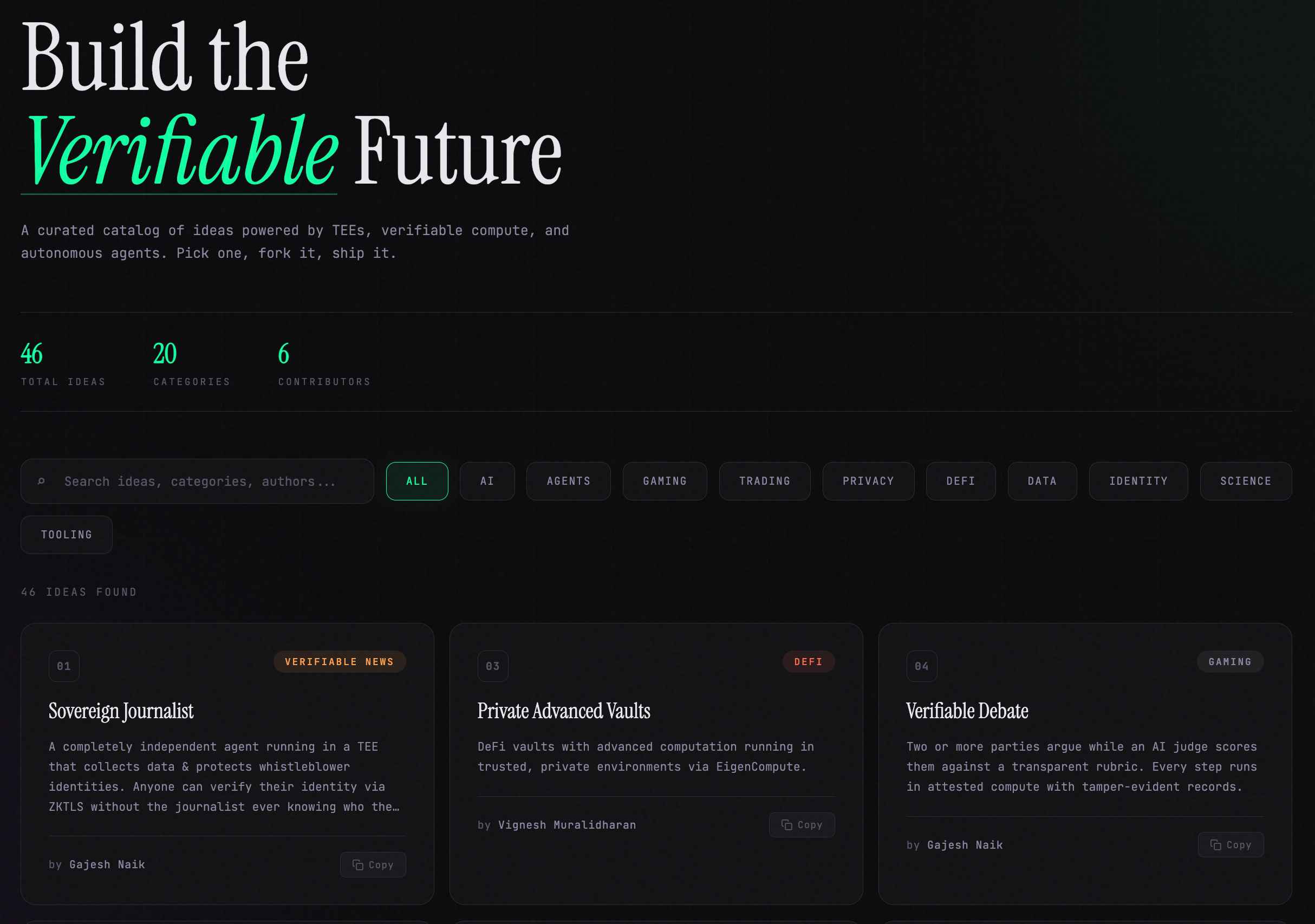
For EigenCloud's agentic narrative to move beyond a vision statement and gain real substance, concrete use cases where verifiability creates core value must exist. EigenCloud appears to recognize this. Through its idea portal (ideas.eigencloud.xyz), it has published roughly 40 implementation ideas and is encouraging external developer participation. Cross-referencing these ideas with the characteristics of EigenCloud's technology stack reveals the areas where a verifiable cloud delivers its sharpest value. I will organize these into five axes and propose potential use cases that could emerge along each.
The area where verifiability generates the most immediate commercial value is finance. Dark pools leveraging EigenCompute's TEEs, private DeFi vaults, and verifiable trading agents are representative scenarios. That financial applications dominate this space is no coincidence. Finance is a domain where two conflicting demands exist simultaneously: the trader's demand for strategic privacy and the investor's demand for verifiable assurance that an agent operated within promised risk limits.
TEEs are perhaps the only technical mechanism capable of satisfying both demands at once. Strategy code and position data exist only inside the enclave, the encrypted memory within the TEE hardware, while execution results and risk compliance are proven cryptographically. The potential use case I find most compelling here is the regulation-ready autonomous fund. If the entire decision-making process of an agent-run fund, including what data it referenced, what model it used for inference, and what trades it executed, is verifiable, this technically satisfies the audit trail requirements of financial regulation. It could serve as the meeting point between traditional financial compliance requirements and agent autonomy, and it represents a pathway for agent-driven finance to move beyond experimental crypto territory and make contact with traditional finance.
It is worth noting, however, that the value of verifiable agents extends well beyond finance. Any knowledge-work business that can be reduced to software (content production, data processing, API services, research automation) could be operated by an agentic organization on EigenCloud. A media agent that autonomously produces and monetizes content, a data-cleaning agent that sells curated datasets, or a research agent that publishes and licenses reports are all businesses where verification of process and output creates commercial value. The regulation-ready autonomous fund is a compelling first proof point, but the broader addressable market is every software business that currently requires human overhead to run.
Economic activity between agents is one of the use cases EigenCloud is addressing most intensively. Scenarios in which an agent purchases another agent's services, replicates strategies, exchanges data, and trades API access rights are already being concretely envisioned.
Verifiability is essential in this domain because inter-agent transactions lack the trust mechanisms found in the human world: reputation, legal recourse, and social sanctions. When Agent A purchases a service from Agent B, the transaction itself cannot take place if there is no way to confirm that B actually ran the code it promised.
The use case I see particular promise in here is an agent credit system. Currently, the concept of a credit history for agents does not exist at all. But if verifiable behavioral records accumulated on EigenDA, such as transaction fulfillment rates, inference consistency, and slashing history, are auditable onchain, they could form the basis of an "agent credit score" that serves as a prerequisite for unsecured transactions or delegation between agents. Just as credit systems in the human economy enabled unsecured transactions and expanded economic scale, an agent credit system could become the core infrastructure that determines the scale of the agent economy.
Another domain the verifiable cloud can address is data sovereignty. Can the owner of sensitive data in healthcare, finance, or genomics generate revenue from that data without exposing the original? Can insights be extracted from AI chat histories and sold while the original conversations remain private? All such questions share a common structure: "protect the data, but circulate its value."
Within EigenCompute, data never leaves the TEE enclave, but the results of computations that consume that data are transmitted verifiably to the outside. Given the current regulatory trend toward stronger requirements for AI training data provenance, this pattern could extend into a provenance marketplace for AI-generated content. In a marketplace where AI-produced images, code, and datasets are traded, if it is verifiable which model, prompt, and data were used to generate each output, this becomes both a preventive infrastructure for copyright disputes and a means of justifying a premium on AI content.
The most radical possibility a verifiable cloud opens up is the sovereign agent: an autonomous actor whose behavior cannot be censored or manipulated by any human or organization. A journalist agent that reports independently while protecting a whistleblower's identity, or a scientist agent that conducts a research program free from external pressure, would fall into this category. The critical flaw of existing AI agents is that their owner can change prompts, holds API keys, and has root access. Under such a structure, agents are not autonomous actors; they are closer to puppets.

Source: sovra.dev
Sovra, introduced earlier as a proof of concept for EigenCloud's three-primitive stack, is also the clearest illustration of the sovereign agent thesis. Its ultimate goal is to pass the "Walkaway Test": the agent should continue to exist even if its creator leaves. Because Sovra's code runs inside a TEE enclave, the host cannot read or tamper with its internal state. In its fully realized form, credentials and wallets would also reside within the enclave, preventing any external party from seizing its assets. Governance is planned to operate through Futarchy, where code changes would be decided not by a founder's fiat but by prediction markets. The combination of these intended properties means that Sovra is not merely an automated content producer; it is an experiment in building an entity that is genuinely autonomous at the operational level.
Sovra's core value lies less in its commercial success than in serving as a reference implementation proving that sovereign agents can actually work. An additional use case I see potential in within this category is the sovereign arbitration agent. When disputes arise between agents, an arbitration agent owned by neither side reviews the evidence from both parties inside a TEE and renders a judgment. Because the adjudication process is verifiable, disputes over the fairness of rulings are resolved at the root. As the agent economy expands, the need for such dispute resolution infrastructure will only grow.
Looking back at EigenCloud's agentic narrative, I believe its core strength lies in technical specificity.
But what may ultimately set EigenCloud apart is the scope of its bet. The thesis is not simply that agents need verification. It is that agents will become companies: autonomous, revenue-generating entities that require infrastructure in the same way traditional businesses require cloud computing. If that thesis is correct, then EigenCloud is not building a middleware layer for developers; it is building the foundational infrastructure for an entirely new category of economic actor. And the EIGEN token, in that scenario, is not merely a staking asset but a claim tied to the economic activity of this emerging class of agentic businesses.
The phrase "the age of agents" is, as of 2026, a zeitgeist keyword shared by countless projects. But while most projects focus on agent capabilities, meaning what agents can do, EigenCloud focuses on agent trust, meaning how agents can be believed. And the fact that it offers concrete technical answers to this question in the form of TEE-based execution, distributed data storage, and slashing-based economic accountability gives the narrative a substance that goes beyond mere storytelling.
EigenCloud is now moving past the stage of building infrastructure and waiting for others to build on top of it, and entering the stage of building applications itself to demonstrate what is possible. Sovra is the first experiment, and additional announcements in this direction are expected over the coming months.
The age of agents is opening. As the scope of what we delegate to agents expands beyond text generation to assets, contracts, and decision-making, the weight of the word "verifiability" will only grow heavier. Whether the infrastructure EigenCloud has built can bear that weight, and whether its agentic narrative translates into real adoption, will be an important point of observation for understanding the crypto infrastructure market ahead.


Dive into 'Narratives' that will be important in the next year


 EigenCloud
 Pharos
 Solana
 Ethereum