*[ASA News] is a bi-weekly newsletter where we share the most important news related to stablecoin in Asia. (2025.11.10~11.23)
Written by Moyed, Heechang
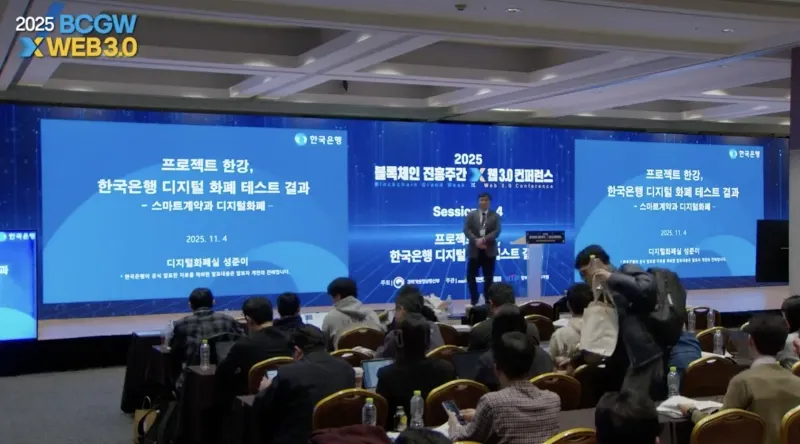
The Bank of Korea released the results of Phase 1 of “Project Han River,” a pilot designed to verify the payment efficiency of central bank digital currency. The bank said the experiments confirmed that a wholesale CBDC can demonstrate practical performance within an interbank settlement environment. The pilot involved seven banks, including Shinhan, NongHyup, Kookmin, Woori, Hana, IBK, and Busan Bank, and ran for about three months. It focused on evaluating processing speed and stability across real transaction scenarios for interbank settlement using a wholesale-focused digital currency.
A key component of the pilot tested whether deposit tokens could perform the role of reserve deposits. The experiment also confirmed system interoperability across smart contract-based transaction processing, account-to-account linking, and ledger consistency. In addition, three types of digital vouchers were used to simulate both online and offline consumer payments, providing partial insights into user experience.
The Bank of Korea is currently executing Phase 2 and is collaborating with the Ministry of Economy and Finance to launch a “tokenized government subsidy pilot.” This project uses permissioned blockchain infrastructure to prevent fraudulent claims and improve execution transparency, aiming to strengthen both trust and security in public financial flows.
1.2.1 Moyed (ASA Contributor, Delta Network) – What the Pilot Reveals About the Practicality and Limitations of Deposit Tokens
The most significant value of this pilot is that it was a large-scale collaborative experiment involving a broad set of stakeholders, including the central bank, commercial banks, and local government voucher operators. Regardless of which digital asset model eventually becomes dominant, the infrastructure experience and user feedback accumulated through this pilot will form a shared foundation for deposit tokens, stablecoins, and CBDCs going forward. In particular, the voucher experiments showed that deposit tokens alone can deliver a sufficient level of programmability, which can be interpreted as an intentional move by the Bank of Korea to highlight functional equivalence across different forms of digital money.
However, the user experience revealed clear limitations. The absence of biometric authentication required multiple layers of password input, seemingly due to technical constraints preventing full integration of deposit tokens into existing banking apps. Even if this is solvable at commercial scale, introducing a new payment method in a country like Korea that already has world-leading digital payments requires more than simple improvements. It requires a compelling narrative that it is “clearly better” than the current system.
Additionally, the suggestion to consider monetary incentives for deposit token usage raises deeper questions about their value as a payment instrument. Users should not need to distinguish between deposits and deposit tokens during payment; conversion should ideally happen invisibly. More broadly, deposit tokens may be more realistically positioned as on/off-ramp infrastructure for stablecoin flows rather than direct competitors in retail payments. In a market like Korea where payment infrastructure is already mature, incentivizing adoption of a new payment method may not be efficient.

Source: JPMorgan officially rolls out 'JPM Coin' deposit token on Base
JPMorgan announced the official launch of JPM Coin (JPMD), its deposit-based digital token, on Base, an Ethereum Layer 2 network, making it available to institutional clients. This marks the completion of a pilot that began in June. Throughout this year, the bank has been actively testing the real-world usability of deposit tokens. JPMorgan stated that JPMD offers 24/7 real-time settlement capability, enabling institutional clients to execute fast and efficient on-chain payments on Base.
Financial and digital asset firms such as B2C2, Coinbase, and Mastercard have already completed test transactions using the token. JPMD reflects actual bank deposits held with JPMorgan, issued as tokens on a public blockchain, and emphasizes regulatory compliance, KYC requirements, and alignment with existing banking infrastructure. Unlike general stablecoins, it is explicitly designed for institutional use.
JPMorgan plans to expand JPMD to more blockchains and has secured the trademark “JPME,” hinting at a future Euro-denominated deposit token. The bank is also working with DBS to develop an interoperability framework enabling transfer of tokenized deposits between public chains and permissioned blockchain networks. Meanwhile, other major global banks, including BNY Mellon, Barclays, Lloyds, and HSBC, are also exploring or piloting similar tokenized deposit services, signaling a global expansion of deposit token experimentation.
2.2.1 Moyed (ASA Contributor, Delta Network) – The Realistic Role of Deposit Tokens as They Expand Into Public Chains
The key point of the JPMD launch is that deposit tokens are not designed to spread freely across public chains, but only within controlled environments consisting of KYC-verified wallets. Within this boundary, the bank directly manages the token. Beyond it, the design intentionally encourages conversion into widely circulating stablecoins such as USDC, thereby minimizing the unique risks and liabilities associated with open public networks. In this architecture, JPMD serves as an on/off-ramp: the bank maintains responsibility where regulatory alignment and stability matter most, while delegating activity in the open ecosystem to established stablecoins. I personally think this is a far more practical role for deposit tokens than competing in retail payments.
Some may reasonably ask, “If everything ultimately converts to USDC, why not just use stablecoins from the start?” But in regions like Asia where banking-centric financial structures are deeply rooted, it is structurally difficult for banks to issue public chain stablecoins directly. Beyond KYC and AML challenges, doing so risks undermining the principle of the singleness of money, creating substantial regulatory and institutional barriers. In this context, JPMD’s pilot structure reflects a realistic compromise: banks operate tokens only within the scope they can manage, while the open ecosystem relies on established stablecoins. This is likely a representative model for how many countries will need to operate deposit tokens and stablecoins in parallel.

Source: Bank of England softens stablecoin stance with new proposals
The Bank of England (BoE) has proposed allowing stablecoin issuers whose tokens may see widespread use to invest up to 60 percent of their reserves in short-term government bonds. This represents a major shift from its previously strict posture and is expected to form a key component of the UK’s upcoming stablecoin regulatory framework. However, the BoE decided to maintain existing holding limits: 20,000 pounds for individuals and 10 million pounds for corporations.
Industry participants previously criticized the BoE’s 2023 proposal requiring all collateral assets to be held in non-interest-bearing central bank accounts, arguing it would stifle growth in the UK stablecoin market. The new proposal partially reflects these concerns by requiring only 40 percent of reserves to be held at the central bank.
While the BoE maintains its stance that only stablecoins likely to be widely used for payments will fall under its supervision, it is offering a temporary exemption that would allow firms currently regulated under the Financial Conduct Authority (FCA) to manage up to 95 percent of collateral in the market during an initial period. The BoE also said it is reviewing a potential liquidity support mechanism, allowing central bank lending to systemic stablecoin issuers in times of market stress. Meanwhile, stablecoins used primarily for asset trading will remain under FCA oversight.
3.2.1 Moyed (ASA Contributor, Delta Network) – The Bank of England’s Cautious, Competitive Calibration Amid Global Regulatory Pressure
This adjustment shows that the Bank of England is pursuing neither full openness nor strict restriction, but a “cautious partial opening” approach. Allowing up to 60 percent of reserves to be invested in government bonds marks a substantial retreat from its previously restrictive stance. Yet maintaining the holding limits signals reluctance to let stablecoins become deposit substitutes or critical payment infrastructure. These limits will be discussed again before the consultation closes in February next year, but for now, the BoE remains more aligned with control than expansion.
Notably, these changes are not driven solely by domestic considerations. As the United States advances federal legislation and regions like Singapore, Hong Kong, and Japan establish detailed stablecoin frameworks to attract global issuers, the UK found itself constrained by its overly rigid position. The new proposals can be seen as a response to mounting regulatory-arbitrage pressure. Fully opening the market raises financial-stability concerns, but maintaining excessive restrictions risks losing industry activity to more accommodating jurisdictions.
Compared to major Asian markets, the UK’s approach remains conservative. Japan already operates a framework allowing licensed institutions to issue deposit-backed stablecoins, while Singapore provides clear operating and supervisory standards tailored for large global issuers, reducing regulatory uncertainty for market entry. The divergence reflects differing policy views on whether stablecoins should be part of payment infrastructure or treated as another class of financial asset. The UK leans toward the latter.
This section is powered by rwa.xyz. Join “RWA.xyz Newswire” to receive the latest updates on stablecoins and RWA.
4.1.1 Ronin and Coins.ph to Enable PHPC Payments Across 600,000 Merchants
PHPC connected to the national QRPH payment network, with real-world usage expected to expand starting in 2026
Enables consumers to spend Web3 earnings directly in daily life amid rapid digital-payment growth in the Philippines
Targets the 40.2 billion dollar remittance market as the Philippine stablecoin ecosystem expands
4.1.2 MiniPay Integrates Stablecoins With Real-Time Local Payment Networks in Latin America
USDT balances directly interoperable with Brazil’s PIX and Argentina’s Mercado Pago
Surpassed 10 million active wallets and is becoming a leading regional stablecoin wallet
Expanded on/off-ramp access across six countries via partnerships with El Dorado, alfred, and others
4.2.1 Kyrgyzstan Launches Gold-Backed USDKG Stablecoin
Backed 1:1 with state-held gold reserves
Launched on Tron for cross-border payments and institutional settlement use cases
Gold trading at near all-time highs is driving demand for tokenized gold
4.2.2 India’s Debt-Backed Rupee Stablecoin ARC Expected for Q1 2026 Launch
Issuance restricted to approved corporate accounts, with Uniswap v4 whitelisting support
Fully collateralized with cash, government bonds, and term deposits
Designed to prevent capital outflows into foreign stablecoins and complement India’s CBDC
4.2.3 Canada Approves Budget Establishing New Stablecoin Regulatory Framework
Bank of Canada given oversight of stablecoin issuers, with 1:1 reserves and immediate redemption requirements
Interest payments prohibited to strengthen consumer protection
Framework resembles US policy, including standards for risk management, disclosures, and security
4.2.4 Australia’s AUDD Surpasses 1 Billion Dollars in Transactions on Stellar
Fully collateralized AUD stablecoin under Australian regulation
Customer assets held at authorized deposit-taking institutions to reinforce trust
AML and CTF compliance supports institutional adoption
4.2.5 UAE Launches First Central Bank-Approved AED Stablecoin
Fully backed 1:1 with transparent reserves and audited smart contracts
Multi-chain rollout enabling rapid support for cross-border payments and institutional settlement
Issued with central bank licensing and backed by a Fitch BBB+ rating, enhancing global competitiveness
4.3.1 KRWQ Surpasses ₩1 Billion in Trading Volume as First Korean Won Stablecoin
Developed through a collaboration between IQ and Frax, designed as a KYC-restricted institutional KRW stablecoin
Leveraging LayerZero OFT and Stargate for multi-chain interoperability
Introduced AERO incentives on Base to strengthen KRWQ-USDC liquidity
4.3.2 Hong Kong Launches ‘Real-Value’ Tokenized Deposit Pilot Based on Live Institutional Transactions
Project Ensemble evolves from sandbox to live settlement platform EnsembleTX
Supports 24/7 tokenized settlement using HKD RTGS infrastructure
Standard Chartered executes real institutional transactions such as tokenized deposits and MMF subscriptions
4.3.3 Palm USD Launches PUSD, a Global Stablecoin Backed by AED and SAR
Adopts a no-freeze model where addresses cannot be frozen
Pegged 1:1 to UAE dirham and Saudi riyal reserves with monthly third-party audits
Received Shariah certification, enabling integration between Islamic finance and digital assets


Dive into 'Narratives' that will be important in the next year


 Mastercard
