Asia Stablecoin Alliance will host the Asia Stablecoin Conference (ASC) on September 25 this year together with Four Pillars, LayerZero, and stablecoin leaders from around the world. ASC Spotlight content highlights the companies sponsoring ASC in advance so that participants can truly immerse themselves in the ASC event and understand how these companies view the Asian market.
ASC Sponsors: Pharos (Title), Ant Digital Tecnhologies (Title), Canton, Ethena, Kiln, Plume, Rialo, Securitize
ASC Participants: Ant Digital Tecnhologies, Avalanche, Bybit, Canton, Ethena, Ethereum Foundation, Four Pillars, Frax, Grove, IDRX, Japan Smart Chain, Kiln, Lambda256, Layer Zero, Mantle, Maple, Neutrl, Pharos, Plume, RedStone, Rialo, Securitize, Sky, Solana, Spark, Stable, Stargate, Sumimoto, Theo, UR Bank, Wyoming Stable Token Commission
For more details about ASC, please refer to the following links:
ASC Website: https://conference.asiastable.org/
ASC Registration: https://luma.com/la44fa6d
The financial system we are still using today remains outdated and operates in a closed manner. In the case of securities, countless intermediaries are involved, making issuance and distribution extremely complex and inefficient. For private credit or institutional funds, the system is very closed, and only a very small number of people can access it. In this respect, the efficiency and openness of blockchain have the potential to revolutionize the issuance, trading, and distribution of various real-world assets.
The future of on-chain tokenization of RWAs has already begun. According to rwa.xyz, the size of tokenized RWAs on-chain has reached $28B, which is about twice as much as a year ago and about four times as much as two years ago. Not only US treasuries funds but also institutional funds, commodities, institutional funds, and equities are currently being actively tokenized.
In the case of fiat currencies or gold, tokenization is relatively easy because they are not securities. However, for other real-world assets classified as securities, they must of course be issued in compliance with the securities laws of each country, and not only issuance but also trading and distribution on-chain must be conducted safely in a fully regulated manner.
Founded in 2017, Securitize is an RWA platform that tokenizes various types of securities and makes them easily accessible on-chain to institutions and individuals around the world. Securitize is the largest RWA tokenization platform in the global RWA market in terms of TVL, having tokenized more than $3B worth of RWAs, and holds a significant market share of 20% across all RWAs.
The strength of Securitize does not end with simply tokenizing securities in a fully regulated manner. From issuance to distribution of tokenized securities, it supports the complete lifecycle on-chain in a fully regulated manner. To make this possible, Securitize has obtained various licenses in the real world and leverages its own technology called the DS Protocol on-chain.
From the perspective of licenses, Securitize has obtained the following through its subsidiaries in the United States:
SEC-registered transfer agent: Securitize, LLC is registered as a transfer agent and can maintain and manage ownership records, process interest payments, and handle other functions for tokenized securities issued and traded on the Securitize platform.
SEC and FINRA-registered broker-dealer: Securitize Markets, LLC is registered as a broker-dealer and can intermediate securities transactions on behalf of clients, as well as distribute or sell investment products.
SEC-registered ATS operator: Securitize Markets, LLC is registered as an ATS operator, serving as an exchange and matching trades for clients.
These licenses provide the foundation for Securitize to issue and distribute tokenized securities in a fully regulated manner in the United States. In addition to the US, Securitize has also obtained similar licenses in the EU, enabling it to conduct RWA tokenization business in the EU market as well.
2.2.1 DS Protocol: The Technical Backbone of Securitize
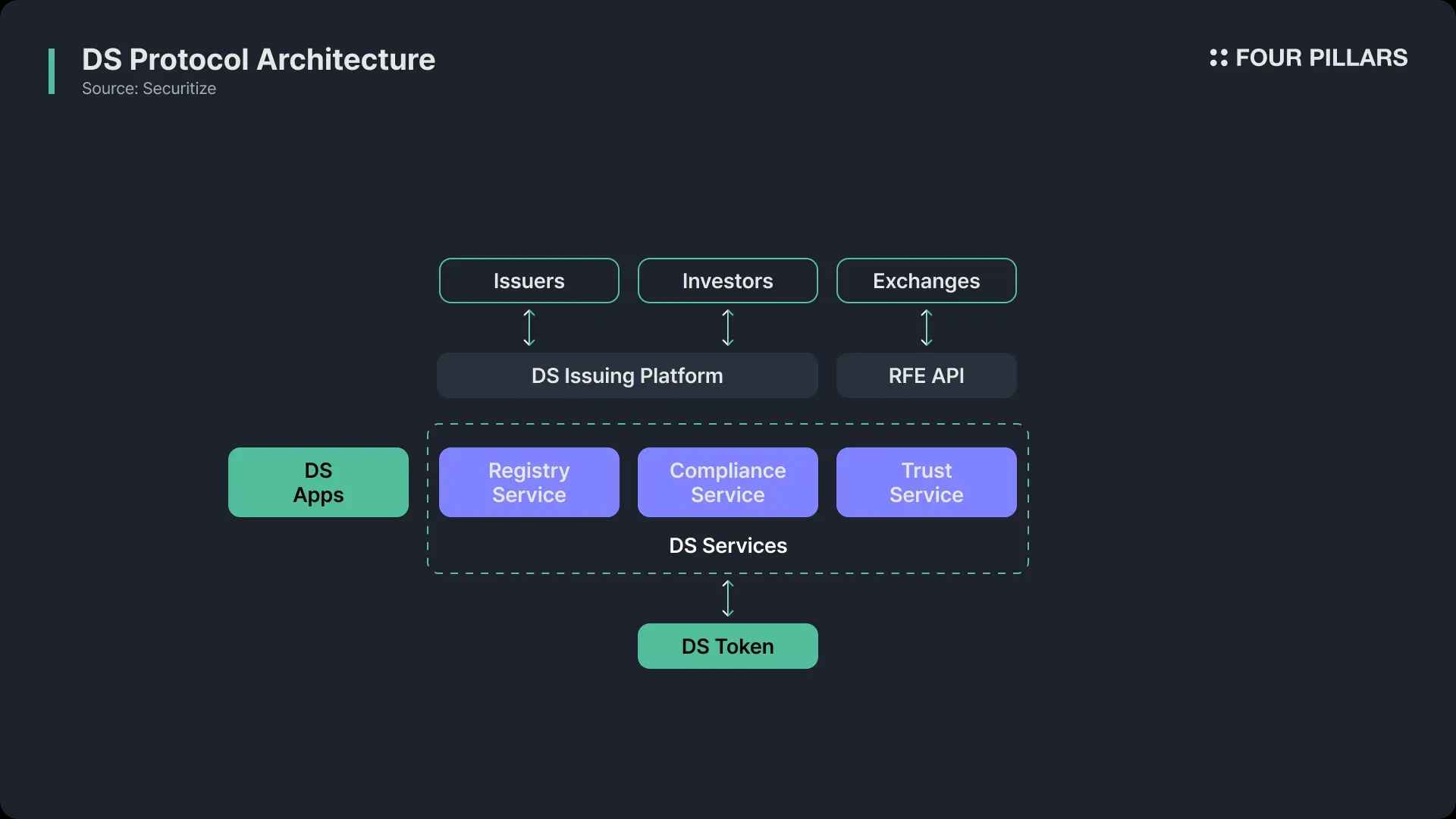
If Securitize complies with regulations in the real world through various licenses, it ensures compliance on-chain through its technical backbone called the DS Protocol. The DS Protocol is a collection of smart contracts that enable tokenized securities to be issued and distributed on-chain in a fully regulated manner. Its main components are 1) DS Token, 2) DS App, and 3) DS Services.
DS Token is compatible with Ethereum’s ERC-20 standard and adds a variety of extended functions required for tokenized securities on top of the basic ERC-20 features. All RWA tokens issued and traded on Securitize, such as BUIDL and ACRED, are DS Tokens.
DS App is an application that ensures the smooth operation of various events throughout the lifecycle of tokenized securities, including issuance, trade support, exercising voting rights, and dividend distribution.
DS Services are the foundational infrastructure that ensures DS Tokens and DS Apps operate in a fully regulated manner. They are a collection of smart contracts including Trust Service, Registry Service, and Compliance Service.
2.2.2 How the DS Protocol Works
Since tokenized securities are still securities under the securities laws of specific countries, they cannot be issued or distributed freely on-chain without restrictions. For example, if in the real world access to Security A is limited to qualified purchasers in the United States, then Token A on the Ethereum network must also only be accessible to wallets verified as qualified purchasers in the United States. In other words, tokenized securities must be treated on-chain in accordance with securities laws and issuer rules, just as in the real world.
To achieve this, Securitize issues all tokenized securities under the DS Token standard. Unlike general ERC-20 tokens, DS Tokens automatically invoke the Compliance Service upon issuance or transfer. The Compliance Service checks whether the transaction is occurring between whitelisted wallets and whether it is conducted in a fully regulated manner.
The Trust Service manages roles by assigning wallet addresses specific permissions (such as issuer, exchange, etc.), while the Registry Service records attribute information such as wallet addresses of investors, nationality, and qualified investor status.
In summary, when a transaction occurs with a DS Token, which represents a tokenized security, the Compliance Service references the Registry Service to verify whether the transaction and participants are acting in a fully regulated manner. Only transactions that meet the regulatory requirements are processed, ensuring that securities laws and issuer rules applicable in the real world are also enforced on-chain.
For readers curious about how the DS Protocol works at the actual smart contract code level, see Four Pillars’ “The Infrastructure of Tokenized Securities: How Securitize Powers the RWA Market.”
Source: Securitize
Financial institutions can tokenize funds and issue them on-chain through Securitize. This is possible because Securitize acts as a transfer agent, managing fund ownership on the basis of token ownership on-chain.
From the perspective of institutions, tokenizing funds on-chain offers the following advantages:
Instant Settlements: Settlement times that previously took several days can be drastically shortened through blockchain.
Automated Compliance: Regulatory requirements can be automatically enforced on users through smart contracts.
Real-Time Shareholder Data: Institutions can access on-chain data in real time to manage data related to token holders.
Enhanced Liquidity Access: They can access abundant blockchain liquidity 24/7.
Flexible Customization: Features such as voting rights and dividends can be flexibly customized according to specific purposes.
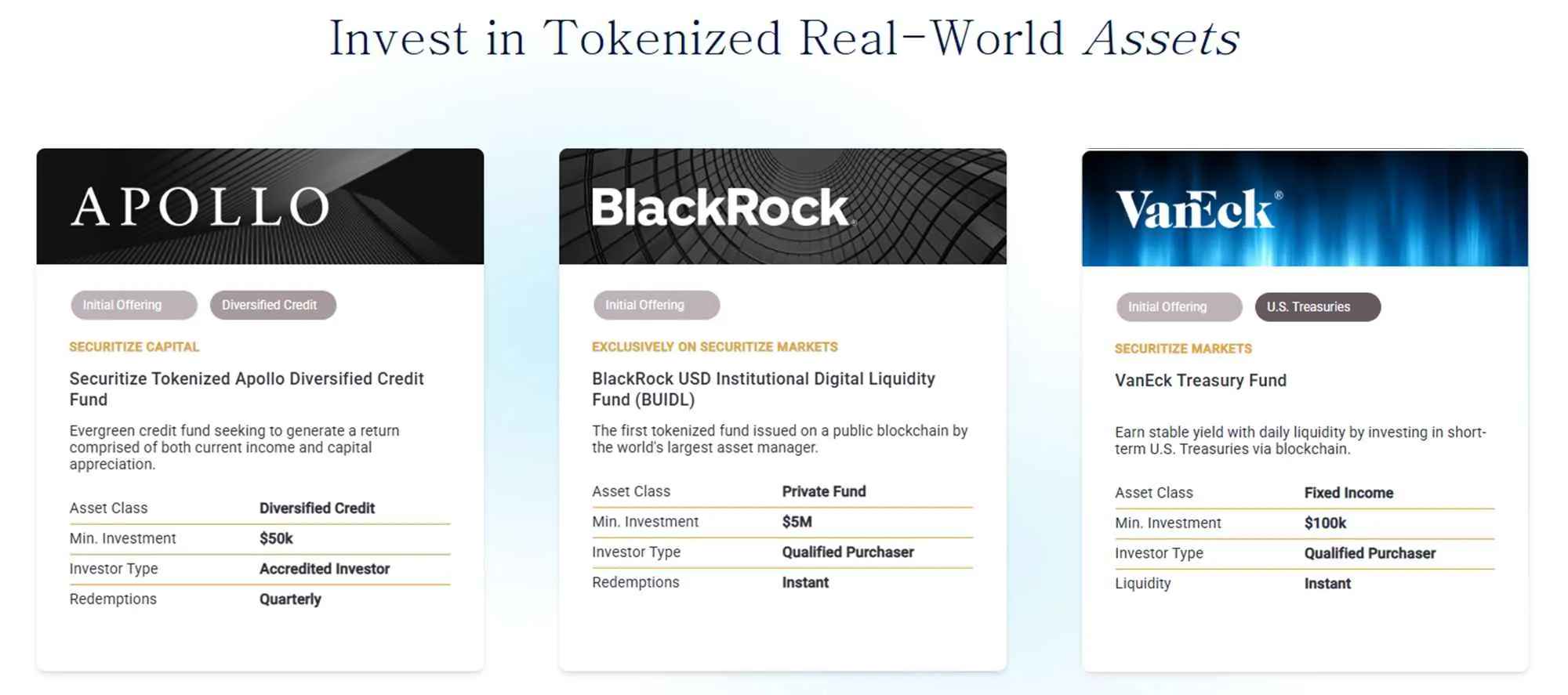
Securitize has already collaborated with various institutions to tokenize a wide range of funds including US treasuries, private credit, crypto, and private equity. Representative examples include BlackRock BUIDL, VanEck VBILL, and Apollo ACRED.
Source: Securitize
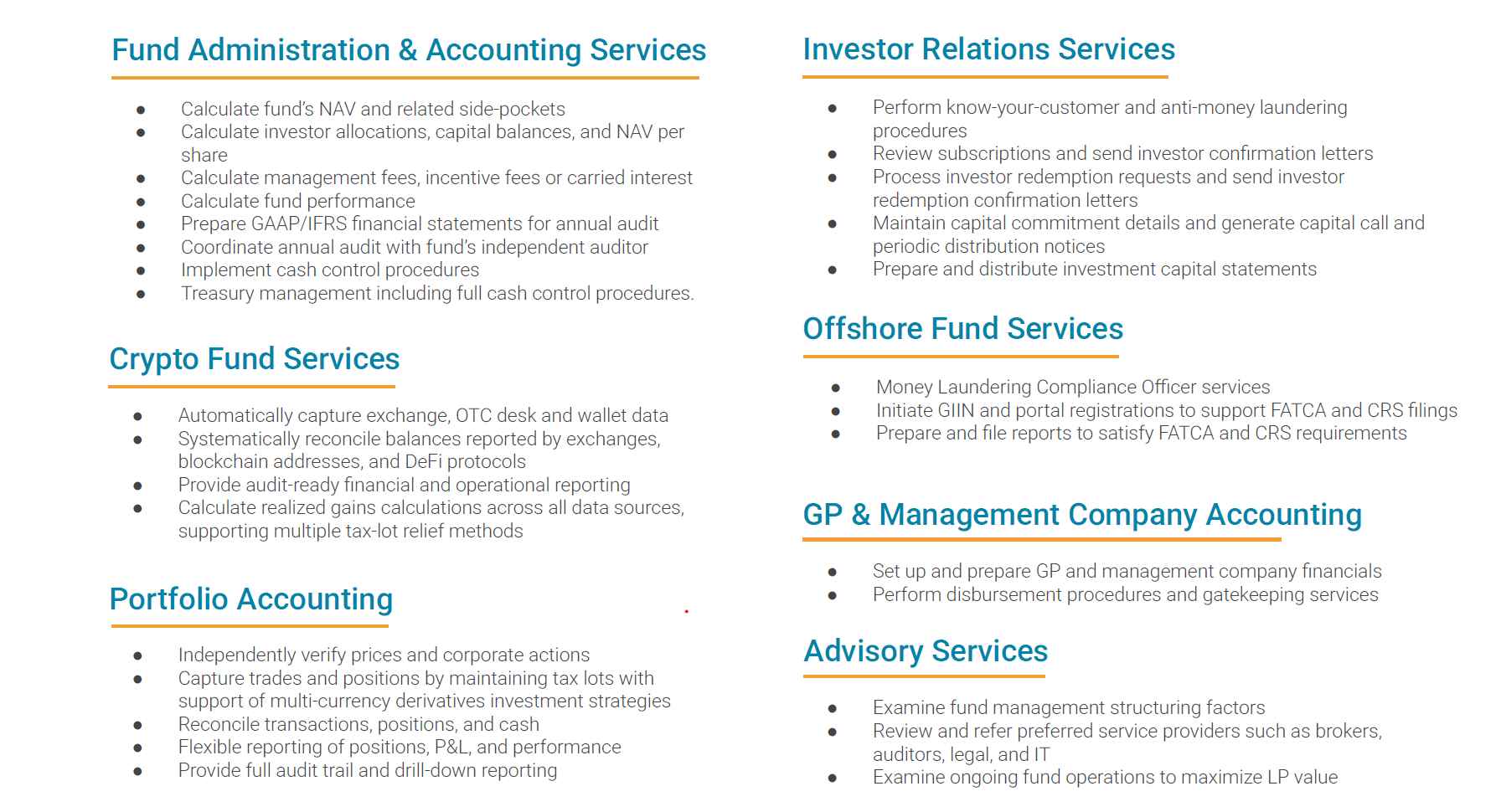
In 2025, Securitize became the world’s largest digital asset fund administrator by acquiring MG Stover’s Fund Administration business. Securitize provides not only basic fund administration but also a wide range of functions, including:
Fund Accounting: Access to the latest fund performance data, calculation of management and performance fees, preparation of GAAP or IFRS year-end financial statements, and audit trail management.
Advisory Services: Applying the most suitable fund structures according to investment strategies, review services, and marketing performance evaluation.
Investor Services: KYC/AML-compliant onboarding, document signing, progress monitoring, and real-time signing.
Crypto Fund Services: Automated integration with exchanges, OTC, and wallets, settlement including verification of exchange and blockchain transactions, and support for various tax treatment methods.
Management Company Accounting: Cash and transaction reconciliation, preparation of financial statements, and establishment and management of annual budgets.
Banking Services: Support for bank account opening, review of wire transfer requests, and preparation of transactions.
Offshore Compliance Services: AML compliance officer and reporting services, and support for FATCA/CRS reporting.

Source: Securitize
BUIDL is a tokenized MMF jointly created by BlackRock and Securitize, with underlying assets consisting of US Treasuries, cash equivalents, and repos. The issuance structure of BUIDL is as follows:
BlackRock USD Institutional Digital Liquidity Fund Ltd. (Fund Entity): A limited liability company established in the BVI, serving as the fund entity. The BVI was chosen for tax efficiency and regulatory flexibility.
BlackRock Financial Management, Inc. (Fund/Investment Manager): A corporation registered in Delaware, USA, and a wholly owned subsidiary of BlackRock Inc. It manages the fund’s assets.
Securitize, LLC (Transfer Agent): An SEC-registered transfer agent that manages the fund’s ownership ledger and records ownership in natively onchain manner.
Securitize Markets, LLC: An SEC-registered brokerage that handles the distribution of BUIDL.
BNY Mellon (Custodian): Provides back-office functions such as accounting and NAV calculation, while also custodizing reserves including cash and treasuries for BUIDL.
PwC LLP (Auditor): One of the Big Four accounting firms, serving as auditor.
The income generated from BUIDL’s underlying assets is automatically distributed to holders’ wallets every weekday using blockchain technology. Instead of increasing the value of BUIDL, its NAV is fixed at $1, and additional BUIDL tokens are distributed as interest. This provides investors with immediate cash flow, reinvestment opportunities, and enhanced transparency in operational reporting.
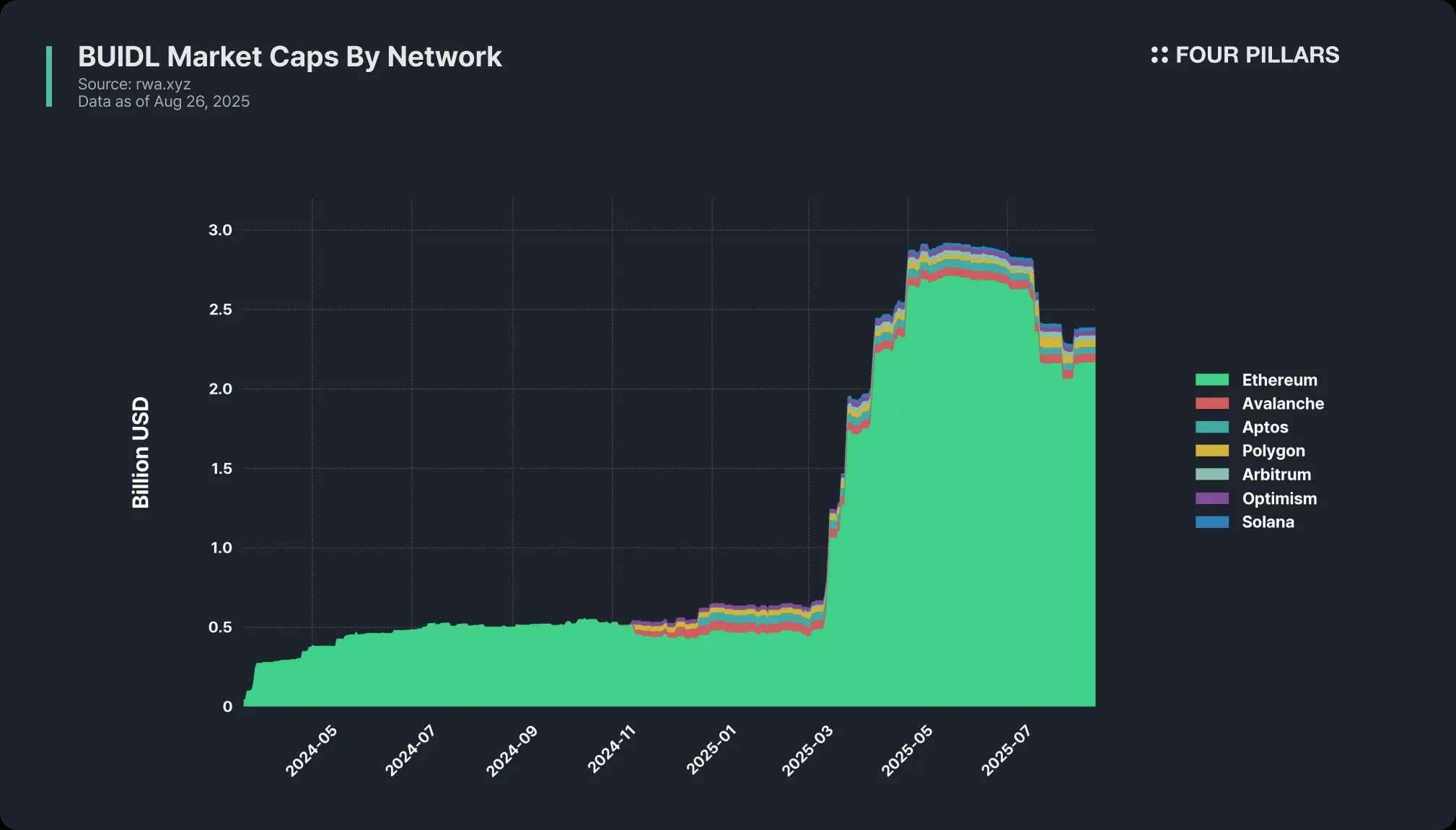
BUIDL currently supports issuance across seven networks: Ethereum, Avalanche, Polygon, Aptos, Arbitrum, Optimism, and Solana, with the majority issued on Ethereum. To prevent fragmentation of BUIDL across multiple networks, BlackRock and Securitize partnered with the cross-chain messaging protocol Wormhole to enable seamless movement of BUIDL across different networks through the Wormhole bridge.
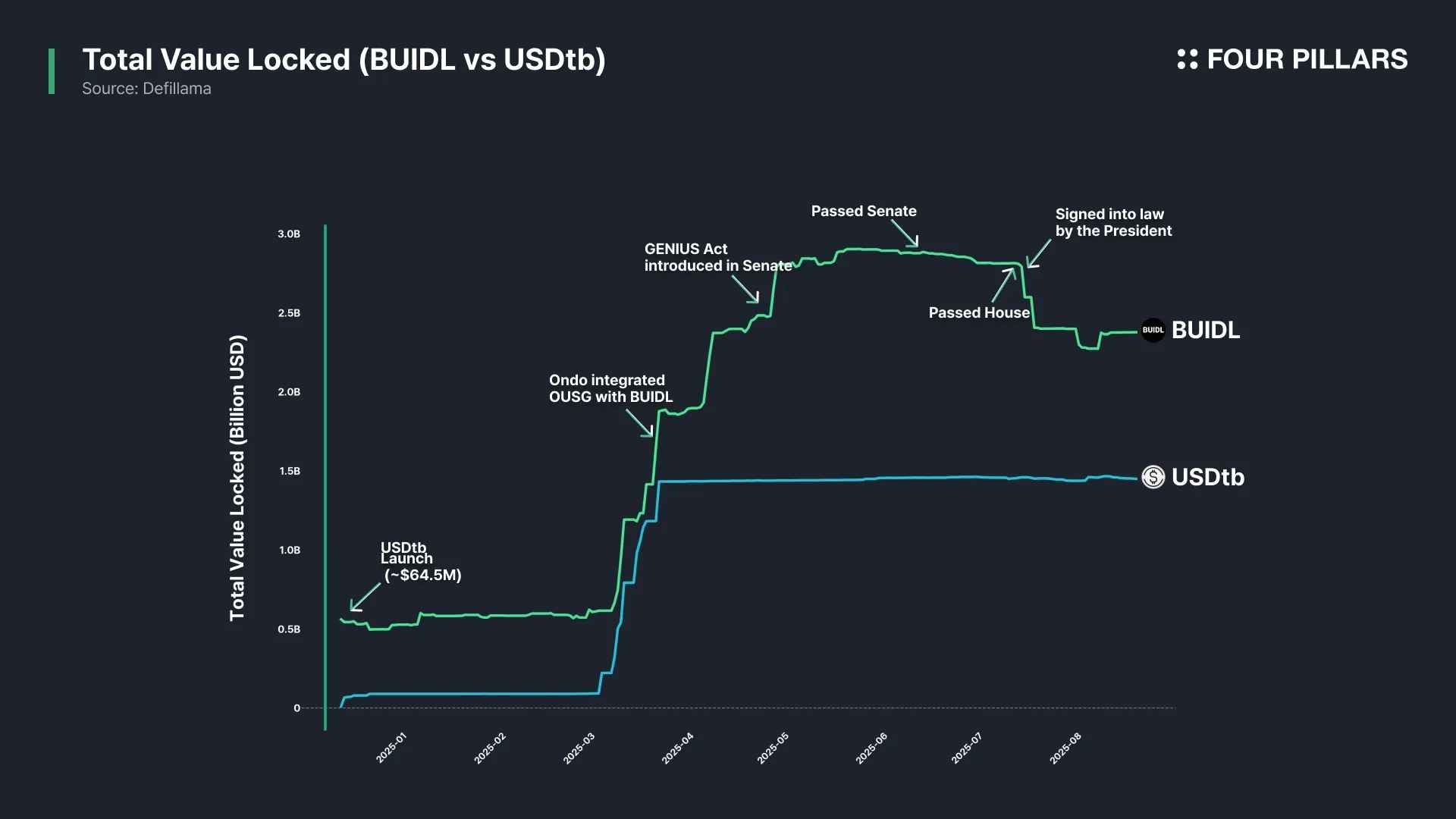
As a tokenized MMF, BUIDL is used by various protocols such as Ethena, Frax, Sky(prev. MakerDAO) and Ondo to back stablecoins or yield-bearing products. Thanks to its active on-chain utilization, BUIDL has an overwhelming issuance volume of approximately $2.2B among US Treasury-based fund tokens, more than double the size of second-ranked WisdomTree’s WTGXX.
Asia is a frontrunner in digital asset adoption, with leading hubs building clear frameworks for tokenized finance. We view the region as a bridge between traditional capital markets and onchain infrastructure; an ideal venue to scale HyFi use cases like regulated, instant settlement and 24/7 distribution. Our strategy is to connect Asian investors and institutions to regulated, onchain securities, bringing the efficiency of smart contracts to the familiar protections of securities law.
Near-term, we’re focused on enabling qualified investors, family offices, and institutions in Asia to access regulated, tokenized U.S. dollar cash equivalents and private-market products through Securitize’s platform that includes a SEC-registered broker dealer, digital transfer agent, fund administrator and operator of an SEC-regulated ATS. We’re building local distribution relationships, whitelisted-wallet networks, and Asia trading windows; and we’re exploring stablecoin-settled subscriptions/redemptions (where permitted) and the use of tokenized securities as collateral in permissioned liquidity venues. Longer-term, we aim to partner with regional banks, custodians, and fintechs to localize operations while maintaining global compliance standards.
The opportunity is significant, but so is the complexity. Key challenges include regulatory fragmentation across markets, varying rules on solicitation and distribution, KYC/AML portability for cross-border investors, custody and bookkeeping treatments for tokenized securities, and operational details like foreign exchange, tax, and bank connectivity for on/off-ramps. We address these with a compliance-first model, local expert partners, and interoperable controls (e.g., whitelisting, attestations) that travel with the investor rather than the venue.
We’re looking for practical standards and pilots. Specifically: interoperable KYC/attestation schemas for permissioned wallets, best-practice guidance for stablecoin-settled fund flows (subscriptions/redemptions, distributions), and policy engagement that harmonizes how compliant, onchain assets move across borders. We’d also welcome working groups to publish case studies and reference implementations that issuers, distributors, and treasurers can adopt, so institutions can move from proof-of-concept to production with confidence.
Ultimately, all of us want to push the Tokenization space forward the right way.
We see the best route to making this happen is putting all of the decision makers in the same room.
The best route in our eyes is the ASA connecting Securitize to the largest asset managers and officials in the region, so we can collaborate on shaping tokenization together.
Securitize is one of the few tokenization platforms capable of handling the entire lifecycle of tokenized securities, from issuance to distribution, in a fully regulated manner. It achieves this through various licenses within US and European jurisdictions and its technical backbone, the DS Protocol. As Securitize already ranks number one among global RWA platforms in terms of TVL, it is expected to leverage its existing influence to drive innovation in the securities system in the Asian market as well.


Dive into 'Narratives' that will be important in the next year
 SBI
SBI


 Securitize