Asia Stablecoin Alliance will host the Asia Stablecoin Conference (ASC) on September 25 this year together with Four Pillars, LayerZero, and stablecoin leaders from around the world. ASC Spotlight content highlights the companies sponsoring ASC in advance so that participants can truly immerse themselves in the ASC event and understand how these companies view the Asian market.
ASC Sponsors: Pharos (Title), Ant Digital Tecnhologies (Title), Canton, Ethena, Kiln, Plume, Rialo, Securitize
ASC Participants: Ant Digital Tecnhologies, Avalanche, Bybit, Canton, Ethena, Ethereum Foundation, Four Pillars, Frax, Grove, IDRX, Japan Smart Chain, Kiln, Lambda256, Layer Zero, Mantle, Maple, Neutrl, Pharos, Plume, RedStone, Rialo, Securitize, Sky, Solana, Spark, Stable, Stargate, Sumimoto, Theo, UR Bank, Wyoming Stable Token Commission
For more details about ASC, please refer to the following links:
ASC Website: https://conference.asiastable.org/
ASC Registration: https://luma.com/la44fa6d
Today’s financial systems face numerous challenges. In developing countries, access to financial infrastructure remains limited, while in developed countries, accessibility appears seamless only because the frontend is designed to be user friendly. Behind the scenes, the backend remains inefficient and outdated. Against this backdrop, blockchain holds the potential to fundamentally transform the payment, banking, and securities networks we rely on today.
That said, blockchain technology still faces significant limitations in overhauling the entire financial system. Despite substantial progress in recent years, performance continues to be the primary bottleneck. Unlocking blockchain’s full potential requires comprehensive optimization across all layers, including consensus, execution, and storage.
Pharos is a high performance L1 blockchain that aims to lay the foundation for a new global financial system. By comprehensively optimizing the components that make up the network, Pharos maximizes network performance and provides scalability that can onboard real world financial systems. Its goal is not only to tokenize simple RWAs but also to build rich liquidity and ecosystems where RWA tokens can actually be utilized.
Pharos seeks to maximize the performance of the network through the following features. This approach optimizes all components of the network from the perspective of the transaction life cycle and actively introduces parallel architecture:
Pharos Consensus
Pharos VM
Transaction Parallel Execution
Pharos Pipelining
Pharos Store
2.1.1 Pharos Consensus
Source: Pharos
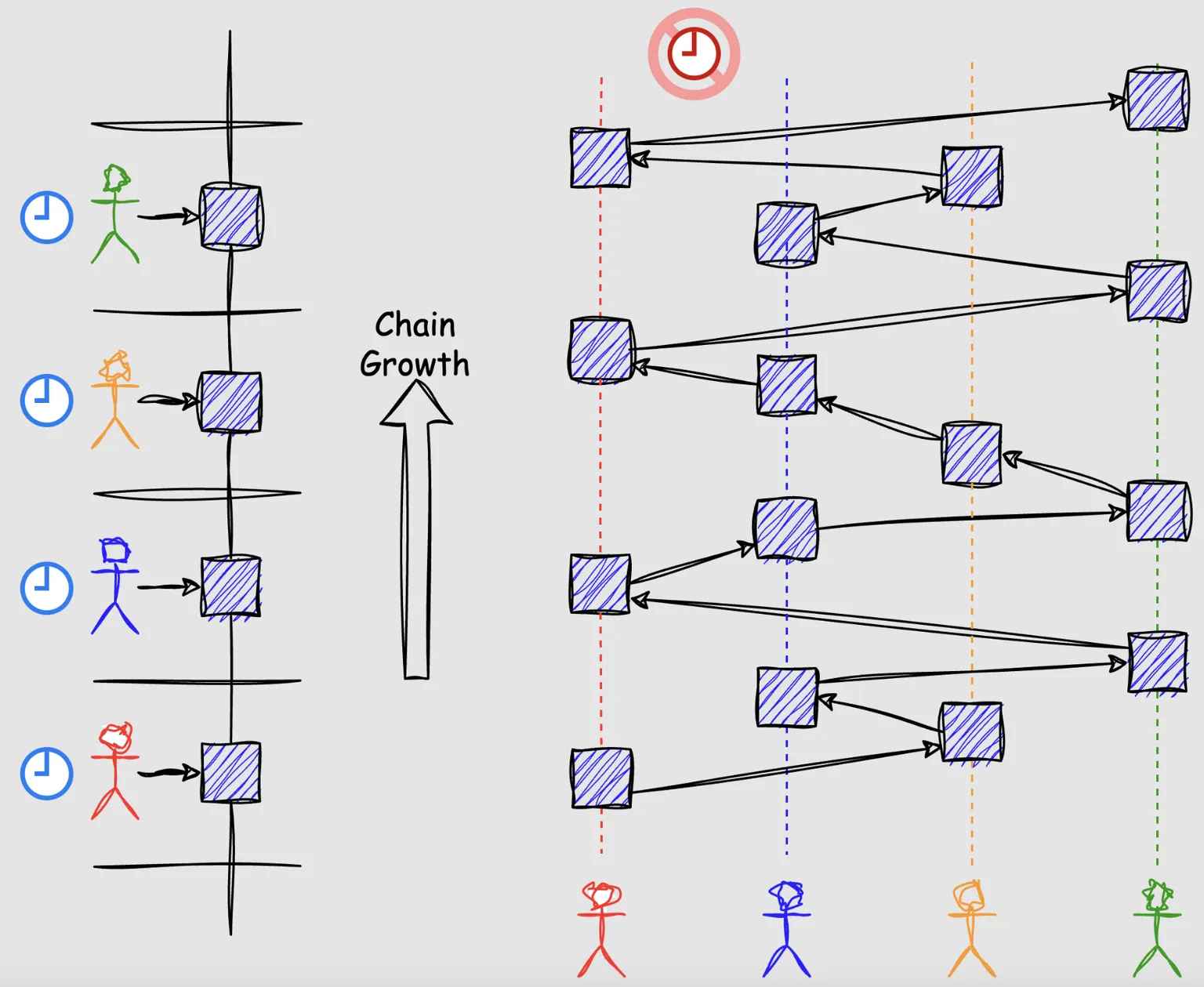
The consensus protocols commonly used in existing blockchains had several factors that hindered scalability. The first is the fixed block generation interval. In most blockchains, block time is fixed, and since a block must be created for a transaction to be finalized, this naturally acted as an upper bound on network scalability. The second is the single proposer. In most networks, within a given timeframe, only one validator becomes the proposer who suggests a block, which is one of the factors that limits performance.
Pharos proposes the Pharos Consensus, which maximizes the utilization of the bandwidth of all validators in the network. First, in Pharos Consensus, the block generation interval is not fixed. The block generation speed is automatically adjusted according to network latency, and since there are no predetermined timeouts or intervals, blocks can be created faster and more flexibly. Second, in Pharos Consensus, block generation does not depend on a single proposer, but instead all validators can freely propose blocks. This removes the bottleneck caused by a single proposer and maximizes scalability.
2.1.2 Pharos VM
Source: Pharos
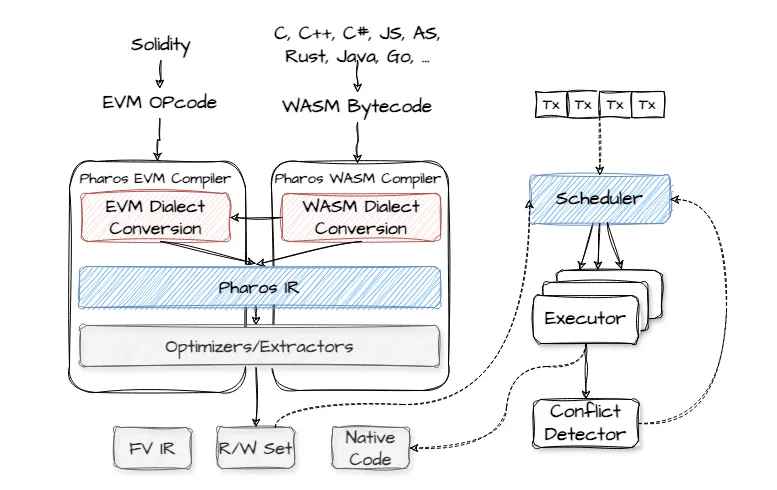
Pharos is fundamentally an EVM compatible L1 network, but it also provides a dual VM that supports WASM, allowing developers to implement smart contracts not only in Solidity but also in languages such as Rust, C++, and Go. This enhances the developer experience, enabling them to create much more diverse and optimized dApps.
2.1.3 Transaction Parallel Execution
Source: Pharos
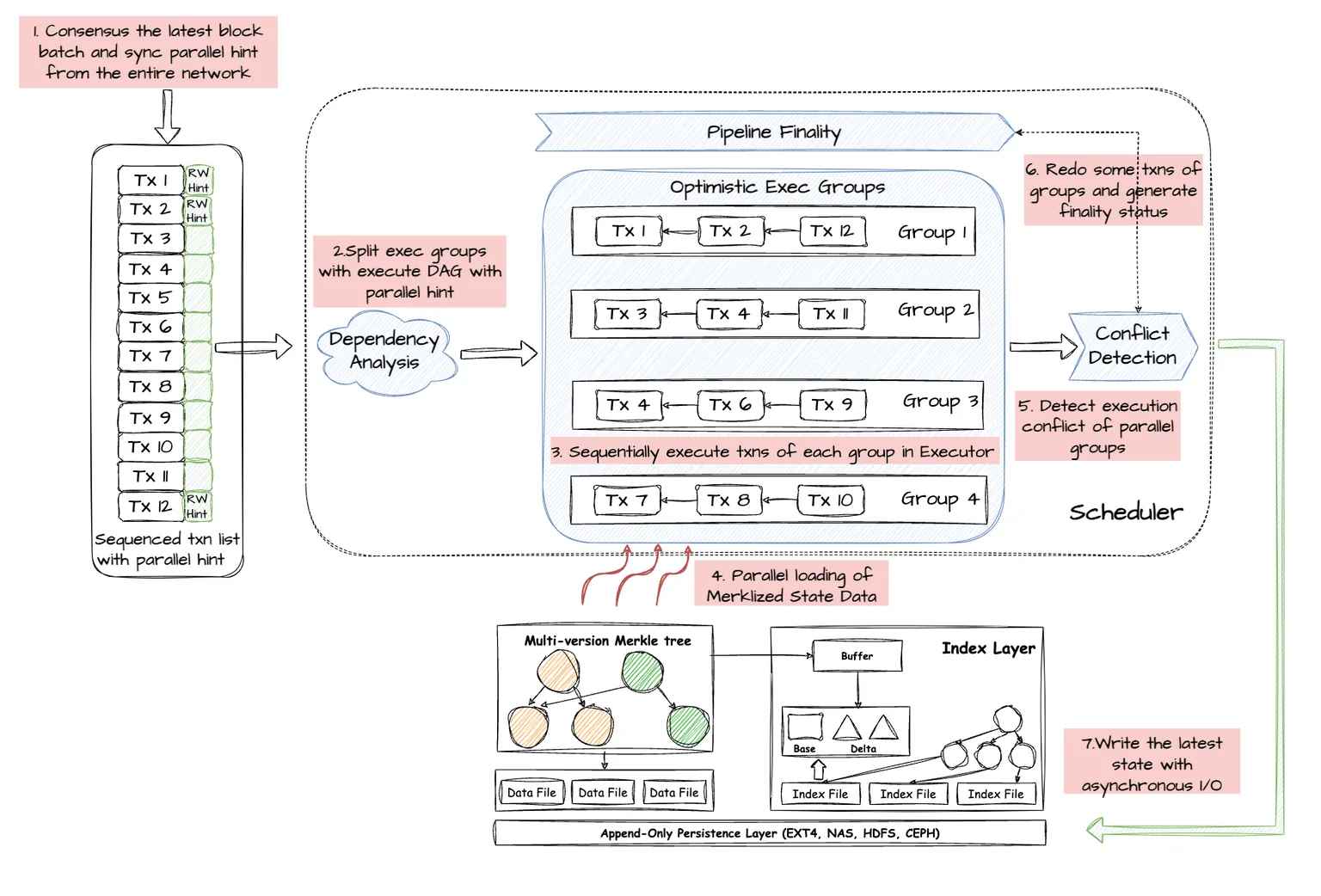
Instead of processing user transactions sequentially, Pharos processes them in parallel, further maximizing network performance. The core of transaction parallel execution is ensuring that the transactions being processed in parallel do not conflict with each other. If transactions that read or write the same data are executed simultaneously, they may cause conflicts, leading to different results depending on the order of execution.
To prevent transaction conflicts, Pharos introduces a Scheduler. Before executing transactions, the Scheduler predicts which values each transaction will read and write, analyzes their dependencies, and generates groups of transactions that can be executed in parallel. Transactions assigned to each group are first executed optimistically, and in the case of conflicts, those transactions are given an order and re-executed later.
2.1.4 Pharos Pipelining
Source: Pharos
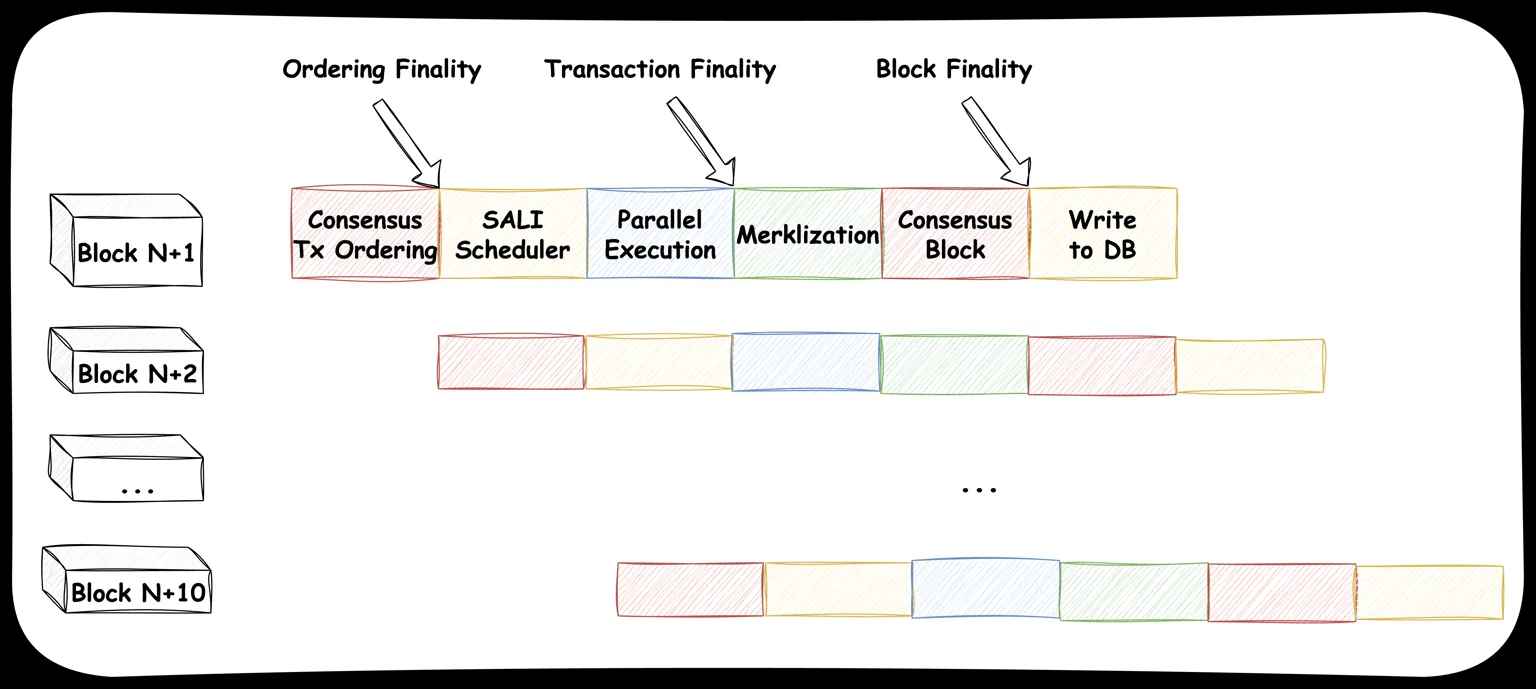
Pipelining refers to processing tasks in parallel, as long as the stages do not overlap, instead of handling them strictly in sequence. For example, in a traditional process, the second block could only begin its A, B, C stages after the first block had fully completed A, B, and C. With pipelining, however, once the first block finishes stage A and moves on to stage B, the second block can immediately start stage A in parallel.
As discussed in section 2.1.3, Pharos not only parallelizes transactions but also extends this approach to entire blocks through pipelining. The stages involved in pipelining include transaction ordering, transaction grouping and parallel execution through the Scheduler, merklization, block ordering consensus, and storing results in the database. Through this process, Pharos is able to process blocks faster compared to other networks.
2.1.5 Pharos Store
Source: Pharos
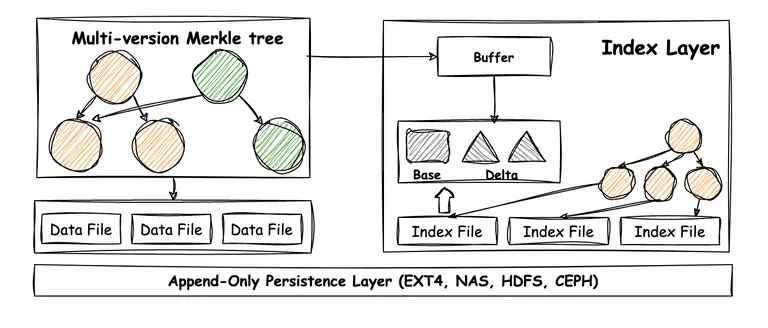
To maximize the performance of the entire network, it is essential to optimize even the final stage of storing blockchain computation results in the database. Pharos Store is Pharos’s blockchain native storage solution, designed to improve read/write efficiency and reduce storage costs. To achieve this, Pharos introduces three key innovations to storage:
ADS Pushdown: Traditionally, data storage (DB) and verification (ADS) were handled separately. Pharos integrates the two processes to increase efficiency.
Version-Based Addressing: Instead of relying on complex hash-based addresses to locate data, Pharos Store uses a simpler version-based addressing system, enabling more efficient lookups.
Delta Encoding: In conventional databases, even small data changes required rewriting the entire dataset. With Pharos Store, only the modified portions are stored, significantly reducing unnecessary duplication.
Source: Pharos
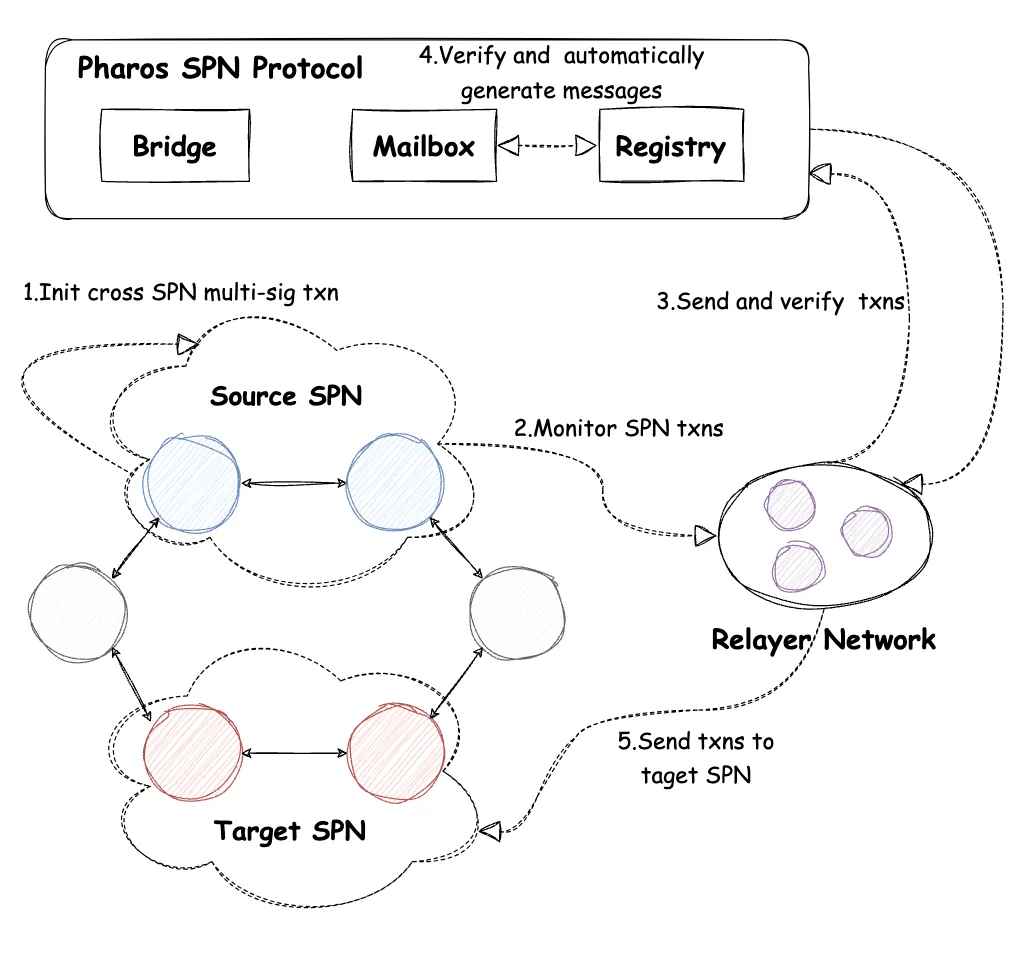
Pharos not only focuses on improving scalability through blockchain optimization, but also places great emphasis on building a foundation that allows developers and the ecosystem to expand aggressively. This foundation is the Pharos Special Processing Networks (SPNs).
Pharos SPNs are specialized blockchains that can be independently built on top of the Pharos network. Developers can easily launch their own blockchains within the Pharos ecosystem by selecting validators from the Pharos network. The security of SPNs is maintained through native restaking. Validators stake P tokens on the Pharos main network to receive stP, which can then be reused within Pharos SPNs to participate in securing the network.
SPNs can adopt execution environments tailored to specific applications and can also integrate specialized protocols such as IoT networks, MPC, FHE, and TEE, making it possible to build a wide range of networks. Pharos even provides a Cross-SPN protocol, enabling seamless cross-chain functionality between different SPNs.
Since Pharos has not yet launched its mainnet, there are not many use cases so far. However, it has been steadily building its financial ecosystem through key partnerships and the operation of its ecosystem fund.
Ant Digital Technologies is a subsidiary of Ant Group, the operator of Alipay. Its main business areas include enterprise cloud, blockchain, and AI services. ZAN is Ant Digital Technologies’ Web3 brand, launched in 2023, which provides a wide range of blockchain infrastructure services such as node RPC, ZK computation, smart contract audits, Web3 KYC services, and appchain frameworks.
Pharos is working closely with Ant Digital Technologies. This collaboration extends beyond the technical aspects discussed earlier and also includes the development of the RWA ecosystem. Given that Ant Group operates Alipay, one of the world’s largest payment services, and offers a variety of financial products, the partnership between Pharos and Ant Digital Technologies will provide a strong foundation for bringing high quality RWAs on chain to the Pharos network.
Even before the mainnet launch, Pharos has been operating a $20M ecosystem fund to support the onboarding of various types of dApps such as payments, RWA, and DeFi, gradually building out its ecosystem.
Fiamma: A Bitcoin bridge based on BitVM2 that enables liquidity from the Bitcoin network to be transferred to the Pharos network easily and securely.
Primus: A zkTLS protocol that verifies Web2 data and validates computations on chain.
AutoStaking: An AI powered stablecoin yield aggregator that allows users to easily invest in stablecoins on the Pharos network.
Brokex, Bitverse: On chain CLOB exchanges where users can trade various assets using an order book model.
AquaFlux: A protocol that enables RWA yields to be divided and traded by principal, interest, and risk components.
R2: A protocol for issuing yield bearing stablecoins.
PNS: A naming service that abstracts addresses on the Pharos network.
OpenFi: A lending protocol on the Pharos network that allows users to borrow cryptocurrencies against various types of collateral.
Zenith, FaroSwap: AMM DEXs that support trading of a wide range of assets.
We see Asia as the key pioneer for RWA tokenization and Web3 adoption, not only because of those well-established financial hubs like Hong Kong and Singapore with their mature economies and thriving institutional fintech ecosystems but also due to the vibrant crypto and digital asset markets like Korea, Japan, Vietnam, the Philippines, where retail participation are rapidly growing. Just as importantly, much of our core team hails from Alibaba Group’s blockchain and payments business division, giving us deep regional tech understanding and expertise in Asia. These factors make Pharos position Asia as both a center of technological innovation and the ideal region to bridge Web2 and Web3 liquidity at internet scale.
Pharos already has an active presence in Hong Kong, Korea, Vietnam, Japan, and Indonesia, engaging with leading enterprises in industries such as financial institutions, renewable energy and mining resources that are exploring tokenization to unlock asset liquidity. We are also collaborating with local technology partners on validator node operations to expand the Pharos network’s footprint across Asia, while launching ambassador programs to connect with local communities, institutions, and users. At the same time, we are working closely with Ant Digital Technologies on next-generation RWA infrastructure and plan to further advance compliance frameworks, stable asset issuance, cross-border liquidity networks, and high-performance DeFi and on-chain financial applications tailored for the region.
The main challenge is different levels of regulatory clarity across different governments. Our vision to connect Web2 and Web3 and ultimately bring trillions in real-world capital on-chain requires alignment with local regulations while ensuring global liquidity interoperability. To gain the trust of traditional financial institutions depends on meeting both compliance and performance requirements. In parallel, we are also focused on achieving seamless interoperability between different stablecoin and RWA frameworks without compromising security or throughput as the ecosystem scales.
We see the ASA as a major bridge between Web3 innovators and regulators. By driving clearer regulations, common interoperability standards, and greater market confidence, we expect collaboration among alliance members will help each other to build on real-world, cross-border financial applications that benefit the entire ecosystem.
Pharos aims to fundamentally reinvent financial systems from the ground up and serve as a lighthouse for next generation blockchain based finance. To achieve this, Pharos is not only focused on maximizing overall network performance but also on bringing high quality RWAs on chain through its close collaboration with Ant Digital Tecnhologies. Given Ant Group’s strong influence in the financial markets of China and across Asia, Pharos is well positioned to expand into both Asian and global financial ecosystems.


Dive into 'Narratives' that will be important in the next year


 Pharos
 Mastercard