
In the early hours of January 3, 2026, the United States announced that it had captured Venezuelan President Nicolas Maduro and his wife, Cilia Flores, through a top-secret military operation called “Operation Absolute Resolve.” The operation was reportedly carried out after months of preparation, with the US military’s Delta Force leading a raid on the presidential residence in Caracas. President Trump reportedly watched the operation in real time and, immediately after its success, posted on Truth Social that “the Maduro couple is in US custody”.
Right after the announcement, the prediction market platform Polymarket suddenly found itself in the global spotlight. Previously consumed mostly within the crypto community, Polymarket rapidly became known to the general public as this incident spread.
The core reason attention exploded was that, just hours before the announcement, an unusual betting pattern was spotted on Polymarket’s market related to the likelihood of Maduro being removed from power. In particular, a newly created anonymous account reportedly made a concentrated purchase of about $30K when the implied probability of Maduro’s removal was only around 5% to 8%. After the operation was announced, the position surged, and reports circulated that it swelled to over $436K. In other words, the account appears to have made roughly $400K in profit, igniting insider trading suspicions.
What further fueled the suspicion was the account’s behavior pattern. The account reportedly had almost no prior activity, repeatedly participated only in Venezuela-related bets, and withdrew profits immediately after realizing gains. As a result, speculation that “classified information may have leaked” gained traction, and analysis posts arguing for an insider based on transaction flows, domain information, and betting timing have been widely shared.
Of course, “insider” controversies around Polymarket are not new. In the past, suspicions have repeatedly surfaced over trades that appeared to reflect public indicators, such as Google search trend movements, ahead of time. This time, however, the story drew far greater attention because it was not merely about corporate-level internal information, but about circumstances seemingly intertwined with a state-level covert operation.
The wallet suspected of being an insider, linked here, was not only involved in the highly publicized “Maduro removal timing” market. Evidence also suggests it placed bets and later settled profits in three additional prediction markets, again focusing on low-probability ranges.
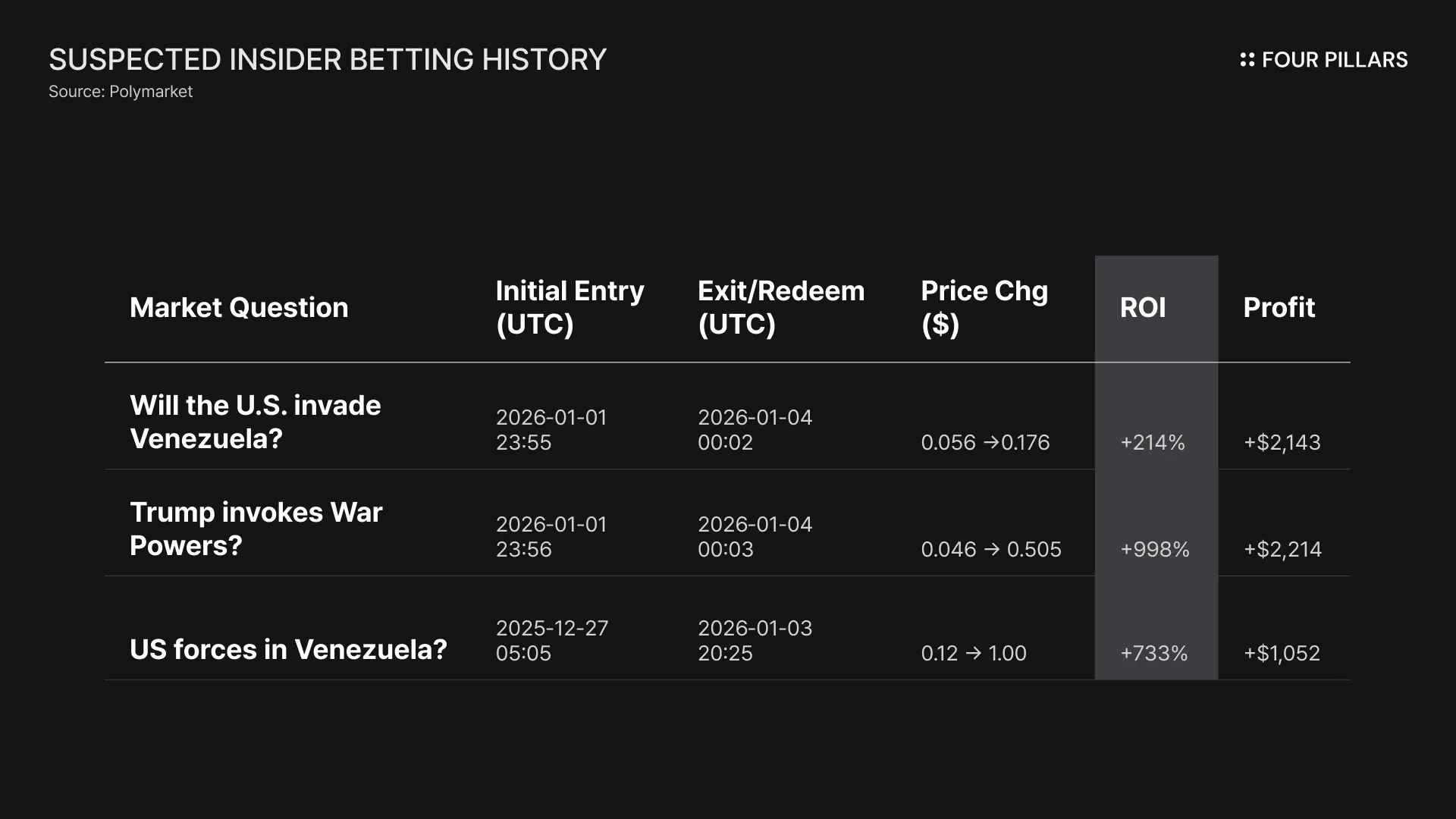
Notably, these bets share a common theme: they concentrate on questions related to the possibility of US military intervention. Between December 27 and January 1, the wallet repeatedly entered related markets, appearing to trade relatively actively even before the January 3 announcement. Estimated returns per trade range from at least 2x to as high as 10x, and the cumulative profit from these three markets is estimated at roughly $5K.
Because the earlier bets were relatively small, they appear closer to a trial run. In contrast, the owner of the wallet built a full position by deploying a total of about $32K into the “Maduro removal likelihood” market.
From December 31 until just before January 3, the wallet deployed about $6,300 in advance at an average implied probability of 7.2%, a notably low range. Then, between 1:38 a.m. and 2:58 a.m. on January 3, it made three additional purchases and concentrated $20,000, about 60% of the total capital. Strikingly, the market price did not move significantly even through this window.
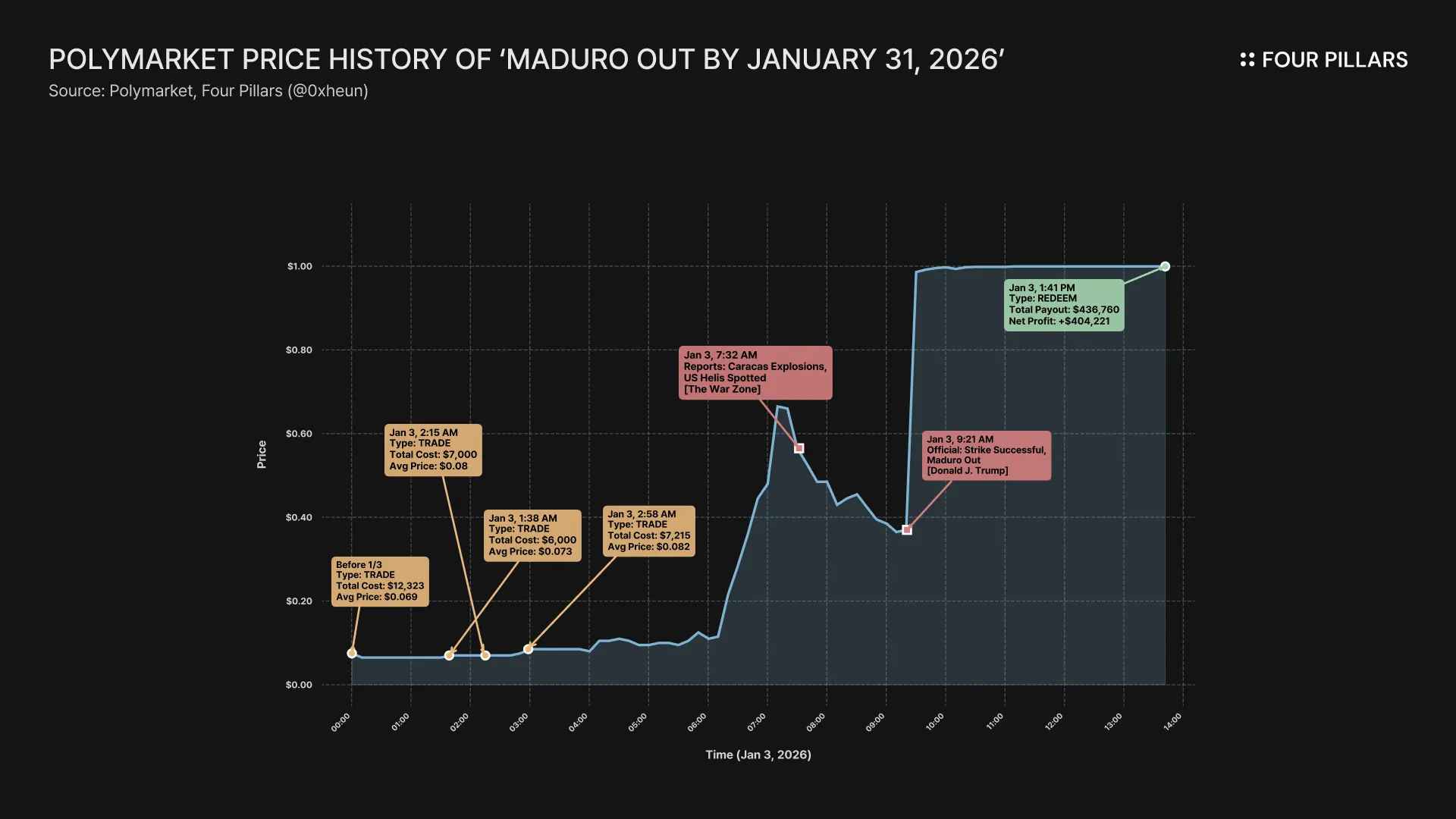
After 6 a.m., rumors about an invasion of Venezuela began spreading through the community. The implied probability briefly climbed above 60%, but then fell again, showing unstable movement. Once President Trump’s official announcement came out, the probability converged to 100%, and the wallet immediately settled its profits. The final betting outcome is as follows:
Total holding period: 4 days
Total capital deployed: $32,528
Total cashed out: $436,759
Net profit: +$404,221
Return: +1,242%
After locking in profits, the wallet sequentially closed out the remaining gains from the other three related markets mentioned earlier. It then stopped all account activity and disappeared from view. This pattern, namely (1) splitting a large purchase before information or rumors circulated widely, (2) participating selectively only in markets tied to US military involvement, and (3) closing the account immediately after securing profits, is presented as a strong basis for suspecting this wallet belongs to an insider.
In the end, prediction markets like Polymarket, especially markets whose outcomes hinge not on natural phenomena but on decisions made by specific actors, are structurally environments where insiders are bound to win. As insider trading concerns become a hot-button issue, efforts to identify potential insiders based on on-chain data are becoming increasingly active on X and elsewhere.
A representative example is recent betting related to Israel. One user points to a wallet’s abnormal activity patterns and overwhelming win rate and strongly argues that the wallet is not simply a trader, but likely an insider with access to real information. Of course, no matter how suspicious the wallet’s history, patterns, and win rate may look, it is impossible to definitively label them an insider without hard evidence. Still, if we assume they are truly insiders, we are forced to confront a fundamental question.
When defending the positive role of prediction markets, people often cite the efficient market hypothesis (EMH), the idea that market prices immediately reflect all available information. But does it make sense to include even extreme “classified” secrets that the public cannot access at all within the concept of “all information reflected by the market”? Can we really say the market is functioning efficiently in a situation where information asymmetry is maximized? This is the moment to think about that question more deeply.


 Polymarket
