*Four Pillars has published extensive research on STO Market in Korea with Shinhan Securities, Hashed Open Research, Bae.Kim&Lee. (Read the Full Report)
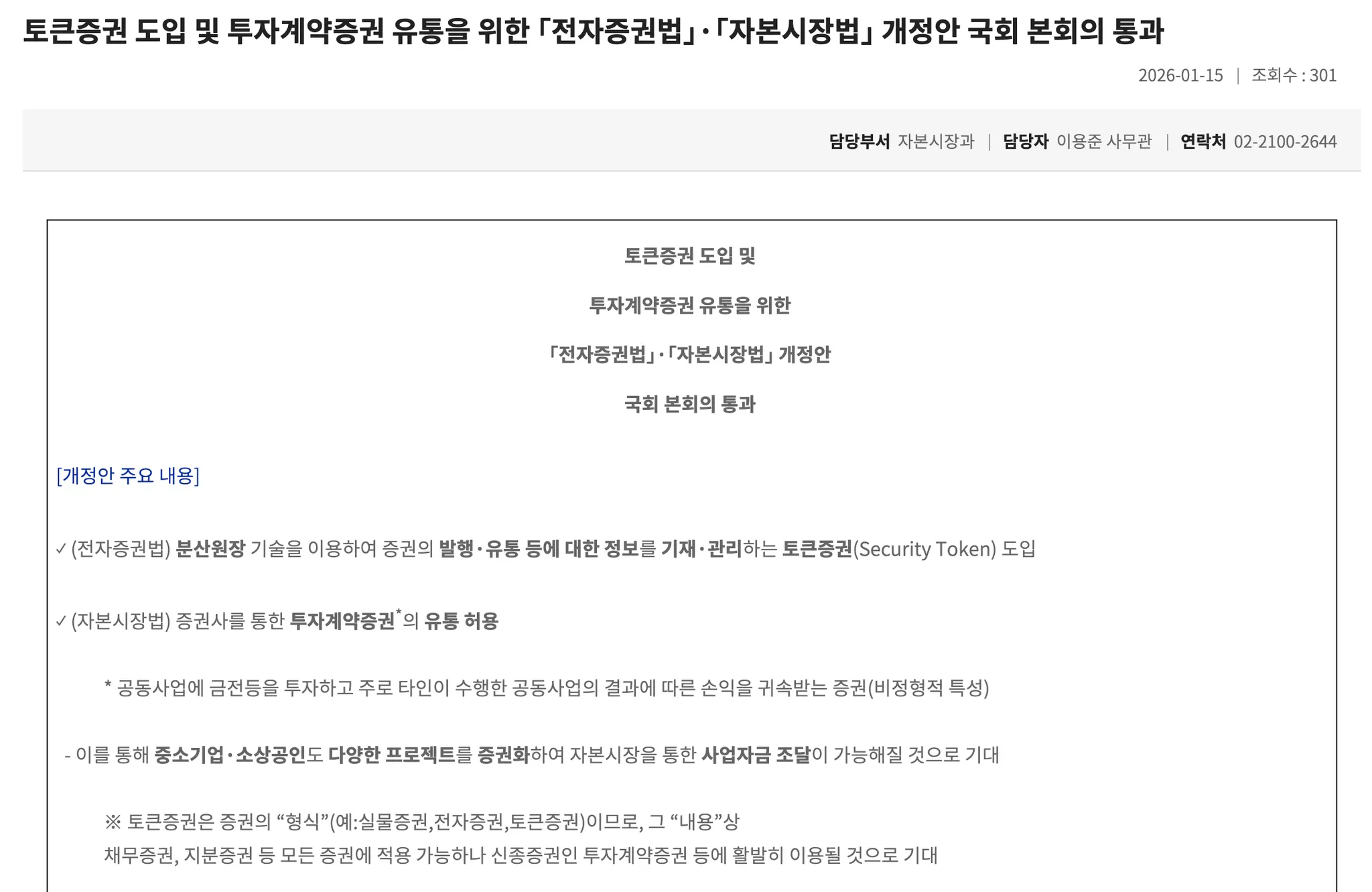
Source: 토큰증권 도입 및 투자계약증권 유통을 위한 「전자증권법」/「자본시장법」 개정안 국회 본회의 통과
Today, Korea's National Assembly passed amendments to the Capital Markets Act and the Electronic Securities Act (commonly referred to as the STO bill). This marks the legal foundation for bringing security tokens into the regulated financial system. However, this doesn't mean tokens can be issued immediately. Before the market can actually operate, subordinate regulations must be established to specify issuance requirements, distribution structures, and the roles of infrastructure participants.
The amendments introduce two key changes.
First, security tokens are now explicitly defined as a type of electronic security. Blockchain-based (tokenized) securities will be subject to the same Capital Markets Act regulations as traditional electronic securities.
Second, issuance and distribution have been structurally separated. Asset-holding companies and projects can issue security tokens, but trading and distribution can only occur through licensed securities firms or regulated markets. This is designed to address longstanding concerns in the fractional investment market: unlicensed distribution and inadequate investor protection. A framework now exists for various assets - art, music royalties, real estate, unlisted shares - to be legally fractionalized and distributed as securities. Distribution is expected to take place on "fractional investment OTC exchanges" licensed by financial authorities.
The Financial Services Commission plans to launch a security token working group to develop distributed ledger-based securities account infrastructure and detailed regulations. Implementation is scheduled for January 2026.
The STO legislation will likely accelerate market entry by major financial institutions and securities firms that have been waiting on the sidelines. Financial companies that have been preparing STO infrastructure and products internally can now move forward with pilot issuances and product launches, now that regulatory uncertainty has been resolved. The early market will likely center on high-quality assets where regulations are clear and valuation is straightforward.
In the medium to long term, STOs could reshape how Korean capital markets approach fundraising and investment access. For startups and venture companies, they offer a new funding channel before IPO. For investors, they open up diversified exposure to asset classes that were previously difficult to access.
But there's a missing piece of the puzzle: the digitization of payment infrastructure.
Even if bonds, funds, and private securities denominated in Korean won are issued on-chain, the core benefits of tokenization cannot be realized if settlement still relies on off-chain KRW bank transfers. Instant settlement (T+0), 24/7 trading, and programmable payments via smart contracts - all of these require the payment layer to be integrated on-chain as well.
On the other hand, introducing a KRW stablecoin first isn't the answer either. Unlike USD stablecoins, a KRW stablecoin would have limited utility due to the lack of on-chain assets to actually settle for.
The optimal solution is parallel development. Tokenization of KRW-denominated assets and issuance of KRW stablecoins (or tokenized deposits) should proceed together, creating a structure where the entire cycle - issuance, distribution, and settlement - operates on-chain.
Even after the STO bill takes effect, Korea will not permit securities to be issued and traded directly on public blockchains as in the United States. The Korean legal framework's concept of a "distributed ledger" prioritizes controllability and legal certainty over technological openness.
The bill defines a distributed ledger as "a ledger and management system in which information is recorded by multiple participants according to criteria such as chronological order, jointly managed, and protected from unauthorized deletion or retroactive modification through technical measures." This is structurally different from the permissionless model of public blockchains.
So what does STO implementation in 2026 mean for the crypto industry?
In the short term, these will likely remain separate worlds. Direct interaction between security tokens operating on private chains and the public blockchain crypto ecosystem will be limited.
But the medium to long-term picture is different. Private chains will also see attempts to build on-chain services based on smart contracts. In this process, protocols and mechanisms proven on public chains will inevitably be referenced. Korean versions of Ethena or AAVE should be able to operate on private blockchains, and for complex structures, implementation should occur through partnerships with existing public protocols.
The fundamental advantage of blockchain is openness. That advantage is only preserved when innovations developed in both private and public ecosystems can be utilized across both.


