Source: BVNK
Payment networks like Visa and Mastercard are steadily internalizing stablecoin rails that cards and bank accounts alone can’t fully cover. As part of that broader shift, Visa has officially announced the integration of stablecoin payouts into Visa Direct.
With this integration, Visa Direct clients will be able to send funds directly to recipients’ stablecoin wallets. Global recipients such as creators and gig workers will be able to receive payments within minutes, without being constrained by banking hours or settlement delays.
The infrastructure partner for this rollout is BVNK, which processes over $300B in annualized stablecoin payments. BVNK is a stablecoin orchestration company that abstracts transfers, payments, settlement, and FX across stablecoin rails.
The importance of this integration is not about adding a single new feature.
What matters is that the minimum condition is now in place for stablecoins to become the default asset unit in corporate treasury.
Payouts are not an isolated action. They are the output of how a company runs its finances. Behind every payout sits treasury management: holding funds, making payments, moving money, and converting currencies.
In that context, Visa opening a stablecoin payout rail means that companies can now hold their available operating capital in stablecoins and deploy it instantly for payouts or transfers. Put differently, corporates can keep their working capital in stablecoins while still executing payments with the same reliability and immediacy as traditional rails.
Ultimately, this changes the structure of corporate treasury itself, allowing the advantages of stablecoins to be applied across day-to-day capital management.
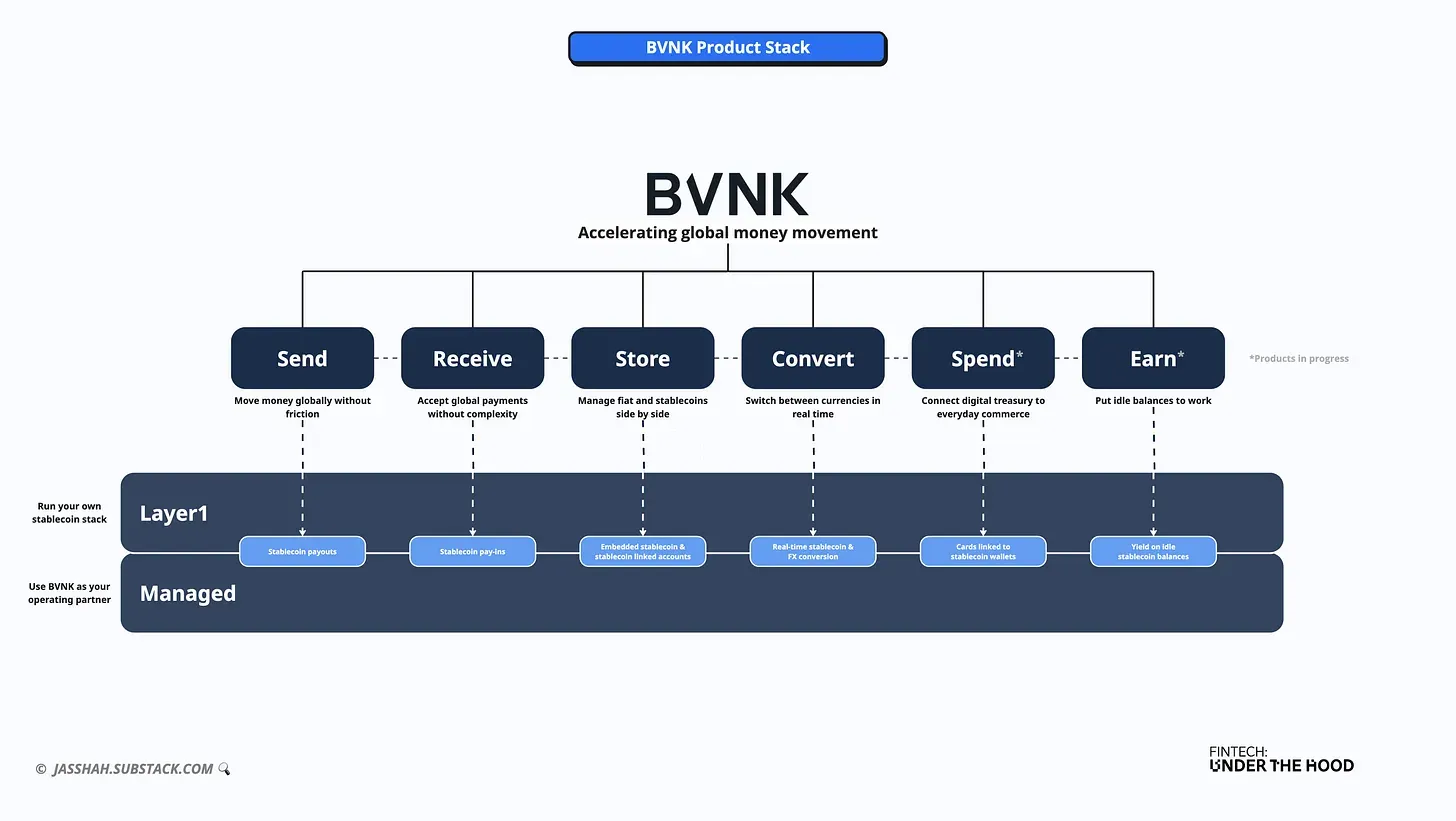
As stablecoin treasury management becomes viable, the players gaining the most relevance are infrastructure companies that support the entire stablecoin lifecycle in an integrated way. A good example is BVNK, which offers enterprises the following services:
Source: Jas Shah (Fintech: Under the Hood)
Custody: secure storage of fiat and stablecoins within a digital treasury
Payouts: real-time global stablecoin payouts to employees, freelancers, and merchants
Conversion: real-time on/off-ramps and USD ↔ non-USD stablecoin conversions
Earn: yield generation on idle stablecoin balances via low-risk assets
Orchestration: end-to-end automation of payouts, collections, FX, and settlement through a single API
And more (card payments, wallets, compliance & license, pay-in, remittance, etc)
Looking at the scope of these services, they cover the full set of treasury functions required for enterprises to operate with stablecoins.
This broader shift is not limited to BVNK alone. Players that historically focused on secure custody or enterprise payment software are now rapidly extending into corporate treasury management by building on their existing strengths. (Stripe, Bitgo, Bastion, Copper.co, Crossmint, etc)
Modern Treasury: Has long operated enterprise payment software on top of bank rails, and recently partnered with Brale to add a compliance layer. This allows customers to instruct stablecoin payouts from the same interface used for traditional bank transfers.
Fireblocks: Building on its track record as an institutional custody provider, Fireblocks is positioning itself as corporate treasury infrastructure. Through the Fireblocks Network, a dedicated off-chain payment network, participating institutions can process stablecoin transfers between each other in real time.
According to one study, 86% of global cross-border payments are B2B. P2P remittances account for about 2%, while retail payments such as B2C and C2B make up roughly 12%.
Enterprise money flows dominate the global payments landscape. Yet in stablecoin discussions, corporate treasury management remains underexplored, compared to retail push payments or P2P remittances.
Stablecoin adoption will be top-down. When corporate treasuries, the hub of payment flows, adopt stablecoins as a default asset, that’s where stablecoin adoption really accelerates.