
According to the GENIUS Act, issuers are not allowed to pay interest to stablecoin holders.
But right now, Coinbase is paying a 3.35% reward to users who hold USDC on the exchange. This is possible because the GENIUS Act does not prohibit distributors from paying interest, only issuers.
However, ahead of the Senate committee markup on Jan 15 for the Market Structure Bill, which aims to systematize crypto regulation, a debate has broken out.
The key question is whether stablecoin rewards should also be banned at the distributor level.
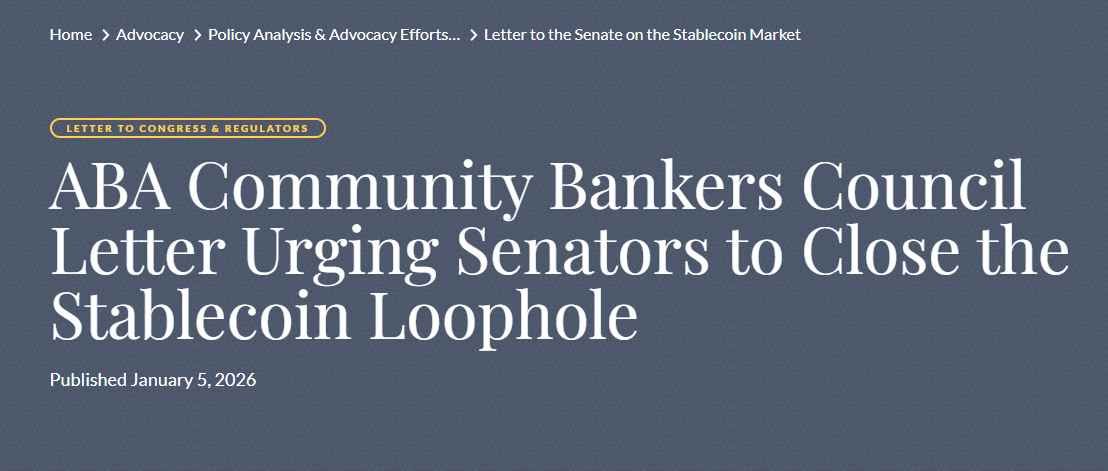
The most prominent group calling for a complete ban on stablecoin rewards is the American Bankers Association (ABA).
In a letter released on Jan 5, the ABA argues that the GENIUS Act’s interest payment ban should not only apply to issuers, but also be broadly interpreted and extended to affiliated parties as well.
They are pushing for this interpretation to be explicitly written into the Market Structure Bill.
The reason the banking industry wants a total ban on stablecoin interest is actually pretty simple.
- First, they are worried about deposits flowing out of banks.
- Second, fewer deposits means less capacity to issue loans.
- Third, stablecoins are not protected by FDIC insurance.
At the end of the day, stablecoins threaten the stable and highly profitable business model that banks have relied on for decades.
From the crypto industry’s point of view, this is a big problem.
Using the Market Structure Bill to expand the restrictions of the GENIUS Act through banking lobby pressure would effectively rewrite and narrow a law that has already passed.
Unsurprisingly, this has triggered strong backlash from the crypto side.
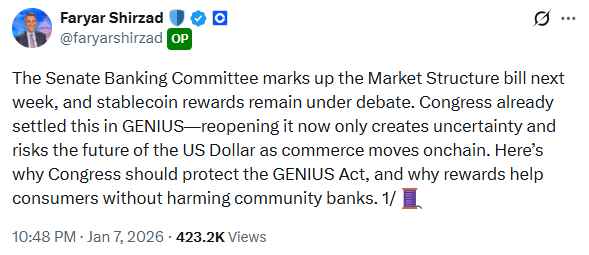
Coinbase’s Chief Policy Officer, @faryarshirzad, pushed back by pointing to research showing that stablecoins do not meaningfully drive bank deposit outflows.
He also highlighted news that China’s e-CNY pays interest, using it as another data point in the debate.
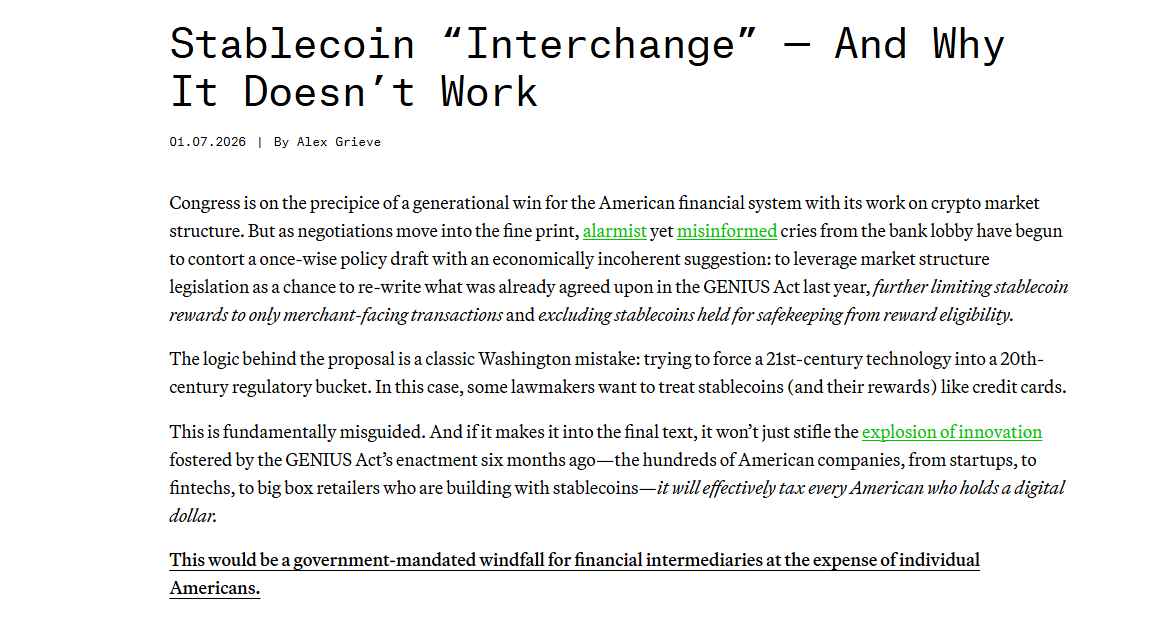
Paradigm’s VP of Government Affairs, @AlexanderGrieve, added another angle.
He argued that even if stablecoin rewards were allowed only when used for payments, it would still be equivalent to imposing a holding tax on consumers.
They may be moving slower than some other Asian countries, but both China and South Korea have recently rolled out a wave of new initiatives around CBDCs and stablecoin policy.
When it comes to interest payments, the differences are especially interesting.
- China’s central bank decided to pay interest on the e CNY, treating it the same as regular bank deposits, as a way to boost CBDC adoption.
- In South Korea, the direction looks more like the US. Issuers are not allowed to pay interest, but distributors are not explicitly banned from doing so.
China’s aggressive stance makes sense once you look at the bigger picture.
The e-CNY is not a private stablecoin. It is a CBDC issued directly by the central bank. By pushing it forward, China can counter the dominance of private platforms like Alipay and WeChat Pay, while strengthening a central bank led financial system.
New technology creates new industries, and new industries can threaten old ones.
Traditional financial institutions, including banks, are facing an unstoppable shift toward stablecoins. At this point, resisting the change does more harm than good. Embracing it and looking for new opportunities is a much better move.
And the truth is, the stablecoin industry can be a massive opportunity even for existing players.
Banks are already finding ways in.
- BNY Mellon is building a business around custodial services for stablecoin reserves.
- Cross River Bank is acting as an intermediary for Circle’s USDC onramps through APIs.
- JP Morgan is experimenting with tokenized deposits.
Card networks also have a lot at stake. As onchain payments grow, traditional card networks could see their business shrink. Instead of fighting it, companies like Visa and Mastercard are actively supporting stablecoin payment settlement and riding the wave toward new opportunities.
Asset managers are getting involved too. Funds like BlackRock are moving aggressively into tokenizing different types of investment funds.
If banking lobby pressure succeeds and a full ban on stablecoin interest payments ends up written into the Market Structure Bill, the shock to the crypto industry would be enormous.
As someone working in crypto, I can only hope the Market Structure Bill does not include provisions that effectively override the GENIUS Act.


