One of the most actively tokenized assets in the RWA market is US government bonds. This is due to their overwhelming liquidity, stability, relatively high yield, growing institutional participation, and ease of tokenization.
The tokenization of US government bonds does not involve any special legal mechanism. Instead, tokenization is achieved when the transfer agent responsible for managing the official shareholder registry uses blockchain instead of the traditional internal database for operations.
This article presents three frameworks for analyzing major US government bond tokens. The first is an overview of the token, including protocol summary, issuance volume, number of holders, and management fees. The second is the regulatory framework and issuance structure, and the third is on-chain use cases.
Since US government bond tokens are digital securities, they must comply with securities laws and related regulations. This has a significant impact on issuance volume, number of holders, on-chain use cases, and more. The article addresses the dynamics of how these seemingly unrelated factors influence one another.
Lastly, contrary to common perception, US government bond tokens face many limitations. The final part of the article includes insights on these constraints.
Every stock, every bond, every fund, every asset can be tokenized. (Larry Fink, CEO of BlackRock)
Since the passage of the US GENIUS Act, interest in stablecoins has surged around the world, including in Korea. But is the stablecoin really the final destination?
A stablecoin, as the name suggests, is a token on a public blockchain that is pegged to a fiat currency. In the end, it is money, and it must be put to use somewhere. As explored in the previous Hashed Open Research x 4Pillars stablecoin report, stablecoins can be used in remittances, payments, settlements, and many other areas. However, the field that is now actively being discussed as the one that can unlock the true potential of stablecoins is RWA.
RWA stands for Real-World Assets, referring to all tangible assets that are represented on the blockchain in the form of digital tokens. In the blockchain industry, however, RWA usually refers to traditional financial assets such as commodities, stocks, bonds, and real estate.
So why is RWA gaining so much attention as the next topic after stablecoins? It is because blockchain has the potential not only to transform money but also to revolutionize the back end of traditional financial markets.
The traditional financial market today still relies on highly outdated infrastructure. While fintech companies have indeed improved the front end for retail customers by making financial products and securities more accessible, the back end of trading remains extremely antiquated.
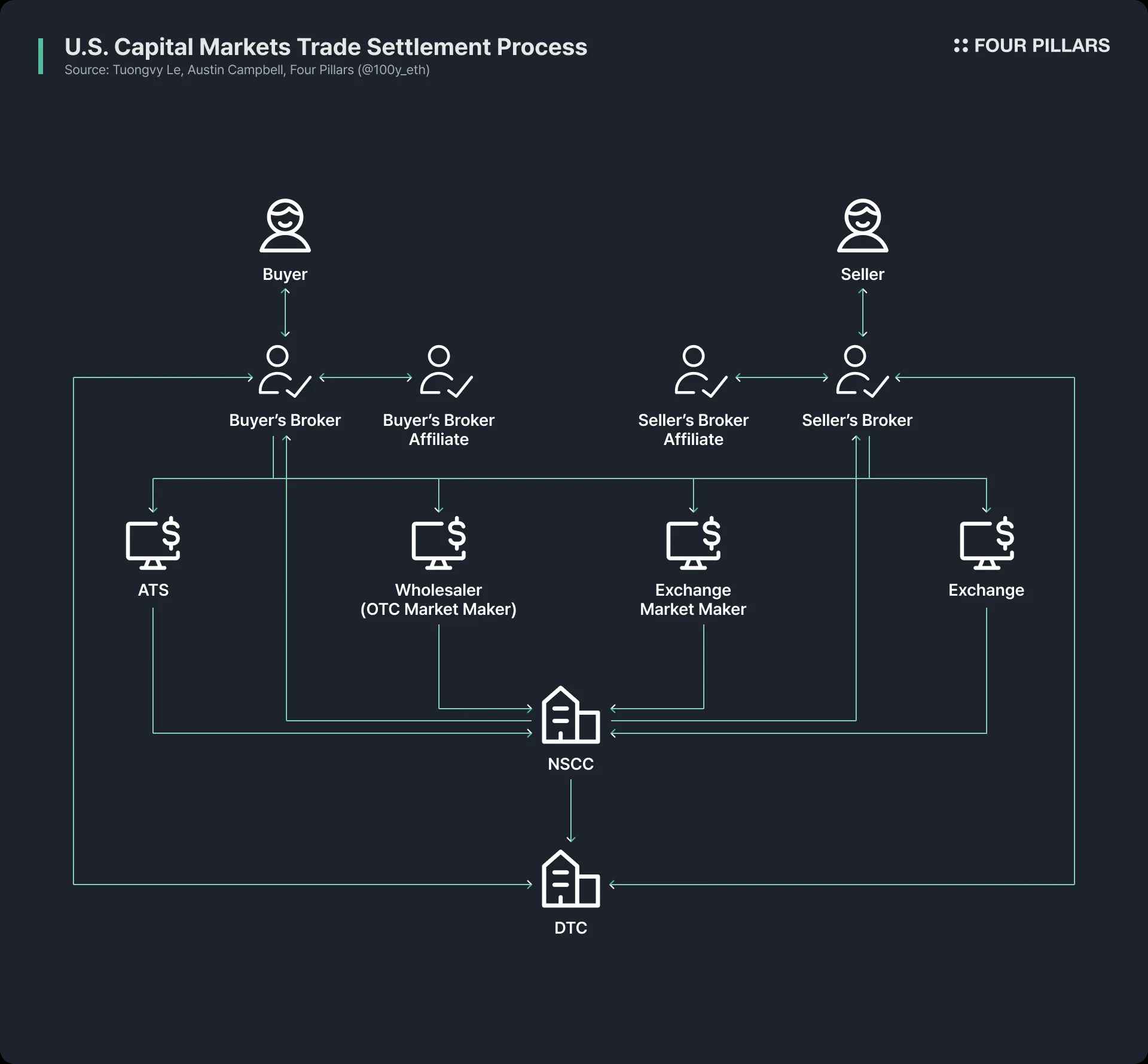
For example, in the case of the US securities market where stocks and bonds are traded, the current structure was established in the 1970s following the Paperwork Crisis of the late 1960s. The Securities Investor Protection Act and securities law amendments were introduced, and institutions such as the DTC and NSCC were created.
In other words, this complex structure has been in place for more than 50 years, with persistent problems such as excessive intermediaries, settlement delays, lack of transparency, and regulatory costs.
Blockchain can fundamentally improve this outdated market structure into a more efficient and transparent system. If the financial market back end is upgraded with blockchain, it could enable instant settlement, programmable finance through smart contracts, direct ownership without intermediaries, enhanced transparency, reduced costs, fractional investing, and more.
Because of this potential, many public institutions, financial institutions, and corporations are actively moving to tokenize financial assets on the blockchain.
For example, Robinhood has announced plans to support stock trading through its own blockchain network, submitted a proposal to the SEC requesting a federal regulatory framework for RWA tokenization, and BlackRock has already issued BUIDL, a $2.4B tokenized money market fund, in partnership with Securitize. SEC Chairman Paul Atkins has also expressed support for stock tokens, and the SEC’s internal crypto task force is formalizing regular meetings and roundtables on RWA.
Source: rwa.xyz
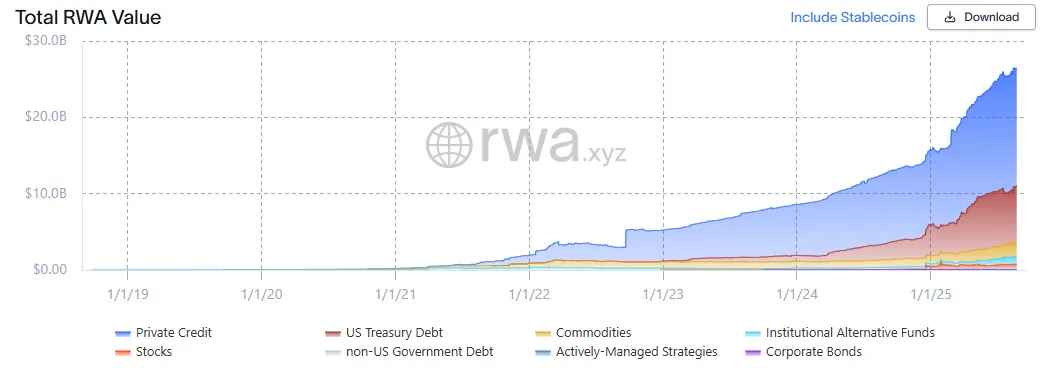
Beyond the hype, the RWA market is in fact growing very rapidly. As of August 23, 2025, the total amount of issued RWAs has reached $26.5B, marking increases of 112%, 253%, and 783% compared to one, two, and three years ago, respectively. The types of financial assets being tokenized are diverse, but the fastest-growing areas are US government bonds and private credit, followed by commodities, institutional funds, and equities.
Source: rwa.xyz
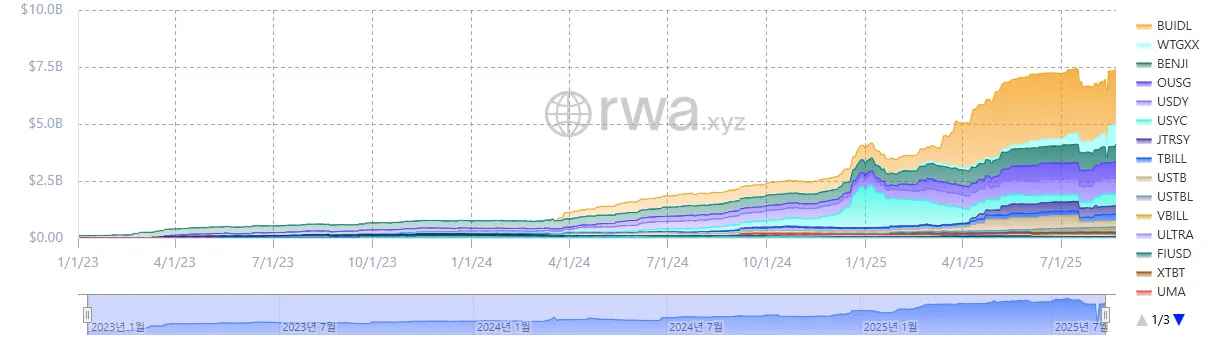
The most actively tokenized sector in the RWA market is undoubtedly US government bonds. As of August 23, 2025, the size of the US bond RWA market is around $7.4B, representing explosive growth of 370% over the past year.
Notably, both global traditional financial institutions and DeFi platforms are actively entering this field. For example, BlackRock’s BUIDL fund is leading the way with about $2.4B in assets, while DeFi protocols such as Ondo have launched funds like OUSG, based on bond-backed RWA tokens such as BUIDL and WTGXX, maintaining a scale of around $700M.
Why are US government bonds the most actively tokenized and largest segment in the RWA market? There are several reasons:
Overwhelming liquidity and stability: US Treasuries have the deepest liquidity in the world and are regarded as safe assets with virtually no default risk, earning high trust.
Global accessibility: Tokenization increases access to US Treasuries, allowing overseas investors with demand for them to invest more easily.
Expansion of institutional participation: Major institutions such as BlackRock, Franklin Templeton, and WisdomTree are leading the market by offering tokenized money market funds and Treasury products, providing credibility to investors.
Profitability: US Treasuries provide a stable and relatively high yield, averaging around 4%.
Ease of tokenization: Although there is no RWA-specific regulatory framework for tokenizing US Treasuries yet, simple tokenization is feasible within existing regulations.
So how exactly are US Treasuries tokenized on-chain? It may seem like there should be complex legal and regulatory mechanisms involved, but in reality, the tokenization of US Treasuries is carried out very simply while complying with existing securities laws. (Of course, since the issuance structure differs by token, we will only look at the representative method here.)
Before explaining the tokenization process, one important point must be clarified. When we talk about US Treasury–based RWA tokens currently being issued, it is not the bond itself that is tokenized. Rather, it is funds or money market funds based on US Treasuries that are tokenized.
Traditionally, public asset management funds such as US Treasury funds are required to designate a transfer agent registered with the SEC. A transfer agent is a financial institution or service company that manages records of investors’ fund ownership on behalf of the securities issuer. Legally, the transfer agent plays the central role in managing securities records and ownership, and it is responsible for officially maintaining fund investors’ shares.
The method of tokenizing a US Treasury fund is very straightforward. Tokens representing shares of the fund are issued on-chain, and the transfer agent manages the official shareholder registry by running its internal operations on a blockchain-based system. In other words, the database used to maintain shareholder records is simply migrated from a proprietary database to the blockchain.
Of course, since there is still no clear regulatory framework for RWAs in the US, holding a token does not yet provide a 100% legally guaranteed ownership of fund shares. However, because transfer agents manage fund share ownership based on the on-chain token ownership during their operations, ownership of the tokens indirectly guarantees ownership of fund shares in most cases, as long as no hacking or accidents occur.
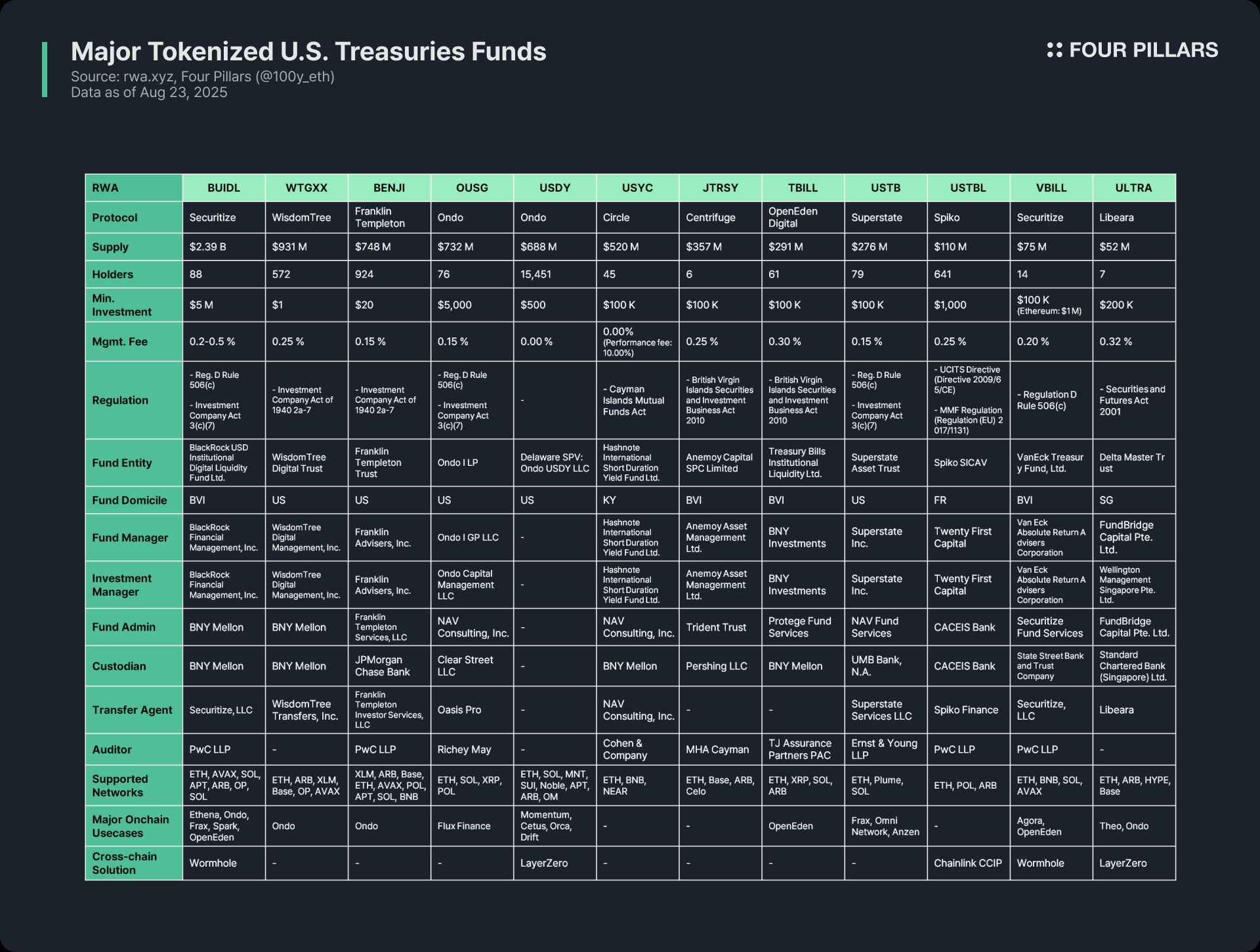
Since US Treasury–based funds are the most actively tokenized sector in the RWA industry, numerous tokenization protocols have issued RWA tokens related to them. The table above summarizes the major protocols and tokens, and I analyzed them in three main parts.
The first is an overview of the token. This includes an overview of the protocol that issued the token, issuance volume and number of holders, minimum investment amount, and management fees. Because each issuing protocol tends to have different fund structures, tokenization methods, and levels of on-chain utility, examining the protocol that issued the token quickly reveals its broad characteristics.
Issuance volume is an important indicator for understanding the scale and popularity of a fund. The number of holders provides hints about the legal structure of the fund and its on-chain use cases.
If the number of holders is small, it is highly likely that, according to securities laws, investors must be accredited investors or qualified purchasers with high net worth. It also means that, apart from whitelisted wallets, it may be difficult to hold, transfer, or trade the token, and that due to the small holder base, the token may not be widely used in DeFi protocols.
The second is the regulatory framework and issuance structure. This part specifies which country’s regulatory framework the underlying fund complies with and investigates the various entities involved in fund management.
After analyzing a total of 12 US Treasury fund–based RWA tokens, the regulatory frameworks can be broadly divided as follows. These vary depending on the nationality of the fund and the scope of investors being solicited:
Regulation D Rule 506(c) & Investment Company Act 3(c)(7): This is the most widely used regulatory framework. Regulation D Rule 506(c) allows companies to publicly solicit funds from an unspecified number of investors, with the key requirement being that all investors must be accredited investors. Issuers must carefully verify investor status through tax records, asset proof, and similar documentation. Investment Company Act 3(c)(7) provides an exemption that allows private funds to operate without SEC registration, requiring all investors to be qualified purchasers and for the fund to maintain a private structure. By using both regulations together, issuers can access a broader range of investors while efficiently avoiding regulatory burdens such as registration and disclosure. Importantly, this framework can be used not only by US funds but also by foreign funds, as long as the requirements are met. Major funds under this framework include BUIDL, OUSG, USTB, and VBILL.
Investment Company Act of 1940 2a-7: This is a regulatory framework for SEC-registered money market funds, ensuring that they maintain stable value, invest only in very short-term and high-credit instruments, and secure high liquidity. Unlike the previous framework, it allows public offerings to general investors. As a result, fund tokens under this framework have low minimum investment amounts and are easily accessible to anyone. Major funds under this framework include WTGXX and BENJI.
Cayman Islands Mutual Funds Act: This framework applies to open-end mutual funds established in the Cayman Islands, where issuance and redemption are flexible. US Treasury funds based in the Cayman Islands must comply with this regulation. The minimum initial investment amount is set at $100K or more. A major fund under this framework is USYC.
British Virgin Islands Securities and Investment Business Act 2010 (Professional Fund): This is the core law regulating all investment funds and investment companies established or operated in the BVI. Among its categories, the Professional Fund is one type of open-end fund, targeted at professional investors rather than the general public, and requires an initial investment of at least $100K. Notably, BVI-based funds must separately comply with US Regulation D Rule 506(c) if they wish to raise capital from US investors. Compliance with only the BVI SIBA framework does not permit fundraising from US investors. Major funds under this framework include JTRSY and TBILL.
Others: Depending on the country of fund establishment, various other regulatory frameworks apply. For example, Spiko’s USTBL, issued in France, follows the UCITS Directive (Directive 2009/65/CE) & MMF Regulation (Regulation (EU) 2017/1131), while Libeara’s ULTRA, issued in Singapore, follows the Securities and Futures Act 2001.
The fund issuance structure was analyzed based on seven key participants as follows:
Fund Entity: The legal entity where investor capital is pooled. Often offshore fund structures established in the US as a trust, or in BVI or Cayman, are used.
Fund Manager: The entity that establishes the fund and takes overall responsibility for its operations.
Investment Manager: The party that makes actual investment decisions and manages the portfolio. Depending on the case, it may be the same entity as the Fund Manager or a separate one.
Fund Admin: The entity responsible for back-office operations such as accounting, NAV calculation, and preparation of investor reports.
Custodian: Responsible for securely holding fund assets such as bonds and cash.
Transfer Agent: Manages the shareholder register, legally recording and managing ownership of the fund or shares safely.
Auditor: An independent accounting firm that conducts external audits of the fund’s accounts and financial statements. This is essential for investor protection.
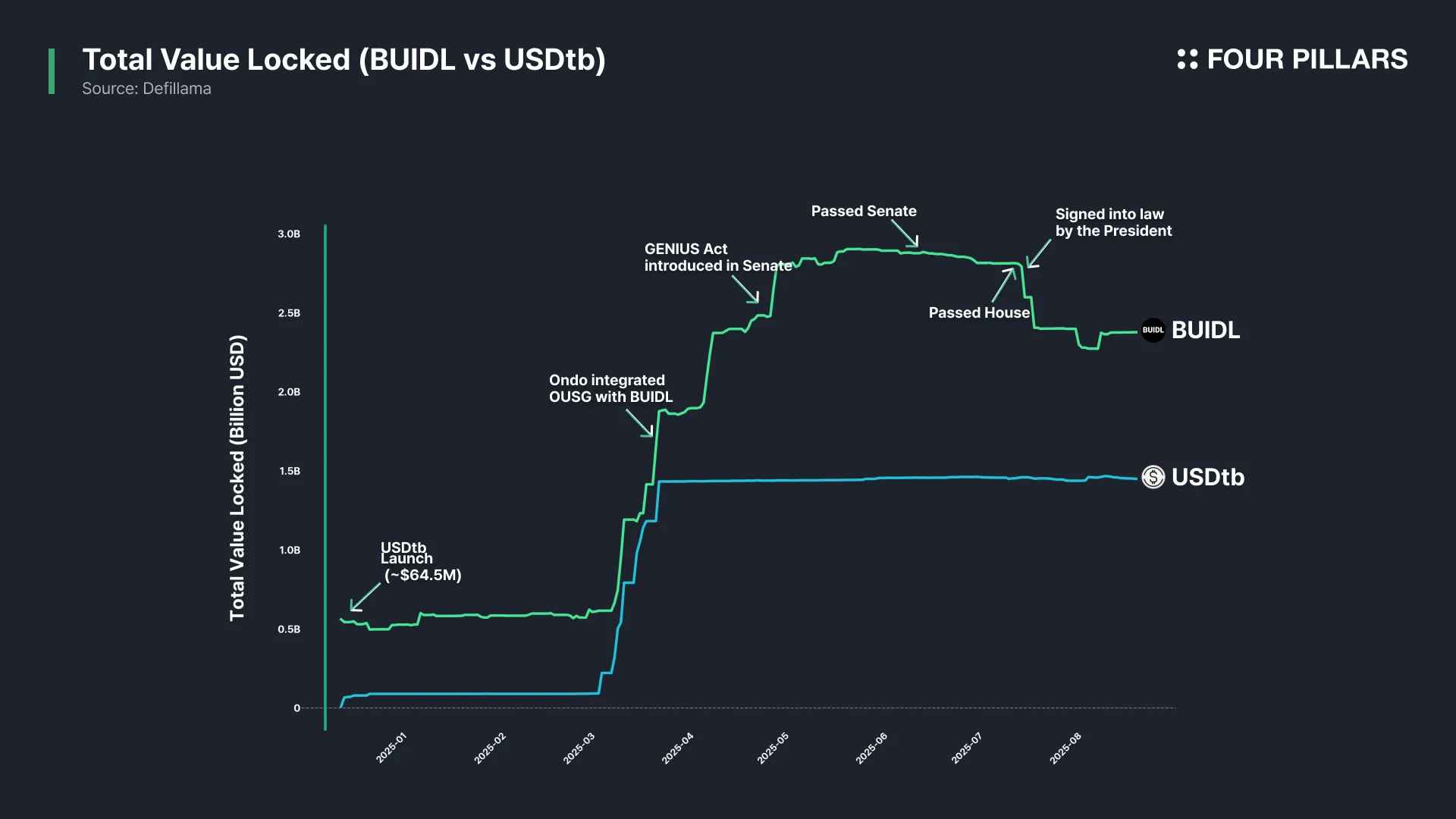
The third is on-chain use cases. One of the greatest benefits of tokenizing bond funds is the potential utility within the on-chain ecosystem. Although regulatory compliance and whitelisting make it difficult to directly use bond fund tokens in DeFi, DeFi protocols such as Ethena and Ondo have used tokens like BUIDL as collateral to issue stablecoins or included BUIDL in portfolios, thereby providing indirect exposure to retail users. In fact, BUIDL was able to quickly increase its issuance volume through integration with major DeFi protocols and has become the number one bond-based token.
Cross-chain solutions are also important for enabling on-chain utility. Most bond fund tokens are issued not only on a single network but also across multiple networks to give investors more options.
Although bond fund tokens do not need liquidity as high as stablecoins, and in fact usually do not have such liquidity, cross-chain solutions remain important for providing better user experience. They make it possible to transfer bond fund tokens seamlessly across multiple networks.
In the upcoming RWA report, I will provide a detailed analysis of 12 major U.S. treasuries fund–based RWA tokens. Before that, I would like to share the implications and limitations I discovered through this research.
Difficulty of on-chain utility: RWA tokens are not freely usable on-chain simply because they are tokenized. They remain digital securities and must comply with the regulatory framework the fund follows in the real world. Fundamentally, all bond fund tokens can only be held, transferred, or traded between whitelisted wallets that have completed KYC. This first layer of entry barrier makes it extremely difficult for bond fund tokens to be used directly in permissionless DeFi.
Low number of holders: Due to these regulatory entry barriers, the number of holders of bond fund tokens is very low. Money market funds like WTGXX and BENJI, which are accessible to retail investors, have relatively high numbers of holders. But most other funds require investors to be accredited investors, qualified purchasers, or professional investors, which greatly limits the pool of eligible investors and makes it difficult for the number of holders to exceed even two digits.
On-chain B2B use cases: For the above reasons, there are no cases of bond fund tokens being directly used in retail-focused DeFi. Instead, large DeFi protocols often adopt and use them. For example, Omni Network has used Superstate’s USTB for its own treasury management, while Ethena issues its USDtb stablecoin collateralized by BUIDL so that retail users can indirectly benefit from it.
Regulatory fragmentation and lack of standards: Bond fund tokens are issued by funds established in various countries under different regulatory frameworks. For example, BUIDL, BENJI, TBILL, and USTBL may all appear to be bond fund tokens, but they comply with entirely different frameworks, leading to widely varying investor eligibility, minimum investment amounts, and use cases. This regulatory fragmentation increases complexity for investors and, in the absence of a unified standard, makes it very difficult for DeFi protocols to adopt bond fund tokens in a universal way, thereby limiting on-chain utility.
Absence of an RWA regulatory framework: There is still no clear regulatory framework dedicated to RWAs. While transfer agents do record shareholder registries on blockchain in bond fund tokens, on-chain token ownership is not yet legally enforced as equivalent to ownership of securities in the real world. Specialized regulation is needed to connect on-chain ownership with legal ownership in the real world.
Insufficient adoption of cross-chain solutions: While almost all bond fund tokens support issuance across multiple networks, few of them have implemented cross-chain solutions. Greater adoption of cross-chain solutions is needed to prevent liquidity fragmentation and to improve user experience.
The detailed report analyzing 12 major bond funds will be released in September, so please stay tuned.


Dive into 'Narratives' that will be important in the next year


 Bitcoin
 Arch
Arch
 OVERTAKE

