Countless projects have emerged to leverage Bitcoin’s massive liquidity, but they failed to make significant progress due to issues such as additional security risks, fragmented liquidity, and poor user experience.
To become a true Bitcoin utilization solution, BTC holders must be able to perform a wide range of financial activities quickly and securely within a Bitcoin-native environment. And Arch is the most suitable solution for this.
The easiest way to understand Arch is by using Saturn, the flagship dApp and AMM DEX in the Arch ecosystem. This article explores Saturn firsthand to experience what Arch offers, and explains why Arch is the key solution to unlocking Bitcoin’s vast liquidity, as well as the technologies that make it possible.
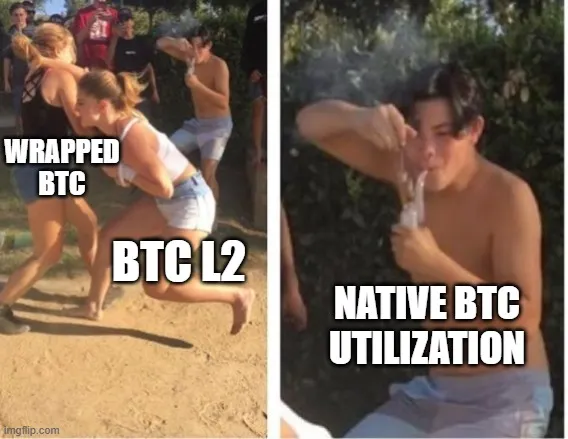
The phrase “utilizing Bitcoin” has become a cliché. Countless projects have tried various ways to tap into Bitcoin’s massive liquidity, but none have yet created meaningful use cases.
Although heavily criticized for being centralized, the most commonly used wrapping method has bridged approximately 126,000 BTC for WBTC and 73,000 BTC for cbBTC. Babylon, which implemented native staking, has about 56,000 BTC, while BTC management protocols such as Lombard and Solv each utilize around 10,000 BTC. Adding up all BTC used onchain gives about 380,000 BTC, which accounts for only 1.8% of the total BTC supply of 21 million.
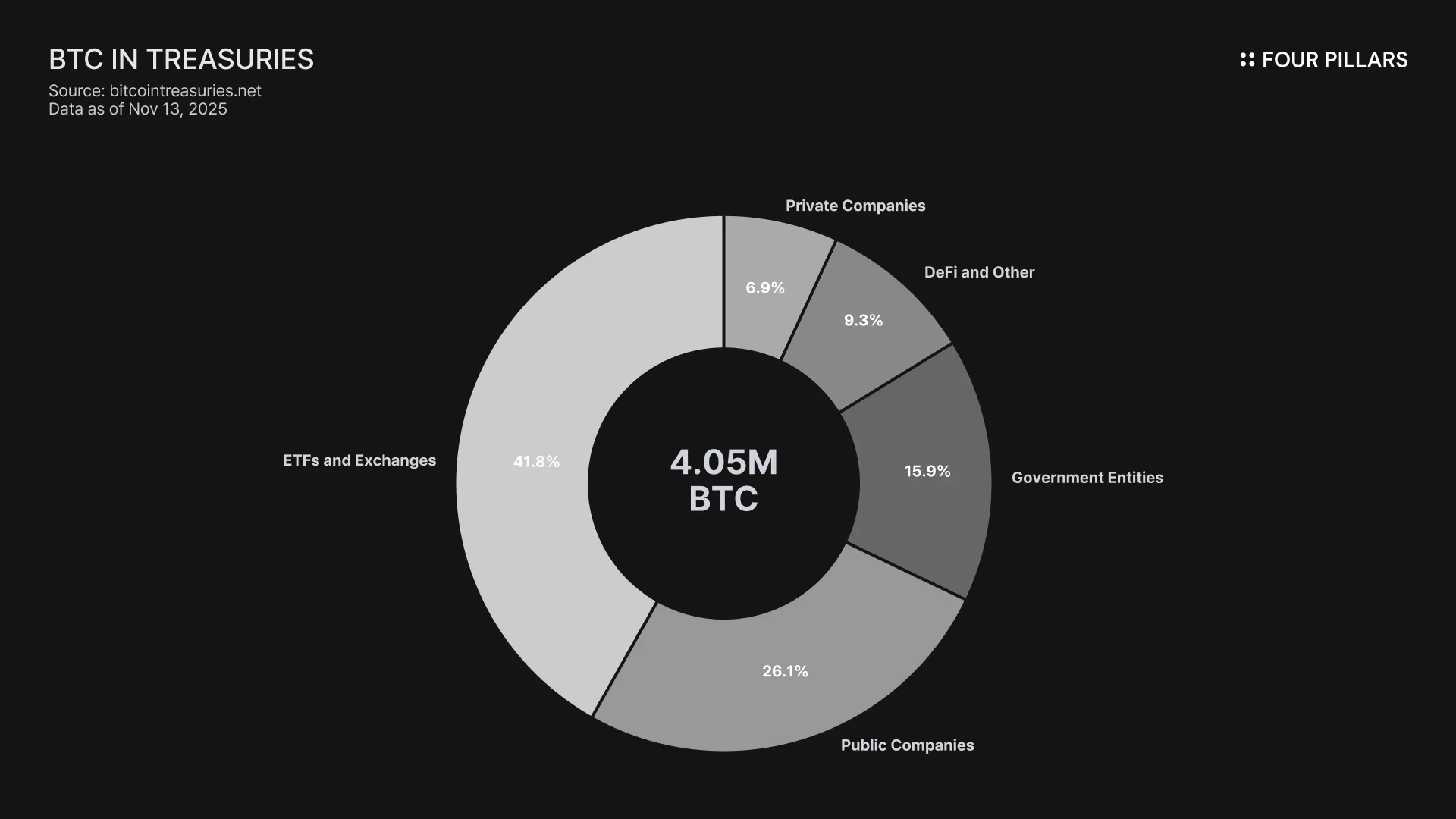
Source: BitcoinTreasuries.net
What about reality? Most BTC simply sits idle, held by corporations, governments, ETFs, and exchanges. ETFs and funds hold about 1.5 million BTC, public companies about 1 million BTC, and governments around 640,000 BTC. The reason why “utilizing Bitcoin” remains a recurring theme, despite being overused, lies in this enormous pool of untapped liquidity.
There have been countless projects attempting to harness Bitcoin’s massive liquidity, yet most have suffered from at least one of the following issues:
Programmability: Meta-protocols like Ordinals and Runes made it possible to represent various types of assets on the Bitcoin network. However, due to the limitations of Bitcoin’s script language, it was nearly impossible to design financial programs based on these assets within the Bitcoin network. The Lightning Network aimed to improve Bitcoin’s scalability but did not enhance its programmability.
Security Inheritance: The foremost requirement for leveraging Bitcoin, the most valuable cryptocurrency, is whether a solution can inherit the Bitcoin network’s robust security. Unfortunately, most wrapped BTCs, BTC bridges, and BTC L2 solutions require additional trust assumptions and risks, making them practically unusable for governments, institutions, and corporations holding BTC. (Even BitVM and ZK-based Bitcoin Layer 2s, known as one of the safest methods, come with a 1-of-n trust assumption.)
Liquidity: When BTC is bridged to another layer such as a Bitcoin L2, new liquidity must be bootstrapped on that layer.
Bitcoin Core Modification: There have been attempts within Bitcoin Core itself, such as OP_CAT and OP_CTV, to make Bitcoin programmable money. However, these require convincing the Bitcoin developer and community ecosystem to modify Bitcoin’s base layer, which is an extremely high barrier.
User Experience: If a solution is not Bitcoin-native, users cannot use existing tools like wallets compatible with the Bitcoin network, leading to a poor UX/DX experience.
Ultimately, there is only one solution everyone wants: to utilize BTC natively on the Bitcoin network with high scalability and security. And this is exactly what Arch aims to achieve.

Four pillars covered all the technical aspects of Arch in a previous article. I recommend you to read the article to understand Arch in depth, but the fastest and most intuitive way to grasp Arch is simply to use it.
If you have ever studied Ethereum dApps, chances are your first experience was with an AMM DEX like Uniswap. The Arch ecosystem features a variety of dApps, but to understand Arch most easily, we will briefly introduce Saturn, the AMM DEX built on Arch.
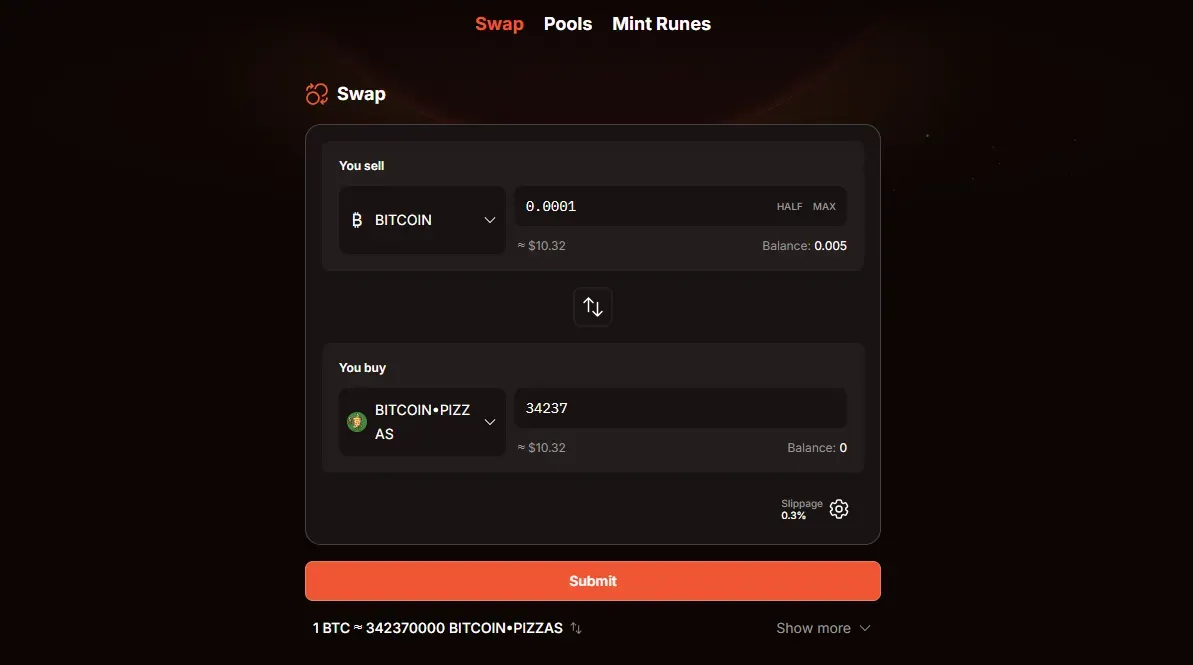
Without further ado, visit Saturn. You will see a familiar swap interface like any other AMM DEX. Users can connect wallets they already use on the Bitcoin network, such as Xverse, Unisat, or Magic Eden. (For actual testing, you can claim 0.005 tBTC from the Bitcoin Testnet4 faucet).
Now you can try various activities on Saturn such as swapping, providing liquidity, and minting Runes. As those familiar with the Bitcoin network know, transactions often take a long time before reflecting in your balance because the average Bitcoin block time is 10 minutes.
However, when using Saturn, you will notice that your balance updates within a minute after initiating a swap transaction. This is because Saturn is built on ArchVM.
Thanks to being built on Arch, Saturn can offer the following user experiences:
Use of Bitcoin wallets: Users can continue using the same Bitcoin wallets they are already familiar with, without needing to prepare a new one for a different ecosystem.
Bitcoin-native experience: Users do not need to add custom networks like Bitcoin L2s and can use BTC and other Bitcoin-native assets directly on the existing Bitcoin network.
Smart contracts: It enables the implementation of AMM smart contracts that were previously impossible on the Bitcoin network.
Fast confirmation: Transactions are reflected much faster compared to the traditional Bitcoin network.
In summary, this represents the closest realization of the ideal solution mentioned earlier. For corporations and institutions holding large amounts of BTC, exposure to risks beyond those inherent to BTC and the Bitcoin network itself is highly undesirable. If they can instead use their BTC in a Bitcoin-native environment to generate additional returns, it would present a tremendous opportunity.
This is also why the Arch network focuses on the institutional-grade RWA sector. While previous Bitcoin utilization and scaling solutions struggled to meet institutional standards for BTC usage—particularly in terms of security and risk management—Arch possesses the potential to make it possible. Specifically, HoneyB, a licensed issuance platform within the Arch ecosystem, aims to onboard various RWAs from traditional finance onto the Arch network, turning BTC into a yield-generating asset.
Thanks to these technical advantages, even traditional financial firms that are deeply committed to Bitcoin, such as ARK Invest, have shown interest in and invested in Arch.

If you have tried using the Saturn DEX, you were probably surprised by how new and seamless the experience felt. I was also amazed when I first used the Arch-based Saturn DEX because it allowed me to 1) use my Bitcoin wallet, 2) on the Bitcoin network, 3) with BTC, 4) to experience smart contracts, and 5) do all this quickly. So what is the secret sauce that makes this possible in Arch?
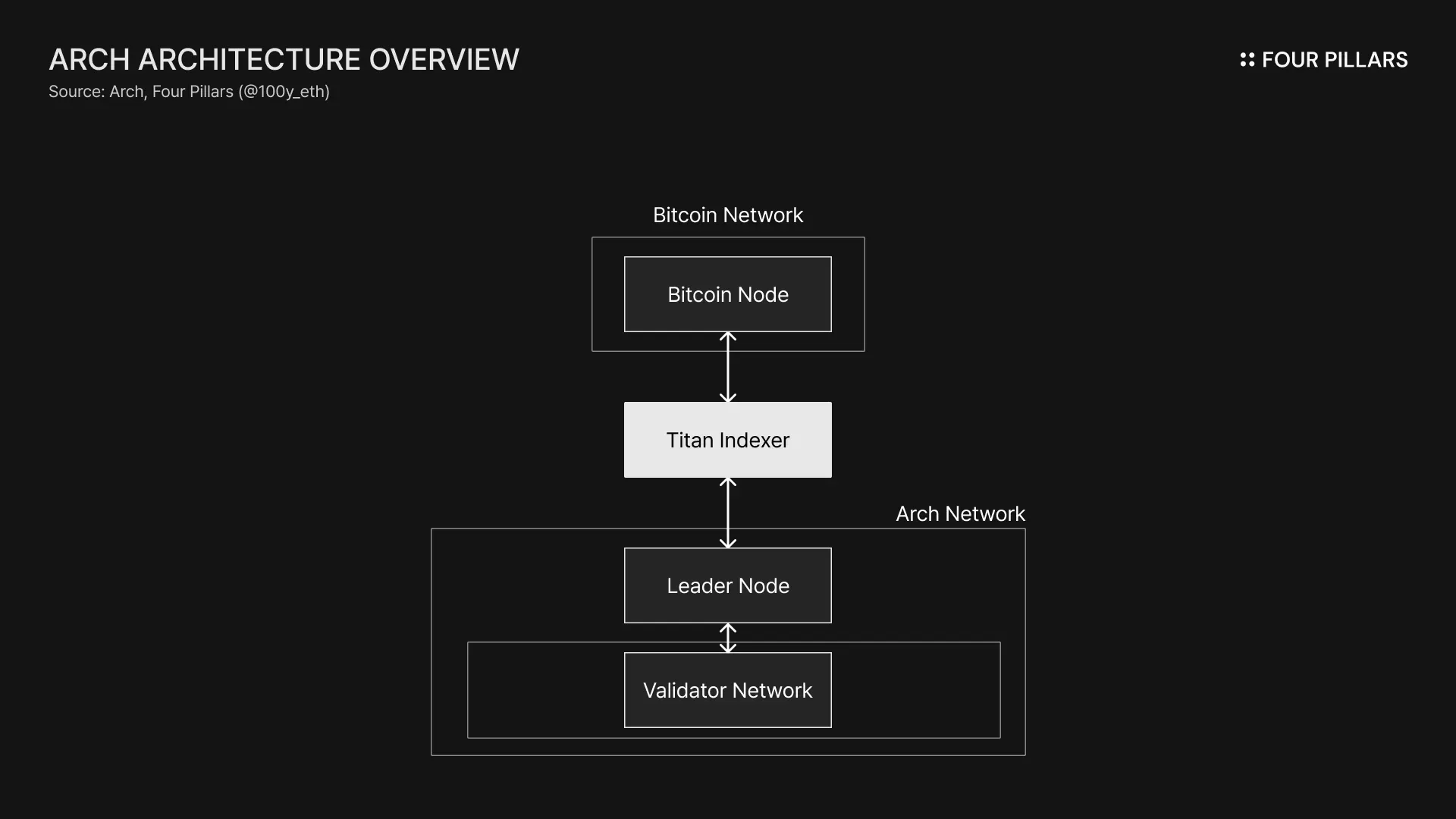
The first ingredient is the Titan Indexer. Titan is Arch’s high-performance indexer developed in-house to rapidly retrieve Bitcoin blockchain data and deliver it to the Arch network in real time. This allows dApps built on Arch to always access Bitcoin state data quickly. Titan also supports indexing at the mempool stage, not just after a Bitcoin block is confirmed. Another strength is that Titan supports not only BTC but also Bitcoin-native assets like Runes.
The second ingredient is ArchVM. ArchVM is a virtual machine developed by Arch to enable smart contract functionality within the Bitcoin ecosystem. Developers can write smart contract logic, called “programs,” using the Rust language. ArchVM is integrated with Bitcoin’s UTXO model and transaction validation, and when transaction computation results are verified by validators on the Arch network, they are recorded on the Bitcoin network through FROST/ROAST threshold signature technology. This allows operations involving Bitcoin-native assets to be executed and safely recorded on the Bitcoin network.
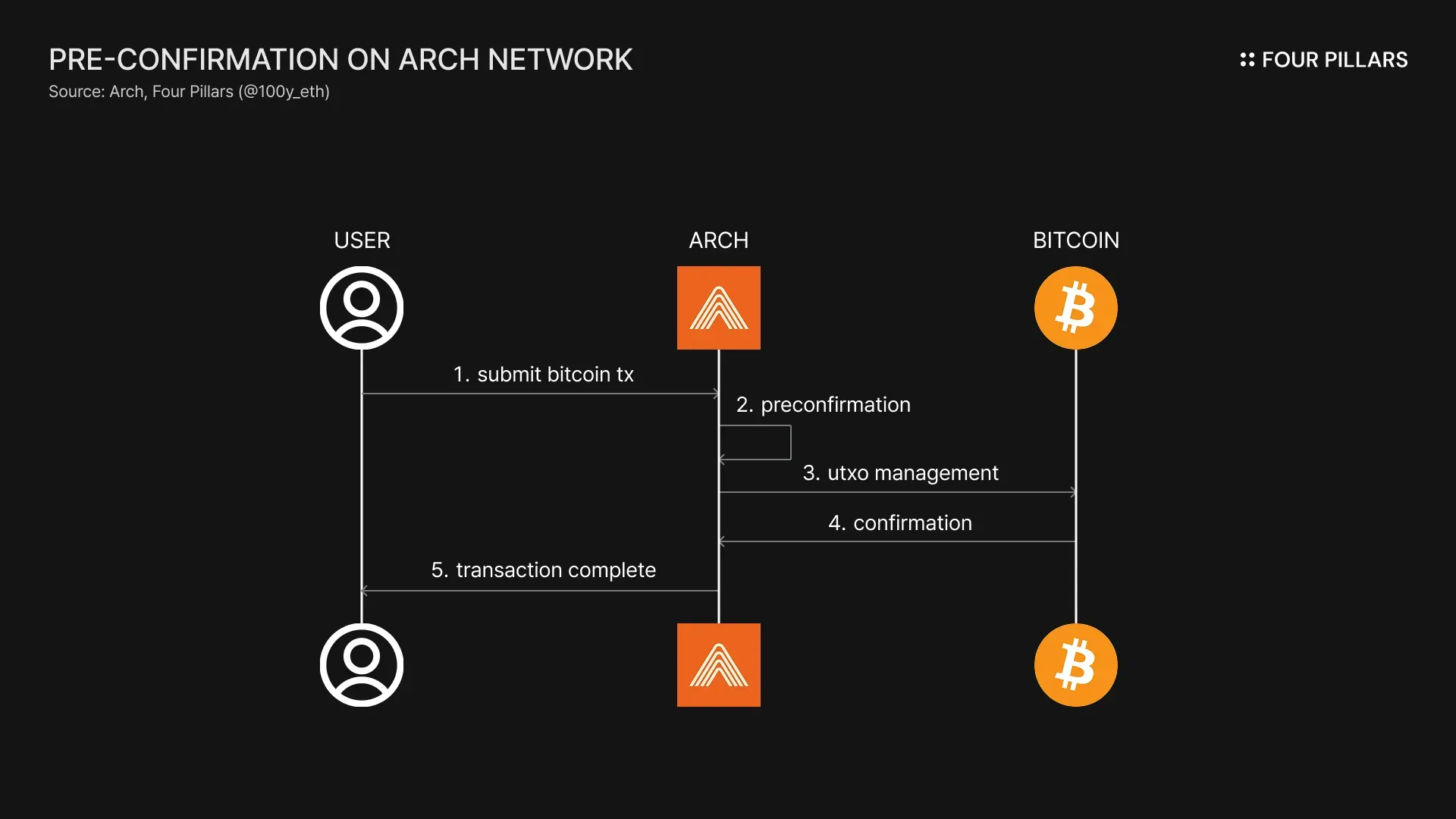
The third ingredient is Preconfirmation. Thanks to the Titan Indexer, Arch can fetch Bitcoin network transactions in real time even before they are included in the mempool and use this data to enable preconfirmation. In other words, if a transaction is highly likely to be included in a Bitcoin block, dApps can treat it as confirmed and proceed with it before it is officially recorded.
In summary, the Arch network retrieves transactions related to Bitcoin-native assets like BTC and Runes from the mempool via the Titan Indexer. Then the validators of the Arch network process them through ArchVM, deliver a highly scalable experience to users through preconfirmation, and finally record the computation results on the Bitcoin network using FROST/ROAST signatures for final settlement on Bitcoin.
Of course, this model is not without risks. The main risk lies in preconfirmation: if a Bitcoin chain reorganization (reorg) occurs, some transactions preprocessed by Arch might not end up being included in the Bitcoin block. In fact, Bitcoin reorgs occur on average once a month.
To address this, Arch has implemented a rollback mechanism. Arch manages all transactions in a DAG structure to identify dependencies between them. Therefore, if a reorg occurs, Arch can immediately identify all transactions dependent on those not included and roll back only the affected ones. Additionally, if these transactions are later confirmed on Bitcoin, Arch can automatically reapply them.

Arch has presented an entirely new and innovative way to unlock Bitcoin’s massive liquidity. While existing Bitcoin solutions have each suffered from at least one issue—such as security risks, poor user experience, or liquidity fragmentation—Arch preserves all the fundamental values of Bitcoin while allowing anyone to use it easily and securely.
In 2024, Stripe processed $1.4 trillion in payments, equivalent to 1.3% of global GDP. Yet most consumers conducting those payments online are unaware that Stripe handled their transactions seamlessly in the background. Arch works in a similar way. As anyone who has used Saturn knows, users can hardly tell that they are interacting with the Arch network; they simply enjoy a richer and faster experience within a Bitcoin-native environment.
Over 20 million BTC are lying dormant. Arch is the most ideal solution to awaken this vast liquidity and has the potential to quietly become the core engine of the immense $2 trillion Bitcoin economy.


Dive into 'Narratives' that will be important in the next year


 Arch
Arch Ethereum
 Pharos
 Solana