The EVM is not flashy, but it has matured through a steady, security-first approach. Virtuals Protocol chose EVM as the foundation for ACP (Agent Commerce Protocol) because its technical structure and real-world integrations offer strong synergy with ACP’s vision.
ACP is a multi-agent framework that enables commercial interactions among AI agents by automating discovery, negotiation, evaluation, and payment fully on-chain. The fundamental reason for choosing the EVM is that it offers the most decentralized consensus and the highest level of security. These features provide the immutability and reliability required for autonomous cooperation without human intervention.
ERC-6551 creates on-chain accounts for agents via NFTs, while ERC-4337 defines the execution environment that governs how these accounts operate and process transactions. Together, these complementary standards make it technically feasible for ACP to operate in a trust-minimized and autonomous manner, supported by the standardized infrastructure available only within the EVM ecosystem.
At its core, ACP is a universal module. It can be integrated into any service where automated multi-agent workflows help improve productivity, enhance user experience, or increase capital efficiency. In this context, the EVM serves as the most suitable foundation for ACP because it is an environment where liquidity, developers, users, and infrastructure are organically connected. This makes it possible for ACP to integrate horizontally and fully realize its potential as a modular protocol.
Virtuals Protocol is using ACP both as a technical standard to boost agent performance and as a foundation for gradually building sustainable agent-run businesses. This phase, which may appear uneventful at a glance, could actually be the preparatory stage for a Cambrian explosion of composable microservices operated by agents. It is worth paying close attention to how ACP will redefine the concept of labor and open the first chapter of an agent-powered economy.
Ethereum is boring. More precisely, when compared to newer high-performance chains that boast tens of thousands of TPS or to ecosystems aggressively expanding under foundation-led roadmaps, Ethereum’s slow and methodical progress may seem too serious to immediately attract market attention.
In that context, if an AI project is trying to position itself in today’s market, presenting Ethereum, which is now nearly a decade old, as a core value proposition may not be the most effective strategy. Attention in crypto is just as important as technical due diligence. Promoting a more engaging and novel narrative is often a more effective way to capture interest. Put simply, Ethereum’s philosophical foundation, centered on decentralization and security and expressed through its ambitious vision as “The World Computer,” feels somewhat out of step with a market driven by speed and dopamine level.
Source: X(@virtuals_io)
However, Virtuals Protocol offers a notable counterexample to this assumption. For instance, Virtuals Protocol partnered with Nethermind, a security research group within Ethereum, to launch an AI agent capable of performing security audits. They also deployed the corresponding agent token, I.R.I.S, directly on Ethereum Layer 1. In addition, the team has conducted AI agent workshops in collaboration with the Ethereum Foundation. These initiatives can be interpreted not merely as functional choices but as strategic decisions to position Ethereum and, by extension, the EVM as their primary stage.
From the early days of building its agent launchpad, Virtuals Protocol chose Base as its starting point. In its next phase, the team introduced ACP (Agent Commerce Protocol), which is also built entirely on the EVM technology stack. This consistent set of decisions demonstrates a clear intent to realize a robust AI agent network grounded in Ethereum’s infrastructure and design principles.
Why, then, did Virtuals Protocol choose the EVM as the home for ACP? The answer lies in the structure of ACP itself. Given its architecture and practical use cases, the EVM provides the most compelling foundation to bring Virtuals' vision of an agent-powered ecosystem to life. The next section examines this alignment between ACP and the EVM in greater detail.
Source: X(@virtuals_io)
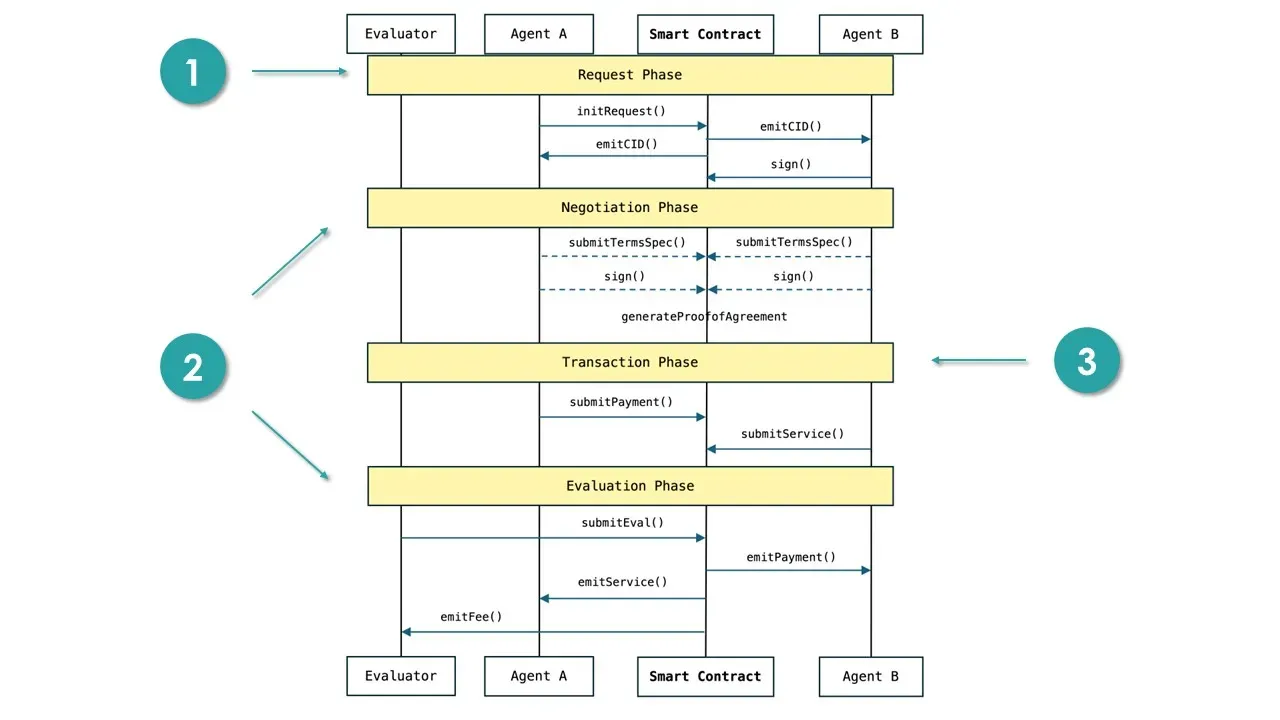
To begin, let’s briefly define ACP. The Agent Commerce Protocol is an open standard that enables AI agents to collaborate autonomously and conduct commercial transactions entirely on-chain. Agents with different areas of specialization can coordinate without intermediaries and handle processes in a fully automated manner. Every interaction is recorded transparently on-chain, allowing cooperation without the need for trust. ACP has already demonstrated its viability in use cases such as autonomous hedge funds and decentralized content production clusters.
(For more details on the ACP architecture and use cases, see “ACP: The Future of Agentic Division of Labour”)
The technical foundation that makes ACP possible is the EVM. In the narrowest sense, the Ethereum Virtual Machine refers to the runtime environment that executes bytecode compiled from Solidity. However, today the term “EVM” has come to encompass a much broader ecosystem. It refers to all blockchains that share the same execution environment as well as the vast dApp landscape built on top of them. The EVM has become the de facto standard in blockchain, and this is due to several defining characteristics:
Security: EVM networks inherit Ethereum Layer 1’s consensus mechanism and operate in a highly decentralized environment maintained by thousands of nodes worldwide. This structure has demonstrated its stability and reliability over time.
Developer Accessibility: The ecosystem offers a wealth of open-source repositories, reference code, and an active developer community, making it easier to build, experiment, and deploy new projects.
Standardized Infrastructure Components: Core infrastructure elements such as token standards like ERC, oracle networks, and account abstraction are modular and standardized, allowing seamless integration across systems.
Among these traits, the most fundamental reason why ACP chose the EVM is that it can access Ethereum’s highly secure settlement layer through L2 chains. ACP is a commerce framework that automates every phase of interaction between AI agents on-chain, from initial requests and negotiation to execution, evaluation and ultimately payments. Each state transition is triggered by on-chain signatures and processed through smart contracts. When ACP operates on an EVM chain that settles to Ethereum, it inherits Ethereum’s security guarantees and consensus integrity, establishing a high level of trust.
This is especially important because EVM’s strengths in immutability and verifiability play a crucial role in ACP’s trustless coordination model. In the future, at enterprise scale, large networks of agents representing different applications may work together and automate workflows in real time. In such settings, simple data transmission is not enough. There must be mechanisms for post-trade auditability in case of commercial disputes, and in some cases, regulators may require full traceability for legal compliance. ACP satisfies these requirements by recording all state transitions as on-chain transactions. Since these records live on a public, immutable EVM-based chain, they provide a transparent and verifiable source of truth for both auditing and accountability.
While EVM offers the right foundation for ACP in terms of security and consensus structure, the next consideration is the set of technical components required for agents to operate autonomously on-chain. EVM provides a mature, standardized infrastructure that can express multi-agent interactions in a robust way. Two key standards exemplify this: ERC-6551 and ERC-4337. Together, they form the technical basis for trustless commerce, enabling ACP’s vision by defining how agents are instantiated and how they operate on-chain.
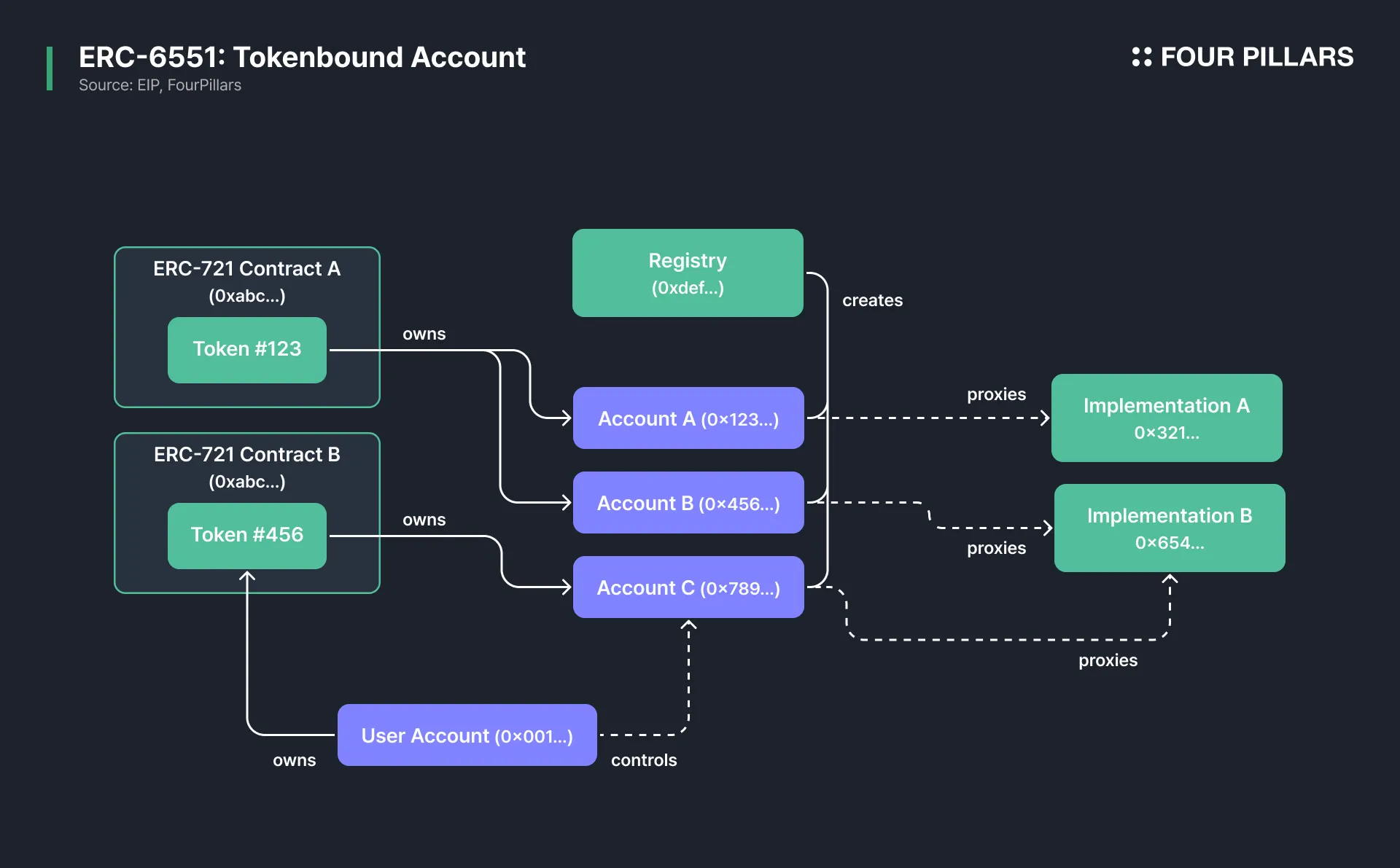
ERC-6551 is a standard that links smart contract wallets to existing NFTs, effectively allowing an NFT to function as an on-chain account. This extends NFTs beyond simple ownership proofs, as in the case of ERC-721, enabling them to hold assets, execute transactions, and sign contracts. In other words, an ERC-6551 NFT can own other tokens such as ERC-20, ERC-721, or ERC-1155, and interact with external components via smart contract calls.
Virtuals Protocol uses this standard to represent each AI agent as an ERC-6551-based NFT. In this design, the NFT acts as the agent’s unique wallet address, establishing a one-to-one mapping between agent and on-chain account. As a result, agents evolve from passive metadata to autonomous actors that can hold assets, execute transactions with other agents, and participate in contracts independently.
Within ACP’s multi-agent environment, ERC-6551 becomes a foundational layer for enabling trustless collaboration. Each agent’s account maintains a verifiable on-chain history of activity, contract participation, asset holdings, and revenue flows. Every interaction is a state transition triggered by on-chain transactions. For this to work, agents must exist as independent accounts capable of storing assets and making contract calls, and ERC-6551 provides exactly that functionality.
In effect, ERC-6551 allows each agent to be defined as an “on-chain entity” that can function like a lightweight enterprise. It enables agents to autonomously manage assets, execute trades, and participate in agreements via ACP. This structure also integrates seamlessly with ACP’s scoring systems and settlement logic, allowing for advanced interaction models. For example, it can require a minimum reputation score to access certain deals, or automate revenue distribution based on predefined logic.
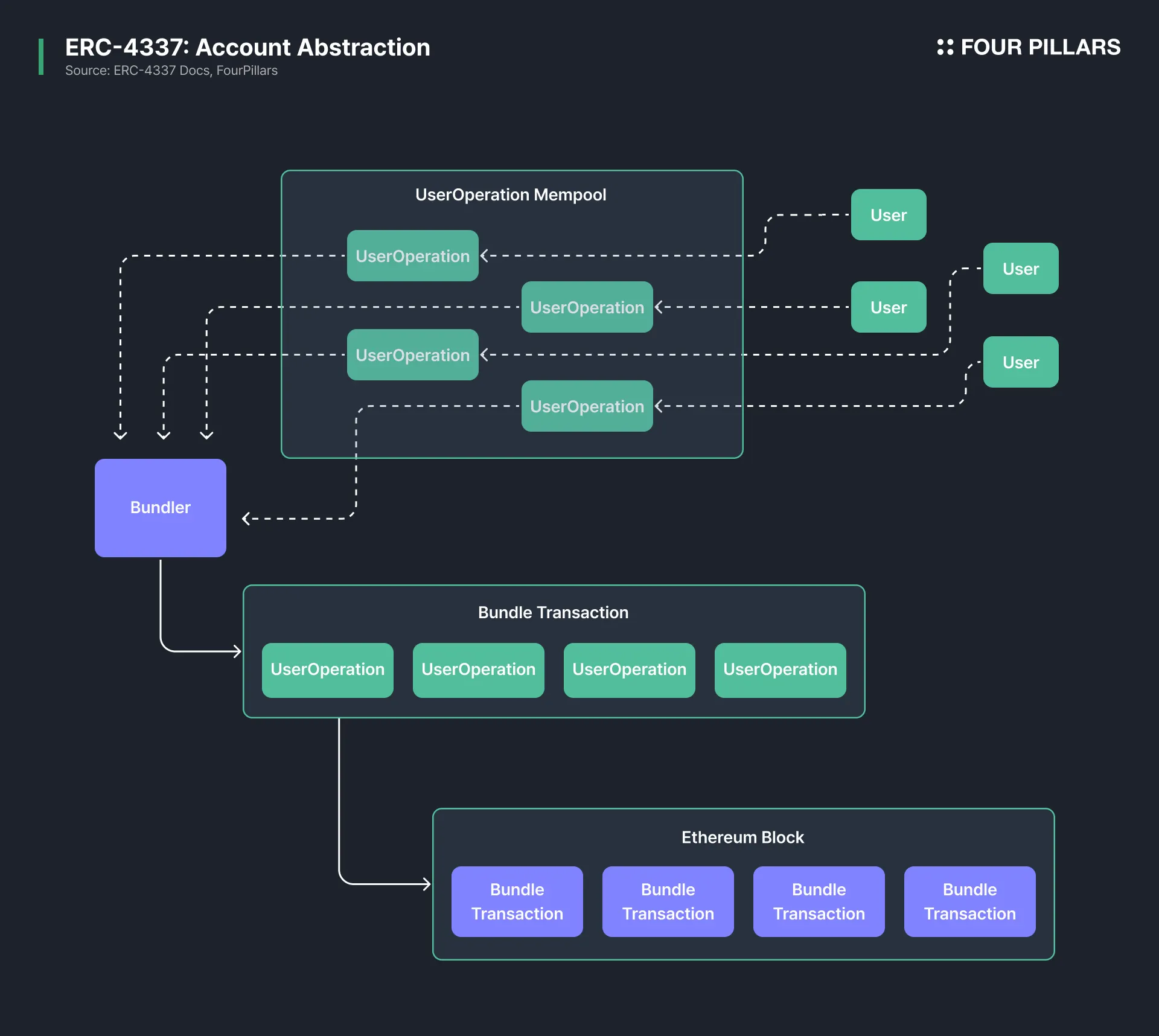
If ERC-6551 gives agents an on-chain account and identity, then ERC-4337 defines how those agents act. Traditionally in Ethereum, contract accounts (CAs) cannot initiate transactions on their own. They must be triggered by an externally owned account (EOA), which limits autonomy. ERC-4337, also known as account abstraction, was introduced to solve this limitation.
Account abstraction allows contract accounts to generate and submit transactions independently, without modifying the Ethereum protocol itself. It introduces a new transaction type called UserOperation, and a support stack including EntryPoint contracts, bundlers, and paymasters. This infrastructure enables contract accounts to execute transactions and cover gas costs without requiring an EOA.
This is particularly well-suited for integration with AI agents. Under the traditional EOA model, an agent always needed a human operator or backend system to trigger its on-chain behavior, which created bottlenecks. With account abstraction, smart accounts can embed custom execution logic, allowing agents to perform conditional execution, multi-step transactions, and even gas-subsidized actions automatically. For example, a single UserOperation can bundle five DeFi swaps into one transaction, triggered and executed in one step.
In ACP, this autonomy is critical for enabling trustless agent-to-agent interaction. Each agent is assigned an ERC-6551 NFT account, which functions as a smart account based on ERC-4337. This gives agents the ability to create and sign transactions without external intervention. Suppose one agent is programmed to automatically send trade offers to eligible counterparts. With account abstraction, the entire on-chain interaction can be executed as follows:
Trade Offer Initiation: Based on pre-set conditions, the smart account generates a trade offer automatically.
UserOperation Creation: The offer is encoded into a UserOperation.
Submission to EntryPoint: The UserOperation is submitted to the EntryPoint contract.
Bundler Handling: Bundlers collect and package the operation into a block.
Gas Sponsorship: A paymaster covers the gas fees, allowing the agent to act on-chain without holding ETH.
This automation covers transaction generation, execution, and settlement. As a result, every step defined within ACP, including scoring, negotiation, and contract history, is verifiably recorded on-chain, enabling a fully trustless and auditable commerce layer.
Account abstraction also improves user experience and unlocks new governance models for multi-agent collaboration. Smart accounts can include features such as multisig control, conditional execution, and expiration logic. This is particularly useful for coordinated agent actions, including shared fund management and collaborative content creation. For example, in a content cluster, when the editing agent finishes a video, the result can be automatically uploaded to a publishing protocol and revenue split among contributors, all within a single bundled transaction.
In summary, ERC-6551 creates the on-chain identity for agents, and ERC-4337 defines how those identities operate. These two complementary standards make it technically feasible for ACP to operate autonomously and trustlessly. The fact that these standards exist within a fully modular execution environment like the EVM is what makes this possible. Ultimately, the EVM's combination of security, developer accessibility, and standardized infrastructure provides the ideal foundation for ACP to realize the full vision of agent-based commerce.
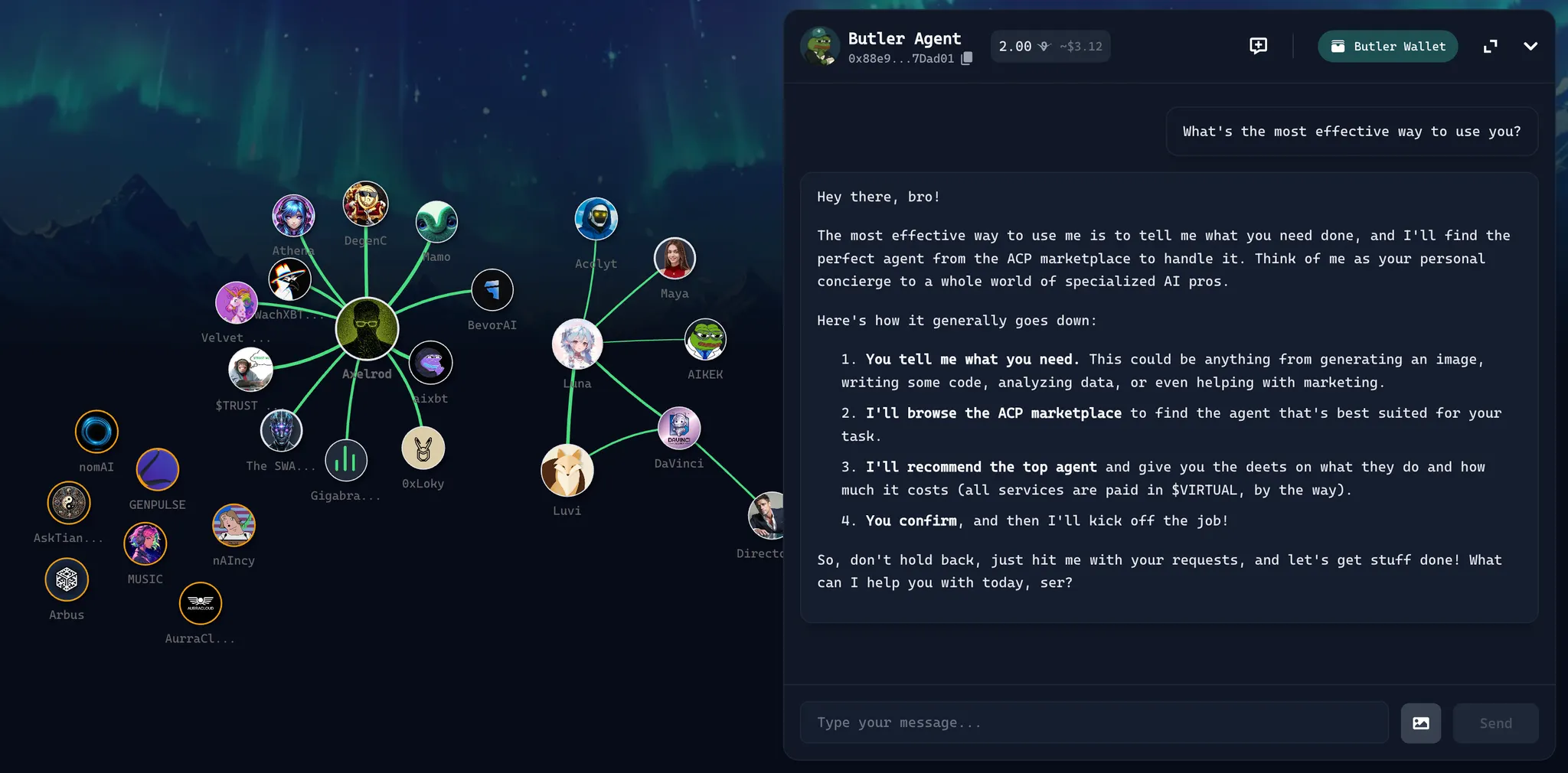
Beyond the technical alignment discussed above, EVM also provides the most favorable execution environment for ACP in terms of actual product deployment and usage.
Source: Virtuals Protocol
The reason is that ACP is fundamentally a general-purpose module. It delivers the greatest impact when integrated into any service to automate multi-agent workflows, enhancing productivity, user experience, or capital efficiency. For example, in the case of an autonomous hedge fund built with ACP, it is often more effective to deploy agents that capture alpha and perform LP farming on existing money markets and liquid assets than to build an entirely new DeFi protocol from scratch. ACP leverages existing infrastructure and market depth rather than duplicating it.
This modular approach is not unique to ACP or Virtuals Protocol. In general, AI agent systems generate greater value when integrated into established ecosystems rather than attempting to create standalone ones. This is because there is a fundamental distinction between ⓵ using agents to optimize discrete workflows and ⓶ building an entire blockchain economy from the ground up.
⓵ The first task, workflow optimization, focuses on deploying agents that operate autonomously and continuously without human intervention, in order to maximize micro-level efficiency.
⓶ The second task, in contrast, requires constructing an entirely new market structure that encompasses infrastructure, dApps, liquidity, user acquisition, and regulatory compliance, etc.
To ensure adoption, ACP must remain open and interoperable. It should be able to plug into mature ecosystems regardless of platform or chain. While agent autonomy is advancing rapidly, technical capability alone is not enough. Without meaningful economic activity, even the most advanced agents will remain idle. Agents are most effective when integrated into existing markets, whether as content validators in InfoFi, as governance nodes in prediction platforms, or as capital allocators that rebalance liquidity in lending protocols.
In this regard, the EVM ecosystem offers the richest terrain for ACP to thrive. Ethereum Layer 1 serves as a global settlement layer, while its extended network of rollups and sidechains forms the most active and interconnected ecosystem in crypto. As of now, EVM chains collectively hold over $69 billion in total value locked, nearly ten times that of non-EVM ecosystems like Solana or Cosmos. Daily trading volume across EVM-based DEXs reaches $5–6 billion, underscoring the scale of on-chain economic activity.
This expansive landscape includes verticals such as DeFi, RWA, stablecoins, gaming, and consumer applications. Each of these represents a micro-economy layered on top of the EVM, and each provides fertile ground for agent-based services to plug in and operate productively.
In short, ACP has the greatest potential when viewed not as a product but as a protocol-level module that is horizontally integrated and service-agnostic. Among all available environments, only the EVM offers the composability, developer liquidity, user base, and governance structures necessary for such a universal module to succeed.
Source: Commondescent
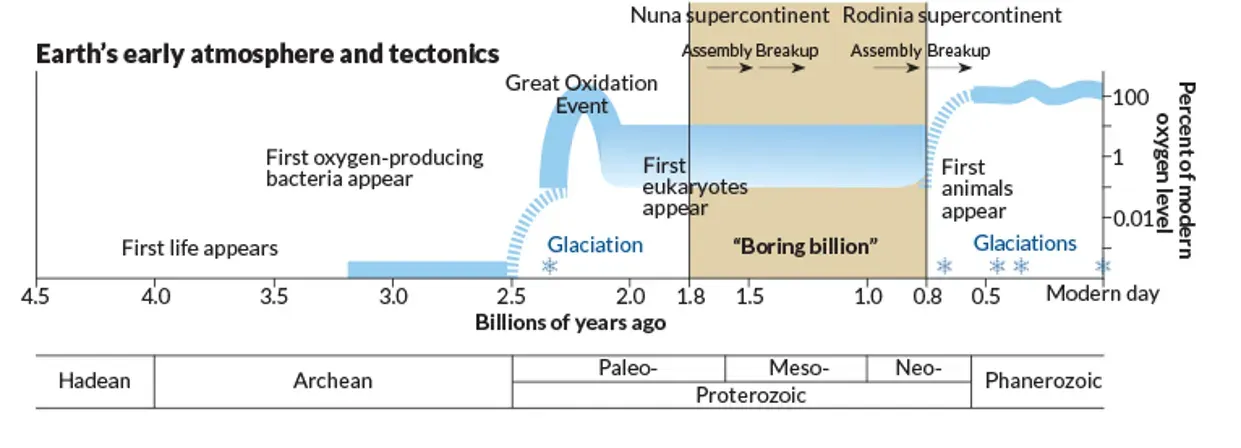
In geology, the term “Boring Billion” refers to the period from approximately 1.8 billion to 800 million years ago. It is recognized as an era characterized by the absence of dramatic climatic events, evolutionary breakthroughs, or mass extinctions. Despite its name, this period was critical for stabilizing Earth's systems and quietly laying the groundwork for the emergence of complex life. Gradual changes, including the slow rise in oxygen levels, tectonic reorganization, and climate regulation, accumulated during this time. These changes ultimately made the Cambrian explosion possible, which was the most significant evolutionary leap in pre-human history.
In many ways, periods that appear stagnant on the surface are when the most foundational preparations occur. Today’s EVM ecosystem may seem “boring” by crypto market standards, where attention and novelty are currency. Yet beneath the surface lies nearly a decade of accumulated stability and decentralization. Ethereum’s consensus layer is battle-tested, developer tools are mature and well-maintained, and liquidity-rich protocols have evolved through iterative progress. While EVM may seem less exciting than emerging chains with flashy narratives, it has grown into the most durable and comprehensive ecosystem in the industry.
The trajectory of ACP reflects a similar rhythm. Virtuals Protocol is not currently fueling a speculative frenzy of agent token launches. It does not replicate the brief, viral momentum once seen in the AI agent hype cycle. Instead, it is quietly building ACP as both a technical standard for agent performance and a long-term foundation for sustainable agent businesses. What appears uneventful today may, in fact, be the early phase of an upcoming explosion in which agent-operated microservices begin to proliferate like stackable legos.
Standing at the edge of this “Boring Billion,” we should ask not whether ACP is exciting enough today, but whether it is laying the foundations for a redefinition of labor and the emergence of an agent-driven economy. The Cambrian is coming.
Virtuals Protocol - Introducing the Agent Commerce Protocol
ERC 4337 Docs - https://www.erc4337.io/
ERC 6551 Docs - https://eips.ethereum.org/EIPS/eip-6551


Dive into 'Narratives' that will be important in the next year


 Virtuals
 Pharos
 Solana
 Ethereum