The recently launched Enso Network is a platform that aggregates on-chain “Shortcuts,” allowing developers to easily combine on-chain functions. Just as Stripe API-fied payments, Enso has API-fied on-chain actions.
The Enso Token ($ENSO) incentivizes network participants through a sustainable cycle of use → reward → expansion → reuse, while also serving governance and staking purposes.
Drawing on past failures, the Enso team found its product-market fit (PMF) and has now entered the expansion stage of the startup J-curve, having demonstrated operational stability by processing $3.1 billion in transactions through the Berachain pre-vault campaign, in a day.
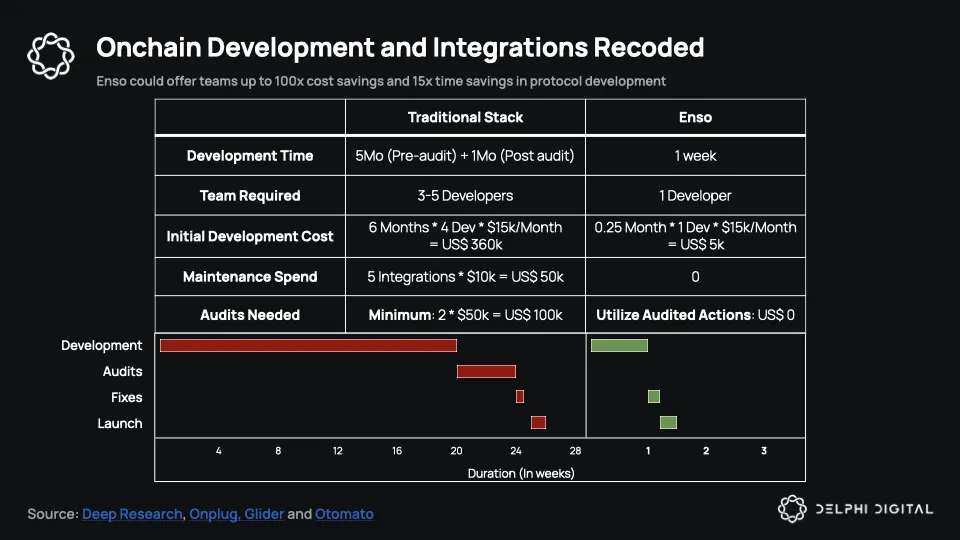
Source: Shortcuts To Scale: How Enso Seeks To Reshape dApp Development - Delphi Digital
As on-chain services diversify, developers still face significant complexity in building them. Each new product requires integrating multiple services and chains, conducting security audits, designing transaction structures, and optimizing gas costs - all of which are repetitive, inefficient, and delay product launches. Skipping integration steps such as connecting bridges or decentralized exchanges (DEXs) inevitably leads to poor user experiences.
Enso tackles this complexity head-on. By introducing the concept of Shortcuts, Enso enables multiple on-chain actions - like swapping, bridging, and depositing - to be executed through a single request. What used to require several separate transactions can now be processed as a single shortcut, allowing developers to focus on their product rather than the infrastructure. Users, in turn, can enjoy seamless on-chain experiences without being exposed to the underlying complexity.
In March this year, I described Enso as a project that “lets developers just ship it” - focusing purely on building. At the time, Enso was mainly a company developing Shortcuts, but it has since evolved into a full-fledged network and ecosystem by launching infrastructure that allows anyone to build and operate Shortcuts. Based on its past achievements, Enso is now building the foundation for an open ecosystem of contributors.
In short, the launch of the Enso Network and Enso Token ($ENSO) marks the first step in Enso’s transition from a service to a platform.
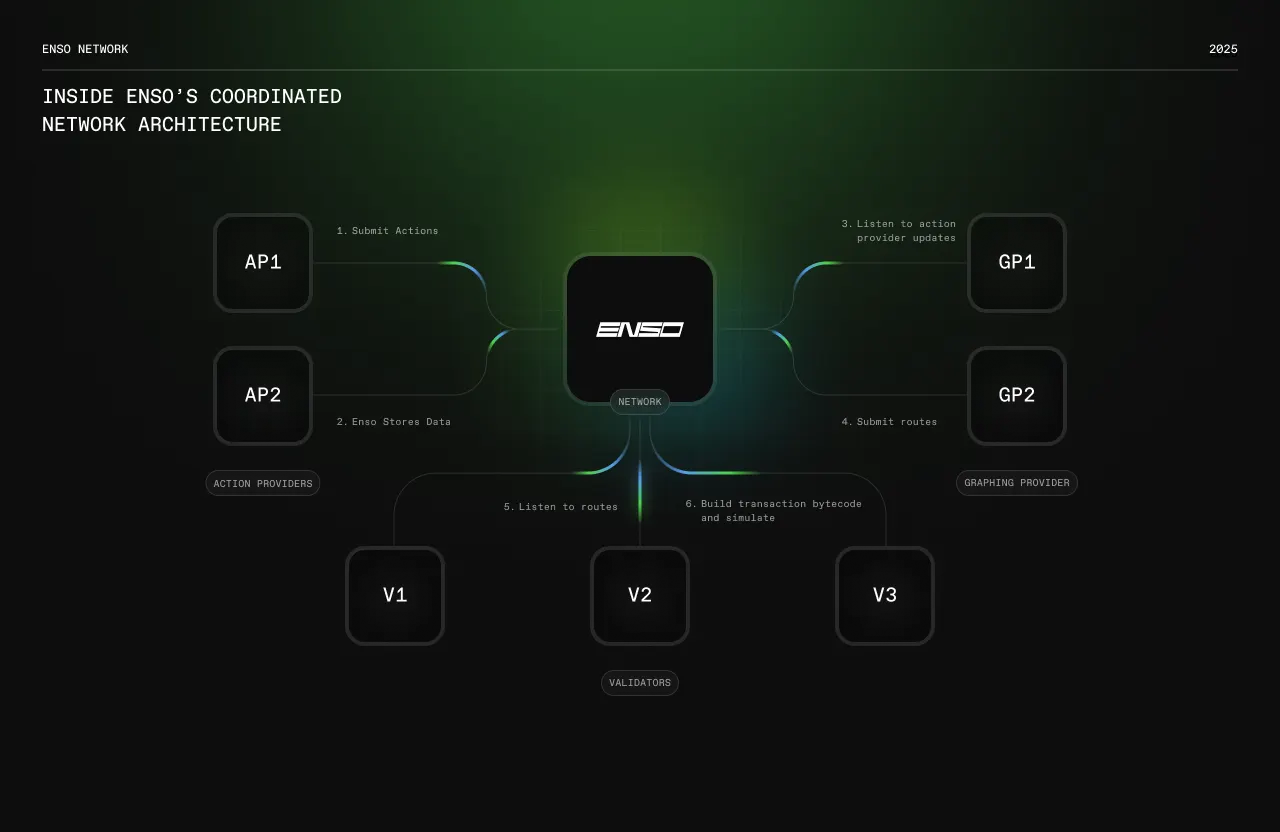
Source: Enso 101: Network Validators
The Enso Network functions as an App Store for on-chain Shortcuts. Developers no longer need to connect to each protocol or chain individually - instead, they can leverage Enso’s Shortcuts to bundle and execute complex on-chain commands.
For example, a user who wants to swap tokens, deposit them, and then bridge to another chain would typically need to interact with 3–4 separate protocols. With Enso, all of this can be executed with a single Shortcut. When a user issues a command such as “Swap and Deposit,” Enso automatically determines and executes the optimal route. A single Intent - such as “Swap my ETH for USD stablecoins and deposit them into a lending pool on another chain” - is processed by Enso, which identifies the best DEX, bridge, and lending pool to complete the transaction. This is achieved through intent-based transactions, not multiple sequential requests.
This approach mirrors what Stripe did for payments infrastructure. If Stripe achieved “API-fied payments,” Enso achieves “API-fied on-chain actions.” In essence, Enso serves as a unified execution engine for operating on-chain products.
Moreover, Enso is not just a collection of Shortcuts - it is also a community-driven marketplace where developers can create, share, and reuse Shortcuts. A Shortcut built by one team can be reused by another or embedded within a different Shortcut. Just as users download apps from an App Store, developers can import and assemble on-chain functionalities modularly through Enso. This modular, composable structure transforms on-chain development into a plug-and-play experience.
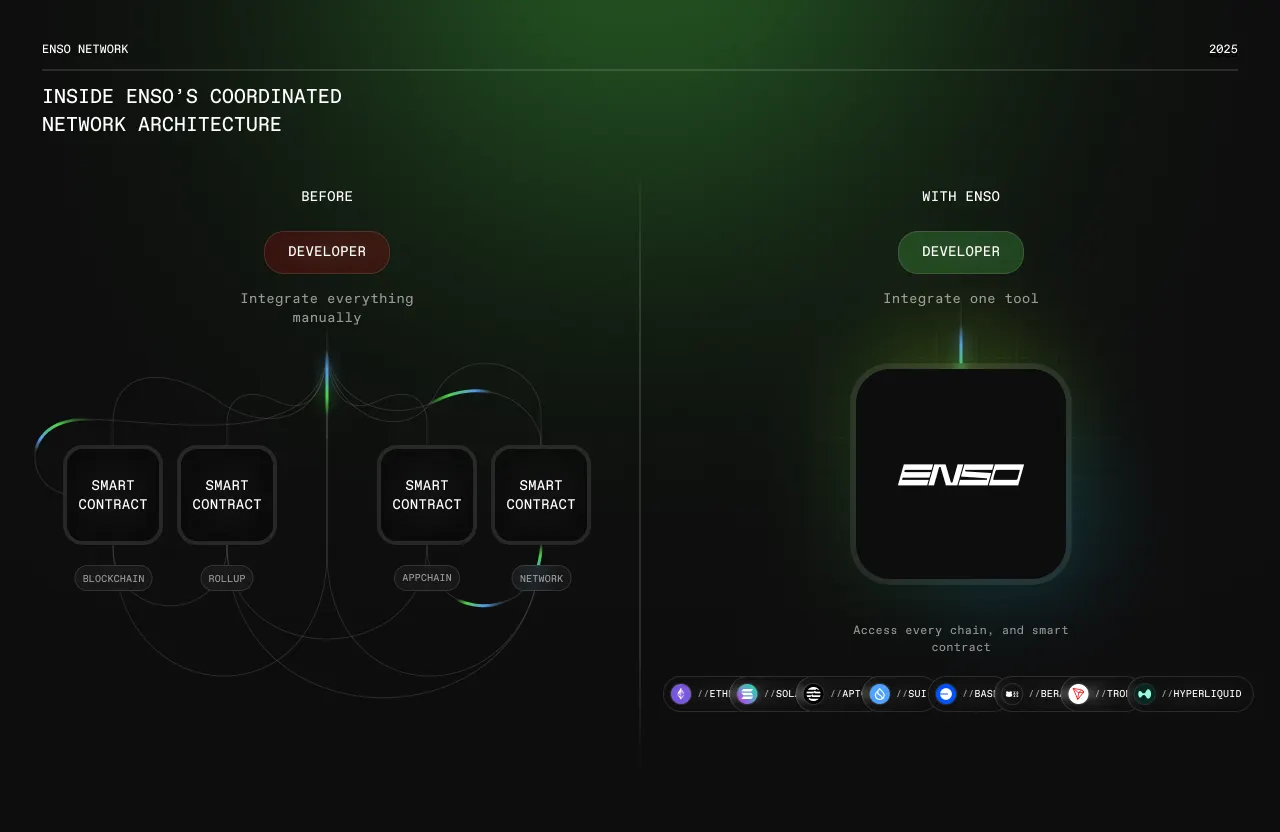
Source: Enso Token Sale - CoinList
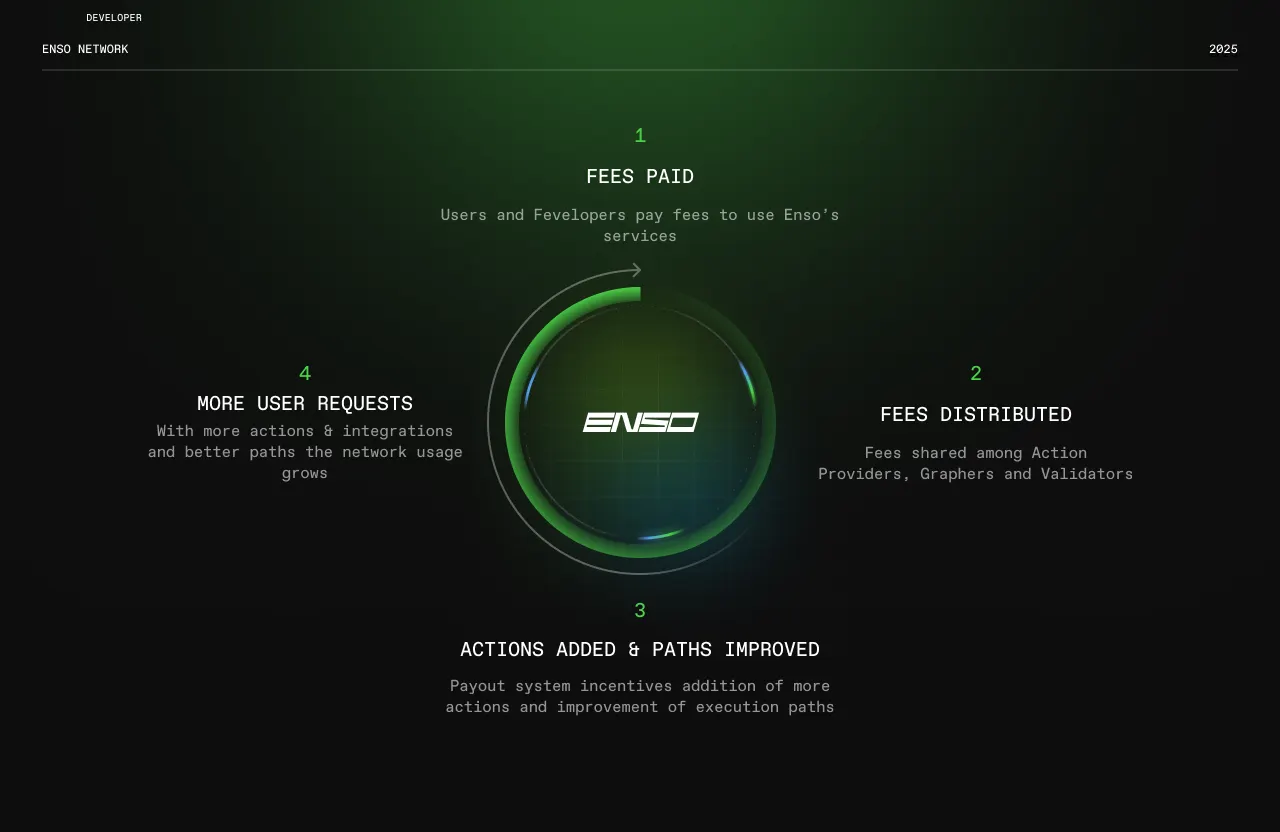
Source: Enso Token Sale - CoinList
The Enso Token ($ENSO) is the economic and governance core of the ecosystem. It ensures autonomous network operation and continuous contribution by rewarding participants who build Shortcuts, integrate new protocols, or expand the ecosystem. This design transforms Enso from a mere technical platform into a contributor-driven economy.
Unlike traditional fee-based models, Enso’s token economy operates on a virtuous cycle: Usage → Rewards → Expansion → Reuse.
Step 1: Usage
Users pay fees when using Enso services such as Shortcuts or Checkout. These fees apply to both developers and users, forming the first stage of value creation - Enso generates revenue from its own network activity rather than relying on external capital.
Step 2: Fee Distribution
The collected fees are distributed among network participants - Action Providers, Graphers, and Validators. Action Providers create and integrate Shortcuts, Graphers design algorithms to optimize execution routes, and Validators maintain network security and validate transactions.
Together, they form the backbone of the Enso ecosystem: functionality, optimization, and stability.
Step 3: Expansion through Rewards
As rewards attract more contributors, developers create new Shortcuts and optimize existing paths, making the network more efficient and feature-rich. This is where Enso’s true nature emerges - an open, participant-driven network rather than a product controlled solely by the Enso team.
Step 4: User Growth and Reuse
The addition of new features naturally drives user adoption. As more users perform on-chain actions through Enso, fees and rewards increase, reinforcing the growth loop.
Ultimately, Enso’s token economy is not a closed cycle but a self-sustaining growth engine. As the network expands, token utility and value rise in tandem. Given Enso’s integration across multiple protocols, baseline user demand is expected to remain strong.
In addition, $ENSO functions as both a governance and staking token. Key decisions - such as protocol integrations, fee adjustments, or feature additions - are made through token-holder voting. Validators and node operators stake $ENSO to secure the network, earning rewards while participating in transaction validation.
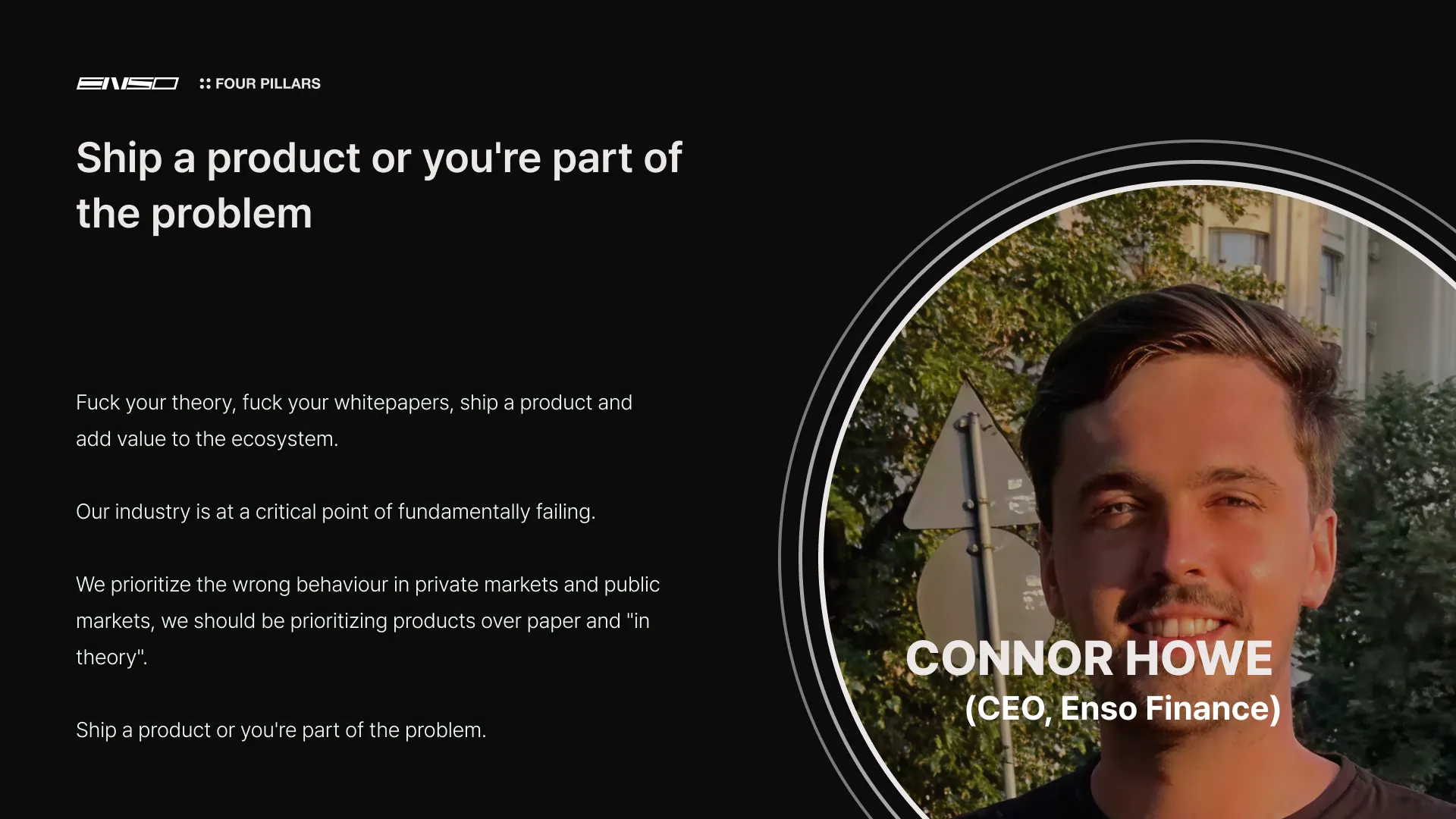
Source: X (@connor_enso)
The name Enso originates from the Japanese Zen symbol “円相 (Enso),” representing simplicity, focus, and enlightenment - values that reflect the team’s philosophy of transforming complexity into elegant simplicity.
Having interacted directly with the early Enso developer community, I witnessed their responsiveness firsthand. Questions posted in Telegram were often answered within minutes, and updates were reflected in the code the very next day. Their product philosophy centers on building for the unseen developers, not just the visible end-users.
Guided by the belief that “Developer Experience (DX) determines User Experience (UX),” Enso’s entire architecture is developer-centric. By simplifying multi-step processes through Shortcuts, SDKs, Checkout, and aggregators, Enso lowers the barrier to building and using on-chain services.
The recently launched Enso Checkout allows users to transfer funds directly from their bank account, convert them into on-chain stablecoins, and deposit them into DeFi - all in one step. Since onboarding to on-chain finance has historically been cumbersome, this dramatically reduces friction for new users.

Source: Introducing Enso Checkout
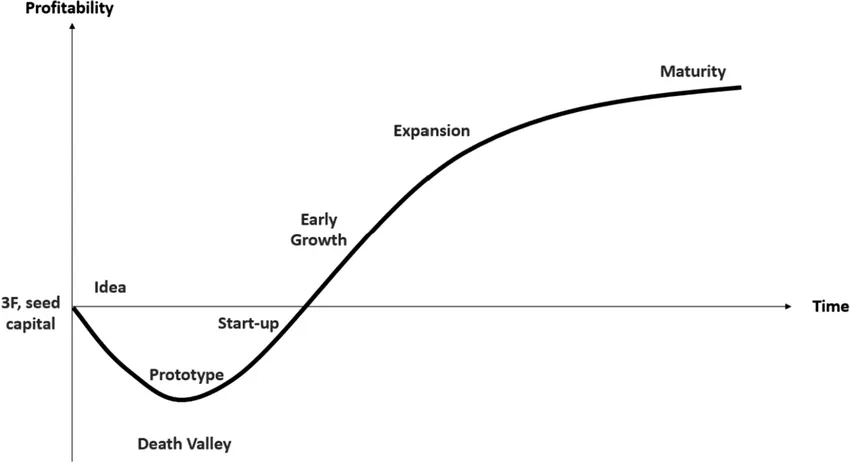
Source: The J-Curve model of the Entrepreneurial Life Cycle (Love, 2016) | Download Scientific Diagram
In the startup lifecycle, the J-Curve represents the transition from initial struggles to rapid expansion. Enso has already endured its “Death Valley” phase. As documented in previous analysis, Enso’s early DeFi projects failed largely due to extended development timelines and high audit costs from integrating multiple services. These hard-earned lessons inspired the creation of Shortcuts - a solution that streamlined these inefficiencies and helped Enso achieve PMF.
Having established PMF, Enso expanded rapidly, powering the Berachain pre-vault, which handled $3.1 billion in transactions in a single day - a clear demonstration of reliability and operational robustness.
As the number of interconnected services continues to grow, Enso’s role in building a truly composable, interoperable on-chain ecosystem will only become more critical. The team has now firmly entered the expansion phase of the J-Curve - scaling from a developer utility into a foundational layer for the next generation of on-chain applications.


Dive into 'Narratives' that will be important in the next year


 Enso
Enso Pharos
 Solana
 Ethereum