
Two days ago, news dropped that the NYSE signed an MOU with Securitize around tokenized securities.
Since it’s only an MOU, the details are still pretty limited. But from what I can see, this move points in a very different direction compared to the recent tokenized equities collaboration between Nasdaq and Kraken.
That difference is worth unpacking.
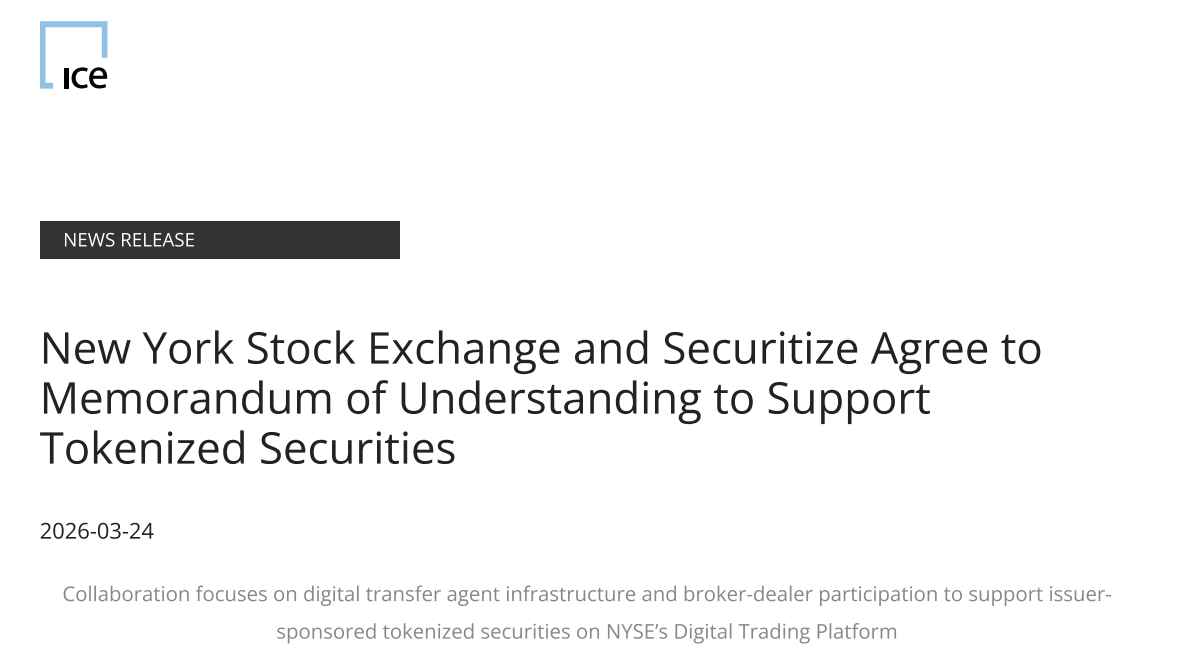
Let’s break down what this partnership actually involves:
NYSE is planning to build a blockchain-based securities market called the “Digital Trading Platform,” where tokenized equities will be traded.
The two firms are collaborating to build out the tokenized securities market. This includes setting standards for digital transfer agents, regulatory frameworks, and technical requirements.
Securitize has been selected as the digital transfer agent for the platform, meaning it can issue shares directly on-chain and manage the shareholder registry.
Securitize Markets will participate as a broker on the platform, facilitating trading of tokenized equities for users.
One detail that really stands out is mentioned at the very end of Securitize’s blog post. They explicitly say they will help build market structure for “issuer-sponsored tokenized securities.”
From my perspective, this is where things start to diverge quite a bit from the Nasdaq x Kraken approach.
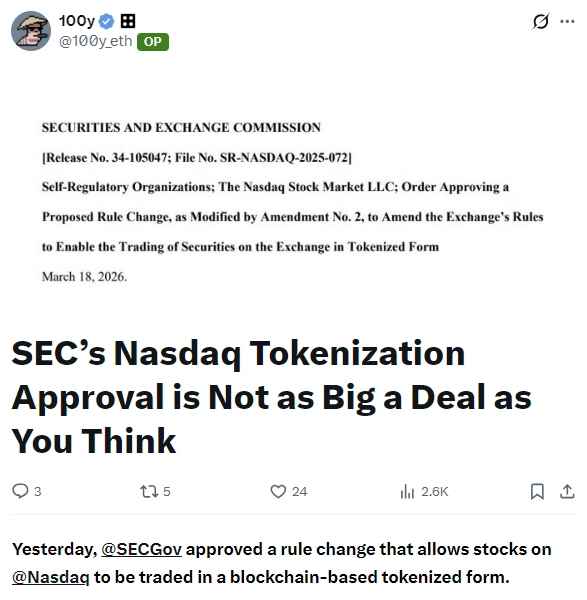
Nasdaq’s approach to tokenized equities is more of an incremental upgrade. It largely preserves the existing market structure.
You still have brokers, NSCC, DTC, and transfer agents all in the loop. The only real change is that settlement at the DTC level moves onto blockchain rails. In the short term, this makes it hard to fully capture the key benefits of tokenization like faster settlement and lower fees.
Within the SEC’s framework for tokenized securities, this falls under a third-party model known as “Custodial Tokenized Securities.”
On the other hand, the NYSE x Securitize model is based on “Issuer-Sponsored Tokenized Securities,” where the issuer and transfer agent directly mint tokens on-chain.
In theory, this structure removes the need for third-party custodians like NSCC or DTC. That makes it a much more radical and potentially transformative approach compared to Nasdaq’s path.
Of course, today’s NYSE still operates on infrastructure provided by DTCC, so this collaboration with Securitize won’t immediately result in a fully reimagined market structure.
But the “Digital Trading Platform” that NYSE is building could, over the long term, introduce a trading model that bypasses DTCC altogether. That’s why this is something worth paying close attention to.
At a high level, Nasdaq and NYSE are chasing the same vision. Lower fees, instant settlement, and 24/7 trading.
But their approaches couldn’t be more different.
Nasdaq is taking the incremental route.
NYSE is leaning into a more radical redesign.
It’ll be interesting to see how these two players shape the future of tokenized equities under the same U.S. regulatory framework.


 Securitize
