

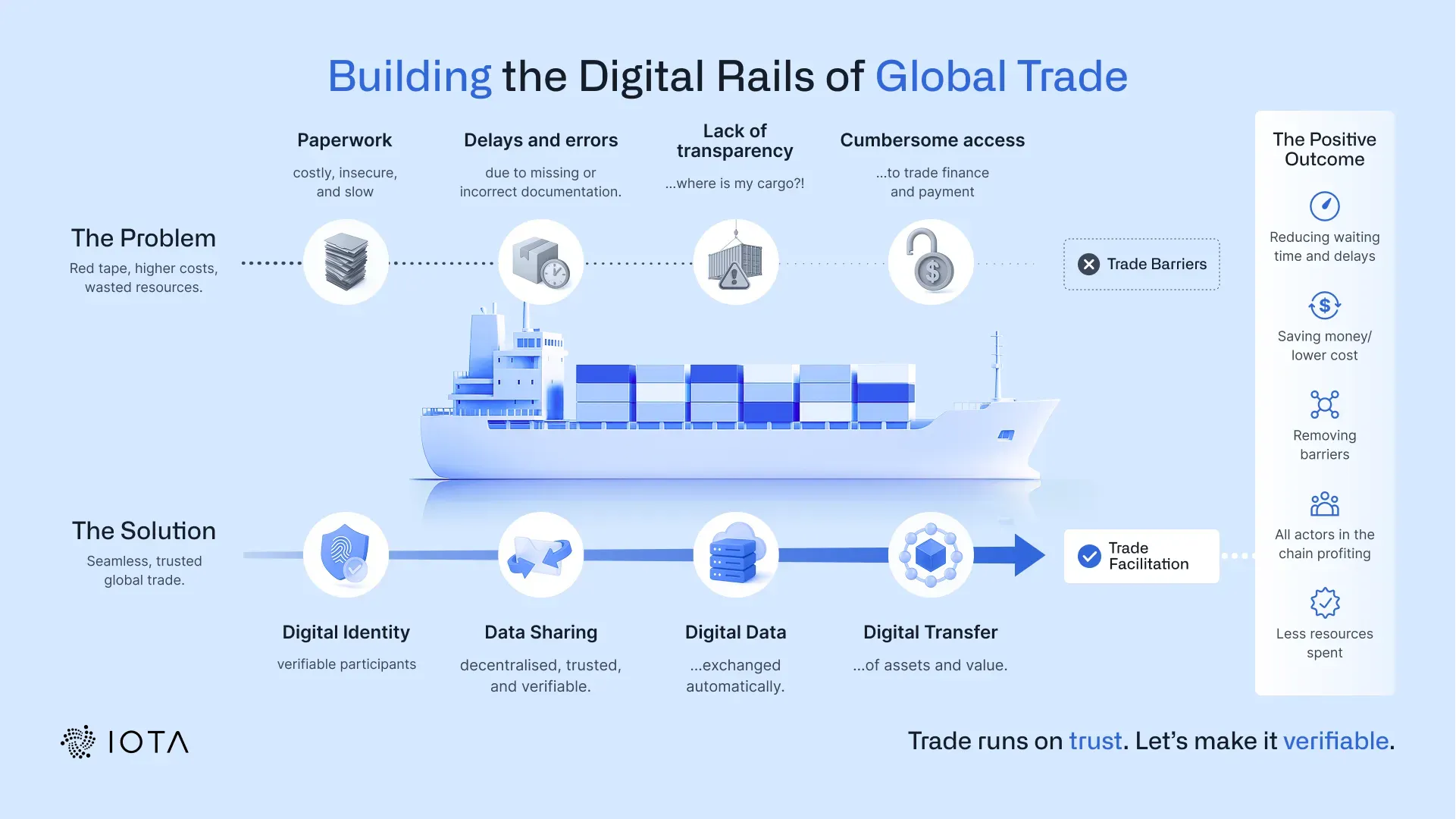
The trade sector still suffers large information gaps and cost waste due to dependence on paper documents. Simply digitizing documents such as electronic bills of lading (eB/L) could save 6.5 billion dollars in direct annual costs and expand global trade by an estimated 30 to 40 billion dollars.
With its recent upgrade to a modernized technology stack, known as IOTA Rebased, the IOTA network has undergone a major overhaul that enhances scalability, speed, and efficiency. Building on this foundation, IOTA is developing the IOTA Trust Framework to provide a neutral and open trade infrastructure that is not controlled by any single actor.
In May 2025, IOTA co‑founded the TWIN (Trade Worldwide Information Network) Foundation with the WEF (World Economic Forum , the Tony Blair Institute, and others. Positioning itself as infrastructure rather than a platform, TWIN provides a node‑centric, modular architecture for a regulation‑friendly, interoperable data pipeline.
In the second half of 2025, partnerships with GLEIF and projects like SALUS connect IOTA’s on‑chain trust, tokenization, and settlement capabilities to trade and supply chains.
On 17 November 2025, IOTA announced the co founding of ADAPT (Africa Digital Access and Public Infrastructure for Trade), a large-scale pan African digital public infrastructure (DPI) designed to interconnect the entire African continent. Based on tokenization, ADAPT aims to build a shared “infrastructure of trust” for Africa – an interoperable, tamper-proof foundation where governments, businesses and financial institutions can exchange trade data securely, verify it instantly and unlock faster, more transparent cross-border commerce at scale.
Over time, trade evolved from simple exchange to cross‑border exchange economies with the introduction of money and institutions. As production and consumption, capital and technology intertwined across countries, trade became a core engine of economic growth.
The numbers make this clear. The ratio of total global trade in goods and services to world GDP rose from the low teens just after World War II to 56 percent as of 2024. This means that more than half of newly created value globally is connected to trade, and not only major economies like the United States and China but also emerging and developing countries rely on trade as a primary growth driver.
Despite technological advances in logistics infrastructure, the front lines of transactions still waste time and money due to information silos and inefficient communication. The root cause is structural dependence on analog documents. McKinsey has pointed out that global maritime trade still relies heavily on paper documents such as the bill of lading (invented in the 1400s), resulting in massive costs and inefficiencies, and that large‑scale structural reform has still not materialized even three years later.
The inefficiency stems not only from slow processing but also from the sheer volume of required paperwork. A June 2025 survey found that roughly 4 billion trade documents circulate daily across international trade networks. Even the simplest single cross‑border trade can involve up to 30 separate parties, with 36 originals and 240 copies exchanged globally. These figures show the severity of trade inefficiencies is far beyond what most imagine.
An OECD 2025 report likewise confirms that, despite rapid digitalization, world trade still depends heavily on paper‑based documents and processes, and it emphasizes the need for electronic documentation, process digitalization, and the adoption of enabling technologies. McKinsey estimates that digitalizing trade documents around electronic bills of lading could save 6.5 billion dollars in direct annual costs and unlock 30 to 40 billion dollars in additional trade.
To address the inefficiencies of paper‑based documents and processes, the WTO’s Paperless Trade Toolkit recommends members adopt pre‑arrival electronic submission and transition to single windows. It notes that success requires both legal frameworks (confidentiality, integrity, reliability) and technical foundations (data standards, interoperability, security).
IOTA argues that distributed ledger technology can address these inefficiencies. Building on the development of its own consensus engine and various initiatives to improve user and developer experience, IOTA is constructing a trust framework to deliver a practical, digital solution for today’s paper‑based trade.
The inefficiency of paper‑based trade processes is like a locked but transparent treasure chest. Simply unlocking it creates enormous value. Historically, regulation was the main lock. Since the adoption of the UN’s MLETR (Model Law on Electronic Transferable Records) in 2017, however, many countries have granted electronic records such as electronic bills of lading and warehouse receipts the same legal effect as paper. This established the legal foundation for digitalizing trade finance documents and even tokenizing them.
On this legal foundation, IBM and shipping giant Maersk launched the blockchain‑based trade platform TradeLens in 2018. Despite clear goals of digitalizing and increasing transparency in global maritime logistics, the project shut down in late Q1 2023 due to governance failure. The issue was not technology or regulation but trust and conflicts of interest.
For competitors, uploading highly sensitive operating data to a platform led by the industry leader Maersk was a non‑starter. Even with claims of independence, other carriers could not dismiss the reasonable suspicion that data and value would accrue to Maersk. Without full industry cooperation, TradeLens’s failure clarified what digital infrastructure for international trade requires.
Beyond technical maturity, a governance model that all participants can trust is essential. It must secure absolute neutrality, robust data governance, and fair incentives and cost sharing. IOTA proposes a solution to this governance problem. Based on IOTA Rebased, the IOTA Trust Framework aims to build truly neutral, trustworthy public infrastructure that no single company can dominate.
To build reliable digital economic infrastructure, IOTA began in 2015 as a network based on a directed acyclic graph (DAG) and launched mainnet in 2016. The team concluded that a decentralized network without smart contract support could not deliver broad value creation and widespread adoption. From 2021, IOTA prioritized programmability first via an L2 EVM Chain connected to the IOTA Mainnet, and in 2025, via IOT Rebased, it transitioned to a high-performance, Move-based architecture that significantly expanded its capabilities.
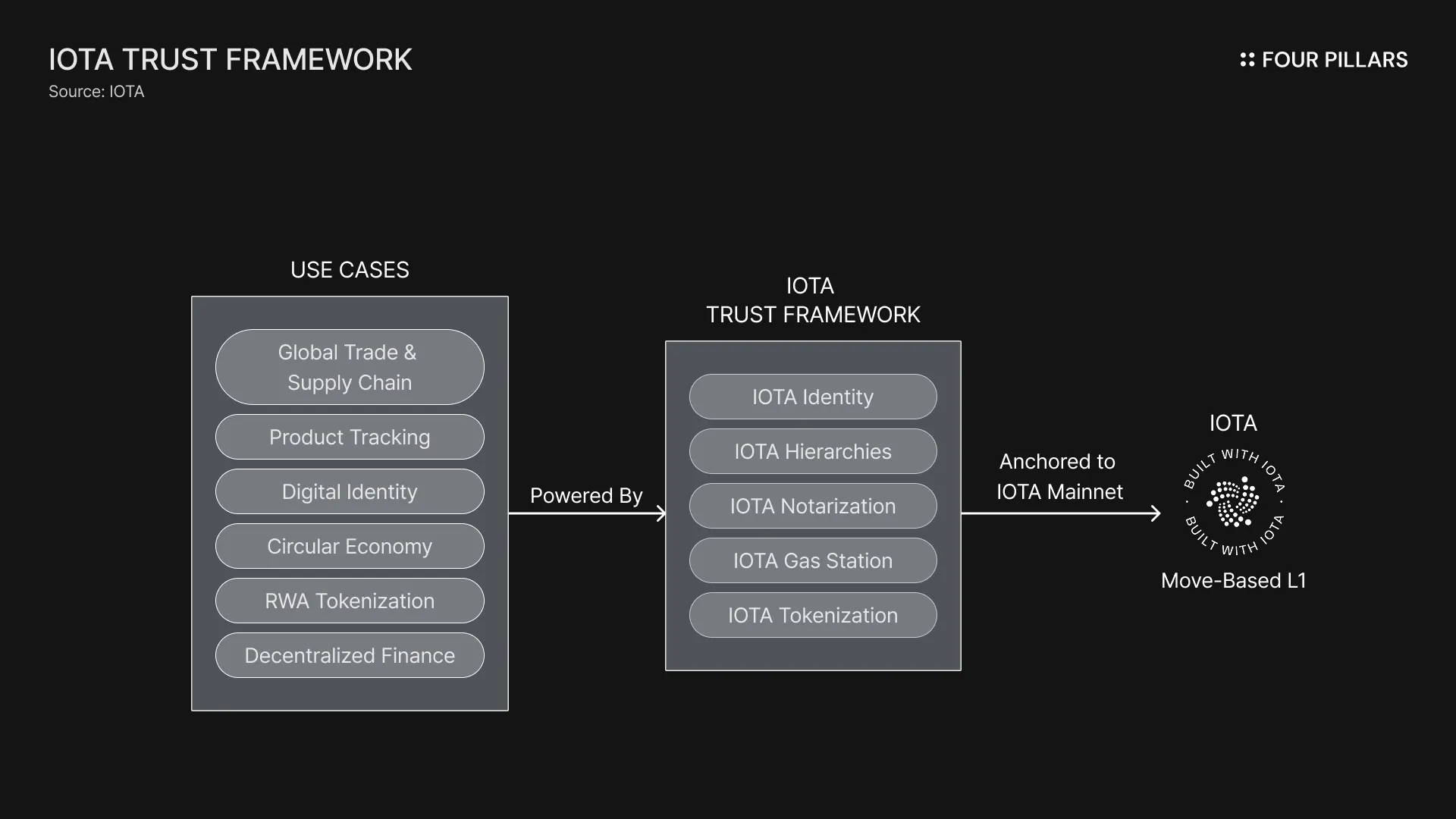
This strategic shift strengthened functionality, stability, and scalability. With the vision of becoming global infrastructure for bringing the real world onchain, IOTA is expanding its ecosystem and advancing the IOTA Trust Framework to enable real‑world usage in trade and industrial domains. The framework has five core components:
Source: IOTA Blog
IOTA Tokenization: Tokenization of real‑world assets
IOTA Identity: Decentralized identifiers and verifiable credentials for participant trust and regulatory compliance
IOTA Hierarchies: Modeling real‑world governance to clarify authority and accountability
IOTA Notarization: Proving the integrity of trade documents on chain
IOTA Gas Station: Sponsored fees to enable tokenless use of on‑chain applications
Together, these components provide an open and trustworthy alternative designed for real‑world needs. Developers get flexible integration tools. Supply chain managers gain verifiable authenticity without ripping and replacing existing systems. Compliance officers get audit‑friendly infrastructure. The framework removes technical barriers.
For more detail, see the earlier article “IOTA’s Bid for the Next DAG‑Based Breakthrough”.
Crucially, the framework focuses on solving the governance dilemma. Led by the IOTA Foundation, the framework centers neutrality to avoid commercial bias and vendor lock‑in. It is open source with community‑driven transparency, and it maintains a free policy with no license fees or infrastructure scaling charges. Anchored to IOTA’s decentralized L1, it functions as public infrastructure that all participants can trust.
On this foundation, the IOTA Trust Framework is already seeing early adoption in trust‑critical areas:
Source: IOTA Blog
Digital identity: Impierce Technologies issues tamper‑evident, globally verifiable diplomas and certificates.
Trade and supply chain: TWIN replaces paper trade documents with verifiable digital records for customs and stakeholder authentication.
Circular economy: Orobo records product lifecycle checkpoints on chain to comply with EU sustainability rules such as the Digital Product Passport.
Product tracking and provenance: ObjectID assigns verifiable identifiers to physical goods, creates digital twins, and secures sensor data integrity.
RWA tokenization: Salus builds a compliant solution that tokenizes critical mineral trades to unlock liquidity and automate trade finance.
One of these efforts to realize neutral and open trade infrastructure is the co‑founding of the TWIN (Trade Worldwide Information Network) Foundation.
Source: IOTA Blog
In May 2025, the IOTA Foundation launched the TWIN Foundation with the World Economic Forum, the Tony Blair Institute, and other leading global organizations. TWIN’s goal is to build open‑source digital infrastructure for secure, real‑time sharing of trade data across supply chains, with a vision to reduce global trade costs by 25 percent. To achieve this, TWIN commits to the following:
Scalable and cost‑efficient data exchange
Data integrity and transparency via distributed ledgers
Confidentiality, privacy, and security
The key point is that TWIN aims to be infrastructure, not a platform. Rather than a service monopolized by a particular company, TWIN provides the pipeline through which all stakeholders in global trade can share data securely. The goal is technical trustworthiness and interoperability.
Building such infrastructure is not trivial. Many participants must interact without intermediaries, and the need‑to‑know principle must be rigorously enforced so that only necessary information is accessible. Given the sensitivity of IoT data, trade volumes, commercial secrets, and personal data, legacy centralized platforms have faced strong resistance to sharing. Solving this is essential for a global trade data infrastructure.
Modern international trade also faces layered regulations, complex interests, and vast data that together create extreme complexity. To function effectively, the infrastructure must be regulation‑friendly while securing integration and interoperability. To this end, TWIN proposes a node‑centric architecture.
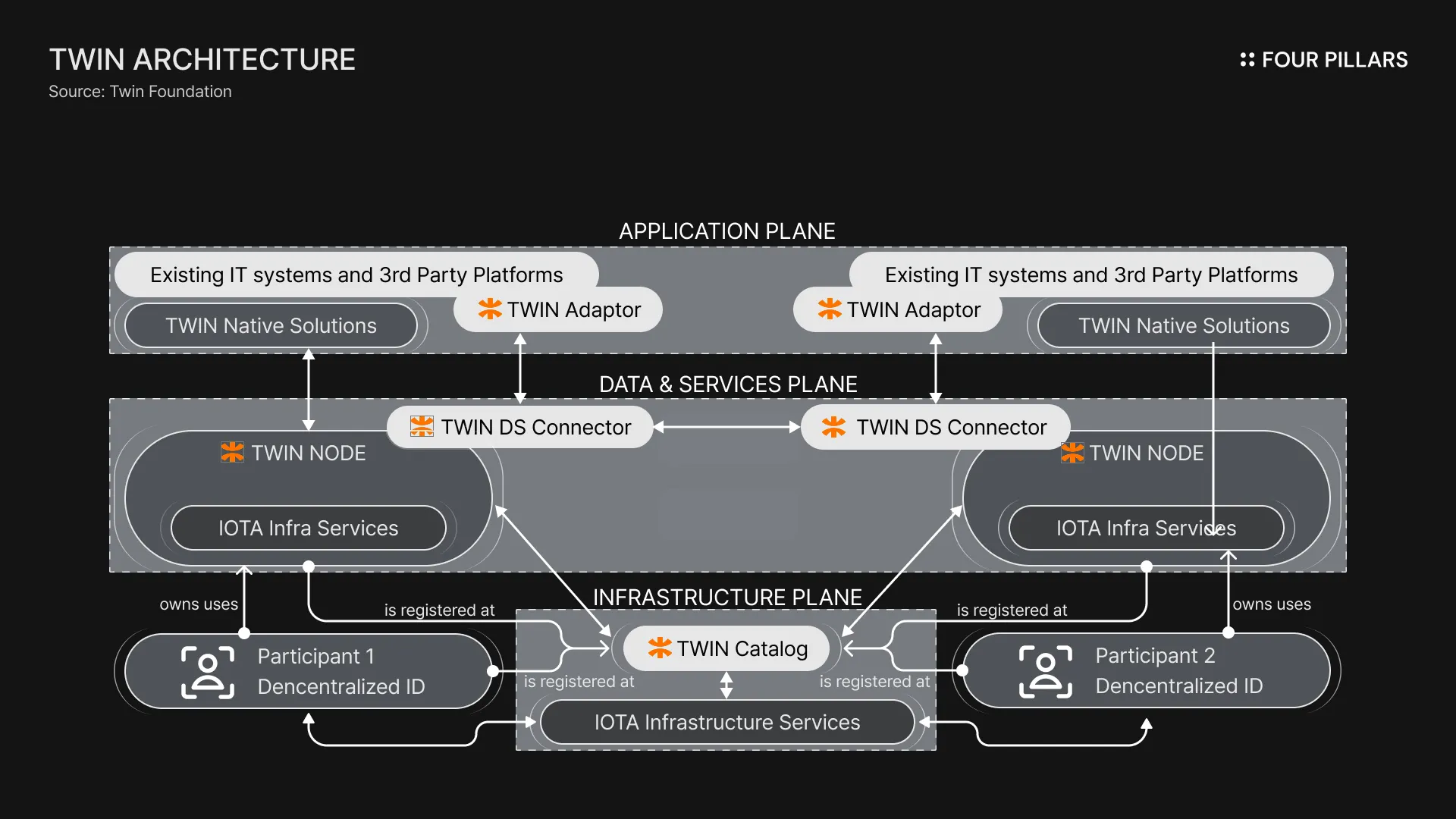
TWIN proposes the following node‑centric architecture.
Source: TWIN Foundation
The architecture comprises three planes and six key elements that interact within them: the Data and Services Plane, the Application Plane, and the Infrastructure Plane. At its core, TWIN Nodes interact organically across these planes to form a Decentralized Trust Framework. Designed for compatibility with international data governance standards such as Gaia‑X and the Industrial Dataspace Association’s Data Space Protocol (Eclipse Dataspace Protocol), it enables the automatic enforcement of data‑subject‑defined policies and delivers secure, compliant data exchange. This lowers entry barriers and accelerates participant onboarding.
TWIN Nodes are modular, extensible agents with open interfaces. They allow participation in the TWIN ecosystem without complex ad hoc integration between existing systems. In the Application Plane, a TWIN Adaptor acts as a bidirectional bridge that connects existing IT systems and third‑party platforms, complementing and extending their value rather than replacing them.
As a result, TWIN connects and extends rather than replaces existing IT infrastructure. It implements an open data ecosystem that can be readily expanded across industries, countries, and regulatory environments, enabling rapid adoption without costly system overhauls or service disruption. The following summarizes how elements interact in each plane.
2.3.1 Data and Services Plane
This plane handles data exchange and interoperability between TWIN Nodes. At the center are TWIN Nodes, modular agents that include infrastructure services such as data processing, storage, key management, and DLT connectivity.
Following the principle of data at the source, each participant keeps data on its local servers and records only hash proofs of integrity on the node. The node acts not as a data repository but as a verifier that stores a kind of digital certificate proving authenticity. Users can verify document authenticity against these certificates without risking disclosure of the originals.
The TWIN DS Connector and TWIN Adaptor together form the data pipeline and standardized gateway between nodes. The DS Connector standardizes trusted data exchange between nodes and external IT systems. When interaction with external systems is required, the Adaptor converts external formats and APIs to the DS Connector’s standard protocols and payloads, and vice versa. For example, an external IT system can publish a document to the TWIN ecosystem by sending it through the Adaptor to the DS Connector. Formats such as XML are translated to the DS Connector’s standard interfaces (REST or WebSocket with JSON‑LD payloads). Where needed, the DLT Connector commits hashes or metadata to a distributed ledger, providing integrity, timestamps, and non‑repudiation.
Access requesters must prove authorization and control of decentralized identity. The IOTA Trust Framework supports this process. IOTA Identity provides self‑sovereign identity, verifiable credentials, and selective disclosure to implement the need‑to‑know principle. Once the requester’s identity is validated against a verifiable registry, the TWIN Catalog’s policy engine authorizes access.
Non‑repudiation: in e‑commerce and similar contexts, a mechanism that prevents a party from later denying the validity or origin of a transaction.
2.3.2 Application Plane
This plane is the user‑facing interface where data and services from lower layers are combined into real business solutions, effectively determining market adoption.
It includes both existing IT systems and third‑party platforms, as well as TWIN‑native solutions. Government single windows and trade operations or customs brokerage systems can connect to the ecosystem through Adaptors and DS Connectors without modification. Their data and services are registered in the TWIN Catalog for discovery and use.
TWIN‑native solutions include track and trace, custom dashboards, and AI‑based automated customs checks that directly use or extend data and services from TWIN Nodes. These applications are discoverable via the TWIN Catalog or connect directly to specific nodes.
In this plane, transferable documents such as electronic bills of lading and promissory notes can be tokenized as NFTs via IOTA Tokenization, with compliance and transfer handled by smart contracts introduced with IOTA Rebased. IOTA Gas Station also enables a node‑sponsored model for fee payments.
2.3.3 Infrastructure Plane
This plane comprises core software services for reliable node operation, with the TWIN Catalog playing a central role. The Catalog is a distributed registry of participants and resources. It enables discovery of who provides which data and under which access policies and exchange permissions. It also maintains immutable objects such as DIDs based on IOTA Identity through a verifiable registry. Additional components such as datastores, object stores, and key management systems improve security and availability.
Thanks to modular design, edge devices like readers, scanners, printers, and mobile sensors can be included as infrastructure components. Zebra Technologies, for example, connected its RFID readers through the Connector to identify and track trade items in real time, boosting data collection efficiency and demonstrating interoperability with other edge devices.
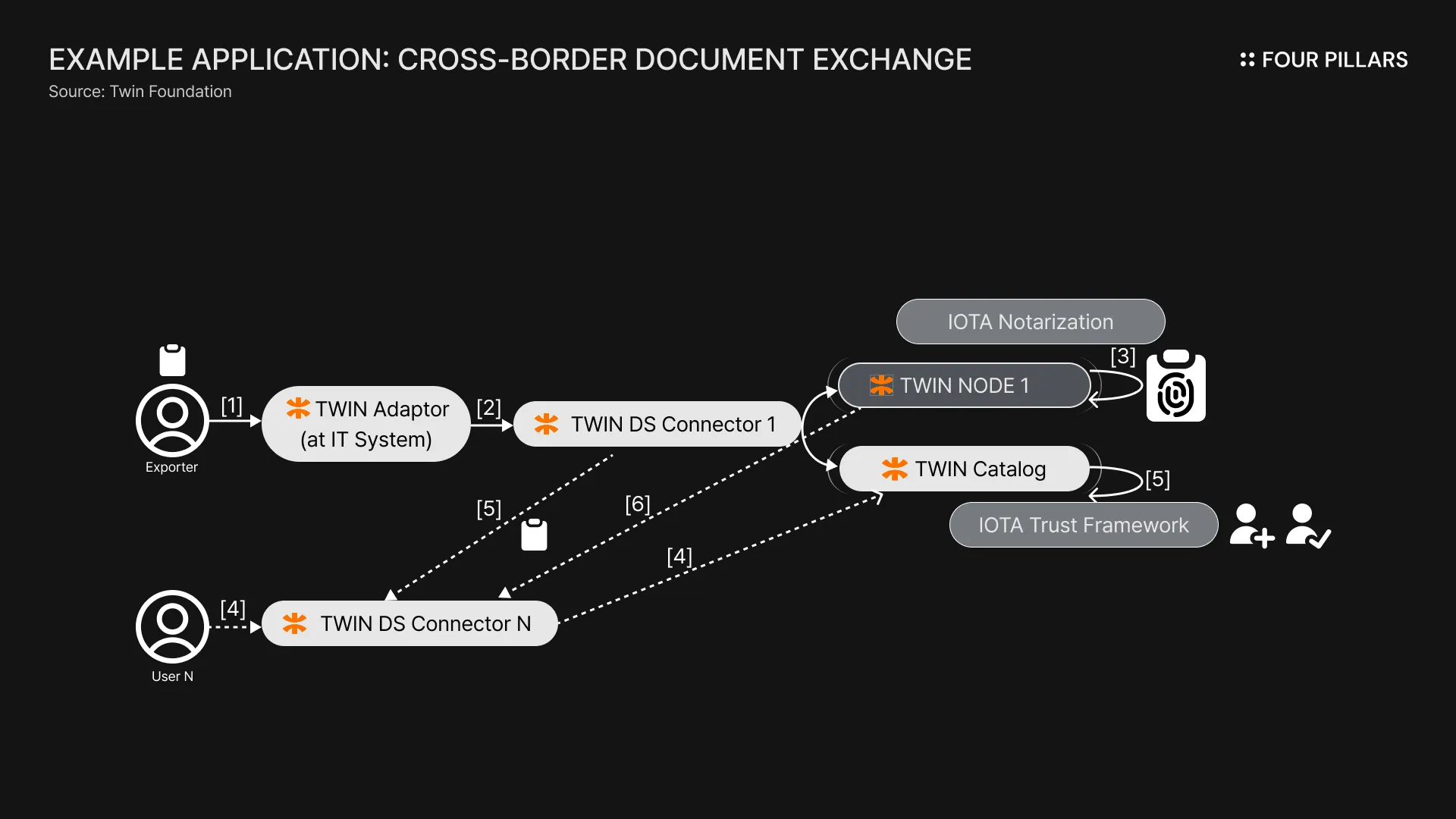
A cross‑border document exchange scenario using TWIN follows these interactions. The process focuses on authenticity, integrity, and controlled access.
Source: TWIN Foundation
The exporter issues an export declaration.
An existing IT system with a TWIN Adaptor posts availability of the document to its TWIN Node 1 Catalog via the DS Connector.
TWIN Node 1 verifies authenticity, computes and stores the hash, and secures tamper‑evidence.
According to data sharing policies, authorized parties such as the importing authority or carrier discover and request access via the Catalog.
Node 1 checks the requester’s DID and credentials against an IOTA Identity‑based verifiable registry, evaluates policy, and, if permitted, transmits the document securely between DS Connectors.
The receiving node verifies integrity by comparing the hash. Once validated, it stores the document locally and updates status.
This approach has been validated through the Trade and Logistics Information Pipeline (TLIP) with TradeMark Africa and the UK Cabinet Office border trade demonstrations. It showed clear potential for faster trade and fewer errors compared with paper processes, and thanks to TWIN’s open interfaces, this contactless information‑sharing model can extend flexibly to other domains.
Built on the IOTA Trust Framework, TWIN provides a modular architecture and decentralized trust structure. These strengths are positioning TWIN not just as a technology provider but as a core infrastructure partner for global trade digitalization. Ongoing collaborations with GLEIF and SALUS include cross‑border trade document digitalization, identity verification, and ESG tracking systems.
2.5.1 GLEIF Partnership
Source: TWIN Foundation
From small suppliers to multinational enterprises, every business must be able to trust the legal status of its counterparties. Fragmented registries, duplicative verification, and inconsistent data make trust slow and expensive, hampering access to trade finance and limiting participation by firms in developing or high‑risk regions.
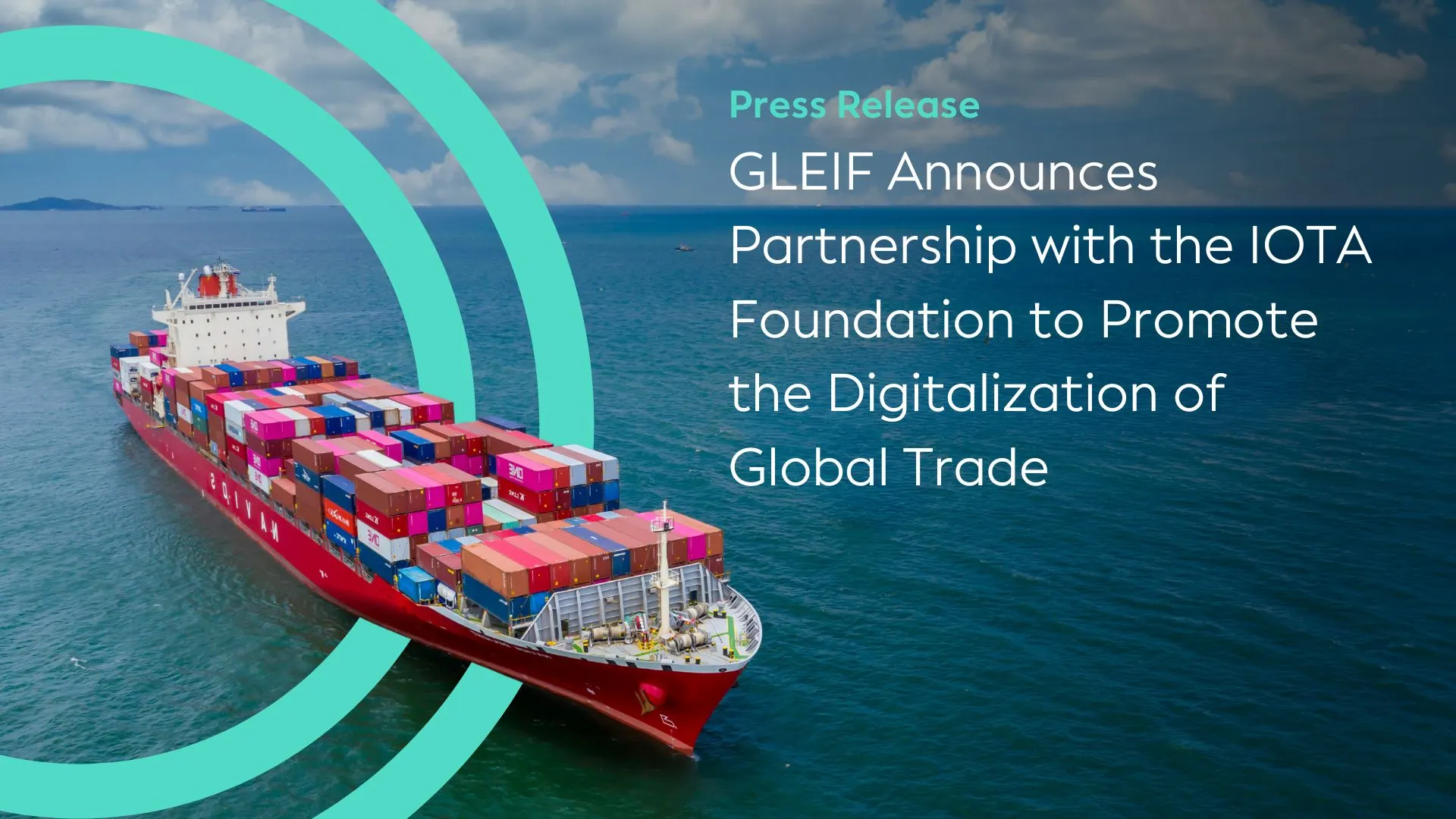
Under the G20’s Financial Stability Board (FSB), the Global Legal Entity Identifier Foundation (GLEIF) was established to address this problem. GLEIF anchors organizational identity to the Legal Entity Identifier (LEI) and its digital counterpart, the verifiable LEI (vLEI), to increase transparency and automation across the financial system.
On September 16, 2025, the IOTA Foundation signed an MOU with GLEIF to collaborate on delivering trusted digital identity across trade and supply chain ecosystems. IOTA will extend GLEIF’s vLEI system into IOTA’s on‑chain environment by combining IOTA’s DID technology with the TWIN architecture.
As a result, organizations can register identity once in either the IOTA or GLEIF ecosystem and interoperate across both networks. For example, linking a GLEIF vLEI to IOTA Identity and integrating it with TWIN Nodes enables immediate on‑chain trust among all participants in a global supply chain. This elevates digital identity to core infrastructure for trade data networks.
2.5.2 SALUS Project
Source: IOTA Blog
Demand for critical minerals such as copper, lithium, and rare earths is surging. Yet slow settlement, lack of trust, and excessive paperwork prevent trade finance from keeping pace, creating liquidity bottlenecks that raise costs and reduce efficiency.
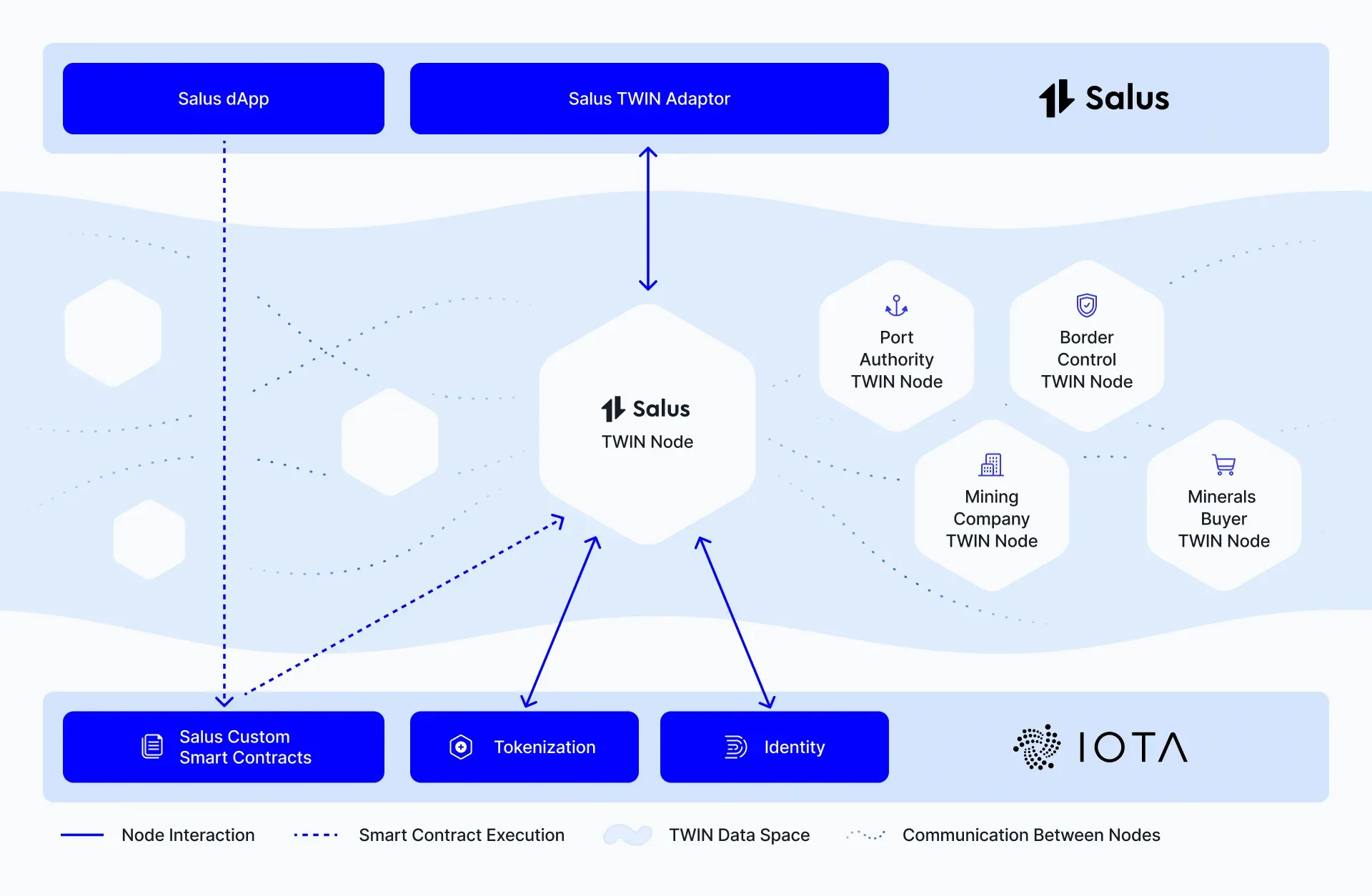
On September 10, 2025, SALUS, a digital trade finance partner, announced with IOTA an assetization and settlement infrastructure focused on critical mineral supply chains. Built on TWIN, it aims to introduce transparent and verifiable trade finance based on digital identity, tokenization, and data sovereignty.
IOTA Identity manages digital identities not only for supply chain participants but also for entities such as containers and transport vehicles. Using DIDs and verifiable credentials, all parties can be uniquely identified without a central authority.
Key trade documents such as warehouse receipts and bills of lading are tokenized as NFTs via IOTA Tokenization and recorded. These NFTs do more than prove ownership. Stored at IOTA’s mainnet, via TWIN Nodes, they can be accessed securely anywhere in the supply chain through node interactions. Designed to comply with digital trade standards, they interact with smart contracts to automate compliance and broaden access to on‑chain settlement using stablecoins. The IOTA Gas Station further lowers entry barriers with sponsored transactions.
Initial operations target tantalum shipped from Rwanda, with plans to expand to more minerals to transform trade finance across the critical minerals industry.
Source: IOTA Blog
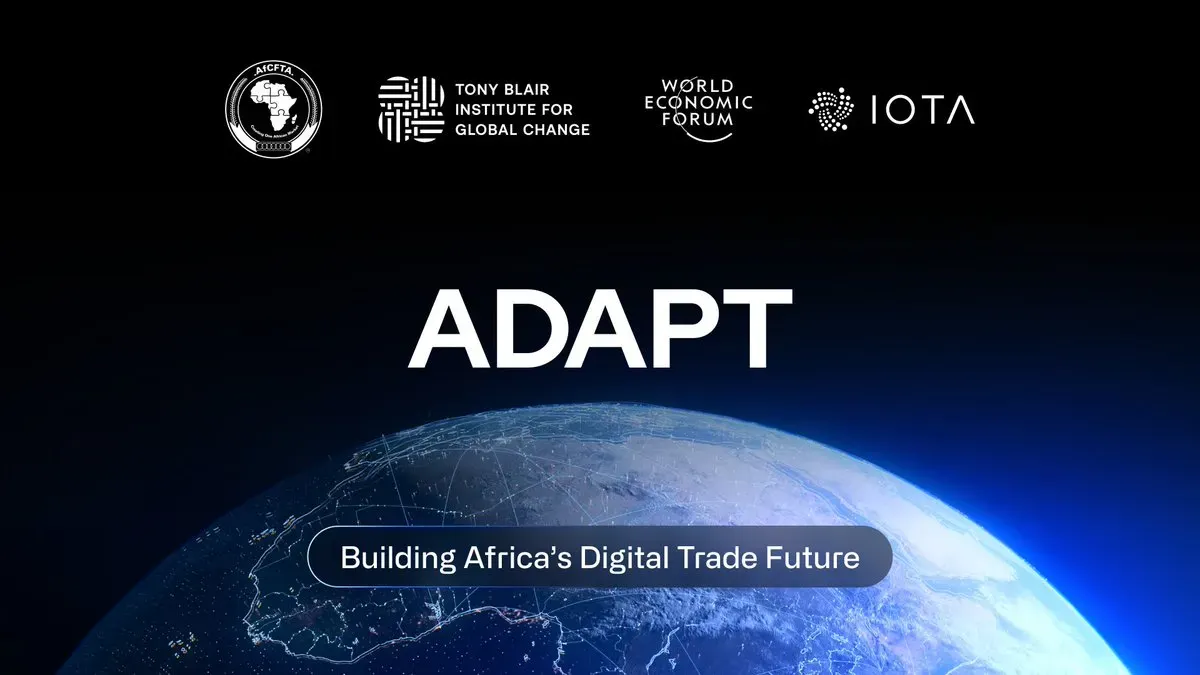
Building on successful TLIP deployments in Kenya, the TWIN solution, and proven work with GLEIF and SALUS, IOTA is now taking a larger step. On 17 November 2025, IOTA announced ADAPT, a new pan African initiative to build the digital trade future of Africa.
ADAPT aims to move beyond country specific pilots and create a continent scale digital public infrastructure that connects Africa as a whole.
Africa has a population of 1.5 billion and a GDP exceeding 3 trillion dollars, positioning it as one of the world’s largest potential free trade areas. Yet its supply chain infrastructure lags behind other regions. While intra regional trade accounts for more than 60 percent of trade in Asia and Europe, Africa’s intra regional trade share stands at only 17 percent, a stark contrast.
At the root of this gap lies the absence of a robust trust infrastructure. Weak physical infrastructure and the lack of digital systems create structural mistrust. Paper based practices amplify inefficiencies. When trust systems are missing, intermediaries become necessary to guarantee transactions, and their fees and processing delays translate into large economic losses.
In cross border payments, this reality is reflected in settlement times that can stretch to several weeks and fees that can reach up to 9 percent, resulting in an estimated 25 billion dollars in capital outflows every year.
To break out of this pattern of delays, mistrust, and high costs, Africa urgently needs Digital Public Infrastructure. As a founding partner of ADAPT, IOTA provides key components of the required platform.
ADAPT is led by the Secretariat of the African Continental Free Trade Area (AfCFTA) in collaboration with IOTA, the World Economic Forum, and the Tony Blair Institute for Global Change. Its goal is to turn Africa’s trade systems into a global benchmark for digital innovation.
Source: IOTA Blog
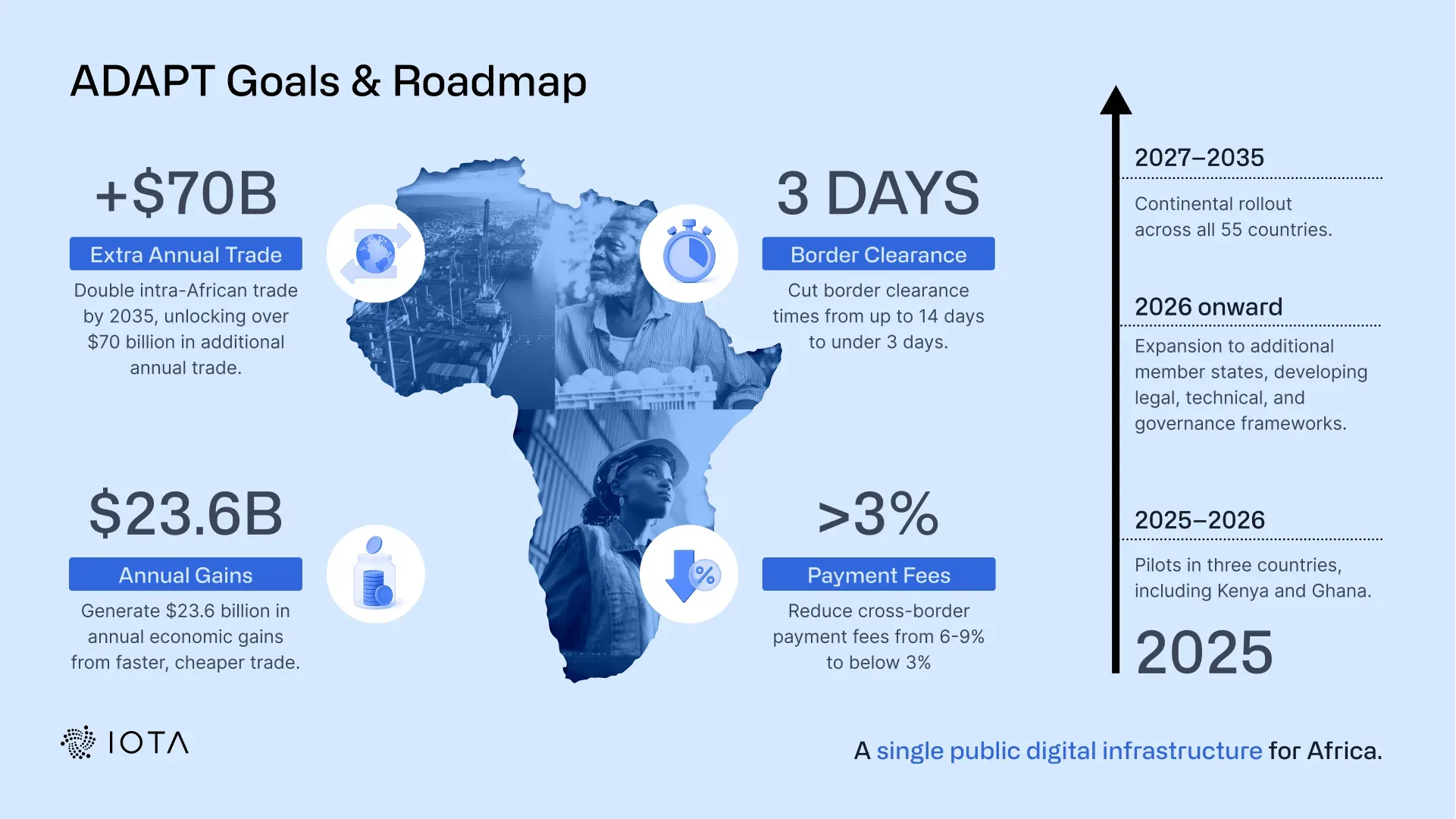
The initiative pursues a shared open source digital public infrastructure for all 55 AfCFTA member countries. By connecting three core layers of infrastructure identity, data, and finance, ADAPT aims to unlock more than 70 billion dollars in additional annual trade, reduce cross border clearance times to under three days, generate 23.6 billion dollars of annual economic benefits, and reduce payment fees below 3 percent, in line with AfCFTA’s vision.
The key components are:
Trusted digital identity: Businesses and governments secure sovereign digital identities that are valid across borders using decentralized identifiers and verifiable credentials. These integrate with existing national systems such as Kenya’s eCitizen and Nigeria’s NIMC to ensure scalability.
Cross border data exchange: Smart contracts, AI based compliance, and IoT based cargo tracking are combined to synchronize the movement of goods and documents in real time. This reduces uncertainty and cuts customs processing time dramatically.
Interoperable financial layer: Mobile money systems, legacy banking infrastructure, and stablecoins such as USDT are linked into a unified network to maximize liquidity. Simplified clearing and settlement flows reduce transaction costs and accelerate payments.
The common thread running through these components is the “infrastructuralization of trust.” In many developing countries with weaker institutional trust assets, the time and cost of verifying counterparties has functioned as an invisible tax on economic growth. By leveraging IOTA’s technology to reduce verification costs, ADAPT seeks to transform trust from a cost into a driver of growth.
Source: IOTA Blog
ADAPT looks to tokenization for answers to Africa’s structural trade inefficiencies.
Tokenization overcomes the spatiotemporal limits of physical assets by mapping them into digital representations. As tokenization of real world assets has become a core trend in global finance, ADAPT extends this approach beyond assets to include information and value exchange.
The power of this approach lies in the fact that every tokenized element operates under smart contracts. Programmable logic, executed automatically by smart contracts, removes complex intermediary processes and cuts trust costs at the root, enabling a transparent and efficient trade infrastructure. ADAPT’s tokenization mechanisms can be summarized in three dimensions.
3.3.1 Tokenizing Information: Turning Trade Documents into Digital Assets
ADAPT tokenizes paper based trade documents as unique digital assets to resolve opacity in supply chains. All documents, including import and export certificates and invoices, are recorded onchain in tamper proof form, each acting as a digital twin of the corresponding physical shipment.
This tokenization of information automates verification and has already shown striking efficiency gains in pilots between Kenya and Rwanda. In these trials, cross border clearance times dropped from six hours to thirty minutes, and manual document handling costs were reduced by more than 60 percent.
3.3.2 Tokenizing Assets: Combining RWA and Trade Finance
ADAPT also tokenizes physical goods such as raw materials and minerals to break down access barriers to finance. When goods stored in a warehouse are represented as blockchain tokens, companies can use those tokens as collateral to access transparent and favorable trade finance terms. For small and medium sized enterprises that have assets but struggle with credit documentation, this becomes a critical tool for unlocking liquidity.
3.3.3 Tokenizing Value Exchange: Payment Transformation with Stablecoins
The high cost and complexity of cross border payments that rely on correspondent banks are addressed by using stablecoins such as USDT as payment tokens. Tokenized money enables direct peer to peer settlement across borders, eliminating the long settlement delays and fee levels of up to 9 percent associated with traditional routes.
IOTA’s vision of an onchain digital economy is built on the premise of neutral public infrastructure. In critical sectors like stablecoins, payments, and Real-World Assets (RWA), it is essential that the mainnet itself acts as the bedrock for verification and policy enforcement. This ensures integrity without reliance on fragmented secondary chains, a core requirement for IOTA's adoption as a global standard.
In line with this, IOTA co-founded the TWIN Foundation with the goal of establishing global trade infrastructure as a public good, and has since demonstrated its effectiveness. Building on this successful model, IOTA officially launched ADAPT, a tokenization-based Digital Public Infrastructure that extends beyond individual African nations to encompass the entire continent.
Solving real-world problems for enterprises and governments through design and execution, and accumulating these use cases, facilitates easier expansion into other sectors. This drives a 'Trust Flywheel': as network adoption and usage increase, the platform leaps forward to become the 'Trust Layer' of the global economy.
As adoption grows, the fee-burning mechanism can increasingly contribute to a clear deflationary effect. Global transport across sea, air, and land is estimated at around 2.5 billion consignment shipments per year. Even if only 1 percent were digitalized on IOTA, that would imply roughly 25 million transactions annually. However, in real-world international logistics, a single consignment rarely ends with the tokenization of just one document. Multiple layers of data anchoring occur as documents move through various institutional checkpoints for exchange and verification. In practice, a single shipment can involve more than 30 participating entities and up to 240 documents being exchanged, meaning the number of required onchain records per consignment is likely to exceed simple estimates by a significant margin. As a result, even digitalizing just 1 percent of global consignments could expand the actual annual transaction volume to several hundred times the baseline figure of 25 million. The fee burning generated from this immense volume of transactions can function as a core mechanism that steadily reinforces the intrinsic value of the token.
There is one precondition for this virtuous cycle. The network must be a neutral, open‑source system built on rigorous design and strong security. As the TradeLens case showed, neutrality and openness that minimize conflicts of interest are effectively mandatory for broad industry adoption. In sensitive domains like trade, however, blockchain immutability and the absence of a single incident‑resolution authority can raise concerns. If these are not addressed clearly, the sector will cling to inefficient paper processes.
TWIN’s architecture offers one solution. It leaves data within participant systems and records only proofs of document and event integrity to the node. This reduces the risk of data leakage. Combined with clear design, uncompromising security, and open governance, a near‑flawless architecture can make network adoption far more persuasive.
IOTA’s role is clear. The steady arc of improvement from the first mainnet in 2016 to Rebased shows the persistence required to build robust global trade infrastructure. As blockchain adoption enters the mainstream beyond simple tokenization of existing rails, IOTA’s on‑chain digital economy is one to watch.
Dive into 'Narratives' that will be important in the next year


 IOTA
IOTA Pharos
 Solana
 Ethereum