Asia Stablecoin Alliance will host the Asia Stablecoin Conference (ASC) on September 25 this year together with Four Pillars, LayerZero, and stablecoin leaders from around the world. ASC Spotlight content highlights the companies sponsoring ASC in advance so that participants can truly immerse themselves in the ASC event and understand how these companies view the Asian market.
ASC Sponsors: Pharos (Title), Ant Digital Tecnhologies (Title), Canton, Ethena, Kiln, Plume, Rialo, Securitize
ASC Participants: Ant Digital Tecnhologies, Avalanche, Bybit, Canton, Ethena, Ethereum Foundation, Four Pillars, Frax, Grove, IDRX, Japan Smart Chain, Kiln, Lambda256, Layer Zero, Mantle, Maple, Neutrl, Pharos, Plume, RedStone, Rialo, Securitize, Sky, Solana, Spark, Stable, Stargate, Sumimoto, Theo, UR Bank, Wyoming Stable Token Commission
For more details about ASC, please refer to the following links:
ASC Website: https://conference.asiastable.org/
ASC Registration: https://luma.com/la44fa6d
Tokenization of real-world assets (RWA) is a multi-stakeholder process. An issuer must legally structure the product, custodians or banks safeguard collateral, regulators require continuous auditability, and investors demand easy access with liquidity. Most blockchain efforts have tackled only one part of this chain. Some build issuance platforms, others focus on custody integrations, and a few design DeFi vaults. These siloed approaches force issuers to stitch together multiple vendors, slowing adoption and creating regulatory risk.

Plume, founded in 2023 and launching its mainnet with “Plume Genesis” in mid-2024, set out to address the fragmentation found with RWAs.. Rather than offering a single component, Plume delivers the full vertical stack from a compliance-first blockchain, a tokenization engine, to even oracle infrastructure.
By mid-2025, Plume had surpassed 220,000 ****wallets, tokenized more than $170 million in assets, and integrated with partners including Superstate and Mercado Bitcoin. Its thesis is clear: large-scale tokenization is only possible on infrastructure where issuance, compliance, data, and yield are embedded natively.
Plume Network: EVM-compatible blockchain with sequencer-level AML screening, combining Ethereum security with institutional compliance.
Plume Portal: Dashboard for issuers and investors to manage offerings, complete KYC/KYB, bridge assets, and track portfolios.
Arc: No-code tokenization engine that embeds compliance rules directly into smart contracts for assets like Treasuries or private credit.
pUSD: Native stablecoin, backed 1:1 by USDC and USD1, serving as the settlement and transaction currency across Plume.
pETH: Liquid staking derivative of ETH that accrues staking rewards and can be used as collateral or in yield strategies.
Nest: Yield marketplace offering structured RWA vaults such as Treasuries and private credit with institutional safeguards.
Nexus: On-chain data highway delivering real-world information like interest rates, reserves, and compliance lists.
Skylink: Cross-chain protocol that mirrors Plume yields and token states across 18+ external networks via LayerZero.
To illustrate Plume’s lifecycle, consider a hypothetical product: the Aurora Credit Fund, a special-purpose vehicle that tokenizes a pool of senior secured loans. The flows below describe how an issuer brings Aurora onchain and how an investor participates.
Issuer: Aurora Credit Fund
Onboarding in Arc: The manager configures the product in Arc by defining the loan pool, jurisdiction, investor eligibility, and lockups. Arc connects with identity providers such as Fractal and Sumsub for KYC/AML, and then generates compliant token contracts with embedded restrictions.
Distribution storefront: Arc deploys a frontend where only wallets that pass eligibility criteria can subscribe. Subscriptions settle on Plume, with tokens governed by embedded compliance logic.
Ongoing operations: Asset performance data such as interest payments and defaults is streamed via Nexus. Coupon payments are distributed in pUSD, and Arc enforces secondary transfer rules automatically.
Composability: Aurora’s tokens can be approved as collateral in Nest vaults or integrated with lending markets, allowing investors to borrow, lever, or build structured positions.
Investor: Alice seeks safe yield
Portal login and checks: Alice logs into Plume Portal with her wallet. The Portal verifies her accreditation status and displays eligible offerings including Aurora and a Treasury vault.
Bridging dollars: Alice bridges USDC into Plume. The bridge issues pUSD 1:1, giving her a native currency to allocate.
Depositing into Nest: Alice invests pUSD into the Aurora Credit Fund vault within Nest. Her vault tokens represent a share of the strategy and automatically accrue yield in pUSD.
Liquidity management: Alice can redeem her vault tokens for pUSD, swap into other assets, or borrow against her holdings. If she holds pETH, she can layer ETH staking yield on top of Aurora’s private credit yield.
Source: Plume
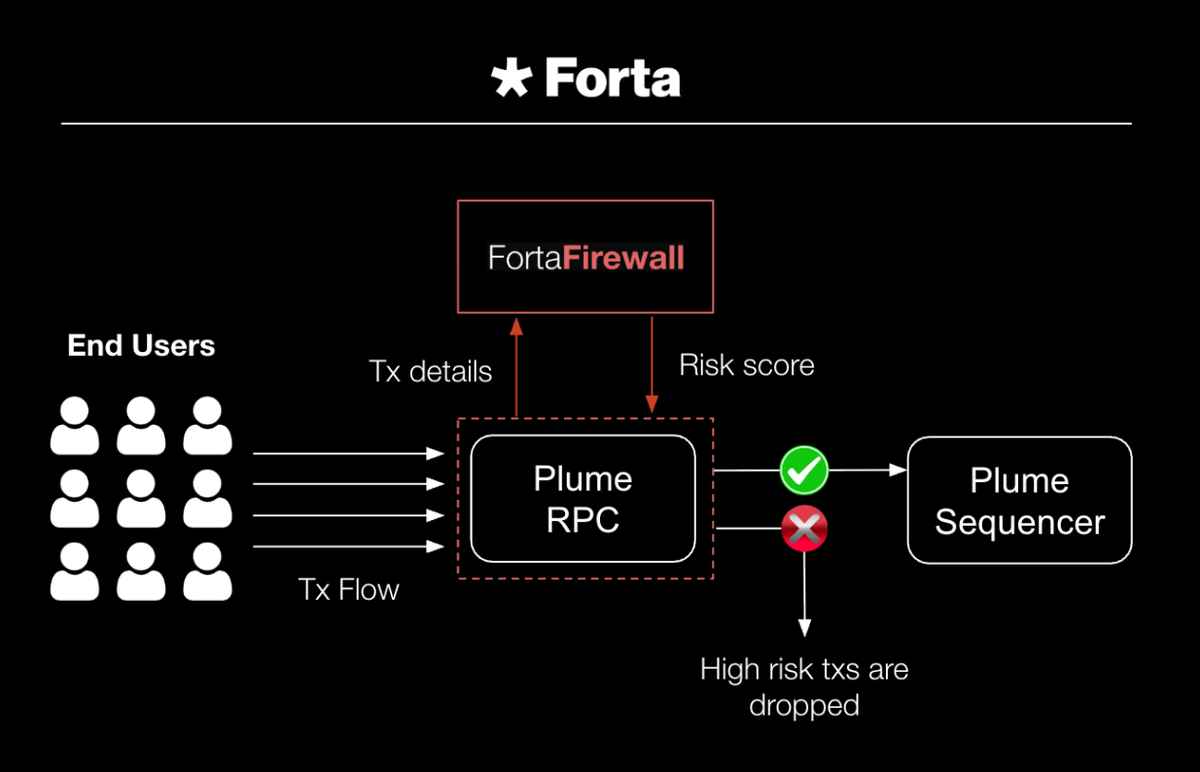
Plume embeds compliance directly into its protocol, making it the unique permissionless blockchain that performs active AML screening at the sequencer level. Every transaction is checked against sanctions and AML criteria before it can be included in a block.
All transactions pass through Plume’s custom RPC, which connects to the Forta Firewall for real-time analysis. Forta simulates the transaction, extracts all involved addresses, and checks them against global sanctions lists such as OFAC’s SDN. If any address is flagged, the transaction is rejected at the gate and never reaches the sequencer. For example, a user bridging USDC from a sanctioned wallet would be blocked from minting pUSD, preventing illicit inflows at the moment of transfer.
Plume also integrates ongoing monitoring from TRM Labs, Chainalysis, and Elliptic. These systems track patterns of suspicious behavior, from darknet-linked flows to potential laundering schemes. While automatic enforcement targets sanctions directly, broader analytics provide an additional layer of intelligence and can support escalations such as law enforcement alerts or contract-level controls.
Nexus and Skylink work in tandem. Nexus brings external data into Plume, ensuring that tokens remain synchronized with real-world conditions. Skylink pushes yield outward, allowing those returns to flow across multiple blockchains. Together, they make Plume both data-rich and interoperable, which are two traits essential for scaling real-world finance on-chain.
Nexus: Data Highway
Purpose: Brings real-world data onchain, keeping tokenized assets aligned with off-chain truths.
Data Source: Market price feeds, compliance registries, identity providers.
Key Use Cases: Price feeds for RWAs, macro indices for lending, compliance/KYC checks.
Nexus is Plume’s integrated oracle system, designed to continuously deliver trusted external inputs to onchain contracts. Smart contracts often need to reference information such as treasury rates, CPI data, reserve attestations, or KYC approvals. Nexus provides this infrastructure natively and makes it accessible to developers through on-chain contracts that can be queried directly.
The system aggregates feeds from decentralized oracle networks and permissioned providers such as custodians and rating agencies. Node operators subscribe to offchain sources and publish verified updates to Nexus, ensuring that tokenized treasuries reflect benchmark rates, private credit funds can update NAVs in real time, and compliance registries always use the latest data. Nexus also reserves block space for critical oracle updates so that feeds remain timely and reliable even during network congestion.
Skylink: Cross-Chain Yield Protocol
Purpose: Streams Plume’s RWA yields and token states across external blockchains.
Data Source: Onchain vaults and assets on Plume, mirrored via LayerZero messaging.
Key Use Cases: Cross-chain yield farming, unified liquidity across dApps, enabling access to Plume yields on chains like Tron or Solana.
While Nexus brings information in, Skylink pushes yield outward. Skylink is built on LayerZero’s omnichain messaging and SyncPool architecture. It mirrors the yield of Plume vaults onto other chains through YieldTokens that represent a claim on assets custodied on Plume. Principal assets remain secured on Plume under compliance controls, while mirrored tokens on external networks accrue yield locally. A Tron user, for example, can mint a mirrored Treasury vault token on Tron and earn the same return as if they had deposited directly on Plume, without moving capital across chains.
This model preserves custody, enforces Plume’s compliance standards across every connected network, and greatly extends the reach of tokenized yields. By mid-2025, Skylink was live on more than sixteen networks including Solana, Tron, Injective, Omni, and ZkSync. The integration with Tron opened access to one of the largest stablecoin communities, allowing millions of users to earn regulated Treasury yields directly within their existing ecosystem.
Source: Plume
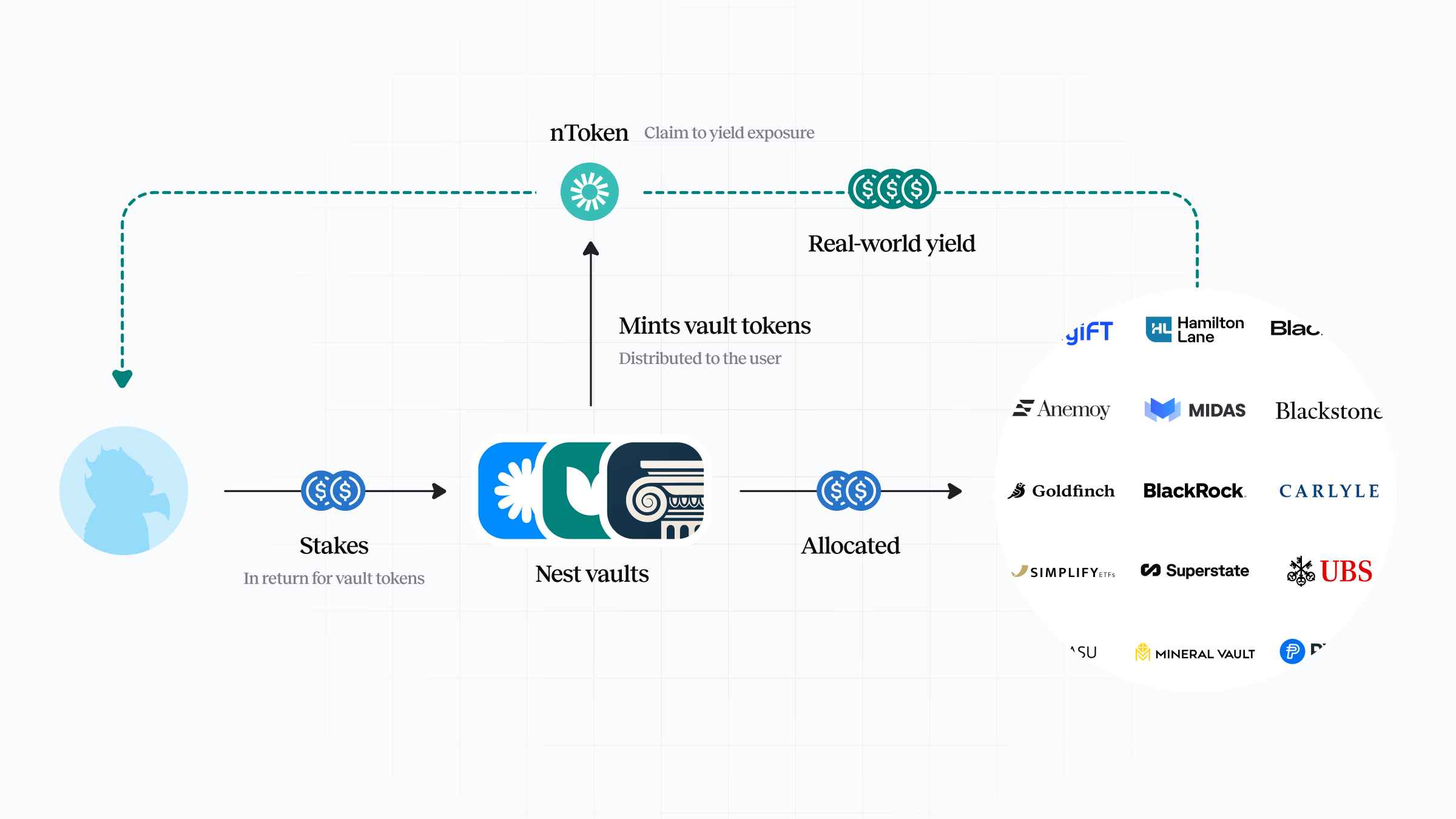
Nest is the DeFi interface to real-world yield. It turns tokenized assets such as treasuries, private credit, real estate, and structured strategies into onchain vaults where users deposit stablecoins and earn income directly in wallet. Each vault is managed by professional issuers, with returns accruing to vault tokens that rise in value. The design is simple for investors yet secured with institutional safeguards like tranching, redemption windows, and regulated custody.
At launch, Nest introduced three core vaults. The Treasuries Vault (nTBILL) focused on short-term U.S. Treasuries, offering a safe, money market–style product. The RWA Flagship Vault (precursor to the Alpha Vault) diversified across tokenized private credit and real estate debt from managers such as Blackstone, Carlyle, and Pimco, balancing higher yields with credit risk. The High Yield Vault blended RWAs with crypto-native strategies like staked ETH or liquidity provision, targeting higher returns with greater volatility.
Nest has since expanded into:
Alpha Vault (nALPHA): Diversified exposure across credit, ETFs, and commodities.
Basis Vault (nBASIS): Delta-neutral strategies combining stablecoin collateral with derivatives or tokenized Treasuries.
ETF Vault (nETF): Access to institutional-grade ETFs and secured debt products, tokenized for DeFi use.
PayFi Vault (nPAYFI): Fintech-driven strategies focused on receivables and invoice financing, giving users exposure to cash-flow–backed yields.
As Plume’s yield layer, Nest connects DeFi liquidity with institutional strategies and offers a spectrum of options, from safe Treasuries to higher-yielding private credit and fintech receivables. Vault tokens are composable across DeFi, allowing them to be reused as collateral or in structured products. For investors, Nest is an accessible gateway to sustainable yield. For issuers, it provides instant demand and liquidity for tokenized assets.
Asia is a key strategic focus for Plume. Our goal is to replicate our proven U.S. RWA strategy and adapt it to the Asian market. In the U.S., we have partnered with leading asset issuers and distributors, and engaged directly with the SEC to explore the real RWAfi market — bringing on-chain RWAs with DeFi composability.
We already serve a substantial user base in Asia and have a dedicated regional team. Markets such as Hong Kong and South Korea are advancing rapidly in establishing clear stablecoin and RWA regulatory frameworks. We have successfully tokenized several Asia-based assets on-chain and collaborate with a strong network of RWAfi ecosystem builders from across the region.
Conducted a Hong Kong roadshow in collaboration with the Hong Kong government to promote RWAs following the Digital Asset 2.0 Policy.
Tokenized Asia-based assets recognized by Singapore and Hong Kong regulators, including CMBI MMF and UBS products via DigiFT.
Expanding the range of tokenized Asia-based assets.
Partnering with additional Asia-based distributors to strengthen market penetration.
The regulatory landscape remains fragmented, with differing policy standards across jurisdictions, for example, MAS (Singapore), SEC (U.S.), and SFC (Hong Kong) each maintain distinct frameworks. In Southeast Asia, every jurisdiction has its own regulations and priorities, creating additional complexity.
There is also a need to raise market awareness and provide education around RWA concepts. Many stakeholders still have fundamental questions about the tokenization process, what types of assets can be tokenized, and the steps required to do so.
Forge new partnerships and integrations across the region.
Gain deeper insights into regional policy developments.
Engage in direct dialogue with regulators.
Participate in key regulatory sandboxes, particularly in Hong Kong and South Korea.
Plume has matured into one of the most complete RWA networks in operation. Its strength lies in integration: Arc for tokenization, pUSD and pETH for liquidity, Portal for user experience, Nest for yield, Nexus for data, Skylink for distribution, and sequencer-level AML for compliance. For issuers this removes vendor sprawl. For investors it offers a single access point to regulated real-world assets with liquidity and yield.


Dive into 'Narratives' that will be important in the next year


 Stable
 LayerZero
 Ethereum