Asia Stablecoin Alliance will host the Asia Stablecoin Conference (ASC) on September 25 this year together with Four Pillars, LayerZero, and stablecoin leaders from around the world. ASC Spotlight content highlights the companies sponsoring ASC in advance so that participants can truly immerse themselves in the ASC event and understand how these companies view the Asian market.
ASC Sponsors: Pharos (Title), Ant Digital Tecnhologies (Title), Canton, Ethena, Kiln, Plume, Rialo, Securitize
ASC Participants: Ant Digital Tecnhologies, Avalanche, Bybit, Canton, Ethena, Ethereum Foundation, Four Pillars, Frax, Grove, IDRX, Japan Smart Chain, Kiln, Lambda256, Layer Zero, Mantle, Maple, Neutrl, Pharos, Plume, RedStone, Rialo, Securitize, Sky, Solana, Spark, Stable, Stargate, Sumimoto, Theo, UR Bank, Wyoming Stable Token Commission
For more details about ASC, please refer to the following links:
ASC Website: https://conference.asiastable.org/
ASC Registration: https://luma.com/la44fa6d
Global financial markets still depend on infrastructure designed for the twentieth century: trading hours fixed to geography, settlement cycles measured in days, and reconciliation processes stretched across fragmented systems. These inefficiencies create costs and systemic risks in a world where capital, collateral, and assets increasingly need to move instantly across borders and time zones.
Public blockchains promised an alternative with 24/7 settlement and programmability, but they exposed every transaction to all participants, forcing institutions to reveal sensitive positions and strategies. Private ledgers offered confidentiality but operated as isolated silos, blocking the network effects and liquidity that come from interoperability. Neither approach gave institutions a workable foundation for modern markets.

The Canton Network was designed to resolve this trade-off. Developed by Digital Asset and launched publicly in 2024, Canton is a public permissionless network that combines atomic settlement and interoperability with privacy and compliance at the protocol level. Its architecture enables institutions to conduct confidential workflows that can still interconnect seamlessly with others while avoiding the extremes of either radical transparency or complete isolation.
Source: Canton
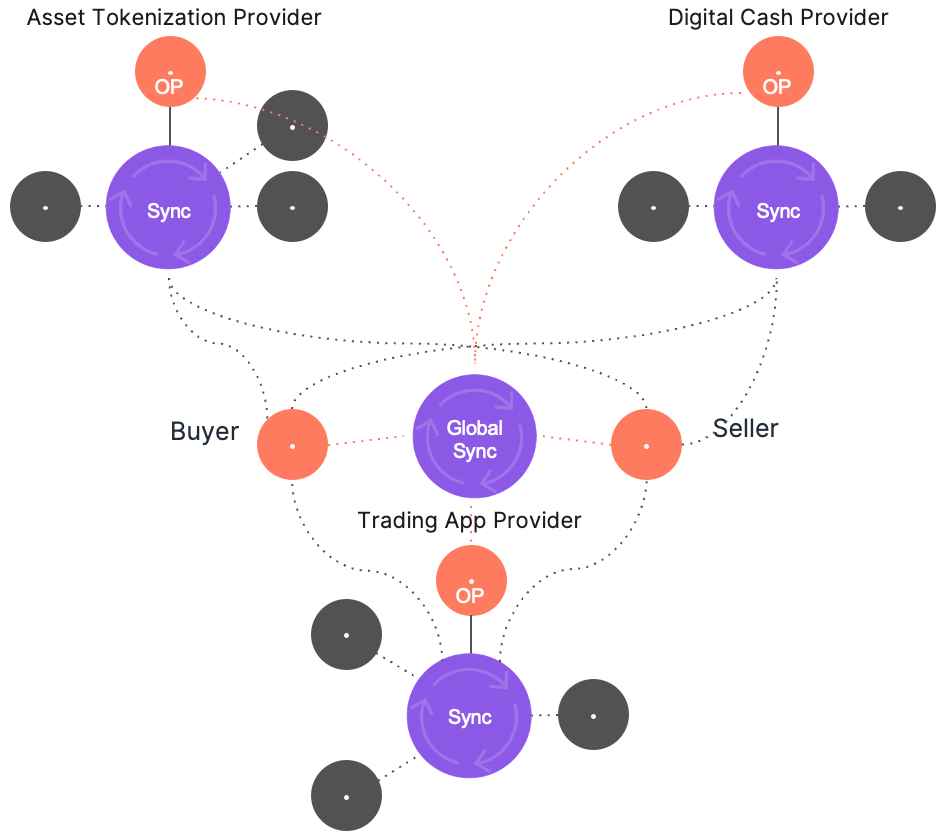
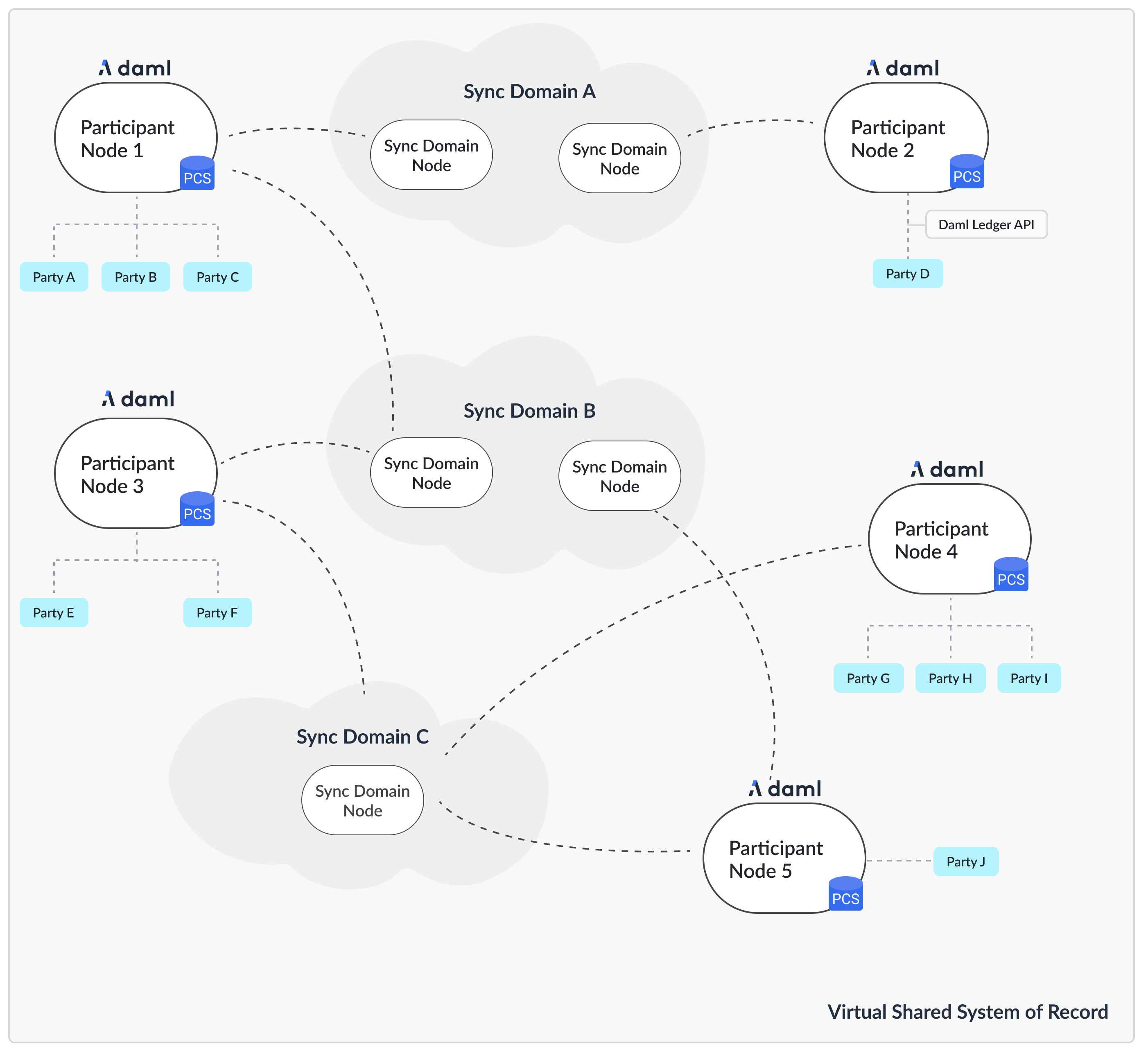
Canton is structured as a network of networks. Unlike traditional blockchains, Canton does not replicate the full ledger state across all nodes; validators only process the transactions in which their hosted parties are directly involved. These applications connect through synchronizers, forming a mesh of participant nodes where each connects to one or more domains.
For a transaction to settle, it is routed through synchronizers, which can be selected for each leg of the workflow. Application providers and users may choose to use private permissioned synchronizers, or rely on the Global Synchronizer as the public coordination layer. No matter which synchronizers are used, any group of validators can transact atomically across applications and subnets. This design preserves sovereignty at the application level while maintaining interoperability across the broader network.
Following concepts are the key components of the Canton Network:
Daml Smart Contracts: Canton’s smart contract language, encoding both financial logic and access control (who can see or act on the contract)
Participant Nodes (Validators): Run the Daml engine and store contracts relevant to the parties they host. Institutions operate their own node or outsource to a Canton Service Provider (CSP)
Parties: Legal entities (e.g., banks, funds, CCPs, regulators) that own or interact with contracts. Each party is hosted on a validator node
Synchronizers: Coordination layers that sequence transactions and ensure atomic commits across connected participant nodes
Global Synchronizer: The public synchronizers, jointly operated by a federation of super validators, guaranteeing interoperability and atomicity even where no private domain is shared
The intention is simple; institutions retain control over their own data and nodes while gaining the ability to participate in a synchronized global financial ecosystem.
Canton’s transaction model is structured as a graph of sub-transactions, allowing each participant to validate only what is relevant to them while maintaining one consistent global outcome.
A Delivery-versus-Payment (DvP) trade illustrates the process:
Transaction creation: A participant node encodes the agreement. For example, securities for cash as a Daml transaction. This produces a transaction tree that may include operations such as creating, transferring, or archiving contracts.
Partitioning into views: The transaction is automatically split into distinct views, with each stakeholder receiving only the branch they are entitled to. A buyer’s bank sees the cash leg; a custodian sees only the securities movement.
Submission to synchronizer: The validator submits these encrypted views to a synchronizer. A sequencer timestamps and orders them, ensuring consistency without ever inspecting the contents.
Two-phase validation: Each stakeholder validator decrypts its view, verifies the contract logic and authorizations, and confirms that the rules of the Daml contract are satisfied. They then return a signed confirmation.
Commit decision: A mediator, a coordinating component of synchronizer collects the signed responses. If all required stakeholders approve, it issues a commit certificate; if any reject, the transaction is aborted.
Finalization: With the commit certificate in place, all stakeholder validators update their ledgers at the same logical time. Each records only its authorized view, but the outcome is globally consistent. This provides atomic finality: either the entire transaction succeeds, or nothing changes.
Source: Canton
Canton achieves privacy not by hiding everything behind complex cryptography, but by building access control directly into its contract model. Each Daml contract defines roles that govern who can authorize, who can act, and who can observe:
Signatory: The party responsible for the contract. Must authorize its creation or archival
Observer: A party allowed to view the contract for supervisory or audit purposes but not modify it
Controller: A party empowered to exercise specific choices such as transfer, close, or seize within the contract
Consider a repo transaction: Bank A delivers $10 million cash to Bank B in return for $10 million in government bonds held by a custodian. Bank A’s validator records only the cash outflow and the right to receive bonds back at maturity. Bank B’s validator records only the bond delivery and the obligation to repay cash. The custodian sees only the securities movements, while a regulator, if designated as an observer, could see both legs for oversight.
Each of these perspectives is a branch of a single transaction tree. Settlement occurs atomically, but no participant has visibility into aspects irrelevant to them. Because payloads are encrypted and synchronization services handle only metadata, even infrastructure operators cannot inspect the contents. The result is a ledger that preserves confidentiality without sacrificing atomic settlement.
Source: Canton
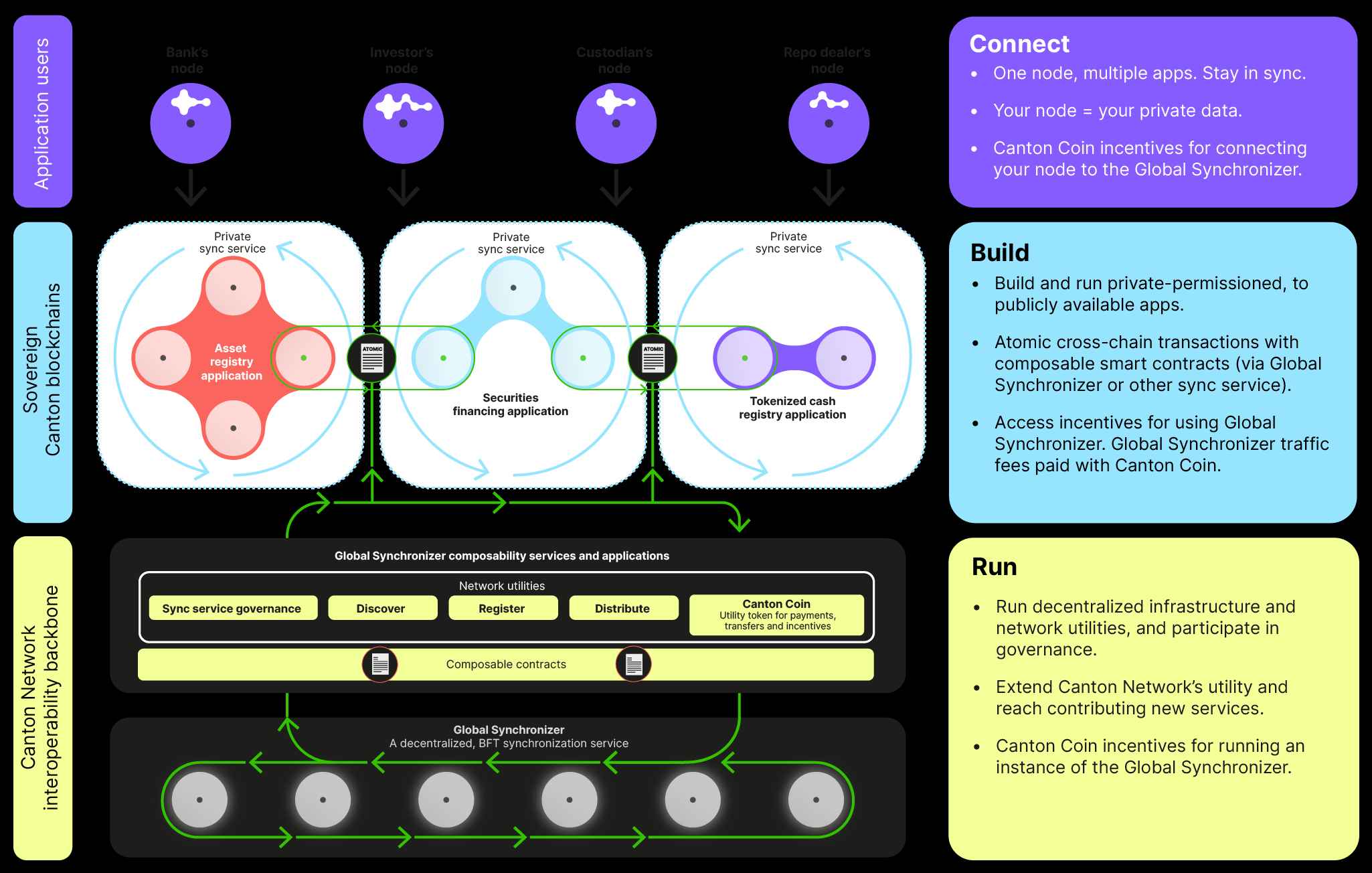
Private synchronizer allow institutions to transact confidentially, but taken alone, they risk creating silos. The Global Synchronizer is what connects them, ensuring that Canton operates as one interoperable network.
It guarantees three things:
Ordering: Transactions are timestamped and sequenced consistently.
Atomicity: Cross-domain workflows succeed or fail in their entirety.
Finality: Once confirmed, transactions are irrevocable.
Importantly, the synchronizer never accesses transaction data; all payloads remain encrypted, and only minimal metadata is processed. The service is run by a federation of super validators with governance provided by the Canton Foundation under the Linux Foundation. The Foundation counts notable members such as Broadridge, LayerZero, Moody’s, and SBI Digital Asset Holdings, reflecting broad industry participation.
Canton has already powered a series of high-profile initiatives.
Euroclear: Tested tokenization of gilts, eurobonds, and gold with 27 institutions, proving traditionally illiquid assets could be mobilized intraday.
Broadridge’s Distributed Ledger Repo (DLR): Built on Canton, now processes more than $4 trillion per month in U.S. Treasury repo.
Nasdaq Calypso: In partnership with QCP and Primrose, integrated Canton to automate 24/7 collateral workflows across derivatives and fixed income.
BitSafe’s CBTC: 1:1 Bitcoin-backed asset, enables Bitcoin to function as institutional-grade collateral.
Source: Canton
Among these, the DTCC U.S. Treasuries Pilot (2024) offered the most comprehensive demonstration of Canton’s ability to enhance collateral mobility.
Run with 26 organizations, the pilot deployed 21 validator nodes and 11 applications, registries, margin systems, and a price oracle, stitched together by the Global Synchronizer. Over six weeks, more than 100 atomic cross-application transactions were executed, while DTCC’s LedgerScan reconciled tokenized “UST Twins” with traditional CSD records.
The pilot tested follwing four flows:
Digital-twin minting: Custodians immobilized Treasuries at the CSD and issued tokenized “UST Twin” contracts, with registry entitlements updated atomically.
Margin delivery: Investors posted UST Twins to meet margin calls, with pricing and haircut data applied in real time, and collateral locked atomically across apps.
Margin return/substitution: Encumbered assets were recalled or swapped intraday, allowing Treasuries to be reused within minutes rather than days.
Close-out & seizure: In a default, secured parties seized pledged twins; assets were transferred atomically and custodians updated legal ownership records.
This initiative has now advanced beyond a pilot into production, with Digital Asset and DTCC completing the first live on-chain U.S. Treasury financing on Canton. Conducted on Tradeweb, the transaction settled tokenized Treasuries against USDC with near-instant, atomic finality, even outside market hours. It marks the shift from pilot to real-world deployment, proving that Treasuries can now move as 24/7 collateral within Canton’s Global Collateral Network
With fast-growing capital markets, leadership in global equities, bonds, FX, and derivatives, and a pioneering role in digital asset innovation, Asia remains strategically critical to the growth of Canton Network. Bank and central bank tokenization initiatives on Canton in the region (e.g., HKMA’s green bond, Project Guardian by MAS) and participation of major regional firms in the Canton Foundation pave the way for Asia to capitalize on the ability to unify traditional and crypto financial systems with privacy and interoperability on Canton.
Canton recognizes Asia as a forward-looking market, balancing public blockchain innovation while prioritizing the need for regulatory-grade infrastructure to unlock 24/7 financial rails. The combination of advanced financial markets and fast-growing crypto-native adoption is a strong fit with Canton, where traditional payments and capital markets are shifting on-chain and converging with retail and institutional DeFi.
Major Asian financial institutions, regulators, market infrastructure providers, and institutional DeFi leaders have long worked with Canton to advance tokenization and distributed ledger initiatives in the region.
Regulators & Institutions: Following the success of HSBC and HKMA with multiple bond issuances, and the success of HKEX Synapse infrastructure, the network continues to gain traction with leading financial institutions and regulators. The Canton Foundation’s membership grew with the addition of HKMA and SBI DAH, and we are seeing increased interest from firms wishing to engage in the network’s governance.
Market Makers & Custodians: Firms like QCP are driving collateral mobility with global market makers on Canton, with collateral mobility continuing to be a key theme for the network going forward. Hydra X became the first in Asia to provide custody for Canton Coin, and has delivered various institutional-grade DeFi products that benefit from the unique privacy and composability capabilities of Canton.
Regional Expansion: Regulatory engagements, partnerships, and activity across Japan, Singapore, HK, and Korea remain a strategic focus. Firms active on Canton will also drive increased activity in the region, for example, through the delivery of privacy-enabled stablecoins, such as USDC and Brale SBC, as well as other stablecoin providers now choosing Canton for this key feature.
Future plans include the continued development of a global collateral network on Canton across the major regional CSDs, building on that momentum in the Asia region.
Fragmented regulation: Diverse and evolving regulatory environments across Asia (e.g., Singapore vs. China vs. Japan) present hurdles for uniform adoption and network expansion.
Privacy maturity: As adoption accelerates, markets are beginning to reemphasize the fundamental need for programmable privacy at the infrastructure layer. Canton demonstrates this is possible through real-world use cases and how important this is to unlock confidence and liquidity, while avoiding risks.
Competing narratives: Because of the way Canton has expanded and gone to market, it is often misperceived as a private, permissioned chain - but today it is a public network with built-in privacy and controls. In a crowded L1 landscape, the market is challenged to understand these nuances between different chains and select the venues with the key features needed to be successful.
Canton views the ASA as a strategic channel to:
Promote regulatory-aligned, privacy-enabled stablecoin standards across Asia, where interoperability with traditional finance is key.
Support the development of institutional-grade stablecoin infrastructure that allows weekend repo, margining, and settlement use cases within a compliant framework.
Advance educational efforts around the role of privacy in stablecoin transactions, collateral management, and institutional liquidity—Canton’s differentiator.
The ASA can also serve as a coordination body to align key players in stablecoin usage for tokenized RWAs, help bridge the crypto-TradFi gap, and promote utility-based adoption models aligned with Canton’s economic incentives and tokenomics.
Canton has moved beyond proof-of-concept to production-scale infrastructure, settling trillions in U.S. Treasury repo through Broadridge, reconciling tokenized Treasuries with DTCC, and supporting pilots with Euroclear and Nasdaq that demonstrate collateral mobility across asset classes in real time. By embedding privacy at the contract level and enabling atomic settlement across domains, it reduces reconciliation costs, lowers settlement risk, and frees liquidity that was previously trapped. In doing so, Canton is establishing itself as a trusted foundation for global markets, built for privacy, designed for interoperability, and proven in production.


Dive into 'Narratives' that will be important in the next year
 Ethereum
 EthereumEthereum


 Canton Network